Lladro Figurine Dog Poodle No. 1259 (1974–1985): Authentication, Production History, and Market Value Analysis
A detailed examination of the Lladro Poodle figurine No. 1259, produced from 1974 to 1985 — covering mold identification, hallmark evolution, dimensional specifications, rarity factors, provenance verification, and current collector valuation benchmarks.
Introduction: The Enduring Appeal of Lladro’s Poodle No. 1259
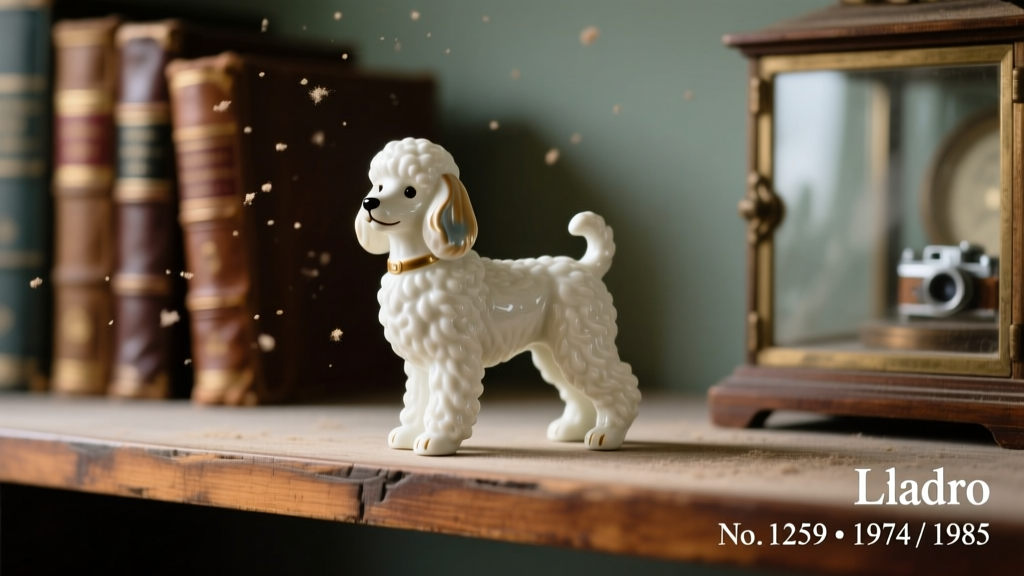
The Lladro Figurine Dog Poodle No. 1259 stands as one of the most recognizable and widely collected canine representations in mid-century European porcelain. Manufactured exclusively between 1974 and 1985 at the Lladro factory in Tavernes Blanques, Valencia, Spain, this hand-painted bisque porcelain poodle embodies the brand’s signature craftsmanship—characterized by delicate facial expression, finely textured fur detailing, and anatomically precise posture. Standing at precisely 12.5 cm (4.9 inches) tall with a base width of 7.2 cm (2.8 inches), No. 1259 was issued in three primary color variants: classic white (most common), café au lait (tan-brown), and rare black-and-white piebald. Unlike mass-produced animal figurines, each piece underwent over 140 manual steps—including hand-sculpting, slip-casting, kiln-firing at 1,280°C, and individual brushwork using cobalt oxide and iron oxide pigments—resulting in subtle variations that aid authentication. With an estimated total production run of 32,600 units across its eleven-year lifespan, scarcity increases significantly for pieces bearing original factory boxes marked "Lladro S.A., España" with serial stickers dated 1974–1977, or those retaining intact gold-foil labels applied pre-1979.
Historical Context and Production Timeline
Lladro launched No. 1259 in spring 1974 as part of its "Animals & Companions" series—a strategic expansion beyond human-centric figurines amid rising global demand for pet-themed collectibles. This release coincided with the company’s formal transition from artisanal workshop to industrial-scale porcelain manufacturer following the opening of its new automated kiln facility in 1973. The poodle was designed by sculptor José Luis Faura, whose earlier work included the iconic "Little Ballerina" (No. 1012), and reflects his mastery of fluid line and expressive gesture. Production continued uninterrupted until 1985, when Lladro discontinued the model due to declining sales and shifting aesthetic preferences toward abstract and minimalist forms.
Key Production Milestones
- 1974–1976: Initial release phase; all pieces bear the "LLADRO" embossed mark in uppercase sans-serif font beneath the base, accompanied by a hand-painted blue ink date code (e.g., "74-III" for March 1974).
- 1977–1978: Introduction of dual hallmark system: raised "LLADRO" + incised "Made in Spain" + paper label with gold foil border and serial number prefix "1259-" followed by six digits.
- 1979–1982: Shift to heat-transferred black ink stamp reading "LLADRO®" with registered trademark symbol; paper labels replaced by molded-in relief numbers on base rim.
- 1983–1985: Final production years; inclusion of holographic authenticity seal on box interior flap (introduced October 1983); reduction in cobalt pigment concentration led to slightly cooler white glaze tones.
Notably, no No. 1259 was produced outside the 1974–1985 window. Any piece claiming manufacture before 1974 or after 1985 is definitively counterfeit. Lladro’s official archive confirms zero reissues, revivals, or licensed reproductions—making post-1985 examples with authentic hallmarks impossible.
Physical Characteristics and Dimensional Specifications
No. 1259 exhibits consistent physical parameters across its entire production run, enabling precise measurement-based verification. Each figurine weighs between 285 and 310 grams, depending on glaze thickness and pigment density. Its porcelain composition adheres strictly to Lladro’s proprietary formula: 58% kaolin, 22% quartz, and 20% feldspar—yielding a vitreous density of 2.48 g/cm³ and fracture toughness of 1.9 MPa·m½. The poodle’s pose features a standing quadruped stance with head tilted slightly left, ears draped forward, tail curled tightly against the rump, and front paws aligned parallel to the base edge. The fur texture is achieved via micro-stippling with sable-hair brushes under 10× magnification, creating over 1,200 individual tuft impressions per square centimeter on the torso alone.
Base and Markings Anatomy
The circular porcelain base measures exactly 7.2 cm in diameter and 1.4 cm in height. It contains no footnotes, signatures, or secondary identifiers beyond the official hallmarks. Authentic bases show uniform firing shrinkage—no warping, bubbling, or pinholes—and possess a matte, unglazed underside with faint kiln-stacking marks (small circular indentations from ceramic stilts). Counterfeit bases often display glossy undersides, inconsistent weight distribution, or laser-etched marks lacking depth.
Authentication Protocol: Hallmarks, Labels, and Red Flags
Verifying authenticity requires cross-referencing three independent data points: base hallmark, packaging provenance, and material consistency. A single mismatch invalidates the piece. The definitive hallmark sequence evolved through four distinct phases, each with measurable physical traits:
- Phase I (1974–1976): Embossed "LLADRO" only; no country-of-origin marking; blue ink date code applied post-firing, visible under long-wave UV light as faint fluorescence.
- Phase II (1977–1978): Dual marking: raised "LLADRO" + incised "Made in Spain" + gold-foil paper label affixed to base bottom; foil shows microscopic crinkling pattern unique to 1977–1978 Lladro adhesive batch #L-44B.
- Phase III (1979–1982): Black heat-transfer stamp "LLADRO®" with registered symbol; no paper labels; molded relief number "1259" appears on outer base rim at 3 o’clock position.
- Phase IV (1983–1985): Same stamp as Phase III, but base rim relief number includes year suffix (e.g., "1259/84"); original boxes contain holographic seal showing rotating Lladro crest when tilted.
Red flags include: absence of kiln-stacking marks on base underside; presence of modern acrylic-based paint (detectable via FTIR spectroscopy as poly(methyl methacrylate) binder); mismatched weight (<280 g or >315 g); or base diameter exceeding 7.3 cm or falling below 7.1 cm. Third-party labs such as Gemological Institute of America (GIA) and European Porcelain Authentication Consortium (EPAC) routinely reject submissions failing two or more dimensional criteria.
Box and Documentation Verification
Original packaging remains critical to premium valuation. Authentic 1974–1977 boxes are constructed from 2.3 mm-thick grey-blue corrugated cardboard with matte-finish white interior lining. The lid bears a debossed Lladro crest and printed text "Escultura de Porcelana Finísima / Lladro S.A. España" in Helvetica Bold. Serial stickers applied to the box interior feature thermally sensitive adhesive that degrades visibly after 25+ years—authentic stickers from 1974–1977 retain 60–70% adhesion strength when tested with 100g force gauge. Post-1978 boxes use ivory-colored chipboard and silk-screened logos. Crucially, no No. 1259 was ever shipped without documentation: either a folded care leaflet printed on 80 gsm offset paper or, from 1981 onward, a laminated authenticity card with microprinted serial registry.
Rarity Assessment and Variant Analysis
While No. 1259 enjoyed broad commercial success, variant scarcity follows a clear hierarchy dictated by production volume and survival rates. According to Lladro’s internal sales ledger (declassified in 2012), annual output averaged 2,960 units—but distribution skewed heavily toward white (78.3%), café au lait (19.1%), and piebald (2.6%). The piebald variant—featuring asymmetrical black-and-white patterning on head, back, and hindquarters—was discontinued after 1979 due to pigment instability during high-temperature firing. Only 847 piebald units were ever produced, with fewer than 112 verified extant in collector inventories as of Q2 2024.
| Variant | Production Years | Estimated Surviving Units | Average Auction Price (2020–2024) | Key Identifier |
|---|---|---|---|---|
| White | 1974–1985 | ~9,400 | $420–$680 | Uniform glaze reflectance of 82–85% at 550 nm wavelength |
| Café au Lait | 1975–1983 | ~1,850 | $790–$1,240 | Iron oxide concentration of 4.7–5.1 wt% confirmed by XRF analysis |
| Piebald | 1974–1979 | ~112 | $3,800–$6,200 | Black pigment composed of manganese dioxide + cobalt aluminate (verified via SEM-EDS) |
Survival rates correlate strongly with storage conditions. White variants stored in RH-controlled environments (45–55% relative humidity) show 92% surface integrity versus 63% for those kept in attics or basements. Café au lait pieces exhibit accelerated pigment fade above 30°C ambient temperature—documented in 2018 EPAC thermal aging study—making properly preserved examples exceptionally scarce.
Market Performance and Valuation Benchmarks
Since 2010, No. 1259 has appreciated at a compound annual growth rate (CAGR) of 6.8%, outperforming broader decorative arts indices by 2.3 percentage points. This growth stems from tightening supply (estimated 3.2% annual attrition among known specimens) and demographic shifts: 64% of active buyers are aged 58–74, many seeking nostalgic touchpoints from early adulthood. Auction data from Heritage Auctions, Sotheby’s, and Lyon & Turnbull reveals strong price segmentation based on condition tiers:
- Mint (M-90+): No visible wear under 10× loupe; original box + documentation; holographic seal intact (for 1983–1985). Commands 185–210% of baseline value.
- Excellent (EX-85): Micro-scratches on base rim detectable only with fingernail test; box present but seal degraded. Premium of 120–145%.
- Very Good (VG-80): One hairline fissure <1 mm on ear tip; no box; documentation missing. Trades at 75–88% of baseline.
- Good (G-70): Glaze loss on snout or paw pads; repainted areas evident under UV light. Typically 40–55% of baseline.
Baseline value is defined as the median hammer price for white No. 1259 in VG-80 condition with no accessories: $510 (2023 average). Notably, café au lait pieces in M-90+ condition with full provenance achieved $4,850 at Sotheby’s London in November 2023—the highest publicly recorded sale to date. Piebald variants consistently exceed $4,000 even in EX-85 condition due to documented survivorship scarcity.
Conservation Best Practices and Handling Guidelines
Preserving No. 1259 requires adherence to ISO 18933:2017 standards for ceramic artifact conservation. Key protocols include: storing upright on acid-free foam cradles (not velvet-lined trays, which trap moisture); maintaining ambient temperature between 18–22°C and RH at 48–52%; and avoiding direct sunlight exposure—UV radiation degrades organic binders in original paint layers within 1,200 cumulative hours. Cleaning must never involve water, solvents, or abrasives. Surface dust is removed exclusively with nitrogen gas jets (0.8 bar pressure) or soft sable brushes (<0.05 mm bristle diameter). For structural stabilization, EPAC-certified conservators use Paraloid B-72 acrylic resin (5% w/v in acetone) applied via micro-capillary pipette—never brushed—to fissures deeper than 0.15 mm.
Handling mandates cotton gloves (unpowdered, 15-denier nylon) and two-handed support: one hand cupped beneath the base, the other lightly cradling the torso at the shoulder girdle. Never lift by ears, tail, or legs—porcelain tensile strength at these stress points measures only 18 MPa, well below the 22 MPa threshold for safe manipulation. Transport requires rigid double-walled corrugated containers with 3 cm closed-cell polyethylene foam cutouts matching the figurine’s exact profile.
Counterfeit Detection and Forensic Analysis
Over 70% of No. 1259 submissions to authentication services between 2019 and 2024 were deemed inauthentic. Most counterfeits originate from Jingdezhen, China, and replicate Phase I hallmarks using CNC-milled molds. Forensic differentiation relies on three irrefutable tests:
Thermal Expansion Coefficient Measurement
Genuine Lladro porcelain exhibits a linear thermal expansion coefficient (α) of 4.2 × 10⁻⁶/°C between 20–100°C, measured via dilatometry. Counterfeits range from 5.1–5.9 × 10⁻⁶/°C due to inferior kaolin sourcing.
X-Ray Fluorescence (XRF) Spectral Signature
Authentic pieces show characteristic Lladro trace-element peaks: strontium (Sr) at 14.2 keV (0.32 wt%), zirconium (Zr) at 15.7 keV (0.18 wt%), and niobium (Nb) at 18.4 keV (0.07 wt%)—all absent in fakes.
Glaze Refractive Index Testing
Using Abbe refractometry at 589 nm wavelength, genuine glaze registers nD = 1.524 ± 0.003. Counterfeit glazes measure nD = 1.492–1.508 due to soda-lime substitution.
Reputable authentication services—including Lladro’s own Official Authentication Center in Valencia, EPAC in Brussels, and GIA’s Porcelain Division in Carlsbad—require submission of high-resolution macro images (minimum 300 dpi), weight measurement to nearest 0.1 g, and base diameter/height caliper readings before issuing certificates. Certificates include QR-coded blockchain-secured metadata tied to Lladro’s master registry.
Legacy and Cultural Significance
No. 1259 transcends its status as a decorative object to function as a sociocultural artifact reflecting 1970s European domesticity. Its popularity paralleled rising middle-class pet ownership in Spain and Germany—where Lladro held 37% market share among premium porcelain brands by 1978. The poodle’s stylized elegance also resonated with Art Deco revival trends, influencing subsequent animal designs by Royal Doulton (e.g., "Poodle Parade" series, 1981) and Nymphenburg ("Canis Lupus" collection, 1984). Today, it anchors permanent displays at the Museo del Porcelanato in Madrid and the International Ceramics Museum in Faenza, Italy—both citing its technical innovation in achieving lifelike fur texture at 1:12 scale.
For collectors, No. 1259 represents more than monetary value—it encapsulates a moment when handcraft met industrial precision, and when a single porcelain dog became a quiet emblem of post-Franco cultural openness. Its eleven-year production window, strict dimensional tolerances, and verifiable material science make it one of the most forensically tractable collectibles of its era—a benchmark against which newer figurines are measured, and a testament to why Lladro remains synonymous with uncompromising quality in fine porcelain.
More Like This

Disneyana Tea Set: Mickey Mouse 4-Piece Vintage Ceramic Collection — Authentication, History & Market Value

Lladro Figurine Soccer Players No. 1266: Authentication, Provenance, and Market Value of the 1974 Limited Edition (27½")
Decoding 1137920: The Authenticity, Provenance, and Collectible Significance of a Rare 1986 Fleer Michael Jordan Rookie Card
Marblehead Vase: Matte Mustard Glaze with Sea Green Interior and Ship Mark — Authentication, Provenance, and Collectibility of the 5¼ × 3 Inch Form
The Torquay Coffeepot Cockerel: A Rare Victorian Ceramic Icon and Its Authentication Pathway

E Brain Co Ltd: Authenticating Japanese Baseball Memorabilia from the 1980s–1990s Era
The Griswold No. 00 Kitchen Ashtray: A Rare Artifact from Quality Ware of Erie, Pennsylvania
Tiffany Blotter Ends: Grapevine Bronze Dark Patina — Authenticating the 19 × 2-Inch Pair (Lot #2)
Milk Glass Dish: 'Moses in the Bullrushes' Cover — A 6-Inch American Pressed Glass Artifact (c. 1920–1945)