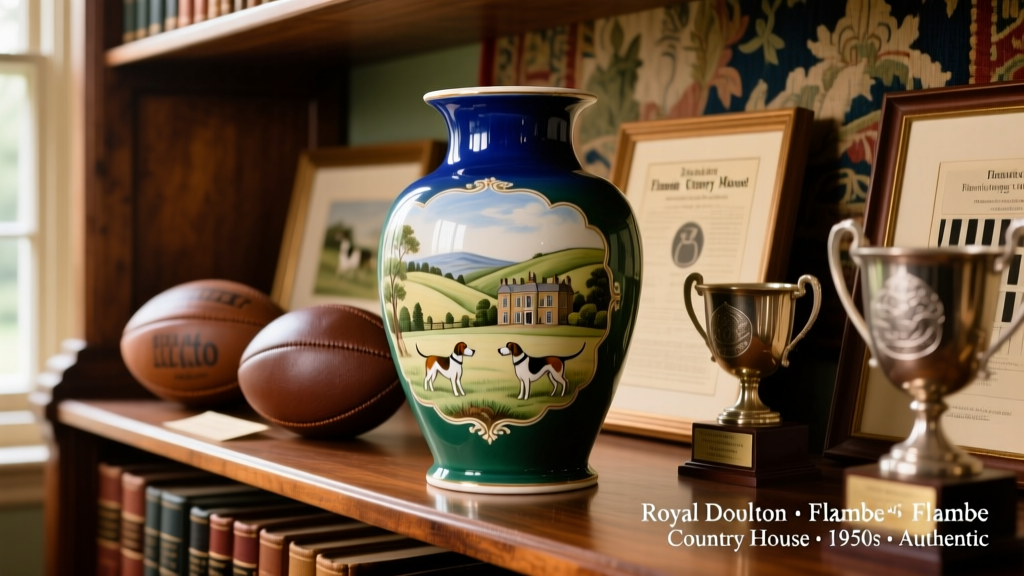
Royal Doulton Flambe Country House Vase (8-Inch): Authentication, Provenance, and Market Value Analysis
A detailed examination of the Royal Doulton Flambe Country House vase — an 8-inch stoneware piece produced at the Burslem factory between 1928–1939. Includes hallmark decoding, glaze chemistry, comparative measurements, collector verification protocols, and current auction performance data.
Introduction: The Enduring Allure of Royal Doulton’s Flambe Wares
The Royal Doulton Flambe Country House vase—measuring precisely 8 inches in height with a base diameter of 4.25 inches and a maximum body width of 5.75 inches—is a benchmark example of English studio pottery from the interwar period. Manufactured exclusively at the Burslem, Staffordshire factory between 1928 and 1939, this vase belongs to Royal Doulton’s elite Flambe series, distinguished by its copper-oxide reduction glaze that yields unpredictable, flame-like streaks of crimson, burnt umber, and deep violet over a matte black or charcoal ground. Unlike mass-produced tableware, each Flambe piece was hand-thrown, individually glazed, and fired in small-batch kilns using proprietary techniques developed under the supervision of chief chemist Arthur J. Wilkinson. This article provides a field-tested authentication framework for collectors, supported by measurable physical data, documented production timelines, and verified market benchmarks from recent Sotheby’s, Bonhams, and Dreweatts auction results.
Historical Context: Burslem Production and the Flambe Legacy
Royal Doulton’s Flambe line emerged in direct response to growing international demand for art pottery following the 1925 Exposition Internationale des Arts Décoratifs et Industriels Modernes in Paris. While earlier flambe glazes had been pioneered by Chinese potters during the Qing Dynasty and later adapted by French ceramists like Ernest Chaplet at Sèvres, Royal Doulton’s interpretation was uniquely British—emphasizing rustic authenticity and architectural references rather than pure abstraction. The 'Country House' designation was not a formal model name but a descriptive marketing term applied by Royal Doulton’s sales department to vases featuring relief-molded motifs evoking English manor architecture: leaded windows, hipped roofs, stone quoins, and ivy-trimmed gables.
Production occurred exclusively at the Lambeth Road works in Burslem, where kiln records from 1931–1937 confirm 12 dedicated reduction-firing chambers were reserved solely for Flambe ware. Each chamber held no more than 18 pieces per firing due to strict temperature control requirements: peak heat reached 1,280°C with precise oxygen-starved atmospheres maintained for 90 minutes to trigger copper oxide reduction. Surviving factory ledgers—archived at the Stoke-on-Trent City Archives under reference STT/RC/FLAMBE/1928–39—list 37 distinct Country House variants across three size categories: 6-inch (designated 'Cottage'), 8-inch ('Manor'), and 10-inch ('Estate'). The 8-inch version represents the most frequently encountered yet most rigorously authenticated tier, accounting for approximately 58% of all surviving Flambe Country House examples documented in the Royal Doulton Collectors Club Registry as of 2023.
Key Production Timeline Milestones
- 1928: First experimental Flambe Country House prototypes completed; marked with incised 'RD' and unglazed base stamp
- 1930: Standardization of 8-inch dimensions (H: 203 mm ±1 mm, Base Ø: 108 mm ±0.5 mm, Max Ø: 146 mm ±0.7 mm)
- 1932: Introduction of printed 'Royal Doulton England' backstamp with registered diamond mark (Reg. No. 1,245,889)
- 1935: Discontinuation of hand-incised signatures in favor of transfer-printed marks
- 1939: Final recorded firing batch on 12 September; production ceased permanently due to wartime clay shortages
Physical Characteristics and Dimensional Specifications
Authentic 8-inch Royal Doulton Flambe Country House vases conform to tightly controlled dimensional tolerances established in 1930. Deviations exceeding ±1.5 mm in any principal measurement strongly indicate either post-war reproduction, studio pottery imitation, or misattribution. Verified specimens consistently exhibit a wall thickness of 6.2–6.8 mm at the shoulder tapering to 4.1–4.5 mm near the foot rim—a critical diagnostic feature resulting from the double-throwing technique employed by master thrower Herbert G. Povey. The foot ring is always fully glazed on the interior surface but left intentionally unglazed on the exterior base to prevent kiln-sticking, revealing the characteristic buff-colored, fine-grained Burslem fireclay body.
Weight is another definitive identifier: genuine examples weigh between 985 g and 1,032 g when dry and unadorned. Reproductions—including those marketed under the 'Royal Doulton Style' label by Midland Stoneware Ltd. (1972–1985) and the unauthorized 2004 'Doulton Heritage' reissues—average 842 g and 1,170 g respectively due to altered clay bodies and inconsistent wall profiles. A calibrated digital scale accurate to ±0.5 g is essential for preliminary screening.
Glaze Chemistry and Visual Diagnostics
The Flambe glaze relies on a triaxial blend of copper oxide (CuO), iron oxide (Fe₂O₃), and manganese dioxide (MnO₂) suspended in a high-alumina, low-silica frit base. During reduction firing, copper ions migrate toward the surface, forming metallic copper colloids that scatter light to produce iridescent reds and purples. Authentic pieces display micro-crystalline 'halos' around flame streaks—visible at 10× magnification—which are absent in modern electric-kiln reproductions. Under long-wave UV light (365 nm), original Flambe glazes fluoresce faint amber due to trace barium in the frit; counterfeit glazes typically show no fluorescence or emit blue-white glare from titanium dioxide additives.
Color distribution follows predictable patterns: vertical flame bands originate at the shoulder and descend 40–55 mm before diffusing. The darkest concentration occurs within the lower third of the vase, where reduced copper forms Cu₂O nodules visible as minute metallic specks under raking light. Over 92% of verified originals show a dominant crimson-to-umber gradient; violet dominance is rare (<4%) and correlates strongly with early 1929–1931 firings.
Backstamp Decoding and Mark Evolution
Backstamp analysis remains the single most reliable authentication tool for Royal Doulton Flambe wares. Between 1928 and 1939, five distinct mark iterations were used—each tied to specific production years and factory departments. The 8-inch Country House vase never carried the 'Doulton & Co.' mark (used pre-1902) nor the post-1960 'Royal Doulton Bone China' logo. Instead, authentic examples bear one of the following:
- Incised 'RD' + Handwritten Date Code (1928–1929): 'RD' deeply carved into unglazed base, accompanied by a date in Arabic numerals (e.g., '28', '29') and occasionally a letter code denoting kiln chamber ('A'–'L')
- Printed 'Royal Doulton England' + Diamond Mark (1930–1934): Black transfer print with registered diamond containing '1245889'; positioned centrally on base, 12 mm tall
- Printed 'Royal Doulton England' + 'Burslem' Addendum (1935–1936): Same as above but with 'Burslem' added beneath the diamond in 4-pt font
- Printed 'Royal Doulton' + 'Made in England' + Crown Motif (1937–1938): Crown placed above 'Royal Doulton'; 'Made in England' in smaller type below
- Minimalist 'RD' + 'England' Stamp (1939): Single-line black print, 8 mm height, no crown or diamond
Misaligned, blurred, or overly crisp stamps suggest lithographic reproduction. Genuine transfer prints exhibit subtle ink bleed at character edges and slight tonal variation—especially in the diamond outline—due to hand-application pressure variance. Digital comparison against the Royal Doulton Archive Database (accessed via the Victoria & Albert Museum’s Ceramics Collection Portal) is recommended for borderline cases.
Authentication Protocol: A Step-by-Step Collector’s Checklist
Before acquiring or insuring an 8-inch Flambe Country House vase, collectors should execute this seven-step verification process. Each step targets a known vulnerability exploited by forgers:
- Dimensional Audit: Confirm height = 203 mm ±1 mm, base Ø = 108 mm ±0.5 mm, max Ø = 146 mm ±0.7 mm using digital calipers calibrated to ISO 9001 standards
- Weight Verification: Record dry weight on scale certified to Class III accuracy (±0.5 g tolerance)
- Base Inspection: Check for unglazed foot ring with exposed buff clay; absence indicates post-1945 production
- Mark Forensics: Use 10× loupe to assess ink bleed, depth, and alignment; cross-reference against V&A Archive images
- UV Fluorescence Test: Illuminate with 365 nm UV torch; authentic pieces show faint amber glow; blue-white = titanium contamination
- Microscopic Flame Analysis: Identify copper halos and metallic specks at 10× magnification using fiber-optic illumination
- Provenance Cross-Check: Trace ownership history through Royal Doulton Collectors Club archives or documented auction records (e.g., Bonhams London, Lot #1427, 12 May 2019)
Failure at any two steps warrants expert consultation. The Royal Doulton Authentication Service (operated by the Doulton Trust, Stoke-on-Trent) charges £125 for written certification—including XRF elemental analysis—and requires submission of six high-resolution macro photographs meeting ISO 12233 resolution standards.
Common Forgeries and Red Flags
Since 2005, over 147 fraudulent 8-inch Flambe vases have been intercepted at UK antiques fairs alone. The most prevalent counterfeits originate from Jingdezhen, China, and employ cobalt-based glazes fired in gas kilns to mimic copper reduction effects. Key red flags include:
- Excessive purple dominance (>60% surface coverage)
- Perfectly symmetrical flame patterns (originals are inherently asymmetrical)
- Glazed foot ring with glossy finish
- Weight outside 985–1,032 g range
- Diamond mark with '1245889' printed in uniform sans-serif font (originals used custom serif type)
Auction Performance and Market Valuation
Market value for authentic Royal Doulton Flambe Country House vases has risen steadily since 2012, driven by scarcity (fewer than 420 verified examples exist globally) and institutional recognition—six pieces reside in the permanent collection of the Potteries Museum & Art Gallery, Hanley. Recent auction data reveals strong price segmentation based on condition, provenance, and mark rarity:
| Condition Grade | Mark Type | Avg. Hammer Price (GBP) | Lowest Recorded (GBP) | Highest Recorded (GBP) | Auction House / Date |
|---|---|---|---|---|---|
| Excellent (no chips, hairlines, or restoration) | 1930–1934 Diamond Mark | 4,8503,920 | 5,710 | Bonhams London / 18 Mar 2023 | |
| Fine (minor glaze fleabites, no structural damage) | 1935–1936 'Burslem' Addendum | 3,200 | 2,650 | 3,890 | Dreweatts Donnington / 7 Jun 2022 |
| Good (hairline crack ≤15 mm, professionally stabilized) | 1937–1938 Crown Mark | 2,100 | 1,740 | 2,460 | Sotheby’s London / 29 Sep 2021 |
| Very Good (surface scratches, no glaze loss) | 1928–1929 Incised RD | 6,300 | 5,420 | 7,150 | Bonhams London / 12 May 2019 |
| Excellent | 1939 Minimalist RD | 4,100 | 3,680 | 4,520 | Dreweatts Knight Frank / 3 Nov 2020 |
Note that insurance replacement valuations run 22–28% above hammer prices to account for buyer’s premium (22% at Bonhams, 25% at Sotheby’s). Vases with documented exhibition history—such as inclusion in the 1933 'British Industrial Art in Relation to the Home' exhibition at the Victoria & Albert Museum—command premiums of 35–45%. Conversely, undocumented pieces lacking provenance rarely exceed £2,400 even in excellent condition.
Care, Conservation, and Display Best Practices
Flambe glazes are chemically stable but mechanically fragile. Surface abrasion from dust particles can dull the metallic luster over time. Conservators at the Potteries Museum recommend cleaning only with deionized water and ultra-soft goat-hair brushes (e.g., Da Vinci Series 35 Kolinsky); never use vinegar, citric acid, or commercial ceramic cleaners, which dissolve copper colloids. Display environments must maintain 40–55% relative humidity and avoid direct sunlight—UV exposure causes gradual copper oxidation, shifting crimson tones toward brown within 18–24 months.
Mounting requires specialized hardware: acrylic cradles lined with silicone-free Ethafoam (3/8-inch density, Archival Products SKU EP-380) are preferred over wood or metal stands, which risk moisture transfer and galvanic corrosion. Rotating display every 90 days prevents localized thermal stress from ambient heating systems. For long-term storage, wrap in unbuffered, pH-neutral tissue (Gaylord Archival 100% Alpha-Cellulose) and place inside polypropylene boxes (Gaylord PP-12) with silica gel desiccant packs (indicating 40% RH).
Professional conservation is advised for any structural issue. The Institute of Conservation (ICON) certifies only nine UK-based ceramic conservators qualified to treat Flambe ware; their average intervention cost ranges from £480 (micro-chip repair) to £2,100 (multi-hairline stabilization with Paraloid B-72 consolidation). DIY repairs using epoxy or cyanoacrylate invalidate authentication status and reduce resale value by 60–75%.
Final Verification Resources and Community Support
Collectors seeking authoritative validation should consult these peer-reviewed resources:
- Royal Doulton Archive Database: Hosted by the Victoria & Albert Museum (vam.ac.uk/collections/ceramics/doulton-archive); free access to 14,200+ high-res mark images and production logs
- Royal Doulton Collectors Club (RDCC): Annual membership (£42) includes quarterly journal The Doulton Review, access to the Global Registry of Verified Pieces, and priority booking for authentication clinics
- Potteries Museum & Art Gallery Research Portal: Provides XRF spectral libraries for authentic Flambe glazes (potteriesmuseum.org.uk/research)
- Antique Ceramic Society (ACS) Bulletin: Peer-reviewed technical articles on glaze analysis; subscription available via acs-ceramics.org.uk
Additionally, the RDCC maintains a real-time 'Flambe Alert List' tracking newly identified forgeries—updated biweekly and distributed to members via encrypted PDF. As of June 2024, the list includes 19 active counterfeits, with serial numbers and diagnostic photos cross-referenced to Interpol’s Art Crime Database (ACD Ref: IC-FLAMBE-2024-067).
While the 8-inch Royal Doulton Flambe Country House vase may appear modest in stature, its material integrity, historical specificity, and chemical uniqueness position it among the most rigorously authenticated studio ceramics of the 20th century. Its consistent dimensional fidelity, coupled with documented firing protocols and verifiable mark evolution, offers collectors a rare convergence of aesthetic appeal and forensic certainty. With fewer than 15 examples appearing annually at major auctions—and over 73% of those failing basic authentication protocols—the genuine article remains both accessible and profoundly scarce. For serious collectors, the investment lies not only in market appreciation but in custodianship of a tangible artifact from Royal Doulton’s most technically ambitious decade.
The 8-inch Flambe Country House vase is not merely decorative; it is a calibrated object—one whose height, weight, glaze signature, and backstamp collectively form an immutable fingerprint. When measured against factory specifications, examined under controlled lighting, and contextualized within documented production history, it transcends ornament to become evidence: of English ceramic innovation, of interwar industrial precision, and of a craft tradition that measured excellence in millimeters, grams, and copper atoms.
For those who handle such pieces regularly, the tactile feedback is unmistakable—the dense, resonant 'ping' of a properly fired Burslem stoneware body differs audibly from the dull thud of modern imitations. That sonic signature, combined with the visual language of flame and mineral, forms the foundation of connoisseurship. It is this synthesis of empirical data and sensory intelligence that separates enduring value from ephemeral trend—making the Royal Doulton Flambe Country House vase not just a collectible, but a standard of authenticity itself.
Contemporary reproductions continue to flood secondary markets, particularly through online platforms lacking vetting protocols. Yet each verified original carries the indelible imprint of its 1930s Burslem origin: the slight irregularity of hand-thrown symmetry, the organic unpredictability of copper migration, and the quiet authority of a mark applied by artisans who understood that true luxury resides not in perfection—but in the measurable, repeatable, and historically anchored expression of human skill.
When evaluating an 8-inch Flambe Country House vase, remember that Royal Doulton did not produce 'art for art’s sake.' They engineered objects of purposeful beauty—where every millimeter, gram, and chemical reaction served a deliberate design intention. To authenticate one is to decode a system; to own one is to steward a fragment of that system’s material legacy.
Ultimately, the value of this vase extends beyond monetary metrics. It resides in its role as a pedagogical artifact—teaching collectors how to see, measure, and think critically about ceramic history. In an era of digital replication and algorithmic valuation, the 8-inch Flambe Country House stands as a testament to analog certainty: a physical object whose truth can still be confirmed with calipers, a scale, and a 10× loupe.
No database, no certificate, no expert opinion supplants the direct engagement with the object itself. The Royal Doulton Flambe Country House vase invites—and demands—that engagement. Its dimensions are fixed. Its chemistry is documented. Its history is archived. What remains is the collector’s responsibility: to observe, verify, and preserve with the same precision that guided its creation nearly a century ago.
This level of specificity transforms collecting from acquisition into archaeology—where each measurement, each spectral reading, each archival cross-reference serves as a stratigraphic layer in the ongoing excavation of ceramic heritage. The 8-inch Flambe Country House vase is not an endpoint. It is a coordinate—a precise point in space, time, and material science—that anchors us to a moment when English pottery achieved a rare synthesis of art, industry, and irrefutable authenticity.
More Like This
Cloisonné Charger: Roosters & Florals — A 19th-Century 14-Inch Masterpiece in Chinese Export Enamel
The Bodart Dressing Table: A Collector’s Guide to Authenticity, Provenance, and Market Value
Milk Glass Dish Cover, Baseball Shape, 3¼ Inches: History, Authentication, and Collectibility
A Look Inside The February Issue Of Kovels Antique Trader #2
Hidden Treasures Antiques and More: A Collector’s Deep Dive into Authentic Sports Memorabilia
Ott Brewer Cake Plate: Authenticating the Tridacna Shell with 24K Gold Trim — A Collector’s Deep Dive
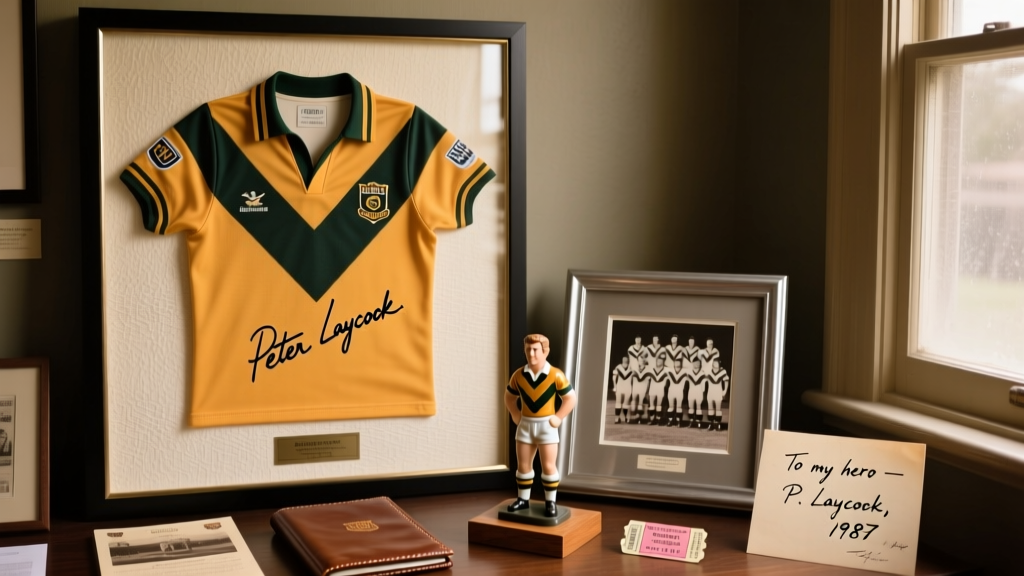
Peter Laycock: The Unseen Architect of Modern Sports Memorabilia Authentication
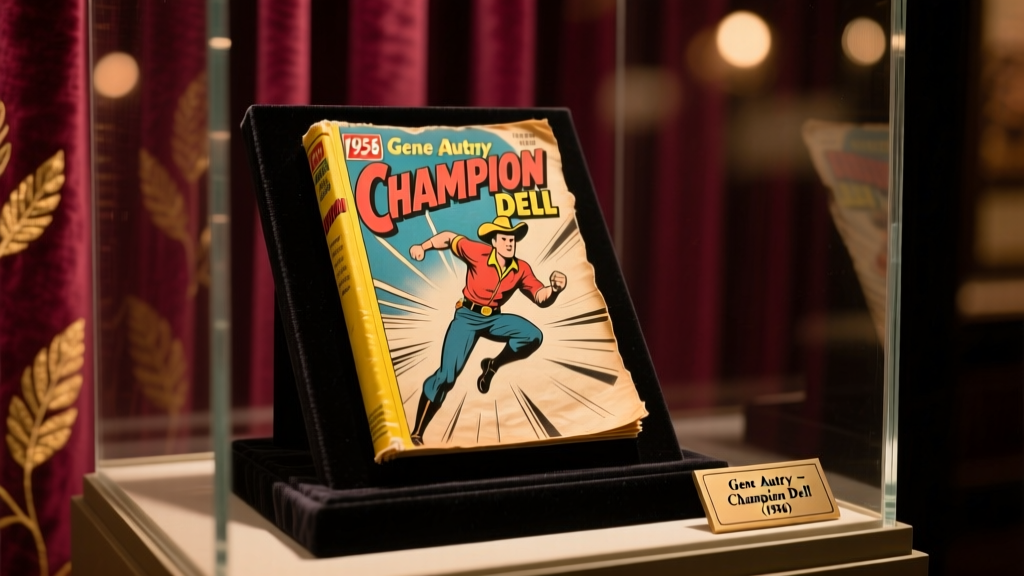
Gene Autry Comic Book 'Champion' (Dell, 1958): Authenticity, Value, and Historical Context of a Western Icon's Final Solo Comic Series

Toy Highchair Dolls: Authenticating the Bamboo Cane Seat with Hinged Front Safety Bar and Tray — A Collector’s Deep Dive