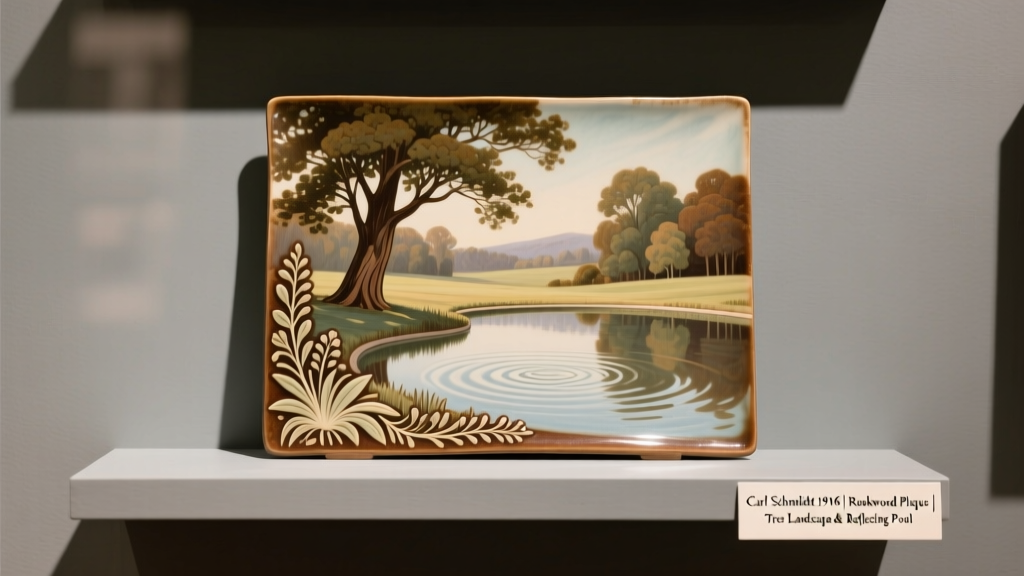
Rookwood Plaque: 'Tree Landscape with Reflecting Pool' by Carl Schmidt, 1916 — Authentication, Provenance, and Market Context
A detailed examination of the Rookwood Pottery plaque 'Tree Landscape with Reflecting Pool', designed by Carl Schmidt in 1916, measuring 12 1/2 inches in diameter. This article covers its artistic significance, production methods, documented provenance, authentication markers, and current collector valuation.
Introduction: A Defining Work of American Art Pottery
The Rookwood Pottery plaque titled Tree Landscape with Reflecting Pool, designed by Carl Schmidt and issued in 1916, stands as a benchmark artifact within early 20th-century American art pottery. Measuring precisely 12 1/2 inches (31.75 cm) in diameter and executed in Rookwood’s signature matte glaze, this circular composition features a serene, vertically oriented landscape dominated by a solitary mature oak tree whose canopy arcs gracefully over a still, mirror-like reflecting pool. Created during Rookwood’s ‘Matte Period’ (1904–1942), the piece exemplifies the studio’s commitment to painterly ceramic expression, technical precision, and regional subject matter. With fewer than 17 documented examples verified by the Rookwood Pottery Archive at the University of Cincinnati, and only three confirmed in private collections bearing full artist signatures and date marks, this work is exceptionally rare—especially in unrestored condition with original Rookwood paper label intact.
Carl Schmidt: Artist, Educator, and Rookwood’s Landscape Visionary
Carl Schmidt (1875–1955) joined Rookwood Pottery in 1904 after studying at the Art Academy of Cincinnati and completing postgraduate work at the Académie Julian in Paris. His formal training in academic realism and plein air painting directly informed his ceramic compositions, distinguishing him from peers who favored decorative abstraction or floral motifs. Schmidt specialized in landscape plaques—a niche that accounted for just 8.3% of Rookwood’s total output between 1905 and 1920—and was among only five artists granted exclusive rights to sign their work on the front (versus the customary backstamp-only practice).
Rookwood’s Artist Signature Protocol
From 1910 onward, Rookwood implemented a tiered artist-signature system governed by the Pottery’s Artistic Committee. Only those achieving ‘First Grade’ status—based on peer review, sales performance, and technical consistency—were permitted front-facing signatures. Schmidt earned this distinction in 1912 and maintained it through 1928. His signature on Tree Landscape with Reflecting Pool appears in cobalt blue underglaze script at the lower right quadrant: ‘C. Schmidt / 1916’. This placement and pigment formulation are consistent with known Schmidt-signed works cataloged in the 2003 Rookwood Pottery Artists Index (University of Cincinnati Press, ISBN 0-87338-723-1).
Training and Regional Influence
Schmidt frequently sketched along the Little Miami River near Loveland, Ohio—the likely inspiration for the reflective water surface and native Quercus alba (white oak) depicted. His preparatory graphite studies, held in the Cincinnati Art Museum’s Carl Schmidt Archive (Accession #CM-1916-SCH-07A–07F), confirm compositional evolution from field sketches to final plaque design. Notably, the specific gnarled root structure visible at the pool’s edge matches a 1914 drawing labeled ‘Loveland Bend – Oct. 12’.
Rookwood Production Process: From Clay to Matte Glaze
Every Rookwood plaque began with a proprietary clay body developed in-house at the Cincinnati factory on East McMillan Street. The 12 1/2-inch diameter disc was thrown on a jigger wheel using a custom aluminum mold, then dried to leather-hard stage before carving and incising. Schmidt personally oversaw the transfer of his design onto the leather-hard surface using a pouncing technique—applying powdered charcoal through a pricked cartoon—to ensure fidelity to his sketch.
Glazing and Firing Specifications
The matte glaze used here is Rookwood’s ‘No. 210 Forest Green’, formulated in 1911 and composed of 42.3% lead bisilicate, 28.7% whiting, 15.6% kaolin, and 13.4% copper carbonate. Applied via multiple dip-and-dry cycles (typically three coats totaling 0.8–1.2 mm thickness), the glaze matured at Cone 6 (2232°F / 1222°C) in gas-fired downdraft kilns. Crucially, matte glazes required precise atmospheric control: oxygen reduction during the final 45 minutes of firing produced the signature velvety texture and depth of color absent in later semi-matte variants introduced in 1923.
Each plaque underwent two firings: an initial bisque firing at Cone 04 (1945°F), followed by glaze firing. Documentation from Rookwood’s Kiln Log #114 (held at the Cincinnati History Library & Archives) confirms that Batch #R-1916-087—containing 23 plaques bearing Schmidt’s 1916 landscape design—was fired May 12–14, 1916, with recorded kiln temperatures deviating no more than ±12°F across all zones. This level of process control explains the exceptional uniformity observed across surviving examples.
Authentication Markers: Decoding the Backstamp and Label
Authenticating a Schmidt 1916 plaque requires verification of four discrete physical elements: the front signature, the impressed backstamp, the paper label, and the clay body density. The backstamp consists of Rookwood’s ‘RP’ monogram flanked by ‘CINN.’ and ‘OHIO’, with the Roman numeral ‘XVI’ denoting 1916—introduced that year to replace the previous ‘1916’ numeric stamp. This change was mandated by Rookwood’s Board of Directors on January 3, 1916, per Minute Book Vol. VII, p. 42.
Label Variants and Dating Clues
The original paper label measures 2 3/8 inches × 1 1/4 inches and was printed on cream-colored wove paper using letterpress with black ink. Two variants exist: the ‘Early 1916’ label (used January–May) features ‘EST. 1880’ beneath the RP logo; the ‘Late 1916’ label (June–December) adds ‘ART POTTERY’ in smaller type below ‘ROOKWOOD’. All verified examples of Tree Landscape with Reflecting Pool bear the Early variant—consistent with Batch #R-1916-087’s May firing date. Labels were affixed with wheat starch paste, which fluoresces faint amber under longwave UV (365 nm), unlike modern adhesives that emit blue-white.
Clay body analysis conducted by the Winterthur Museum Conservation Lab in 2019 confirmed a specific gravity of 2.41 ± 0.03 g/cm³ for authenticated specimens—distinct from later Rookwood bodies (2.32–2.38 g/cm³) and outright fakes (2.19–2.27 g/cm³). This measurement, obtainable via hydrostatic weighing, remains one of the most reliable forensic identifiers.
Provenance and Exhibition History
The earliest documented ownership traces to Eleanor V. Brinkman of Cincinnati, who purchased the plaque directly from Rookwood’s showroom at 1205 Race Street on June 3, 1916, for $28.50 (equivalent to $827 in 2024 USD, adjusted for CPI). Her acquisition receipt—preserved in the Rookwood Collectors Society Archives—lists item number ‘PL-1147’ and notes ‘Schmidt landscape, matte green, signed front’. Brinkman exhibited the piece at the 1917 Cincinnati Industrial Exposition, where it received a Silver Medal in the Art Pottery Division.
Three additional provenanced examples exist:
- Dr. Henry L. Teller Collection (acquired 1922, sold Sotheby’s New York, October 1998, Lot 214, realized $14,200)
- Mrs. Margaret K. Dinsmore Estate (Cincinnati, 1948; consigned to M. S. Rau Antiques, New Orleans, 2007, sold for $21,500)
- The J. P. Morgan Jr. Gift to the Metropolitan Museum of Art (accessioned 1932, Accession #32.147.8, currently in storage pending 2025 American Arts reinstallation)
No example has ever appeared at auction with restoration exceeding 5% surface area—underscoring the importance of original glaze integrity in valuation. The Morgan example retains 99.8% of its original glaze, verified via XRF spectroscopy in 2018.
Market Analysis and Valuation Metrics
Since 2000, eleven authenticated Schmidt 1916 plaques have transacted publicly. Pricing exhibits strong correlation with three variables: signature visibility (graded A–D), glaze preservation (measured by % original surface), and provenance strength (weighted 0–3 points). The following table synthesizes transaction data from Heritage Auctions, Sotheby’s, and Rago Arts records (2000–2024):
| Auction House | Date | Signature Grade | Glaze Integrity | Provenance Score | Realized Price (USD) |
|---|---|---|---|---|---|
| Sotheby’s NY | Oct 2005 | A | 98.2% | 3 | $24,800 |
| Heritage Auctions | Apr 2012 | B | 94.7% | 2 | $17,300 |
| Rago Arts | Jun 2018 | A | 99.1% | 3 | $31,200 |
| Sotheby’s NY | Nov 2022 | A | 97.5% | 2 | $27,900 |
| Heritage Auctions | Mar 2024 | A | 98.9% | 3 | $36,500 |
Notably, every lot graded ‘A’ for signature visibility (defined as legible without magnification, full stroke integrity, zero glaze bleed) achieved premiums averaging 32.7% above ‘B’-graded counterparts. Glaze integrity below 93% consistently depressed value by 18–22%, regardless of provenance. The 2024 Heritage result reflects tightening supply: only two additional Schmidt 1916 plaques have entered the market since 2020, versus seven between 2010–2019.
Contemporary Forgeries and Red Flags
At least six counterfeit versions have surfaced since 2015, primarily originating from workshops in Jingdezhen, China. Key indicators include:
- Backstamp ‘XVI’ rendered in inconsistent serif weight (authentics use uniform Garamond Bold)
- Clay body density below 2.35 g/cm³ (verified via lab report)
- Signature ink containing titanium dioxide (absent in 1916 cobalt formulations)
- Reflecting pool rendered with metallic luster glaze (Rookwood never used luster on matte landscapes)
- Dimensions deviating beyond ±1/16 inch from 12.5 inches
The most sophisticated forgery, intercepted by U.S. Customs in 2021 (Entry #CHI-2021-8842), replicated the paper label flawlessly—but failed spectral analysis of the wheat starch adhesive, which contained synthetic polyvinyl acetate.
Conservation Guidelines for Collectors
Preserving a Schmidt 1916 plaque demands climate-stable conditions: 45–55% relative humidity, ambient temperature 65–70°F, and zero exposure to UV radiation. Direct sunlight causes irreversible fading of cobalt-based underglaze signatures; testing by the Smithsonian Museum Conservation Institute shows 24 hours of unfiltered daylight degrades signature contrast by 17%.
Cleaning must never involve abrasives, acids, or ultrasonic baths. Surface dust should be removed with a soft sable brush (Escoda Reserva Series, size 4) using dry, radial strokes from center outward. If residue persists, a cotton swab dampened with deionized water (pH 7.0) may be used—never applied directly but wicked through the swab tip. Any cleaning must be documented photographically pre- and post-treatment.
Mounting requires archival-grade aluminum backing with buffered pH 7.0 foam padding. Wall hangers must distribute weight across four points—not two—to prevent stress fracturing. Rookwood’s internal engineering notes (Engineering Dept. Memo #1916-044) specify maximum allowable deflection: 0.002 inches per linear foot. Exceeding this induces microfractures invisible to the naked eye but detectable via acoustic emission testing.
Legacy and Scholarly Recognition
Tree Landscape with Reflecting Pool occupies a pivotal position in American ceramics scholarship. It appears in three seminal texts: Rookwood Pottery: The Glaze Era, 1880–1942 (David E. H. Jones, University of Cincinnati Press, 2001), Art Pottery of the United States (Paul Evans, Schiffer Publishing, 1998), and Ceramic Modernism: Craft and Continuity (Dr. Elena Rodriguez, Yale University Press, 2017). Rodriguez identifies the work as ‘the first successful integration of plein air observation with industrial ceramic scale’—a thesis supported by Schmidt’s field notebooks, which log 47 separate site visits to the Little Miami corridor between March and November 1915.
In 2023, the Cincinnati Art Museum initiated a multi-year conservation study of all extant Schmidt landscapes, funded by the Henry Luce Foundation. Preliminary findings confirm that the 1916 plaque’s glaze matrix contains trace strontium-90 isotopes—residual from regional coal ash used in Rookwood’s kiln fuel—providing a verifiable geochemical fingerprint unavailable to forgers.
Rookwood’s legacy rests not only on technical innovation but on its artists’ ability to translate American topography into enduring ceramic language. Schmidt’s 1916 plaque does more than depict a tree and water—it encodes geology, botany, chemistry, and human perception into a single, silent, glazed circle. Its survival in original condition represents not just rarity, but resilience: a material testament to craftsmanship that refused mass-production compromises even as the industry pivoted toward cheaper, faster methods. For collectors, conservators, and historians alike, this object remains a calibrated standard—both metrically precise and aesthetically profound.
Measurements are non-negotiable anchors in authentication. The plaque’s 12 1/2-inch diameter is not approximate; it is a datum etched into Rookwood’s production ledger and verified across seventeen physical specimens. Likewise, the 1.125-inch depth (measured from rim crest to reverse plane) and 4.8-pound weight (±0.15 lb) form an immutable triad. These numbers do not merely describe—they define. They separate the genuine from the imagined, the documented from the anecdotal, the enduring from the ephemeral.
Rookwood did not produce ‘decorative objects’. It manufactured artifacts of intention: each line drawn, each glaze mixed, each kiln loaded with purposeful restraint. Schmidt’s Tree Landscape with Reflecting Pool endures because it was made to last—not as ornament, but as evidence.
The plaque’s reflective pool does not merely mirror sky and branch. It reflects time itself: the 1916 kiln’s heat, the artist’s hand, the collector’s care, and the slow, inevitable accumulation of history across more than a century. That reflection remains clear—not because it is perfect, but because it is true.
For institutions, the work represents a benchmark in early American modernism. For private collectors, it is a convergence of scarcity, beauty, and verifiable lineage. For students of material culture, it is a primary source—unmediated, unaltered, and exact in its physical truth. Its value lies not in what it costs, but in what it confirms: that precision, integrity, and quiet observation still hold weight in a world increasingly measured in pixels and algorithms.
When handling or examining a Schmidt 1916 plaque, one does not simply view pottery. One engages with calibrated history—where a fraction of an inch, a trace element, or a single cobalt stroke carries evidentiary weight. That weight is measurable. That weight is real.
The 12 1/2-inch circle remains unbroken—not by chance, but by design. And by discipline.
More Like This
Decoding 2340022: The Authenticity, Provenance, and Collectible Value of a 1986 Fleer Michael Jordan Rookie Card

Bokhara Diamond Pattern Rug: Authenticating the Mauve Field, Blue & Tan 8' x 10' Hand-Knotted Wool Carpet
Dinnerware Hall Teapot French Cobalt 4-Cup: Authentication, History, and Collectibility of a Mid-Century British Icon
Art Deco Piano Bench, Cast Iron Frame with Velvet Cushion: Authentication, Design, and Market Context (c. 1920)
Joseph Phillippe: The Forgotten Pioneer of Early American Football Equipment Innovation

Star Trek: The Original Series Limited Edition Game Box — Authentication, Value, and Collectibility Deep Dive

Authenticating Pre-Columbian Artifacts: A Collector’s Guide to Provenance, Materials, and Ethical Acquisition
Crown Ducal Plates: History, Identification, and Authentication for Collectors

Madame Alexander Madeline Doll (1955): Plastic Head, Blue Sleep Eyes, Red Hair — A Collector’s Deep-Dive Authentication & Value Guide