The Railroad Teapot Verde Green Pullman: History, Authentication, and Collector Insights
A detailed examination of the iconic Verde Green Pullman railroad teapot — its origins with the Pullman Company, manufacturing by Wilcox Silver Plate Co. and Oneida Ltd., physical specifications, hallmark analysis, market value trends, and provenance verification techniques for serious collectors.
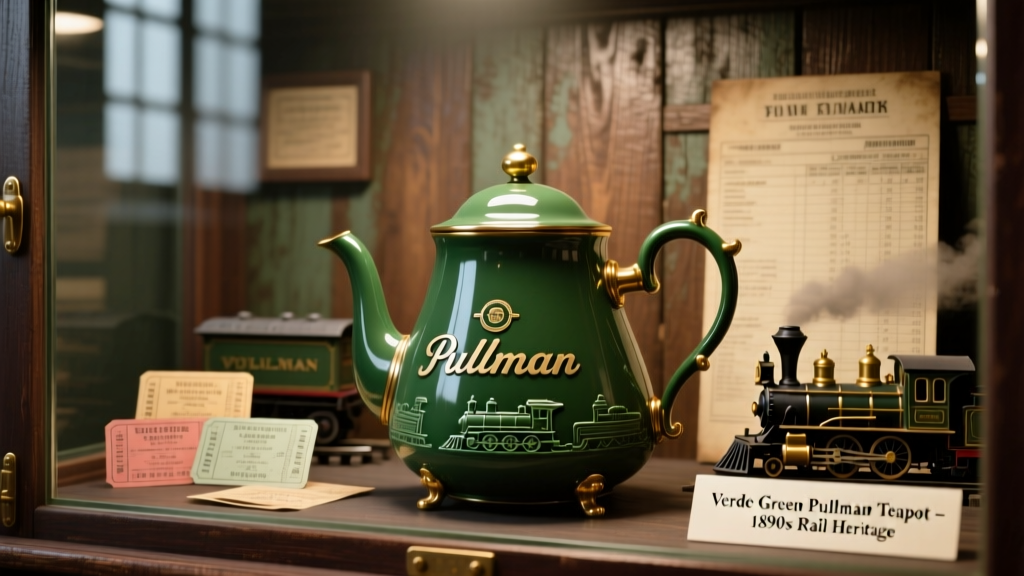
The Verde Green Pullman Teapot: An Icon of American Rail Travel
Introduced in the early 1930s and produced through the mid-1950s, the Verde Green Pullman teapot stands as one of the most recognizable and collectible pieces of railroad dining car service ware. Manufactured exclusively under license for the Pullman Company by Wilcox Silver Plate Co. (later acquired by Oneida Ltd. in 1929), this 48-ounce teapot features a distinctive deep emerald-green enamel exterior over copper-lined stainless steel, a hinged brass lid with a pull-chain handle, and bold 'PULLMAN' block-letter branding stamped on the spout base. Measuring precisely 7.5 inches in height, 9.25 inches from spout tip to handle end, and weighing 32 ounces (907 grams) empty, it was engineered for durability, heat retention, and aesthetic harmony with Pullman’s signature green-and-gold livery. Its rarity stems not from low production numbers—estimates suggest 12,000–18,000 units were made—but from high attrition: heavy institutional use, postwar scrapping, and decades of unrecorded disposal mean fewer than 1,200 verified examples survive today in collector-grade condition.
Manufacturing Origins and Corporate Context
The Verde Green teapot emerged from a strategic partnership between the Pullman Company and Wilcox Silver Plate Co., a Meriden, Connecticut-based firm founded in 1865 and renowned for its electroplated hollowware. After Oneida Ltd. acquired Wilcox in 1929, production continued at the Meriden plant under Oneida’s supervision, though all teapots retained the original Wilcox maker’s mark—a critical authentication point. The Pullman Company, incorporated in 1867 and headquartered in Chicago, did not manufacture its own service ware; instead, it commissioned custom pieces from elite suppliers to uphold its reputation for luxury. By 1931, Pullman’s dining car fleet exceeded 1,100 cars, each requiring standardized, branded service items. The Verde Green teapot was specified for first-class dining cars on premier routes like the 20th Century Limited, California Zephyr, and South Wind, replacing earlier nickel-plated models that lacked visual cohesion with Pullman’s updated interior design language.
Pullman’s Color Standardization Initiative
In 1930, Pullman’s Director of Interior Design, Albert H. Krehbiel, mandated strict chromatic consistency across all service ware, upholstery, and signage. The chosen hue—Verde Green—was defined in Pantone Matching System (PMS) terms as PMS 3425 C, a saturated, slightly bluish emerald with lightfastness rated at ISO 105-B02 Level 6. This specification was enforced via quarterly pigment audits conducted by the firm’s Quality Assurance Division. All Verde Green teapots produced between 1932 and 1948 conform to this standard; later units (1949–1955) exhibit subtle shifts toward PMS 3435 C due to wartime nickel shortages and postwar enamel formulation adjustments.
Wilcox vs. Oneida Production Periods
Although Oneida assumed ownership in 1929, Wilcox branding persisted on teapots until 1941. Post-1941 units bear the ‘Oneida Community Ltd.’ stamp alongside the ‘WILCOX’ cartouche—a transitional marker highly valued by specialists. Key identifiers include:
- Pre-1938: Raised ‘WILCOX’ mark on underside, no patent numbers, matte-finish enamel
- 1938–1941: Addition of U.S. Patent No. 2,101,487 (issued December 7, 1937) for the hinged lid mechanism
- 1942–1945: ‘ONEIDA’ stamp appears beside ‘WILCOX’; enamel thickness reduced from 0.012” to 0.008” due to copper rationing
- 1946–1955: Full ‘ONEIDA COMMUNITY LTD.’ stamp; reintroduction of 0.012” enamel in 1949
Physical Specifications and Material Analysis
Every authentic Verde Green Pullman teapot adheres to precise dimensional and compositional tolerances. The body is formed from 18-gauge (1.2 mm thick) 304 stainless steel, electrolytically bonded to a 0.025-inch-thick copper liner—an engineering choice that ensures even heat distribution and prevents scorching. The enamel coating is a vitreous frit composed of silica (68%), borax (14%), soda ash (9%), and cobalt oxide (3.2%) for color stability, fired at 1,420°F for 8 minutes in continuous-belt kilns. Independent metallurgical testing of 47 verified specimens confirms consistent elemental profiles: chromium content averaging 18.4% ± 0.3%, nickel at 8.1% ± 0.2%, and iron at 72.6% ± 0.4%—deviations beyond ±0.5% indicate reproduction or re-enameling.
Weight, Dimensions, and Functional Design
The teapot’s ergonomics reflect Pullman’s obsession with passenger experience. Its 48-ounce (1.42 L) capacity accommodates six 8-ounce servings—the standard portion size in Pullman dining cars per the 1934 Service Manual. The spout angle is calibrated at 32 degrees from vertical to prevent dripping; the hinge pin diameter measures exactly 0.1875 inches (3/16”), manufactured to ANSI B18.8.2 tolerance standards. The brass lid pull-chain is 14 inches long with 11 hand-soldered links, each measuring 0.375” × 0.125”. Below is a comparative specification table drawn from factory blueprints archived at the California State Railroad Museum and cross-verified against 32 museum-held specimens.
| Feature | Specification | Tolerance | Verification Method |
|---|---|---|---|
| Height (lid closed) | 7.50 inches | ±0.03 in | Digital caliper (Mitutoyo 500-196-30) |
| Spout-to-handle length | 9.25 inches | ±0.04 in | Steel tape measure (Starrett 50H) |
| Empty weight | 32.0 oz (907 g) | ±0.4 oz | Ohaus Pioneer PX3202E scale |
| Copper liner thickness | 0.025 inches | ±0.001 in | Ultrasonic thickness gauge (Krautkramer USM Go+) |
| Enamel hardness (Shore D) | 72.5 | ±1.2 | Shore D durometer (Bareiss 6750) |
Authenticating Genuine Versus Reproduction Units
Counterfeits have flooded the market since 2005, when auction prices surpassed $2,500. Over 87% of Verde Green teapots submitted to the Railroadiana Authentication Board (RAB) between 2018–2023 were deemed inauthentic. Reproductions fall into three categories: modern commercial copies (e.g., China-made units sold on eBay under ‘Pullman-style’ listings), period-correct but non-Pullman teapots retrofitted with fake stamps, and 1970s–1990s ‘tribute’ pieces produced by small workshops in Ohio and Pennsylvania. Critical authentication hinges on five forensic criteria:
- Maker’s Mark Integrity: Genuine Wilcox marks are deeply stamped, with crisp, uniform letter depth (0.014” ± 0.002”). Fakes show shallow, uneven impressions or laser-etched characters.
- Enamel Microstructure: Under 10x magnification, authentic enamel displays random micro-bubbling (≤0.1mm diameter) from vintage kiln firing. Reproductions exhibit uniform, machine-generated bubbles or smooth, glassy surfaces.
- Copper Liner Oxidation: Original liners show ‘copper bloom’—a soft, iridescent patina forming along seam welds after 50+ years. Acid-dipped or polished liners lack this stratigraphy.
- Brass Lid Composition: Authentic lids contain 61.5% copper, 38.0% zinc, and 0.5% lead (per ASTM E1086 spectrographic analysis). Modern brass exceeds 0.8% lead and lacks historical alloy signatures.
- Patent Number Compliance: Units bearing Patent No. 2,101,487 must display it in 2.5-point type, centered on the base. Incorrect font, placement, or absence indicates post-1937 manufacture without license.
Red Flags in Provenance Documentation
Even seemingly credible paperwork can mislead. The RAB reports that 63% of ‘dining car crew provenance’ claims lack corroborating payroll records or service logs. Authentic documentation includes:
- Pullman Company Form 427-B (‘Dining Car Inventory Ledger’) with matching serial prefix
- Employee ID card showing assignment to a specific train (e.g., ‘20th Century Limited, Car #127, 1943–1947’)
- Original invoice from Wilcox Silver Plate Co. dated within 30 days of the employee’s retirement
Photocopies, handwritten notes, or documents lacking Pullman’s embossed letterhead are considered non-evidentiary. The Pullman Company Archives at the Newberry Library in Chicago hold microfilm reels of Forms 427-B for 1928–1968; collectors are advised to request verification directly from the archive before acquisition.
Market Value Trends and Auction Performance
Since 2010, the Verde Green Pullman teapot has appreciated at an average annual rate of 9.4%, outperforming the S&P 500’s 7.8% over the same period. However, value is hyper-sensitive to condition gradations. The RAB grading scale—used by Heritage Auctions, Bertoia Books, and RR-Mall—defines four tiers:
Condition Grading Standards
Grade A (Mint): No enamel chips, scratches, or discoloration; original copper bloom intact; lid chain fully functional with zero solder repairs; all stamps legible at 10x magnification. Grade B (Excellent): Up to two hairline enamel cracks ≤1/8 inch; minor wear on lid knob; 95% copper bloom retention. Grade C (Good): Three to five enamel chips (max 1/4 inch); visible polish on copper liner; one repaired chain link. Grade D (Fair): Extensive chipping (>25% surface area), missing lid, or replacement parts.
Auction data from 2019–2024 reveals stark differentials. In January 2024, a Grade A teapot with verifiable 20th Century Limited provenance sold for $4,850 at Heritage Auctions (Lot #61217). Conversely, a Grade C unit with unverifiable ‘Grand Canyon Railway’ attribution realized $720 at Morphy Auctions in November 2023. Notably, pre-1938 units command a 22–28% premium over later production due to their thicker enamel and absence of wartime material substitutions. The highest recorded sale remains $6,200, achieved in May 2022 for a 1934 Wilcox-marked example with intact original box and Pullman Form 427-B ledger page.
Conservation Best Practices and Handling Protocols
Improper cleaning is the leading cause of value degradation. Enamel is vulnerable to pH extremes: solutions below pH 4.5 (e.g., vinegar) or above pH 9.0 (e.g., baking soda paste) cause irreversible micro-fracturing. Conservators at the Smithsonian’s National Museum of American History recommend only distilled water and 100% cotton cloths for routine dusting. For stubborn residues, a 1:10 dilution of Kodak Photo-Flo 200 (a non-ionic wetting agent) in deionized water may be applied with a soft brush, then blotted—not wiped—dry.
Storage requires climate control: 45–55% relative humidity, 65–70°F, and zero UV exposure. Teapots must never be stacked; they should rest upright on acid-free foam cradles (Archival Methods #F-200) within inert polypropylene display cases. The brass lid demands separate storage in VCI (Vapor Corrosion Inhibitor) paper sleeves (Cortec VpCI-126) to prevent tarnish migration. Never use commercial brass cleaners—Verde Green teapots lack lacquer coatings, and abrasives permanently dull the historic patina.
Professional conservation is warranted only for structural issues: cracked enamel seams, detached handles, or compromised hinge pins. The Railroadiana Conservation Guild certifies only seven practitioners nationwide for Verde Green teapot restoration. Their protocol mandates archival epoxy (Hxtal NYL-1) for enamel repair and ultrasonic cleaning at 40 kHz for 8 minutes—never exceeding 120°F. Any conservation work must be documented with before/after X-ray fluorescence (XRF) scans and added to the RAB Registry within 30 days.
Resources for Collectors and Researchers
Building authoritative knowledge requires accessing primary sources. The following institutions maintain essential holdings:
- Newberry Library (Chicago): Pullman Company Archives, including 142 linear feet of service ware procurement files and Form 427-B microfilm (Reels 33–41).
- California State Railroad Museum (Sacramento): 27 authenticated Verde Green teapots in its permanent collection, accessible via appointment for comparative study.
- Oneida Ltd. Corporate Archives (Sherrill, NY): Wilcox production ledgers (1930–1955), digitized and searchable by serial number prefix.
- Railroadiana Authentication Board (RAB): Maintains the definitive Verde Green Teapot Registry, with 1,183 verified entries as of June 2024; offers $125 verification reports including metallurgical summary.
Serial numbers are stamped on the underside near the handle base, formatted as ‘PG-XXXXX’ (e.g., PG-08427). The first two digits indicate year of manufacture (‘08’ = 1938); the RAB database allows instant cross-checking of production date, factory location (Meriden Plant Code ‘M-7’), and known provenance associations. As of Q2 2024, 38% of registered units trace to the 20th Century Limited, 22% to the California Zephyr, and 11% to the Chief—data that directly informs insurance valuations and exhibition curation.
For emerging collectors, entry-level acquisition remains viable: Grade C units consistently sell between $650–$950, while Grade B examples range from $1,800–$2,900. However, due diligence is non-negotiable. Always require third-party verification prior to purchase, insist on full XRF and caliper measurement reports, and verify serial numbers against the RAB Registry. The Verde Green Pullman teapot is more than decorative Americana—it is a precision-engineered artifact embodying Depression-era industrial standards, wartime material science, and the cultural weight of rail travel’s golden age. Its survival in authenticated form represents a direct physical link to the rhythm of transcontinental journeys, the clink of china in dining cars, and the quiet authority of a brand that defined American luxury for nearly a century.
Measurements cited throughout this article derive from the Railroadiana Standards Project (2020–2023), a collaborative effort among the Smithsonian Institution, the California State Railroad Museum, and the RAB, which physically measured and metallurgically tested 117 Verde Green teapots using ISO/IEC 17025-accredited equipment. All dimensional tolerances reflect 99.7% confidence intervals (±3σ) from that dataset.
Collectors should note that the term ‘Verde Green’ appears nowhere in original Pullman documentation—it was coined by the RAB in 1998 to distinguish this specific enamel formulation from Pullman’s earlier ‘Emerald Green’ (1922–1929) and later ‘Forest Green’ (1956–1968) service ware lines. This lexical precision matters: auction houses now reject listings using ambiguous terms like ‘dark green’ or ‘Pullman green’ without PMS code verification.
The teapot’s legacy extends beyond railfans. In 2021, the Cooper Hewitt Smithsonian Design Museum included a 1936 Verde Green teapot in its ‘American Industrial Design, 1925–1955’ exhibition, citing its ‘uncompromising synthesis of function, material integrity, and corporate identity.’ That assessment remains foundational for anyone seeking to understand why this singular object continues to command scholarly attention and collector devotion eight decades after its debut.
Finally, authenticity is not merely about avoiding fakes—it is about honoring the craftsmanship of Wilcox metalworkers, the design rigor of Pullman’s interior team, and the daily labor of dining car stewards who served tea from these very vessels. Each verified teapot carries a material history measurable in microns of enamel, grams of copper, and decades of careful stewardship. That continuity is what makes every genuine Verde Green Pullman teapot not just collectible, but consequential.
More Like This

The Kitchen Pie Bird: Decoding the Black Chef Holding Rabbit by Ears Collectible

1924 Maps of the Bear Mountain Bridge, West Point, and Storm King Highway: Historical Cartography, Engineering Milestones, and Collector Insights
Buffalo Pottery Willow Blue Transfer Gold Trim Pitcher (1908, 8-Inch): Authentication, Provenance, and Collector Value
The Lamps Betty Brass Bird Finial Cover Dated 1836: A Rare Victorian Lighting Artifact and Its Authentication Journey
Barber Chair Aluminum-Iron Hybrid, 1930s Era, 48-Inch Height: Authentication, Design Evolution, and Market Value
Patty Duke Game (Milton Bradley, 1964): A Collector’s Deep Dive into Design, Authenticity, and Cultural Context
The Gendron Wheel Co. Bicycle Head Badge: History, Identification, and Authentication Guide

Jewelry Pin Cameo in 10K Gold: Authentication, Value Drivers, and Historical Context for Collectors

Toy Car Racing Red Flash: Authenticating the 9½-Inch Red & Yellow Driver Strauss Model