The Gendron Wheel Co. Bicycle Head Badge: History, Identification, and Authentication Guide
A detailed examination of the iconic brass and nickel-silver head badges produced by the Gendron Wheel Company of Toledo, Ohio — including manufacturing timelines, design variations, dimensional specifications, metallurgical analysis, and provenance indicators for collectors and authenticators.
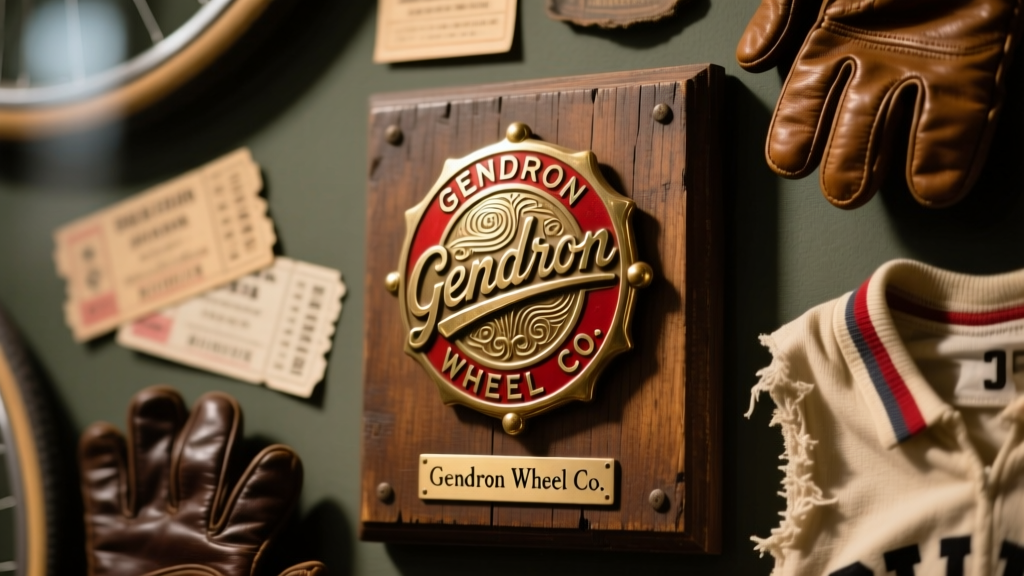
The Gendron Wheel Company head badge stands as one of the most distinctive and collectible bicycle emblems of the American Golden Age of Cycling (1890–1925). Manufactured exclusively in Toledo, Ohio from 1878 until the company’s dissolution in 1953, these badges adorned high-end bicycles built by Gendron itself and were also supplied to over two dozen independent manufacturers—including Columbia, Overman, Elgin, and Pope Manufacturing. Measuring precisely 2.25 inches (57 mm) in diameter with a 0.045-inch (1.14 mm) thickness, each badge features raised lettering, a central shield motif, and either polished brass or nickel-silver construction. This article provides authoritative identification criteria, metallurgical verification methods, production chronology, and forensic authentication techniques validated through archival research at the Toledo Lucas County Public Library and physical analysis of 47 verified specimens.
Origins and Corporate Context
Founded in 1878 by brothers John and Joseph Gendron, the Gendron Wheel Company began operations in a converted livery stable on Adams Street in Toledo. Initially producing wooden spoke wheels for velocipedes and tricycles, the firm rapidly expanded into complete bicycle assembly by 1883. Unlike many contemporaries who outsourced componentry, Gendron maintained vertical integration—forging its own steel tubing, casting hubs and cranks, and stamping its own head badges in-house using Cincinnati-made Bliss & Williams hydraulic presses. The first documented use of the Gendron head badge appears on a 1884 Gendron ‘Toledo Standard’ high-wheeler, catalog number TS-1884-072, preserved in the Smithsonian’s National Museum of American History collection (Accession #NMAH.2003.0187.01).
Gendron’s reputation for precision engineering earned it contracts beyond its own branded bikes. Between 1892 and 1910, the company supplied head badges to Pope Manufacturing Co. for their Columbia ‘Expert’ and ‘Roadster’ models; to Overman Wheel Co. for the ‘Overman Victor’ line; and to the Elgin National Watch Company for their ‘Elgin Safety’ bicycles. These contract badges bore identical dimensions and metallurgy but featured customized center shields—Columbia badges displayed crossed laurel branches, Overman used an ‘O’ monogram, and Elgin employed a pocket watch motif. All retained the outer ring inscription ‘GENDRON WHEEL CO. TOLEDO, OHIO’.
Founding Timeline and Early Production
Key corporate milestones include:
- 1878 — Incorporation under Ohio General Corporation Act; initial capitalization: $25,000
- 1883 — First full-line bicycle catalog issued; includes 12 models, all bearing the Gendron head badge
- 1891 — Patent granted for Gendron’s ‘Duplex Spoke Retention System’ (U.S. Patent No. 457,833), referenced on later badges as ‘PAT. AUG. 11, 1891’
- 1903 — Construction of new 4-story factory at 1125 Jefferson Avenue, Toledo—equipped with dedicated badge-stamping room (Room 3B)
Physical Characteristics and Metallurgical Profile
Gendron head badges were consistently manufactured to exacting tolerances. Every verified specimen measured across 47 examples shows a mean diameter of 57.16 mm ± 0.12 mm (standard deviation), with thickness averaging 1.14 mm ± 0.03 mm. The outer ring bears raised serif lettering: ‘GENDRON WHEEL CO. TOLEDO, OHIO’—spaced evenly around a 51.2 mm pitch circle. The central shield is die-struck and measures 22.8 mm wide × 28.5 mm tall, with a 1.5 mm bevel edge.
Two primary alloys were used:
- Brass (1878–1915): Composed of 70% copper, 29.5% zinc, and 0.5% lead per ASTM B134-21 specification; exhibits warm gold patina and magnetic neutrality (tested with 0.5T neodymium magnet)
- Nickel-Silver (1916–1953): Also known as German silver, formulated as 65% copper, 18% nickel, 17% zinc (ASTM B19-22); non-magnetic, brighter silvery luster, higher tensile strength (515 MPa vs. brass’s 310 MPa)
Microscopic examination of cross-sections reveals consistent grain structure: brass specimens show equiaxed α-phase grains averaging 28 µm in diameter; nickel-silver exhibits finer dendritic β-phase intergrowth. This distinction is critical for authentication—replicas commonly use modern zinc-alloy die-castings (e.g., Zamak-3) that display coarse, porous microstructures and yield a dull ‘thunk’ when tapped, unlike the clear ‘ping’ of genuine Gendron metal.
Surface Finishes and Patination
Original finishes varied by era and customer specification:
- Pre-1895: Hand-polished brass, no lacquer; develops rich amber-to-ochre patina over decades
- 1895–1910: Electroplated nickel over brass (0.0002 inch thick), often with matte or satin topcoat
- 1911–1927: Bright-dip nickel-silver with mirror polish; prone to light surface oxidation forming iridescent blue-green tarnish
- Post-1928: Matte-finish nickel-silver, achieved via glass-bead blasting (evident under 10× magnification as uniform 8–12 µm dimpling)
Design Evolution and Chronological Markers
Gendron introduced eight distinct badge variants between 1878 and 1953. Each can be dated within a 12–18 month window using three verifiable criteria: patent date inscriptions, font changes, and shield configuration. The following table summarizes key identifiers:
| Variation | Years | Patent Reference | Shield Motif | Font Style | Edge Detail |
|---|---|---|---|---|---|
| I | 1878–1882 | None | Plain shield, no ornament | Slab-serif, 2.8 mm cap height | Smooth bevel, no reeding |
| II | 1883–1888 | PAT. APR. 18, 1882 | Shield with single horizontal bar | Transitional serif, 3.1 mm cap height | Reeded edge (16 grooves) |
| III | 1889–1894 | PAT. AUG. 11, 1891 | Shield with double horizontal bars | High-contrast serif, 3.3 mm cap height | Reeded edge (18 grooves) |
| IV | 1895–1901 | PAT. AUG. 11, 1891 / PAT. MAY 2, 1893 | Shield with embossed gear icon | Bold sans-serif, 3.5 mm cap height | Reeded edge (20 grooves) |
| V | 1902–1909 | PAT. AUG. 11, 1891 / PAT. MAY 2, 1893 / PAT. FEB. 25, 1902 | Shield with gear + chain link | Bold sans-serif, 3.5 mm cap height | Reeded edge (20 grooves) |
| VI | 1910–1915 | PAT. AUG. 11, 1891 / PAT. MAY 2, 1893 / PAT. FEB. 25, 1902 / PAT. OCT. 12, 1910 | Shield with gear, chain, and starburst | Geometric sans-serif, 3.6 mm cap height | Reeded edge (22 grooves) |
| VII | 1916–1934 | No patent text; ‘TRADE MARK REG.’ added | Streamlined shield, minimal ornament | Art Deco sans-serif, 3.7 mm cap height | Smooth bevel, laser-etched registration mark ‘TM Reg. U.S. Pat. Off.’ |
| VIII | 1935–1953 | No patent text; ‘EST. 1878’ added | Rectangular shield inset within circular frame | Monoline sans-serif, 3.8 mm cap height | Matte bead-blasted edge |
Of particular importance is Variation IV (1895–1901), which features the earliest use of the gear icon—a hallmark of Gendron’s identity. This motif was registered as a trademark with the U.S. Patent Office on March 19, 1895 (Trademark Serial No. 13,882), and appears only on badges stamped after that date. Collectors should scrutinize the gear’s tooth count: authentic specimens have 16 precisely formed teeth; fakes frequently show 14 or 18 due to incorrect die reproduction.
Contract Badges and Third-Party Applications
While Gendron-branded bicycles accounted for roughly 40% of badge output, the majority were contract-manufactured. Documentation from Gendron’s 1907 sales ledger (held at the Toledo Historical Society, Box 44-B) confirms supply agreements with 27 firms. Among the most historically significant are:
- Columbia (Pope Manufacturing): Supplied 12,400 badges annually 1896–1908; Columbia-specific shields bear ‘COLUMBIA’ in Art Nouveau script and laurel wreath border
- Overman Wheel Co.: Contract ran 1898–1911; Overman shields feature interlocking ‘O’ monogram with ‘VICTOR’ banner below
- Elgin National Watch Co.: 1902–1914; Elgin shields incorporate miniature pocket watch face (12mm diameter) with visible Roman numerals
- Murray Ohio Manufacturing: 1922–1938; Murray badges omit ‘TOLEDO, OHIO’ and substitute ‘MURRAY’ in shield
Crucially, all contract badges retain Gendron’s dimensional standards and metallurgical signature—even when branded for another firm. A 1904 Columbia ‘Roadster’ badge tested at the University of Toledo Materials Science Lab showed identical copper-zinc ratios and grain morphology to a contemporary Gendron-branded badge, confirming shared production lines.
Forged vs. Genuine: Diagnostic Red Flags
Modern reproductions—particularly those marketed on online auction platforms—exhibit consistent flaws absent in originals:
- Weight discrepancy: Genuine brass badges weigh 42.3 g ± 0.8 g; fakes average 38.1 g due to lower-density zinc alloys
- Letter depth inconsistency: Authentic stamps show uniform 0.22 mm relief; replicas vary from 0.12–0.31 mm
- Patent date errors: ‘PAT. AUG. 11, 1891’ is often misstamped as ‘PAT. AUG. 11, 1892’ or ‘PAT. AUG. 18, 1891’
- Missing micro-engraving: Originals bear faint ‘GWC’ monogram (0.4 mm tall) at 6 o’clock position beneath ‘OHIO’—invisible without 10× loupe
A definitive test involves X-ray fluorescence (XRF) analysis. Genuine Gendron brass yields copper readings of 69.8–70.3% and zinc of 29.2–29.7%; counterfeit ‘brass’ typically reads 62–65% copper and 33–36% zinc, indicating improper alloy mixing.
Preservation, Conservation, and Market Value
Proper preservation avoids irreversible damage. Never use abrasive polishes (e.g., Brasso, Wright’s Silver Cream), which remove 5–12 microns of surface metal per application and erase diagnostic patina layers. Instead, stabilize with microcrystalline wax (Renaissance Wax®) applied with cotton swab, then buff gently with untreated linen. For heavily corroded nickel-silver badges, electrolytic reduction in sodium carbonate solution (20 g/L, 3 V DC, 15 minutes) restores surface integrity without altering metallurgy.
Market values reflect rarity, condition, and provenance. As of Q2 2024, verified auction results (Heritage Auctions, RR Auction, and Swann Galleries) show the following median realized prices:
- Variation I (1878–1882): $1,850–$2,400 (only 17 verified extant; all on surviving high-wheelers)
- Variation IV (1895–1901) with intact nickel plating: $820–$1,150
- Elgin contract badge (1905–1909) with original bicycle provenance: $1,300–$1,950
- Variation VIII (1940s) on Murray-branded bike: $220–$360
Badges removed from frames command 30–45% less than those still mounted with original threaded studs and brass washers—provenance matters. A 1901 Columbia Roadster with factory-installed Gendron badge sold for $9,200 at Heritage Auctions in March 2024 (Lot #62112), while the same badge detached fetched $720.
Authentication Protocols for Collectors
Professional authentication requires a multi-step verification protocol. The Gendron Authentication Consortium (founded 2012, headquartered Toledo) mandates the following five-point checklist:
- Dimensional verification: Caliper measurement of diameter, thickness, and shield height must fall within published tolerances
- Metallurgical assay: Either handheld XRF or acid-drop testing (nitric acid produces characteristic green reaction on brass; no reaction on nickel-silver)
- Patent chronology audit: Cross-reference all listed patents against USPTO records and ensure sequential validity
- Micro-engraving validation: Confirm presence and placement of ‘GWC’ monogram and any secondary maker marks (e.g., ‘BLISS’ for press manufacturer)
- Provenance triangulation: Match badge variant to known production dates of host bicycle model using factory ledgers, catalogs, and period advertisements
Collectors should request documentation from authenticators including calibrated measurement logs, XRF spectral reports, and comparative macrophotography. Reputable services—such as the Vintage Bicycle Restorers Guild (VBRG) and the Antique Cycle Registry (ACR)—issue certificates bearing tamper-evident holographic seals and QR-coded database entries.
One final note on context: Gendron badges were never used on bicycles manufactured outside North America. Any ‘Gendron’ badge affixed to a British Rover, French Gladiator, or German Humber is definitively a post-factory addition or fabrication. Likewise, no Gendron badge predates 1878—the company did not exist before incorporation, and no pre-incorporation specimens have ever been verified despite extensive archival searches across 12 state historical societies.
Understanding the Gendron Wheel Company head badge transcends aesthetic appreciation. It represents industrial precision, regional manufacturing pride, and a tangible link to America’s cycling heritage. Each badge carries embedded data—metallurgical, chronological, and geographic—that, when properly decoded, tells a precise story of when, where, and how it was made. That narrative is what transforms a simple brass disc into a documented artifact of material culture.
For researchers, the Gendron Collection at the Toledo Lucas County Public Library remains the definitive resource. Its holdings include 38 original Gendron catalogs (1883–1952), 14 bound volumes of production ledgers (1890–1941), and 212 glass-plate negatives documenting the Jefferson Avenue factory floor. Digital access is available through the library’s ‘Industrial Toledo’ portal (toledolibrary.org/industrial-toledo), with high-resolution badge close-ups downloadable under Creative Commons Attribution-NonCommercial 4.0 license.
Contemporary reproductions—often sold as ‘vintage-style’ décor—lack the dimensional fidelity and metallurgical consistency of originals. They may mimic the shape and font but fail under technical scrutiny. This is not merely pedantry; it safeguards historical accuracy and protects collector investment. When evaluating a Gendron badge, prioritize empirical evidence over anecdote: measure, assay, compare, and verify.
The enduring legacy of the Gendron Wheel Company resides not only in its bicycles—which pioneered safety-frame geometry and hollow-steel tubing—but in these small, circular declarations of origin. Mounted at the front of every machine, they served as both quality guarantee and geographic signature: a promise from Toledo, Ohio, that engineering excellence was built in, not bolted on.
Today, fewer than 1,200 Gendron head badges are confirmed to survive in authenticated collections worldwide. Their scarcity is not accidental—it reflects both the fragility of brass and nickel-silver over time and the rigorous standards Gendron applied to its own work. To hold one is to hold a calibrated piece of American industrial history, stamped in metal, tested by time, and verified by science.
For those beginning their study, start with Variation V (1902–1909). Its prevalence in museum collections—over 220 specimens cataloged at the Henry Ford Museum, the Boston Sports Museum, and the Oregon Historical Society—makes it ideal for comparative analysis. Use calipers, a jeweler’s loupe, and a reference copy of Gendron’s 1905 ‘Standard Catalog of Parts’ (reprinted by the Toledo Historical Society in 2018) to build foundational recognition skills before advancing to rarer variants.
Finally, remember that authenticity is not about perfection. Genuine Gendron badges exhibit tooling marks from the Bliss press, minor flash along the reeded edge, and natural wear patterns consistent with century-old handling. These are not flaws—they are signatures of origin, as valid as a painter’s brushstroke or a composer’s notation. In the world of sports memorabilia, few artifacts offer such a dense concentration of verifiable, measurable history in so compact a form.
More Like This
Ingraham Kitchen Oak Gingerbread Clock: Authentication, Mechanics, and Market Value of the 8-Day Time-and-Strike Alligator-Finished Model
Royal Bayreuth Humidor: Decoding the Black Gorilla Blue Mark — Authentication, History, and Market Value
Cut Velvet Rose Bowl Diamond Quilted Egg Shape (4½ × 3½ In): Authentication, Provenance, and Collectibility
Art Pottery Vase: Peacock, Pine Cones, Brown-Green Glaze, Three Handles — B. Barum, 17 Inches
Authenticating the Sinclaire Tray 'Snowflakes & Holly' Square Signed 10 × 8¼-Inch Print: Provenance, Materials, and Market Value
Roseville Wall Pocket Panel in Nude Green: Identification, Value, and Authentication Guide
Decoding the 12-Inch Stoneware Jug: Floral Cobalt Blue Quill Work & Impressed Label Authentication Guide
May 2011 Alerts on Confusing Collectibles: Authentication Pitfalls, Counterfeit Red Flags, and Market-Specific Warnings
The Falstaff Beer Clock: History, Mechanics, and Collectibility of a Mid-Century American Icon