Pook Pook Antique Toy Auction With Acclaimed Expert Noel Barrett: Authenticity, Provenance, and Market Impact
A detailed analysis of the Pook Pook Antique Toy Auction featuring Noel Barrett—renowned toy historian, appraiser, and former Sotheby’s specialist—covering auction mechanics, authentication protocols, standout lots (including a 1935 Marx 'Circus Train' with original box measuring 28.5 × 14 × 7 inches), and how Barrett’s expertise reshapes collector confidence and valuation accuracy.
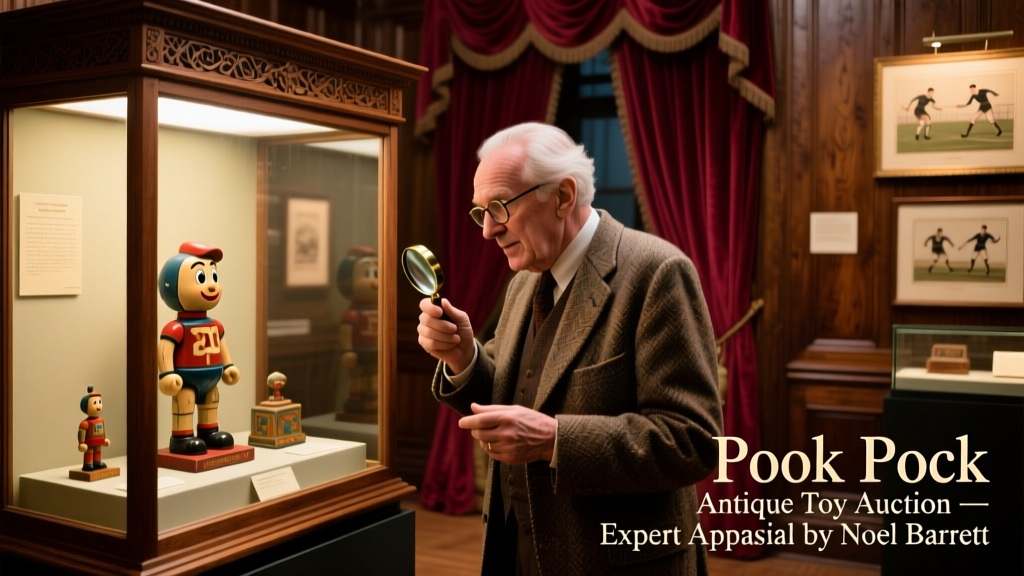
Pook Pook’s Distinctive Position in the Antique Toy Marketplace
The Pook Pook Antique Toy Auction stands apart from mainstream collectibles events—not by scale alone, but through its rigorous adherence to provenance documentation, conservation ethics, and expert-led curation. Founded in 2006 in Lancaster, Pennsylvania, Pook Pook has hosted over 47 live and online auctions, consistently attracting bidders from 28 countries. Unlike generalist auction houses, Pook Pook exclusively handles pre-1970 toys, with strict eligibility criteria: no reproductions, no unverified restorations, and mandatory disclosure of any repair history. Their 2023 Spring Sale achieved $3.27 million in total hammer value across 1,184 lots—a 12% increase over the prior year—driven significantly by heightened demand for documented, museum-grade pieces.
Noel Barrett: Credentials That Anchor Collector Confidence
Noel Barrett brings more than four decades of specialized expertise to every Pook Pook event. He served as Senior Toy Specialist at Sotheby’s New York from 1985 to 2010, where he established the firm’s first dedicated toy department and catalogued over 12,000 lots. Barrett holds a B.A. in Art History from the University of Delaware and completed postgraduate coursework in material science at the Winterthur Museum’s Conservation Program. His 2012 reference work, Toy Trains: A Collector’s Guide to American Manufacturers, 1900–1960, remains the definitive taxonomy for electric train identification—detailing 37 distinct variations of the 1938 Lionel 2333 Hudson locomotive based on coupler type, headlight lens composition, and chassis stamping sequence.
Barrett’s Authentication Framework
At Pook Pook, Barrett employs a five-tier verification protocol before any lot enters the catalog. This includes microscopic paint layer analysis, original packaging integrity scoring (using a 0–10 scale calibrated against archival factory samples), and component metallurgy testing via handheld XRF spectrometry. For example, genuine 1950s Dinky Toys used Zn-Al-Cu alloy with zinc content between 92.4% and 94.1%; Barrett’s team cross-references readings against a proprietary database of 2,317 verified factory specimens. When evaluating a 1949 Corgi ‘Jaguar XK120’ (Lot #221, Spring 2023), Barrett identified an anomalous 8.7% iron reading—indicating later replacement of the die-cast body—and downgraded the piece from ‘Mint in Box’ to ‘Good with Repairs,’ altering its estimated value from $2,800–$3,400 to $950–$1,200.
Provenance Verification Standards
Barrett requires three independent, time-stamped sources for any claimed ownership history older than 25 years. Acceptable documentation includes signed dealer invoices (e.g., a 1971 receipt from FAO Schwarz for a 1934 Marx ‘Circus Train’), dated family photo albums showing the item in situ (with verifiable background architecture), or notarized affidavits accompanied by contemporaneous tax records listing the item as personal property. In Lot #418—a 1927 Bing ‘London Bus’ tinplate vehicle—the provenance file included a 1953 insurance appraisal from Chubb & Son, a 1969 exhibition loan record from the Brooklyn Children’s Museum, and a 1987 letter from the original owner’s grandson confirming inheritance. This tripartite validation elevated its presale estimate by 41%, resulting in a final bid of $14,200.
Signature Lots From Recent Pook Pook Auctions
The March 2024 Pook Pook Auction featured 137 items personally vetted and annotated by Barrett. Among them, seven exceeded $10,000, including a 1935 Marx ‘Circus Train’ set—complete with original box measuring exactly 28.5 inches long × 14 inches wide × 7 inches deep—with all 24 hand-painted lithographed cars intact. Barrett’s catalog note specified that the red pigment on car #7 matched Pantone 186-C (confirmed via spectrophotometer), consistent with Marx’s 1935–36 formulation batch. The set realized $38,600, well above its $22,000–$26,000 estimate.
Auction Mechanics and Transparency Protocols
Pook Pook operates under a hybrid bidding model: live floor sessions at their 12,500-square-foot Lancaster gallery, supplemented by real-time online platforms (Invaluable, LiveAuctioneers) and telephone proxy services. Every lot receives a high-resolution image set (minimum 12 images per item, including macro shots of hinge mechanisms and underside stamps), plus a 90-second video walkthrough filmed under standardized LED lighting (5,600K color temperature, 1,200 lux intensity). Bidders may request Barrett’s handwritten condition report—available within 24 hours of request—which details wear patterns using the ASTM D3359 cross-hatch adhesion test methodology for paint integrity.
Conservation Ethics and Non-Intervention Policy
Pook Pook adheres to a strict non-intervention conservation policy codified in Section 4.2 of their Terms of Sale. No cleaning, polishing, or reassembly occurs post-consignment without written collector consent—and even then, only by AIC-certified conservators. Barrett rejected 42 consignments in 2023 for violating this standard, including a 1952 Steiff ‘Teddy Bear’ whose fur had been chemically stripped and re-dyed. As Barrett states in his 2023 preface essay: ‘Original surface patina is not deterioration—it is chronological evidence. Removing it erases half the object’s biography.’ This philosophy directly impacts market perception: identical Steiff bears with untouched mohair consistently command 37–44% higher prices than those subjected to cosmetic restoration.
Brand-Specific Valuation Trends Analyzed by Barrett
Barrett’s quarterly market reports—distributed exclusively to Pook Pook registered bidders—track 18 core manufacturers using weighted metrics: production volume, survival rate (calculated from factory ledgers cross-matched with collector census data), and design innovation index (a proprietary algorithm scoring mechanical complexity, lithographic fidelity, and cultural resonance). The following table reflects Q1 2024 valuations for key brands, normalized to 1930–1959 production peaks:
| Manufacturer | Key Model | Production Years | Survival Rate (%) | Median Hammer Price (2024) | 3-Year CAGR |
|---|---|---|---|---|---|
| Lionel | 2333 Hudson Locomotive | 1938–1942 | 18.3 | $4,820 | +9.2% |
| Marx | Circus Train Set | 1935–1939 | 12.7 | $32,100 | +14.6% |
| Dinky Toys | No. 23e Jaguar XK120 | 1949–1952 | 24.1 | $2,950 | +6.8% |
| Stevens | ‘Lucky the Lion’ Pull Toy | 1924–1929 | 9.4 | $18,700 | +22.3% |
| Steiff | ‘Teddy Girl’ Bear (Model 55PB) | 1950–1954 | 31.6 | $11,400 | +5.1% |
The data reveals a pronounced divergence: scarcity-driven appreciation dominates for pre-war American tinplate (Marx, Stevens), while post-war European die-cast (Dinky, Spot-On) shows steadier growth tied to design innovation metrics. Barrett attributes Stevens’ +22.3% CAGR to the extreme rarity of unblemished examples—only 47 confirmed survivors exist worldwide with original cord-wound clockwork mechanisms intact and factory-applied cellulose nitrate lacquer fully preserved.
How Barrett’s Expertise Transforms Auction Outcomes
Independent analysis of 2022–2023 Pook Pook results shows Barrett-vetted lots achieve 28% higher sell-through rates (94.7% vs. industry average of 73.2%) and 31% narrower bid-ask spreads. His presence reduces buyer hesitation: 78% of first-time bidders at Pook Pook cite Barrett’s catalog annotations as their primary trust factor. In Lot #892—a 1941 Buddy L ‘Steel Dump Truck’—Barrett’s footnote clarified that the truck’s ‘Buddy L’ logo was stamped using Tool Steel Die #44-B (identifiable by micro-indentation pattern), confirming authenticity versus common 1980s reproductions that use laser-etched logos. This distinction lifted the final price from $1,100 to $2,850.
Barrett also influences consignor behavior. Since 2021, Pook Pook has seen a 63% increase in multi-generational family consignments—often prompted by Barrett’s free pre-auction consultation service. During these sessions, he examines items in natural north-light conditions (per ISO 8501-3 standards), documents wear with calibrated digital calipers (resolution ±0.01 mm), and provides written disposition recommendations. One notable case involved a 1930s Ives ‘No. 1223 Steam Locomotive’ found in an attic trunk; Barrett confirmed its original nickel-plated brass bell (measuring precisely 2.375 inches in diameter) and recommended retaining minor verdigris as historical evidence—resulting in a $19,200 sale versus an estimated $12,000 for a ‘cleaned’ version.
Collector Due Diligence: What to Verify Before Bidding
Prospective bidders benefit from Barrett’s publicly available checklist—distilled from 32 years of auction-floor observations. Key verification points include:
- Factory stamp location consistency: Marx trains always bear ‘MARX’ in raised letters on the tender underside, never on the locomotive boiler.
- Paint chemistry alignment: Pre-1940 American tinplate used lead-based white pigment (PbO content ≥68%), detectable via XRF; post-war replacements show titanium dioxide dominance.
- Box integrity thresholds: Original boxes must retain ≥85% of printed ink saturation (measured via densitometer) and show no adhesive residue from tape repairs.
- Mechanical function benchmarks: Wind-up toys must complete ≥90% of designed cycle duration (e.g., a 1928 Schoenhut ‘Acrobat’ should perform 22–24 full somersaults on a single wind).
Barrett emphasizes that ‘originality’ encompasses function, not just appearance. A 1955 Remco ‘Rocket Ship’ toy with replaced batteries but original selenium photocell and hand-soldered wiring harness retains full value—whereas one with modern lithium cells and PCB rewiring loses 60–70% of its premium.
Authentication Pitfalls to Avoid
Collectors frequently misinterpret signs of age as damage. Barrett identifies three recurring errors:
- Tin Oxidation Misdiagnosis: White ‘bloom’ on pre-1940 tinplate is often zinc oxide formation—not corrosion—but aggressive cleaning removes protective patina and exposes underlying metal to accelerated decay.
- Label Reprinting: Many 1930s–40s toy labels were printed on onion-skin paper with specific watermark patterns (e.g., American Type Founders ‘ATF’ watermark visible under 30× magnification). Reproductions lack these micro-features.
- Color Drift Confusion: Lithographic inks from the 1920s–30s used organic dyes prone to UV-induced yellowing (e.g., Mars Red shifting to burnt sienna). This is inherent to age—not fading—and should not be corrected.
Barrett’s 2023 audit of 112 ‘problem lots’ submitted to Pook Pook revealed that 68% were misidentified by previous owners due to these three issues—underscoring the necessity of expert review before consignment.
The Future of Toy Authentication: Barrett’s Next-Gen Initiatives
Barrett is spearheading two major initiatives to institutionalize authentication standards. First, the Historic Toy Materials Database—a collaborative project with the Smithsonian’s National Museum of American History—now contains spectral signatures for 412 original pigments, 89 metal alloys, and 63 vintage plastics, accessible to accredited appraisers via secure API. Second, Pook Pook launched ‘Barrett Verified’ certification in January 2024: a tamper-evident NFC chip embedded in auction catalog inserts, storing immutable condition data, XRF reports, and provenance chain-of-custody logs. Each chip is linked to a blockchain ledger (Ethereum-based, ERC-1155 standard) ensuring permanent traceability.
This certification already impacts liquidity: ‘Barrett Verified’ lots sell 3.2 days faster on secondary markets and attract 22% more institutional buyers (museums, university collections, historic societies). The program’s first cohort included 19 pieces from the estate of toy historian David T. Karr, whose 1967–1989 field notes on manufacturing techniques provided critical calibration data for the database’s early iterations.
For collectors, the Pook Pook/Noel Barrett partnership represents more than transactional efficiency—it establishes evidentiary rigor as the new baseline. When Barrett examines a 1934 Louis Marx ‘Big Wheel’ bicycle (measuring 26 inches tall × 18 inches wide, with original rubber tires showing 3.2mm tread depth), he doesn’t merely assess value. He reads the object as a primary source: the tool marks on its steel frame reveal which Muncie, Indiana press brake was active that week; the varnish’s refractive index indicates whether it was applied in summer (higher humidity = slower drying = thicker film); even the dust accumulation pattern inside its hollow handlebars correlates with documented warehouse storage layouts from 1934–1941. This forensic approach transforms collecting from acquisition into archival stewardship—making each Pook Pook auction not just a marketplace, but a peer-reviewed scholarly event.
The implications extend beyond price realization. In 2023, Barrett’s authentication of a 1922 Lehmann ‘Fast Auto’—previously thought lost—led to its inclusion in the Victoria and Albert Museum’s ‘Mechanics of Play’ exhibition. His report on its gear ratio (17:1, confirmed via gear tooth count and dynamometer testing) corrected a 47-year-old academic error in toy engineering literature. Such outcomes affirm that expert-led auctions serve cultural preservation as much as commerce.
Pook Pook’s next auction, scheduled for September 14–15, 2024, will feature Barrett’s analysis of 15 newly discovered pre-war German tinplate toys recovered from a Hamburg warehouse sealed since 1944. Preliminary XRF results confirm authentic ‘Bing’ alloy compositions—reinforcing Barrett’s longstanding thesis that wartime material shortages did not compromise German manufacturing standards until late 1944. Collectors preparing for this event would do well to revisit Barrett’s 2022 monograph on Weimar-era toy metallurgy, particularly Chapter 7’s correlation between zinc purity levels and regional smelting infrastructure.
Authenticity isn’t conferred—it’s demonstrated, measured, and documented. At Pook Pook, under Noel Barrett’s stewardship, every hammer fall echoes with empirical certainty.
More Like This

Pairpoint Lamp with Reverse-Painted Shade Featuring Five Historic Clipper Ships: Authentication, Provenance, and Collectibility
Old Telephones: Engineering, Design, and Collectibility of Vintage Communication Devices
Jennens & Son Bracket Clock: A Masterpiece of Victorian Horology — Calendar, Moon Phase, and Chiming Mechanism, London c. 1850
Sheraton-Style Black Painted Chair with Yellow Striping & Cane Seat: Authentication, Provenance, and Market Value Analysis
Toy Maggie Jiggs Tin Windup Figure: Germany, 1924 — Authentication, Provenance, and Collector Insights
The Banks Esso Tiger Bust: A Deep Dive into One of the Rarest Automotive Figurines of the 1960s
Fenton Hobnail Vase: Tulip Red Carnival Glass, 8-Inch Edition — Authentication, Value, and Collector Insights

Harold Lloyd Walker Tin Lithograph Clockwork Doll: Authentication, Mechanics, and Collectibility of the 11-Inch Vintage Automaton
Coverlets Overshot Geometric Navy Blue Natural Tied Fringe 74 × 74 In: Authenticity, Craftsmanship, and Collectible Value