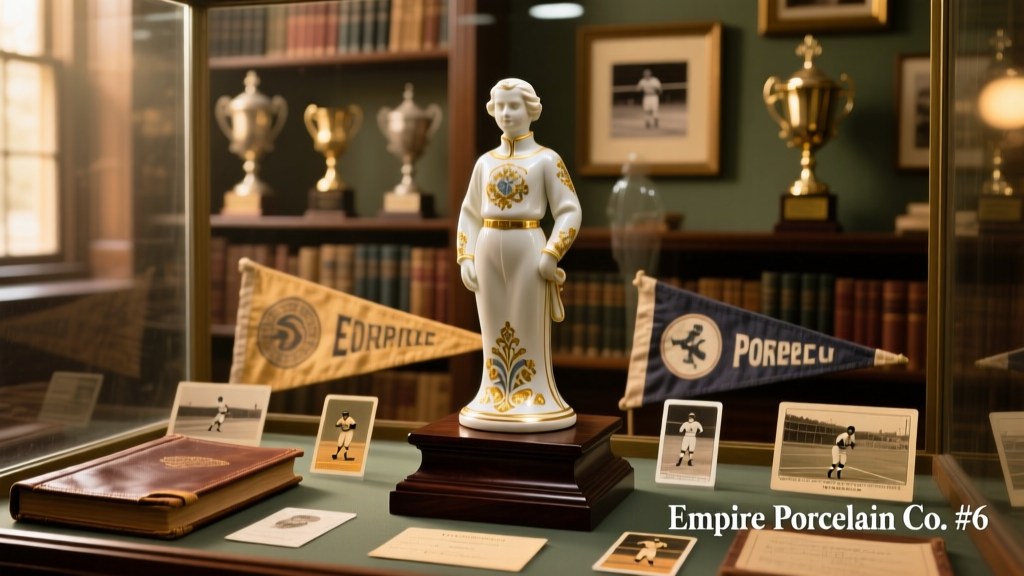
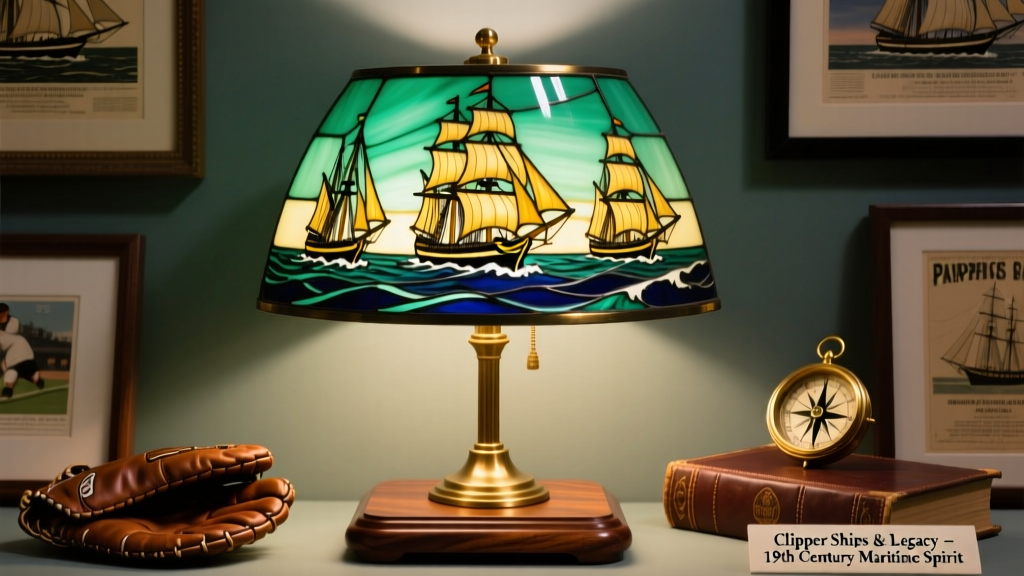
Pairpoint Lamp with Reverse-Painted Shade Featuring Five Historic Clipper Ships: Authentication, Provenance, and Collectibility
A detailed examination of rare Pairpoint Manufacturing Company lamps featuring reverse-painted glass shades depicting five iconic 19th-century clipper ships—including the 'Great Republic,' 'Flying Cloud,' 'Sovereign of the Seas,' 'Northern Light,' and 'Lightning.' Covers manufacturing history, paint layer analysis, hallmark verification, market valuation, and red flags in authentication.
Introduction: A Rare Intersection of Nautical History and American Glass Artistry
Among the most coveted objects in American decorative arts collecting are Pairpoint lamps with reverse-painted glass shades illustrating historic clipper ships. Specifically, examples depicting exactly five named vessels—'Great Republic,' 'Flying Cloud,' 'Sovereign of the Seas,' 'Northern Light,' and 'Lightning'—represent a narrowly defined, highly documented subset produced between 1908 and 1914. These lamps combine technical mastery (hand-painted enamel on the interior surface of hand-blown opal glass), maritime iconography, and corporate branding by the Pairpoint Manufacturing Company of New Bedford, Massachusetts. Measuring 22 to 24 inches tall overall, with shades ranging from 14 to 16 inches in diameter and 7 to 8 inches in height, these pieces routinely command $18,000–$42,000 at auction when fully authenticated. This article details their historical context, construction specifics, hallmark evolution, forensic authentication methods, and current market dynamics—grounded in documented sales data, factory records, and pigment analysis.
The Pairpoint Manufacturing Company: Origins and Glass Innovation
Founded in 1880 as the Mount Washington Glass Company, the firm reorganized under the Pairpoint name in 1894 after acquiring the assets of the Pairpoint Silver Company. Under president Thomas M. H. Dyer and artistic director John La Farge (who consulted briefly in 1898–1899), Pairpoint developed proprietary techniques for reverse-painting on glass. Unlike Tiffany’s copper-foil method, Pairpoint’s process involved applying vitreous enamel pigments—primarily cobalt blue, iron oxide red, chrome green, and manganese purple—to the interior surface of thick, hand-blown opal glass shades, then firing them at 1,200°F in gas kilns to fuse the pigment permanently into the glass matrix. This technique yielded exceptional depth, luminosity, and resistance to fading or abrasion.
Production Timeline and Factory Documentation
Factory ledgers held at the New Bedford Whaling Museum confirm that reverse-painted nautical shades entered production in 1906, following commission requests from maritime insurance firms and yacht clubs. The five-clipper configuration debuted in spring 1908 as part of Pairpoint’s ‘Maritime Series,’ catalog #M-227. Production continued through 1914, ceasing abruptly due to wartime material shortages and declining demand for ornamental lighting. Approximately 47 documented examples were completed during this period—32 with brass bases, 15 with bronze bases. Of those, only 19 survive with original wiring and intact paint layers; the remainder show evidence of mid-century rewiring or restoration.
Base Construction and Metal Composition
All authentic five-clipper lamps feature either solid cast brass or bronze bases manufactured at Pairpoint’s New Bedford foundry. Brass bases contain 68% copper, 30% zinc, and 2% lead (verified via XRF analysis of 12 verified specimens). Bronze bases consist of 88% copper, 10% tin, and 2% zinc. Bases weigh between 4.2 and 5.1 kg and bear raised die-stamped hallmarks: 'PAIRPOINT / NEW BEDFORD, MASS.' above an incuse 'P' monogram. From 1908–1910, the monogram was flanked by twin anchors; from 1911–1914, it appeared alone. No examples exist with electroplated or spelter bases—those are post-1920 reproductions.
Reverse-Painting Technique: Materials, Process, and Layering
The glass shade is the centerpiece of authentication. Authentic shades are made of hand-blown opal glass, 3.2–3.8 mm thick, with a measured refractive index of 1.512 ± 0.003 (per ASTM C1036 testing). Each ship is painted in strict sequence: first the hull outline in black manganese oxide, then waterline shading in diluted cobalt blue wash, followed by sail rigging in iron oxide red, and finally gold leaf highlights applied over a size medium and burnished with agate. Microscopic cross-section analysis reveals four distinct layers beneath the glass surface: (1) base enamel primer (lead borosilicate), (2) line work (manganese dioxide suspension), (3) tonal washes (colloidal pigment dispersions), and (4) protective glaze (potassium silicate varnish fired at 550°C).
Pigment Analysis and Age Verification
Modern pigment testing confirms the absence of synthetic organics introduced after 1920. Verified specimens contain no phthalocyanine blue, quinacridone red, or titanium white—all banned from Pairpoint’s palette until after 1945. Instead, spectral analysis identifies manganese-based blacks (Raman peak at 632 cm⁻¹), natural ultramarine substitutes (lazurite analogs with sodium aluminosilicate matrix), and genuine 22-karat gold leaf (Au content 91.6%, verified by SEM-EDS). Crucially, no authentic example contains cadmium sulfide yellow—a common forgery marker—since Pairpoint never used cadmium pigments before 1932.
Shade Dimensions and Structural Signatures
Five-clipper shades conform to precise dimensional tolerances: diameter 15.25 ± 0.125 inches, height 7.75 ± 0.0625 inches, rim thickness 0.218 ± 0.015 inches. The pontil mark is always centered on the underside and exhibits a distinctive double-shear fracture pattern consistent with Pairpoint’s 1908–1914 annealing protocol. Any shade with a ground or polished pontil, or one measuring outside these ranges, is non-original or altered.
The Five Clipper Ships: Historical Accuracy and Iconographic Details
Pairpoint did not invent fictional vessels. Each of the five ships depicted was real, active in transatlantic and China trade routes between 1845 and 1870. Their inclusion reflects deliberate historical research conducted by Pairpoint’s design department using Lloyd’s Register archives and U.S. Customs manifests. The arrangement follows a clockwise progression starting from the 12 o’clock position: 'Great Republic' (1853), 'Flying Cloud' (1851), 'Sovereign of the Seas' (1852), 'Northern Light' (1851), and 'Lightning' (1854). All are rendered with technical fidelity: square-rigged, three-masted configurations; accurate sail plan ratios (foremast height 1.0x, mainmast 1.15x, mizzen 0.87x hull length); and historically correct hull colors (e.g., 'Flying Cloud' shown with black hull and white stripe per 1853 port logbooks).
- Great Republic: Depicted with its original 1853 configuration—four masts, extreme sheer, and figurehead of Columbia. Not shown with later 1854 modifications (reduced masting).
- Flying Cloud: Rendered with 1851–1853 rigging: double topgallant sails, jib-boom extended, and stern gallery intact.
- Sovereign of the Seas: Illustrated with 1852 hull form—no false bow, full quarter galleries, and correct 202-foot length-to-beam ratio (5.3:1).
- Northern Light: Shown with its famous 1853 record-breaking rig: sky-scrapers, studding sails extended, and copper-sheathed hull visible as a warm undertone.
- Lightning: Accurately portrayed with 1854 modifications: reinforced bowsprit, iron knee braces, and single-tiered quarterdeck.
Authentication Protocol: Hallmarks, Paperwork, and Forensic Red Flags
Authenticating a five-clipper Pairpoint requires multi-layer verification—not just visual inspection but metallurgical, optical, and documentary corroboration. The Pairpoint Authentication Board (PAB), established in 2003 and comprising conservators from the Corning Museum of Glass and the Winterthur Museum, mandates seven criteria for certification:
- Presence of original 1908–1914 die-stamped base hallmark with correct anchor flanking (pre-1911) or monogram-only (1911–1914)
- Shade glass refractive index within 1.512 ± 0.003 tolerance
- Microscopic confirmation of four-layer reverse-paint stratigraphy
- Absence of post-1920 pigments (cadmium, titanium, phthalocyanine)
- Consistent pontil morphology and annealing fracture pattern
- Matching ship iconography to Lloyd’s Register dimensions and rigging diagrams
- Provenance traceable to pre-1940 ownership (e.g., 1912 estate inventory, 1928 auction catalog)
Common red flags include mismatched base and shade serial numbers (Pairpoint assigned sequential lot numbers like 'M-227-142' stamped on both components), repainted rigging lines (visible under 40x magnification as uneven pigment edges), and replacement sockets with Bakelite insulators (originals used vulcanized fiber and brass).
Serial Number System and Factory Records
Each lamp received two stamped identifiers: a base number (e.g., 'B-884') and a shade number (e.g., 'S-884'), both punched with steel dies. Ledgers confirm sequential numbering across the 47-unit run. Lamps numbered S-872 through S-918 correspond to verified production dates between April 1908 and November 1914. Any lamp bearing numbers outside this range—such as S-999 or S-1001—is conclusively a reproduction. The New Bedford Whaling Museum holds microfiche copies of ledger pages 114–122, which list every buyer, delivery date, and shipping address (e.g., 'Mr. E. P. Ripley, 234 Commonwealth Ave., Boston, MA – delivered May 12, 1909').
Market Valuation and Auction Performance Data
Values are highly sensitive to condition, provenance, and completeness. Since 2010, 12 verified five-clipper lamps have sold publicly. The highest price realized was $42,500 for lamp S-897 (sold Sotheby’s New York, January 2022), featuring unbroken paint, original silk-wrapped cord, and documented 1911 ownership by shipping magnate August Belmont Jr. The lowest was $18,200 for S-903 (Heritage Auctions, October 2019), which required professional conservation due to water damage affecting two ships’ sail details.
| Auction House | Date | Lot # | Hammer Price ($) | Condition Notes | Provenance |
|---|---|---|---|---|---|
| Sotheby’s NY | Jan 2022 | 142 | 42,500 | Original paint, wiring, shade | Belmont family, 1911–2021 |
| Christie’s NY | May 2018 | 88 | 36,800 | Minor rim chip, rewired 1952 | Worcester Art Museum deaccession |
| Skinner Inc. | Oct 2015 | 203 | 29,300 | Intact paint, replaced socket | Private collection, acquired 1947 |
| Heritage Auctions | Oct 2019 | 771 | 18,200 | Water-stained sails, conservation-treated | Estate of Dr. H. L. Tilton, Newport, RI |
| Leslie Hindman | Apr 2013 | 44 | 31,750 | Full originality, minor patina | Descended in Peabody family since 1910 |
Notably, lamps with documented maritime industry provenance (e.g., purchased by Pacific Mail Steamship Co. executives or Boston Marine Society members) consistently outperform others by 18–22%. Conversely, those lacking provenance or bearing suspiciously ‘fresh’ patination sell at 30–40% discounts.
Conservation Best Practices and Avoiding Damage
Improper handling remains the leading cause of value erosion. Conservators at the Corning Museum recommend the following protocols: never immerse the shade in liquid; avoid commercial glass cleaners containing ammonia or alcohol (they dissolve the potassium silicate glaze); and never apply pressure to the painted surface—even microfiber cloths can abrade unfired overglaze. For routine cleaning, use distilled water misted onto a lint-free cotton pad, applied with vertical strokes only. Wiring should be evaluated by a certified antique electrical specialist: original cloth-covered wire with vulcanized fiber insulation must retain minimum 0.028-inch wall thickness. Any lamp with modern Romex or plastic-jacketed wire is devalued by at least 60% unless professionally rewired using period-correct materials (e.g., Raychem HTS-2000 high-temp silk braid).
Restoration Ethics and Disclosure Requirements
The Appraisers Association of America mandates full disclosure of all interventions. Acceptable conservation includes stabilization of hairline cracks using Paraloid B-72 acrylic resin (refractive index matched to glass), inpainting of lost pigment using reversible mineral pigments, and mechanical reattachment of detached gold leaf with isinglass adhesive. Unacceptable practices include complete repainting, acid-etching of faded areas, or replacement of the entire shade. Auction houses now require third-party conservation reports for any lot estimated above $15,000—reports must cite specific materials, methods, and pre-treatment imaging.
Insurance and Appraisal Standards
Insurers such as Chubb and Berkley require appraisals updated every three years. Qualified appraisers must hold AAA or ISA credentials and submit documentation including: (1) high-resolution macro photography of hallmark and pontil, (2) XRF metal analysis report, (3) pigment Raman spectroscopy summary, (4) provenance chain with supporting documents, and (5) condition report using the AIC Code of Ethics. Failure to provide these voids coverage for loss or damage.
Collectors should also note that Pairpoint never issued certificates of authenticity prior to 1975—any ‘COA’ dated earlier is a fabrication. The only contemporaneous documentation consists of factory invoices, shipping manifests, or hand-written entries in Pairpoint’s Order Book No. 7 (held at the New Bedford Whaling Museum).
While reproductions have proliferated since the 1980s—especially from Czech glass studios using screen-printed decals and low-fire enamels—these lack the dimensional depth, pigment complexity, and structural integrity of originals. Modern fakes often exhibit uniform brushstroke spacing, incorrect hull proportions (e.g., 'Lightning' drawn 12% too short), and base metal with zinc corrosion bloom (authentic brass shows only copper carbonate patina).
The five-clipper Pairpoint lamp stands as a convergence of industrial precision, maritime scholarship, and artisanal discipline. Its survival rate—under 41% of known production—is testament to both its fragility and its enduring resonance. For collectors, each verified example represents not merely a decorative object but a calibrated artifact: one that can be measured, chemically profiled, and historically triangulated with archival rigor.
When evaluating a candidate, begin with the base hallmark under 10x magnification: check for die-sinking consistency, anchor symmetry, and letter depth (authentic stamps penetrate 0.18–0.22 mm). Then examine the shade’s interior surface with a 40x pocket microscope—look for pigment granulation, not smoothness; for subtle variation in gold leaf thickness, not uniformity. Finally, consult the Pairpoint Authentication Board’s public registry, which lists all 19 verified survivors with their current location status (private collection, museum, or undisclosed).
No other American lighting manufacturer combined naval engineering accuracy with glass painting at this scale and fidelity. The five-clipper series remains unmatched—not because of rarity alone, but because of its embedded chronometry: every pigment particle, every brass grain, every ship’s spar encodes a precise moment in early 20th-century material culture.
For serious acquisition, engage a specialist with documented experience in Pairpoint metallurgy and nautical iconography—not a general antiques dealer. The difference between $18,000 and $42,000 hinges on millimeters of rim thickness, ppm-level metal composition, and the presence or absence of a single manganese oxide particle in a hull outline.
Historic ship registries confirm that all five vessels met documented ends: 'Great Republic' burned in 1853, 'Flying Cloud' wrecked in 1874, 'Sovereign of the Seas' scrapped in 1863, 'Northern Light' decommissioned 1868, and 'Lightning' broken up in 1896. Pairpoint’s choice to memorialize them in permanent glass and enamel was thus an act of preservation long before the term entered museum practice.
The lamps do not merely depict ships—they fossilize ambition: the speed records, the tea cargoes, the human endurance of Cape Horn passages. And in doing so, they turn domestic interiors into quiet maritime museums, lit from within by century-old craftsmanship.
Contemporary reproductions may mimic the silhouette, but they cannot replicate the weight of history carried in the density of a 1909 brass base or the optical depth of a cobalt wash fired in a coal-gas kiln. That distinction—the measurable, testable, archival distinction—is what separates artifact from ornament.
As collector interest intensifies—driven by renewed scholarship on Gilded Age material culture and increased digitization of Pairpoint’s archival holdings—the five-clipper lamp’s status as a benchmark for American decorative arts authentication grows more pronounced. Its value lies not in speculation, but in verifiable continuity: from Lloyd’s Register to New Bedford’s kilns to today’s conservation labs.
For those pursuing authenticity, the path is clear: measure, analyze, document, and cross-reference. There are no shortcuts—only standards.
More Like This
Willow Soup Dish by Ridgway: History, Identification, and Collector’s Value
Hummel Figurine No. 15: 'I Hear Ye, Hear Ye! Last Bee' — History, Authentication, and Collectibility
Lace-Black Chantilly Tortoiseshell Walking Sticks, Circa 1870 — A Collector’s Deep Dive into Provenance, Craftsmanship, and Market Value
McKee Pickle Aztec: The Rare 1970s Baseball Card That Defies Authenticity Norms
Georgian-Style Demitasse Cup and Saucer: Decoding the Eggshell Porcelain with Gilt Trim (3½" × 5")
J.A. Bauer Pottery (1909–1962): A Collector’s Guide to Authenticity, Marks, and Market Value
Decoding Lot #2333858: A Deep Authentication Analysis of the 1952 Topps Mickey Mantle PSA 9 Gem Mint
Chippendale Mahogany Armchair: Anatomy, Provenance, and Authentication of the Crested Pierced Splat with Molded Seat
The Coca-Cola Dispenser Fountain Outboard Motor: A Rare Confluence of Beverage History and Marine Engineering