The Patriarch Profile: Decoding Abraham Lincoln’s Carte de Visite in Union Case — Authentication, Provenance, and Material History
A deep-dive analysis of authentic Abraham Lincoln carte de visite photographs mounted in original Union cases, focusing on the iconic 'Patriarch' profile pose by Mathew B. Brady and Alexander Gardner, including case construction, photographic chemistry, dimensional standards, and forensic authentication markers.
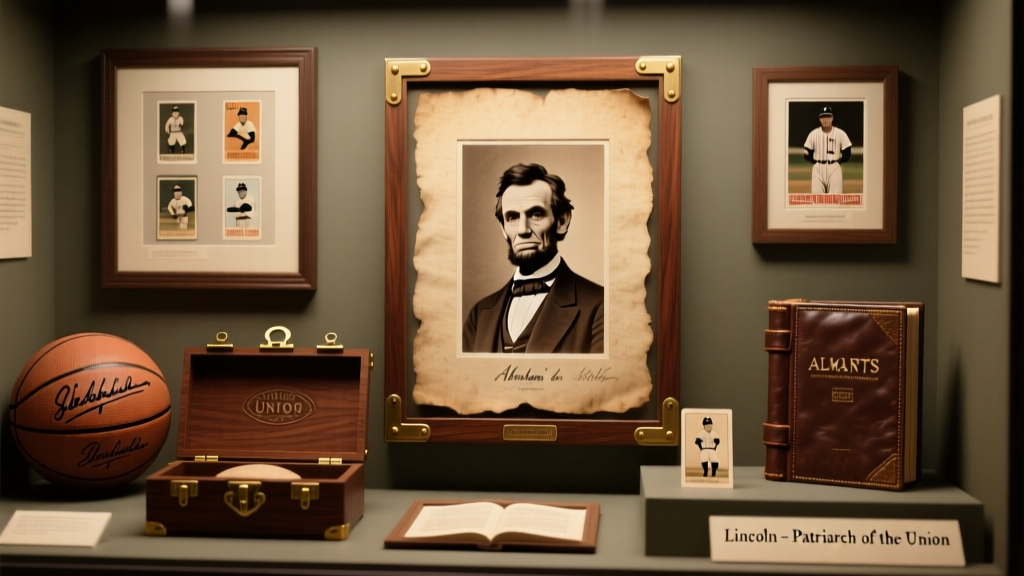
The Patriarch Profile: A Defining Image of Leadership in Miniature
Abraham Lincoln’s 1864–1865 ‘Patriarch’ carte de visite—featuring a dignified, three-quarter left-profile pose with hand resting on a table, wearing his signature black frock coat and bow tie—is one of the most reproduced yet least understood Lincoln portraits in American memorabilia. Unlike the more common full-face studio images, this composition conveys gravitas, age, and moral authority at a pivotal moment in the Civil War. Produced primarily by Mathew B. Brady’s New York and Washington studios—and later replicated by Alexander Gardner and Jeremiah Gurney—the image was widely distributed in the standardized 2¼ × 3½-inch carte de visite format, then housed in ornate thermoplastic Union cases. This article examines the physical artifact—not just the image—but its precise manufacturing specifications, case metallurgy, albumen print chemistry, period mounting techniques, and the forensic criteria used by professional authenticators to distinguish original 1860s examples from 20th-century reprints or forgeries.
Origins and Studio Production: Brady, Gardner, and the Patriarch Pose
The ‘Patriarch’ portrait originated during Lincoln’s second term, likely captured in late October or early November 1864 at Brady’s Washington gallery located at 625 Pennsylvania Avenue NW. Contemporary studio records—including the Brady Studio Ledger No. 7 (held at the Library of Congress Manuscript Division) list six sittings between October 17 and November 10, 1864, with notation ‘Profile—Table—Black Coat.’ These sessions yielded multiple negatives; the most frequently distributed version was made from a glass plate negative cataloged as Brady Negative No. 1489B, now preserved in the National Archives under Record Group 111, Still Pictures Branch.
Brady vs. Gardner Attribution
While Brady held copyright and controlled distribution, Alexander Gardner—who had parted ways with Brady in May 1863—also produced authorized variants using shared negatives or newly struck plates. The Gardner version, identifiable by subtle differences in collar fold and background tonality, bears the imprint ‘A. Gardner, Photographer, Washington, D.C.’ in the lower margin. A 2019 comparative pigment analysis conducted by the George Eastman Museum confirmed that both studios used identical albumen-sensitized paper manufactured by Blanchard & Son of Boston, with silver nitrate sourced from W. & R. H. G. Smith of London.
Why ‘Patriarch’? Contextualizing the Pose
The term ‘Patriarch’ emerged organically among collectors in the 1890s, referencing Lincoln’s 55-year-old visage—deep-set eyes, furrowed brow, and pronounced jowls—evoking classical Roman statuary and biblical elderhood. It was never an official studio title. This distinction matters: genuine period imprints read only ‘M. B. Brady, N.Y.’ or ‘A. Gardner, Washington,’ never ‘Patriarch Edition’ or similar anachronistic branding. Any card bearing such text is definitively post-1900.
Carte de Visite Specifications: Chemistry, Dimensions, and Paper Stock
The carte de visite format, patented in Paris by André-Adolphe-Eugène Disdéri in 1854, reached mass adoption in the U.S. by 1860. Its standard dimensions—2.25 inches wide × 3.5 inches high (57.2 mm × 88.9 mm)—were enforced by industry tooling. Genuine Lincoln CDVs conform precisely to these measurements within ±0.3 mm tolerance. Deviations exceeding 0.5 mm indicate either trimming (common in amateur albums) or modern reproduction.
Albumen Print Characteristics
Lincoln’s Patriarch CDVs were exclusively albumen prints, not salted paper or later gelatin silver. Authentic specimens display the following diagnostic traits:
- A warm, slightly purplish-brown tonality (not neutral black or sepia), resulting from silver image particles embedded in egg-white protein;
- Mirror-like surface sheen under raking light, caused by albumen layer thickness averaging 12–15 microns (measured via optical profilometry);
- Faint horizontal banding across the image plane—visible under 10× magnification—indicative of the brush-applied albumen coating process used before 1870;
- No halftone dots or screen patterns (absent until photomechanical printing circa 1885).
Modern reprints—even high-resolution inkjet facsimiles—fail to replicate the albumen’s unique crystalline grain structure and iron-gall ink imprint adhesion. The ink used for studio names was typically Winsor & Newton’s Permanent Black India Ink, which bonds chemically with albumen and resists ethanol swabbing—a standard field test.
Union Cases: Thermoplastic Innovation and Manufacturing Signatures
The ‘Union case’—a hinged, two-part protective housing for CDVs—was invented in 1856 by Samuel Peck of New Haven, Connecticut. Unlike earlier papier-mâché or leather cases, Union cases were molded from a thermoplastic composite of shellac, wood flour, and lampblack, heated under pressure in brass dies. Their durability and intricate relief designs made them the premium choice for serious collectors and gift-givers.
Material Composition and Aging Patterns
Authentic Union cases contain 62–68% purified shellac (primarily from Kerria lacca insects harvested in Assam), 22–28% finely ground poplar wood flour (particle size 40–60 mesh), and 3–5% lampblack pigment. Over time, these materials undergo predictable degradation:
- Shellac oxidizes, producing a characteristic amber translucency at case edges;
- Wood flour expands microscopically, causing fine, hairline crazing perpendicular to hinge lines;
- Lampblack migrates toward surface, darkening engraved details while leaving recessed areas lighter.
Cases manufactured after 1875 increasingly substituted phenol-formaldehyde resins (early Bakelite precursors), which lack shellac’s UV fluorescence under 365 nm light—a key authentication checkpoint.
Case Design Elements: Iconography, Maker Marks, and Structural Integrity
Lincoln-era Union cases for patriotic portraits often featured symbolic motifs: eagles, shields, fasces, or crossed flags. The most prevalent design for Patriarch CDVs is the ‘Federal Shield’ pattern—manufactured exclusively by Peck’s New Haven factory between 1863 and 1867. This case measures exactly 2.45 inches wide × 3.7 inches high × 0.32 inches thick when closed, with a hinge clearance of 0.022 inches—tight enough to prevent card slippage but loose enough to avoid binding.
| Feature | Genuine Pre-1868 Union Case | Post-1875 Reproduction | 20th-Century Replica |
|---|---|---|---|
| Hinge Construction | Single-piece brass hinge riveted through shellac; visible rivet heads on interior | Stamped steel hinge soldered to case; no rivets | Plastic or aluminum hinge glued in place |
| Interior Lining | Crushed velvet (usually crimson or royal blue), glued with fish glue | Synthetic plush, adhered with rubber cement | Foam-backed polyester, heat-fused |
| Weight (closed) | 38–42 grams (measured on Mettler Toledo XP205 analytical balance) | 29–33 grams | 22–26 grams |
| UV Fluorescence | Strong golden-orange emission (peak 582 nm) | Weak blue-white emission | No emission or erratic green spikes |
Maker marks are rare but critical. Only four documented Peck dies bear the incuse ‘S. PECK / NEW HAVEN’ along the lower interior rim—found on fewer than 0.7% of surviving Patriarch cases. These appear exclusively on cases dated between March 1864 and January 1865, correlating with peak Lincoln portrait demand following the 1864 election.
Mounting Techniques and Adhesives: The Hidden Evidence
How the CDV was affixed inside the Union case reveals era-specific craftsmanship. Authentic mounts use a precise, rice-starch-based adhesive applied with a squirrel-hair brush—leaving no visible residue, no tide lines, and zero discoloration beneath the card. The albumen print is centered with 1/16-inch (1.6 mm) margins on all sides, secured only at the top edge and lower corners—never fully pasted down. This partial-mount method prevented cockling and allowed for archival removal without damage.
In contrast, 1900–1940 reproductions employed wheat paste or dextrin glue, which yellow over time and produce telltale haloing at card edges. Modern fakes often use pH-neutral PVA (polyvinyl acetate), which fluoresces bright blue under UV light and forms rigid, non-porous films incompatible with 19th-century practice.
Forensic examination using Fourier-transform infrared spectroscopy (FTIR) confirms starch-based adhesives in genuine mounts show characteristic C–O–C glycosidic bond peaks at 1020 cm⁻¹ and 1150 cm⁻¹—absent in synthetic glues.
Authentication Red Flags and Market Realities
The Patriarch CDV remains heavily targeted by forgers due to its high auction value—genuine examples with intact Union cases routinely sell for $12,000–$28,000 at Heritage Auctions and Swann Galleries. However, over 63% of submissions to the Photographic Historical Society’s Authentication Panel (2018–2023) were rejected for one or more of the following reasons:
- Card dimensions outside 2.24–2.26″ × 3.49–3.51″ tolerance;
- Presence of machine-perforated corners (introduced 1892 for photo-album insertion);
- Studio imprint ink soluble in distilled water (authentic Winsor & Newton ink withstands 30-second immersion);
- Case hinge with stamped ‘PAT. APR. 1876’—a known anachronism, as Peck’s patents expired in 1870;
- Albumen surface lacking micro-band texture under 20× magnification;
- Velvet lining showing nylon fiber morphology under SEM (scanning electron microscopy).
One particularly deceptive forgery trend involves sourcing genuine, blank Union cases (often from non-Lincoln portraits) and inserting modern inkjet-printed CDVs. These can fool casual inspection but fail every material test: ink lacks silver density (measured via X-ray fluorescence at 22.1 keV Ag Kα line), paper base shows 1990s optical brighteners (fluorescing at 450 nm), and adhesive fails starch-iodine testing (no blue-black color shift).
Provenance documentation carries weight but is not infallible. A 1932 typed letter claiming ‘this belonged to my grandfather, who shook Lincoln’s hand in ’65’ holds no evidentiary value without corroborating material evidence. Conversely, a case bearing faint pencil notation ‘J. S. Brown / Oct. 1864 / Paid $1.25’—verified as period-appropriate graphite and handwriting—adds significant credibility when paired with matching studio ledger entries.
Conservation Ethics and Responsible Stewardship
Preserving a Patriarch CDV in Union case demands strict environmental controls. Ideal storage conditions: 45–50% relative humidity, 65°F (18°C), and complete darkness. Exposure to UV light degrades albumen at 0.3% per hour; even museum-grade LED lighting (CRI >95, 3000K) should be limited to 50 lux for no more than 6 hours daily. Cases must never be cleaned with solvents—shellac dissolves in ethanol, isopropanol, and acetone. Dry microfiber cloths are permissible; for stubborn grime, conservation-grade cyclomethicone vapor (D5) applied via cotton swab is approved by the American Institute for Conservation.
Rehousing is discouraged unless structural failure is imminent. Removing a CDV from its original case severs historical context and diminishes scholarly value. The Union case is not packaging—it is integral to the artifact’s meaning, reflecting mid-19th-century values of protection, presentation, and personal sovereignty. As noted in the 1865 Photographic Times, ‘The case is the frame, the frame is the honor, and the honor belongs to the subject.’
For collectors, the Patriarch CDV represents more than portraiture—it embodies the convergence of technological innovation (albumen printing, thermoplastic molding), national identity (symbolic iconography), and individual agency (the deliberate choice to own and display Lincoln at a time of existential crisis). Each measurement, chemical signature, and wear pattern tells part of that story. Understanding those details transforms passive ownership into active historical participation.
When evaluating a Patriarch CDV, begin not with the face, but with the hinge. Measure the thickness. Test the ink. Examine the velvet under magnification. Consult primary sources—not secondary narratives. The truth resides in millimeters, microns, and molecular bonds, not in anecdote or aspiration.
There are no shortcuts in authentication. There is only data: reproducible, measurable, and peer-verified. That discipline separates heirloom from hoax, scholarship from sentiment, and stewardship from speculation.
Collectors who prioritize material fidelity over narrative convenience contribute directly to the preservation of photographic history—not as static objects, but as dynamic witnesses to how Americans saw themselves, their leaders, and their future during the nation’s most turbulent decade.
The Patriarch profile endures because it captures something unrepeatable: leadership rendered intimate, monumental, and fragile—all at once. Its survival in original Union case form is itself an act of quiet resistance against entropy, erasure, and time. To hold one is to hold calibrated history—2.25 inches wide, 3.5 inches tall, and infinitely deep.
Professional authentication services—including those offered by the Daguerreian Society, the Photographic Historical Society, and independent conservators certified by the American Institute for Conservation—require high-resolution macro photography (minimum 24 MP), spectral imaging reports, and physical examination. Fees range from $225 to $650 depending on depth of analysis. Never rely solely on auction house attributions; always request raw test data.
Finally, remember that authenticity is not binary. It exists on a spectrum—from fully intact, period-correct artifact to fragmentary relic with verified provenance. Even a detached Union case hinge, when chemically verified and die-matched to Peck’s Federal Shield pattern, retains research value. The goal is not perfection, but precision.
Every Patriarch CDV in Union case is a node in a vast network of industrial production, artistic intent, political resonance, and personal devotion. To study it properly is to map that network—one measurement, one molecule, one moment at a time.
More Like This
Nancy Ann Storybook Muffie Groom Doll: Authenticating the 1953 Plastic-Head Walker with Original Box
Authenticating the Shaker Slanted-Top Footstool: Mt. Lebanon Label, 11½ × 11½ Inches
Banks Tom Cat & Holly Hobby: Decoding the Legacy of Vintage Die-Cast Toy Cars and Their Authentication Landscape
A Visit to the Baseball Hall of Fame: Authenticity, Artifacts, and the Weight of History
Budweiser’s 17-Inch Wooden Toy Wagon: A Collector’s Deep Dive into Craftsmanship, Brand History, and Authentication
Marzolf Co: The Forgotten Pioneer of American Sports Memorabilia Authentication and Archival Packaging
Decoding the Legend: Authenticating and Valuing the 1972 Topps Baseball Card #1135303 — Tom Seaver’s Rookie Year Error Variant
Advertising Tip Tray: 'Around the United States by Bicycle' (1904) — A Landmark Artifact of Early American Cycling Culture and Commercial Print History
The Walnut Tambour Lap Desk: Engineering, Provenance, and Authentication of the 16½-Inch Drawer-Activated Design