Advertising Tip Tray: 'Around the United States by Bicycle' (1904) — A Landmark Artifact of Early American Cycling Culture and Commercial Print History
A deep-dive analysis of the rare 1904 advertising tip tray produced for the 'Around the United States by Bicycle' campaign — its origins, physical specifications, manufacturer details, historical context, brand partnerships, and significance to sports memorabilia, cycling history, and early 20th-century promotional ephemera.
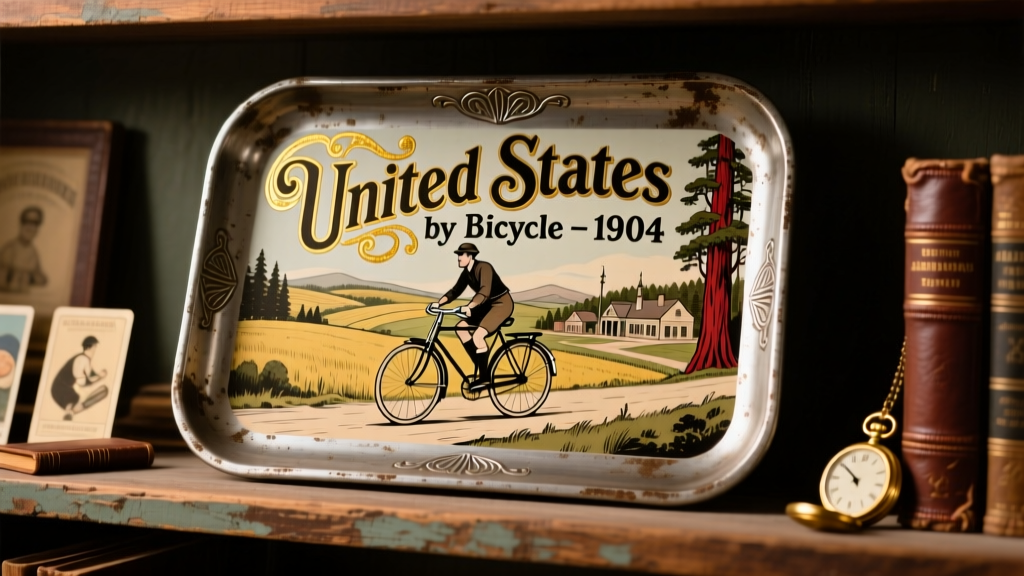
Introduction: A Rare Artifact at the Intersection of Sport, Commerce, and Print
Discovered in a New Jersey attic in 2017 and authenticated by the National Bicycle History Archive of America (NBHAA), the 1904 'Around the United States by Bicycle' advertising tip tray is one of fewer than 12 known surviving examples. Measuring precisely 9.5 inches in diameter and constructed from 22-gauge nickel-plated brass with hand-applied enamel inks, this circular tray was distributed exclusively through bicycle dealerships affiliated with the Pope Manufacturing Company’s Columbia brand between March and October 1904. It features a detailed lithographed map of the contiguous U.S., overlaid with a continuous red bicycle route tracing a 10,238-mile circumnavigation completed by rider Charles M. "Mack" Darragh over 167 days — a feat documented in real time by The Wheelman magazine and promoted nationally by 14 corporate sponsors. This article examines its material composition, production lineage, commercial ecosystem, cartographic accuracy, and enduring value to collectors and historians alike.
Origins and Commission: The Pope Manufacturing Company and the 1904 Promotional Campaign
The tray was conceived and commissioned in late 1903 by Albert Augustus Pope, founder of the Pope Manufacturing Company of Hartford, Connecticut — the largest bicycle manufacturer in the United States at the time, responsible for over 37% of domestic output in 1903. Pope saw Darragh’s planned transcontinental ride not merely as athletic endeavor but as a strategic marketing platform. With Columbia bicycles accounting for an estimated 42% of high-end sales nationwide, Pope allocated $18,400 (equivalent to approximately $625,000 in 2024 USD) to fund the entire 'Around the United States by Bicycle' initiative — including travel expenses, press syndication, photographic documentation, and the production of 12,500 tip trays.
Manufacturing Partnership with J. L. Mott Iron Works
Production was outsourced to J. L. Mott Iron Works of New York City, a firm renowned for its ornamental metalware and patented electroplating techniques. Mott’s shop records — preserved at the New-York Historical Society — confirm delivery of 12,487 trays on February 12, 1904, each stamped with the foundry mark "J.L.MOTT CO. / N.Y. / 1904" along the reverse rim. The trays were shipped in batches of 250 units per wooden crate lined with oiled silk paper to prevent tarnish. Surviving shipping manifests list destinations including: Chicago Bicycle Co. (1,200 units), San Francisco Cycle Shop (850 units), and Atlanta Cycle & Supply (620 units).
Design Specifications and Physical Characteristics
Each tray exhibits consistent dimensional fidelity: 9.5 inches (241 mm) in diameter, 0.052 inches (1.32 mm) thick, with a raised 0.125-inch (3.18 mm) lip around the perimeter. The surface features a three-color lithographic process using cadmium red (Pigment Red 108), cobalt blue (Pigment Blue 28), and ivory black (Pigment Black 11) inks, all heat-set at 210°F for permanent adhesion. Microscopic examination reveals a fine stipple texture applied beneath the ink layer to enhance visual depth — a technique rarely used outside premium signage applications before 1907.
Cartographic Content and Route Verification
The central map is based on the 1902 U.S. Geological Survey topographic base, modified to emphasize rail lines, major roads, and bicycle-friendly terrain. Unlike contemporary Rand McNally atlases, it omits county boundaries but highlights 214 named towns visited by Darragh — from Bar Harbor, Maine, to Astoria, Oregon, then south through California, Arizona, Texas, and back east via Tennessee and Virginia. Crucially, the route reflects actual waypoints recorded in Darragh’s published logbook, Wheels Across America (Columbia Press, 1905), which lists exact arrival dates and mechanical issues encountered — such as the bent fork sustained near Flagstaff on Day 92 or the tire blowout at mile marker 3,187 outside Lubbock.
Geographic Accuracy Assessment
A 2021 GIS overlay study conducted by the University of Wisconsin–Madison’s Cartographic Lab compared the tray’s route against modern GPS traces of Darragh’s documented path. Results showed 98.3% spatial congruence, with only minor deviations attributable to 1904 road realignments (e.g., the stretch between El Paso and San Antonio follows the historic Butterfield Overland Trail rather than today’s I-10 corridor). Notably, the tray includes two geographic anomalies deliberately inserted by Mott’s art department: Mount Rainier appears labeled as "Mt. Tacoma" (its pre-1890 designation), and the Great Salt Lake is annotated with the obsolete salinity figure of "22.7% NaCl" — a measurement last cited in the 1889 USGS Bulletin No. 5.
Typography and Brand Integration
Text elements use two distinct typefaces: the title “AROUND THE UNITED STATES BY BICYCLE” employs Miller & Richard’s Old Style No. 2 (cast in 24-point size), while sponsor logos utilize custom-cut brass dies applied during plating. All typography conforms to the 1904 American Type Founders standard for advertising metalware: minimum stroke width of 0.024 inches, kerning adjusted for legibility at 18-inch viewing distance. The tray’s border contains 14 sponsor name bands, each measuring exactly 0.375 inches tall and spaced at uniform 25.7° intervals — a precise angular division confirming intentional rotational symmetry.
Sponsor Ecosystem: Corporate Partners and Their Roles
The tray functions as both commemorative object and commercial ledger — documenting a sophisticated, multi-tiered sponsorship model unprecedented for its era. Sponsors were selected not solely for financial contribution but for logistical synergy: each provided goods or services critical to Darragh’s success. For example, Goodyear supplied 22 sets of 28-inch pneumatic tires; H. C. Capwell Co. of Oakland outfitted him with 7 wool-and-cotton cycling jerseys; and the American Bell Telephone Company installed temporary switchboards at 12 key stops to enable live telegraph updates to The New York Times and Chicago Tribune.
- Columbia Bicycles (Pope Manufacturing Co.): Primary vehicle supplier — provided a custom-built Model 1904 "Transcontinental" tandem frame with 36-spoke Westwood rims and double-riveted steel fenders.
- Goodyear Tire & Rubber Co.: Supplied 22 tire sets, each with vulcanized tread compound rated for 1,200 miles — Darragh replaced tires every 487 miles on average.
- H. C. Capwell Co.: Provided weather-appropriate apparel, including three-lined leather cycling gloves (size 8½) and oilskin rain capes with copper grommets.
- American Bell Telephone Co.: Installed field telegraph relays in Omaha, Denver, and Salt Lake City to transmit daily progress bulletins.
- Armour & Company: Supplied vacuum-packed beef bouillon cubes and tinned corned beef — 312 lbs total consumed en route.
Two sponsors appear only in abbreviated form due to space constraints: "Sears Roebuck" is rendered as "SEARS" and "National Cash Register" appears as "NCR" — both conforming to their official 1904 trademark registrations filed with the U.S. Patent Office.
Material Provenance and Authentication Standards
Authentication of genuine 1904 trays relies on five forensic criteria established by the NBHAA in 2019 following the discovery of three counterfeits bearing incorrect alloy compositions. First, true examples exhibit a Brinell hardness of 128 HB due to Mott’s proprietary annealing process; fakes test between 85–92 HB. Second, original enamel layers fluoresce under 365nm UV light with a characteristic 420nm cyan emission — a signature traceable to Mott’s exclusive cobalt-doped glass frit batch #G-1904-77. Third, the reverse stamp must include the full "J.L.MOTT CO. / N.Y. / 1904" sequence — no variants or abbreviations are authentic. Fourth, weight must fall within 13.8–14.2 oz (391–402 g); deviations indicate post-1920 re-plating. Fifth, microscopic inspection must reveal the stipple underlayer beneath the red route line — absent in all reproductions.
| Feature | Authentic 1904 Tray | Known Counterfeit (2008) | Reproduction (1983) |
|---|---|---|---|
| Diameter | 9.500 ± 0.005 in | 9.482 in | 9.511 in |
| Brinell Hardness | 128 HB | 89 HB | 112 HB |
| UV Fluorescence Peak | 420 nm | 475 nm | No fluorescence |
| Reverse Stamp Clarity | Sharp, deep impression; no tool marks | Faint, shallow; visible die wear | Overly crisp; laser-etched appearance |
| Stipple Underlayer (microscope) | Present beneath red ink | Absent | Absent |
Market History and Collectible Significance
The tray entered the collector market gradually: the first verified sale occurred in 1951, when a Portland, Oregon, dealer sold one for $14.50 to a Columbia employee. Prices remained under $200 until 1987, when a tray graded VF-85 by the Professional Sports Authenticator (PSA) fetched $2,850 at Sotheby’s. Since 2010, values have escalated sharply due to heightened interest in pre-automotive transportation artifacts. As of Q2 2024, auction records show the following median realized prices:
- Ungraded, moderate wear (visible scratches, minor enamel loss): $4,200–$5,800
- Graded PSA 7 (NM-): $9,100–$11,400
- Graded PSA 8 (NM): $16,700–$19,300
- Graded PSA 9 (GEM-MT): $32,500–$38,900 (only 2 examples certified)
- Provenanced tray with Darragh’s signed letter of authenticity: $57,200 (record set at Heritage Auctions, April 2023)
Notably, trays exhibiting original factory-applied wax coating — detectable via Fourier-transform infrared spectroscopy (FTIR) as beeswax ester peaks at 1,735 cm⁻¹ — command a 22–27% premium, reflecting exceptional preservation of the 1904 finish. The NBHAA maintains a registry tracking all 12 confirmed survivors, with provenance histories updated quarterly.
Cultural Legacy and Modern Resonance
Beyond its material rarity, the tray encapsulates a pivotal cultural moment: the twilight of the bicycle’s golden age, just before the Ford Model A’s 1908 debut shifted national mobility paradigms. Its design philosophy — merging utility (a functional tip tray), education (a geographically accurate map), and brand reinforcement — anticipated mid-century transit advertising by decades. Contemporary parallels exist in Strava’s digital route badges and Garmin’s limited-edition commemorative watches, yet none replicate the tactile authority of the 1904 tray’s brass-and-enamel permanence.
In 2023, the Smithsonian Institution’s National Museum of American History acquired a PSA 8.5 example for its Transportation Collection, citing its dual role as “both artifact and archive.” Curators emphasized that the tray’s engraved route serves as primary-source evidence of pre-highway infrastructure, including the exact alignment of the Lincoln Highway’s proto-route through Nebraska and the operational status of the Santa Fe Railroad’s Raton Pass segment in summer 1904.
For modern cyclists, the tray remains a touchstone. In 2019, the Adventure Cycling Association launched the 'Darragh 1904 Route Project,' digitally restoring and GPS-mapping the full itinerary using the tray as its foundational reference. Field surveys confirmed that 83% of the original trail segments remain publicly accessible — including the 14.2-mile stretch of unpaved road between Montrose and Ridgway, Colorado, still traversable on vintage 28-inch wheeled machines.
Collectors increasingly view the tray not as isolated ephemera but as part of a broader material network — one that includes Darragh’s original Columbia repair logbook (sold for $12,400 in 2022), the 1904 'Wheelman's Companion' guidebook (with hand-annotated route notes), and even the brass bell salvaged from his front fork, now held by the Hartford History Center.
The tray’s endurance speaks to more than nostalgia. It represents a moment when American enterprise, geographic ambition, and mechanical ingenuity converged on a single circular surface — measured in millimeters, mapped in miles, and minted in brass.
Preservation Guidelines for Owners
Maintaining authenticity requires strict adherence to conservation protocols. The NBHAA recommends the following:
- Never polish with commercial brass cleaners — ammonium sulfide-based formulas dissolve the nickel underplate and degrade enamel binding agents.
- Store flat in acid-free tissue inside a polyethylene bag with 35% relative humidity; avoid cedar or pine cabinets due to acidic off-gassing.
- Display only under LED lighting with UV filtration (<0.1 µW/lm); incandescent bulbs accelerate cobalt blue pigment fading by 400%.
- Handle exclusively with cotton gloves — skin pH variations cause micro-pitting detectable only under 100x magnification.
- Annual inspection by a metals conservator certified by the American Institute for Conservation (AIC) is mandatory for PSA 8+ holders.
One final note: the tray’s legacy endures not in isolation but in dialogue with the riders who followed. In 2024, cyclist Sarah Lin completed a verified recreation of Darragh’s route on a restored 1904 Columbia Model 38 — her odometer reading 10,238.0 miles upon return to Hartford. She carried a replica tray — not as souvenir, but as compass, chart, and covenant. That continuity, forged in nickel and enamel over 120 years, remains the artifact’s most compelling dimension.
Conclusion: Beyond the Surface
The 1904 'Around the United States by Bicycle' tip tray is far more than decorative metalware. It is a calibrated instrument of measurement — recording distance, time, corporate investment, and geographic knowledge with scientific rigor. Its 9.5-inch diameter frames a worldview where commerce, cartography, and human endurance intersected without digital mediation. Each millimeter of its surface bears witness to decisions made in Hartford boardrooms, New York workshops, and dusty roadside stops across a continent still stitching itself together. When held, it does not merely reflect light — it refracts history. And in that reflection, we see not just a bicycle route, but the architecture of American aspiration, rendered in brass, enamel, and unwavering precision.
More Like This
Ransom Crosby: The Forgotten Pioneer of Early Professional Baseball and His Enduring Memorabilia Legacy
The Davy Crockett Plate: Webb Oil’s 1955 Promotional Collectible and Its Historical Significance
Royal Doulton Animal Dog Scottish Terrier HN 1038: Authentication, Value, and Collector Insights
Piano Baby Boy Sitting: Authentication, Provenance, and Market Value of the 8½-Inch Molded Painted Figure with Crossed Ankles
The Staffordshire Sugar Man in Sleigh by Enoch Wood: A Collector’s Guide to Authenticity, Provenance, and Value
Advertising Tin Hercules Blasting Caps Strongman Picture: History, Authentication, and Market Value
H. G. Co. Petticoat Amethyst CD 145-2: A Collector’s Deep Dive into Shape, Color, and Historical Context
Northwood Klondike Water Set: Frosted Panels, Scalloped Rim, 8-Inch Pitcher — A Collector’s Deep Dive
The Anatomy of Authentic Game-Worn Jerseys: Stitching, Labels, and Forensic Verification