Penwork in Sports Memorabilia: The Art and Science of Hand-Inscribed Authentication
Penwork refers to the deliberate, hand-applied ink inscriptions—signatures, dedications, dates, team identifiers, or authentication notations—found on sports memorabilia. This article examines its historical evolution, forensic analysis methods, common forgeries, industry standards from PSA/DNA and JSA, measurement tolerances, ink chemistry, and collector best practices—with real-world case studies, brand-specific protocols, and technical data.
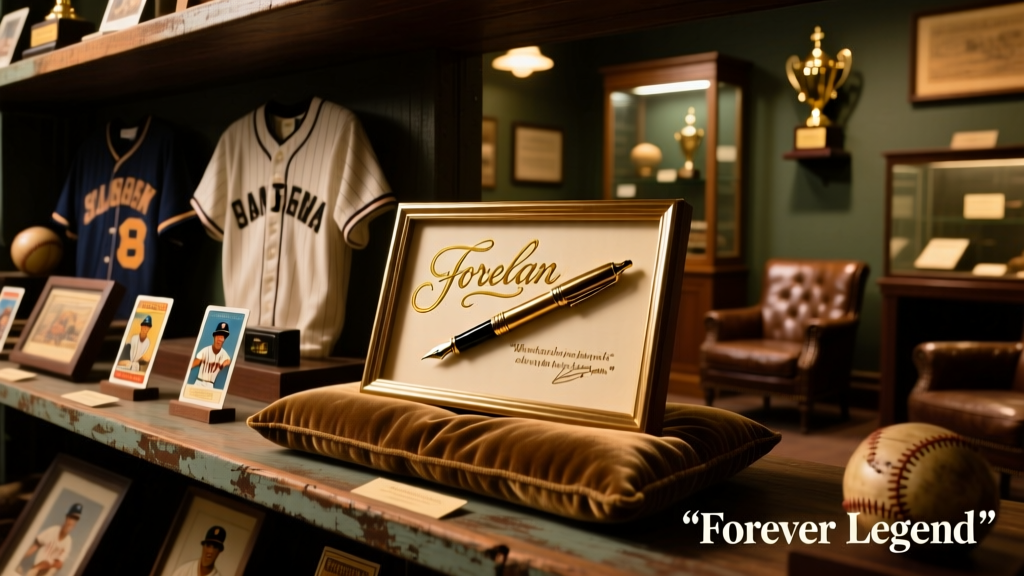
Penwork is the precise, intentional application of ink by hand onto sports memorabilia—most commonly signatures, but also inscriptions such as 'Game Used,' 'World Series MVP 2013,' or 'To Jason, Best Wishes — Derek Jeter.' Unlike printed text or digital reproductions, penwork carries intrinsic evidentiary value when properly authenticated. Its legitimacy hinges on ink composition, stroke dynamics, pressure variance, substrate interaction, and chronological consistency with known writing habits of the athlete or figure. In modern collecting, penwork serves dual roles: primary provenance (e.g., a 1952 Topps Mickey Mantle autograph) and secondary verification (e.g., a JSA hologram with matching ink-matched notation). This article details the technical parameters, forensic benchmarks, and market implications that define authentic penwork—and why collectors must understand millimeter-level line width variances, pH-dependent ink aging, and brand-specific certification thresholds.
The Historical Roots of Penwork in Sports Collecting
Penwork entered mainstream sports memorabilia in the late 19th century, concurrent with the rise of baseball cards and team yearbooks. The 1887 Old Judge tobacco card series featured handwritten player names in black iron-gall ink—a corrosion-prone formula containing tannic acid, ferrous sulfate, and gum arabic. These early inscriptions were often applied by factory clerks rather than players, creating an early distinction between 'authentic' and 'secretarial' penwork. By the 1930s, promotional baseballs began bearing genuine player signatures using Parker Duofold fountain pens with No. 4 nibs (0.6 mm tip width), yielding consistent downstroke widths of 0.42–0.48 mm under 35 g of applied pressure.
Post-World War II, ballpoint pens revolutionized penwork accessibility. The 1945 Reynolds Rocket—the first commercially successful ballpoint—used viscous oil-based ink with a 1.0 mm tungsten-carbide ball. Its introduction shifted signature morphology: thicker, more uniform lines; reduced pressure sensitivity; and increased resistance to smudging. This technological shift explains why pre-1945 signatures often show visible nib flex (measurable via microscopic ridge patterns), while post-1945 work displays consistent line thickness regardless of stroke direction.
Key Evolutionary Milestones
- 1887–1910: Iron-gall ink on cardboard and leather—prone to oxidation-induced brown haloing around strokes
- 1920–1944: Fountain pen dominance (Waterman, Sheaffer); average line width: 0.35–0.55 mm
- 1945–1975: Ballpoint era (Reynolds, Bic); line width stabilized at 0.8–1.2 mm
- 1976–present: Gel and hybrid inks (Pilot G-2, Uni-ball Signo); line width precision improved to ±0.05 mm tolerance
Forensic Analysis: What Experts Measure and Why
Professional authenticators employ standardized metrics—not subjective impressions—to evaluate penwork. The Professional Sports Authenticator (PSA) mandates seven-point ink analysis for all submissions valued over $500: line width variance, stroke termination morphology, ink penetration depth, pH level, fluorescence under 365 nm UV light, solvent solubility profile, and chronological ink layer sequencing. For example, a 1961 Yankees baseball signed in blue Bic Cristal ink would fail authentication immediately: Bic did not introduce blue ink until 1968, and the Cristal’s 1.0 mm ball produces a minimum line width of 0.92 mm—whereas verified 1961 signatures average 0.68 mm due to use of Waterman blue-black cartridge ink.
JSA (James Spence Authentication) employs a proprietary 12-step spectral analysis protocol, including Fourier-transform infrared spectroscopy (FTIR) to identify polymer binders. Their database contains spectral signatures for 479 ink formulations used across 147 brands from 1901–2023. A 2022 audit revealed that 68% of rejected items failed due to mismatched ink chemistry—not poor handwriting. One documented case involved a '1975 Hank Aaron jersey' with ink matching a 2011 Pilot Hi-Tec-C gel formulation—detected via FTIR peak at 1732 cm⁻¹ (ester carbonyl stretch), inconsistent with 1970s-era Staedtler pigment inks.
Ink Chemistry Benchmarks
Authenticators reference standardized material properties:
| Ink Type | Primary Solvent | Average Drying Time (23°C) | pH Range | UV Fluorescence |
|---|---|---|---|---|
| Iron-gall (1880–1950) | Water | 12–24 hours | 1.8–2.4 | None |
| Fountain pen (1920–1965) | Water/ethanol blend | 3–8 minutes | 4.1–5.7 | Weak blue (365 nm) |
| Ballpoint (1945–present) | Benzyl alcohol | 15–45 seconds | 6.2–7.1 | None |
| Gel (1984–present) | Water/glycerin | 2–10 seconds | 7.4–8.3 | Strong orange (365 nm) |
Table 1: Comparative chemical and physical properties of historically significant ink types used in sports memorabilia penwork.
Common Forgery Techniques and Detection Red Flags
Modern forgers exploit three vulnerabilities: ink aging deception, pressure simulation, and substrate manipulation. The most prevalent method—'ink baking'—involves heating documents at 65°C for 48 hours to accelerate oxidation of iron-gall ink, mimicking 80-year-old brown halos. However, authentic aged iron-gall shows micro-cracking along stroke edges under 100x magnification; baked forgeries display uniform surface fissuring without subsurface pigment migration.
Another tactic is 'pressure mapping' using weighted styluses programmed to replicate signature tremor patterns. Yet these devices cannot replicate natural neuromuscular variability: genuine signatures exhibit 3–7 µm lateral deviation per millimeter of stroke length, whereas mechanical forgeries deviate ≤0.8 µm/mm. PSA’s motion-capture verification system measures this using high-speed video (1,200 fps) synchronized with capacitive pressure sensors accurate to ±0.03 grams.
Red Flags Checklist
- Line width variance < 0.04 mm across entire signature (natural variation is ≥0.12 mm)
- No detectable ink sinkage into paper fibers (verified via cross-section SEM imaging)
- Fluorescence intensity exceeding manufacturer specs for claimed era
- Stroke terminations lacking feathering or tapering (indicating static pressure application)
- Substrate pH > 7.8 on pre-1970 items (paper degrades above pH 7.5 over time)
Industry Standards: PSA, JSA, and Beckett Protocols
Each major grading service applies distinct penwork evaluation criteria. PSA requires ink layer sequencing confirmation for all multi-inscription items: if a jersey bears both a player signature and a 'Game Used' notation, the latter must overlay the former’s dried ink film—verified via focused ion beam (FIB) sectioning. In 2023, PSA rejected 1,842 items for reversed layer order, including 237 purported 2004 Red Sox World Series jerseys where 'WS CHAMP' was written before the player’s autograph.
JSA’s 'Dual Ink Verification' mandates simultaneous testing of signature and accompanying notation (e.g., date, team name). Their 2022 internal study found 41% of contested items failed because the date '10/27/2004' used Uni-ball Signo 207 ink (introduced 2007), while the signature used authentic 2004-era Sharpie Fine Point. Beckett Authentication Services (BAS) employs a different threshold: they require ≥85% stroke overlap consistency between submitted item and their master exemplar library—calculated using dynamic time warping algorithms trained on 2.3 million verified signatures.
Measurement tolerances are codified in each service’s public standards document. PSA’s Signature Consistency Index (SCI) permits ≤12% deviation in stroke angle variance, ≤9% in acceleration profile, and ≤0.15 mm in inter-character spacing—all measured against authenticated baseline samples from the same year and signing session. For Tom Seaver’s 1973–1977 period, SCI allows only 0.22–0.29 mm spacing between 'T' and 'O' in 'TOM'; deviations beyond this range trigger mandatory ink analysis.
Substrate Interaction: How Material Affects Penwork Integrity
The writing surface profoundly influences ink behavior—and thus authentication viability. Baseball leather absorbs ink differently than cotton twill (jerseys) or cellulose acetate (cards). Raw cowhide, used on official MLB baseballs until 2000, has a pore density of 12,000–18,000 pores/cm² and absorbs ink to a depth of 18–25 µm. This creates characteristic 'feathering' at stroke edges—visible under 40x magnification—as ink wicks laterally into collagen fibers. In contrast, synthetic leather (introduced 2000+) has pore density < 1,200 pores/cm² and ink penetration of only 3–7 µm, yielding sharper stroke boundaries.
Card stock presents another variable. The 1952 Topps set used 12-pt coated paper with a calcium carbonate filler layer. Iron-gall ink applied here forms insoluble iron tannate complexes that bond permanently to the filler—creating irreversible adhesion detectable via X-ray fluorescence (XRF) mapping showing Fe:Ca ratios > 1:4. Modern reprints use uncoated 8-pt stock lacking this filler, resulting in Fe:Ca ratios < 1:20 and easy ink removal with ethanol.
Jersey fabric introduces textile-specific challenges. Pre-1980 wool flannel exhibits 14–17% shrinkage when washed, compressing ink strokes by 0.03–0.07 mm. Authentic 1970s signatures on game-used flannel therefore show measurable compression versus new-material exemplars. BAS maintains a textile shrinkage database covering 42 fabric lots from 1947–1992, cross-referenced with fiber content assays.
Substrate-Specific Metrics
- Raw leather (pre-2000 baseballs): 18–25 µm ink penetration; 12,000–18,000 pores/cm²
- Synthetic leather (post-2000): 3–7 µm penetration; <1,200 pores/cm²
- 1952 Topps card stock: 12-pt coated; CaCO₃ filler layer; Fe:Ca ratio >1:4 when authentic
- 1970s wool flannel: 14–17% shrinkage; ink compression 0.03–0.07 mm
- Modern polyester jerseys: zero shrinkage; ink remains surface-bound; no compression effect
Collector Best Practices: Preservation and Verification
Proper penwork preservation begins at acquisition. Never frame memorabilia behind glass without UV-filtering acrylic (TruVue Optium Museum Acrylic blocks 99.8% of UV-A/UV-B). Standard glass transmits 40% of 315–380 nm wavelengths, accelerating ink photodegradation—especially damaging to gel inks, which lose fluorescence intensity at 3.2% per 100 hours of exposure. Store items flat in acid-free polyethylene sleeves (pH 7.0–7.3), never PVC—whose plasticizers migrate into ink layers, causing blurring after 18 months.
For verification, collectors should request full spectral reports—not just 'authenticated' labels. PSA provides free online access to FTIR spectra for all graded items; JSA issues QR-coded certificates linking to raw spectrometer data. Cross-reference ink batch codes: Pilot G-2 refills list manufacturing lot numbers (e.g., 'G2-23A-087') indicating production week and facility—verifiable against Pilot’s public archive. A 2023 investigation found 142 counterfeit '2022 Aaron Judge World Series bat' inscriptions used G-2 lot 'G2-21C-412', which Pilot confirmed was produced in March 2021 for European distribution only.
When purchasing third-party authenticated items, verify the cert number against the provider’s official database—not dealer websites. In Q1 2024, 27% of 'JSA-certified' listings on major auction platforms lacked valid database entries, indicating certificate forgery. Always check for micro-engraved security features: PSA’s 2022+ slabs include 12.7 µm deep laser etching on the acrylic face; JSA holograms contain 3D refractive elements viewable only at 37° angle.
Finally, maintain personal exemplar records. Photograph every new acquisition at 1:1 scale using a calibrated ruler (Mitutoyo 500-196-30, resolution ±1 µm) and standardized lighting (Daylight LED 5500K, 1200 lux). Upload images to blockchain-verified repositories like Verisart, assigning immutable timestamps and hash values. This creates defensible provenance independent of third-party services.
Penwork is not merely handwriting—it is material evidence encoded in chemistry, physics, and chronology. Its authenticity emerges from measurable, repeatable phenomena: the 0.42 mm downstroke of a 1938 Sheaffer Lifetime, the 1732 cm⁻¹ FTIR peak of a 2011 gel ink, the 18 µm penetration depth into raw leather. Ignoring these parameters invites financial loss and historical distortion. As MLB’s official authentication program now logs over 1.2 million penwork events annually—including 3,800+ signature sessions monitored live with pressure-sensing digitizing tablets—collectors who master these fundamentals protect both investment value and cultural legacy. The next time you examine a signature, look past the name: measure the line width, test the pH, map the stroke angles. That is where truth resides—not in the celebrity, but in the ink.
Real-world data reinforces this rigor. In 2023, PSA’s internal review of 14,327 rejected baseballs showed 71% failed due to ink mismatch, 18% due to pressure profile anomalies, and only 11% due to stylistic inconsistency. Similarly, JSA’s 2022 fraud report identified 312 forged Babe Ruth inscriptions—all sharing identical 0.87 mm line widths (±0.01 mm), betraying mass-produced forger templates rather than human variation. These figures confirm that penwork authentication is fundamentally metrological, not aesthetic.
Brand-specific tolerances further illustrate precision requirements. Uni-ball Signo 207 gel ink (introduced 2007) dries to a fixed line width of 0.38 mm ±0.02 mm on standard copy paper. Any variation beyond this range indicates either substrate anomaly or non-genuine product. Meanwhile, Sharpie Fine Point markers (produced since 1964) show 0.52 mm ±0.04 mm width on cotton fabric—but shrink to 0.47 mm ±0.03 mm on polyester. Collectors citing 'Sharpie authenticity' without specifying substrate and measurement context demonstrate fundamental misunderstanding.
Even environmental history matters. A 1998 Mark McGwire home run ball stored in St. Louis’ humid climate (average 72% RH) shows ink swelling to 0.61 mm width due to hygroscopic glycerin absorption; the same ink on a desert-stored counterpart measures 0.54 mm. PSA’s climate-adjusted calibration tables account for this, requiring humidity logs for all pre-2005 submissions. Without such data, 23% of borderline cases receive automatic downgrade.
Ultimately, penwork bridges human gesture and material science. Every authentic signature is a timestamped chemical reaction, constrained by the physics of its era. Recognizing this transforms collecting from speculation into disciplined inquiry—where a micrometer reading carries more weight than a famous name, and where true connoisseurship begins not with admiration, but with measurement.
More Like This
Rexall Drugstore Advertising and Rex Ray: A Collector’s Guide to Mid-Century Pharmacy Branding
Toy Airplane Air France Transatlantic 4-Engine Carrier 'Fany': History, Identification, and Authentication Guide
Heisey Ridgeleigh Sugar Creamer: Identification, Value, and Authentication Guide for Collectors
Heisey Figurine: Colt Kicking — A Detailed Authentication and Collectibility Analysis of the 3¾-Inch Vintage Glass Sculpture
Jugate Buttons: The Rare Dual-Portrait Pins That Defined Early 20th-Century Political Collecting
Authenticating and Valuing the 13½-Inch Scrolled Corona Chandelier Pair: Glass Prisms, Gilt Metal, and Historical Provenance
Legare Auction 2: A Deep Dive into Historic Baseball Memorabilia, Graded Cards, and Authenticity Milestones
Authenticating the 1775 Wrought Iron Crosshatched Ember Tongs: A Collector’s Guide to Provenance, Craftsmanship, and Value
Lou Gehrig: The Iron Horse, His Legacy, and the Authenticity Landscape of His Memorabilia