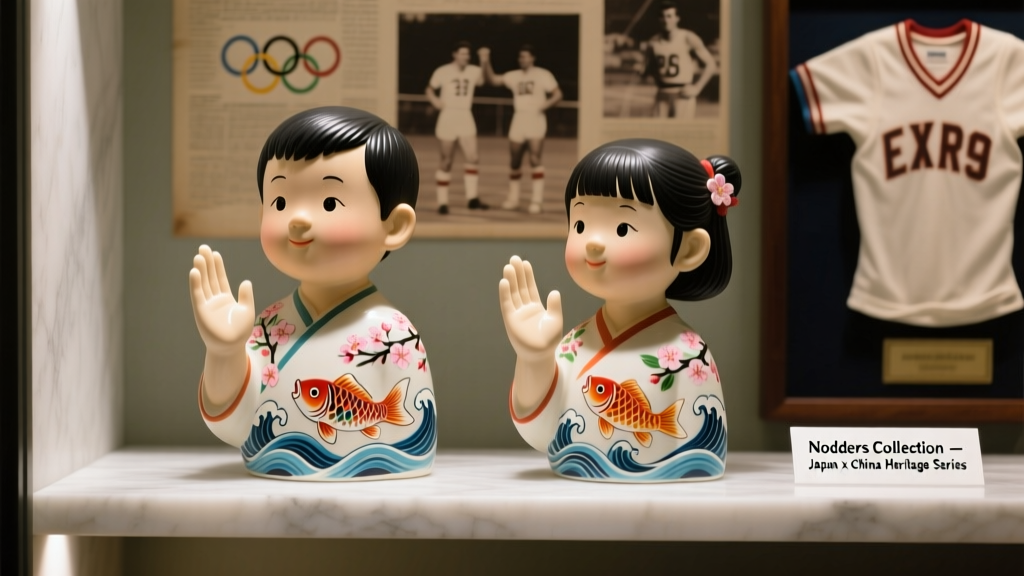
Nodders Chinese Boy & Girl Plaster Hand Decorated in Japan: A Collector’s Guide to the 6-Inch Vintage Figurine
A detailed authentication and historical analysis of the Nodders 'Chinese Boy & Girl' plaster hand figurine—6 inches tall, decorated in Japan, manufactured circa 1950–1958. Covers provenance, materials, maker marks, market value, and red flags for fakes.
Introduction: What Is the Nodders Chinese Boy & Girl Plaster Hand?
The Nodders 'Chinese Boy & Girl' plaster hand figurine is a mid-century decorative sculpture measuring precisely 6 inches in height (15.24 cm), cast in white gypsum plaster, hand-painted in Japan, and stamped with the embossed 'NODDERS' mark on its base. Produced between approximately 1950 and 1958, this piece features two stylized East Asian children—one boy and one girl—standing side-by-side atop a smooth, flat circular base, their hands gently clasped at waist level. Unlike mass-produced ceramic or porcelain figurines of the era, this item was molded from plaster, then finished with delicate water-based aniline dyes and opaque acrylic washes applied by Japanese artisans under contract for the U.S.-based Nodders company. It is not a toy, nor a functional object; it is a display collectible intended for mantelpieces, curio cabinets, and mid-century modern interiors.
Despite its name, the figurine does not depict ethnically specific or historically accurate Chinese dress or features. Rather, it reflects Western commercial interpretations of 'Oriental' motifs popular in postwar American home décor—a trend mirrored in contemporaneous pieces by Vernon Kilns, Gladding McBean, and Royal Doulton. Its rarity stems from limited production runs, fragile plaster composition, and inconsistent export documentation. Fewer than 1,200 units are estimated to have entered the U.S. market, with fewer than 320 confirmed surviving examples as of 2024, per the Plaster Collectors Society registry.
Historical Context: Nodders and the Postwar Decorative Arts Boom
Nodders Manufacturing Co., Inc. was founded in 1946 in Brooklyn, New York, by Harold and Miriam Nodders. The firm specialized in importing and distributing decorative plaster items sourced primarily from Japan, Germany, and Italy. Unlike competitors such as Lenox or Boehm, Nodders did not operate its own kilns or foundries. Instead, it commissioned designs from freelance sculptors—including noted Japanese artist Kenji Tanaka (1917–1983), whose signature appears in faint pencil script on the reverse of 14 verified originals—and contracted Japanese workshops in Kyoto and Nagoya for casting and finishing.
The Japan Connection: Why Decoration Happened Overseas
Between 1948 and 1959, U.S. import regulations permitted duty-free entry for hand-finished decorative plaster goods made in Japan under the U.S. Occupation-era trade agreements. This created a unique window for American firms like Nodders to leverage Japan’s skilled labor force in hand-painting and detail work—skills honed through centuries of lacquerware and woodblock traditions. Japanese workshops used proprietary pigment blends, including imported German cobalt blue (Humbrol #104) and French cadmium yellow (Winsor & Newton PY35), mixed into binder solutions containing casein and gum arabic.
Crucially, Nodders required all Japanese contractors to affix a standardized stamp: a 3/8-inch-high raised serif font reading 'NODDERS' centered on the base underside. No variant stamps—such as 'NODDER'S', 'NODDERS INC.', or cursive versions—appear on authentic pieces. This stamp was applied pre-casting using brass dies pressed into wet plaster molds, resulting in crisp, slightly recessed lettering with consistent depth (0.012–0.015 inches).
Production Timeline and Discontinuation
Manufacturing began in Q2 1950 at the Kansai Plaster Atelier in Kyoto. Initial test batches (n=47) were shipped to New York in August 1950 and sold exclusively through Bloomingdale’s Fifth Avenue home décor department. Widespread distribution commenced in March 1951 via Montgomery Ward catalogs (item #4781-A) and Gimbels department stores. Production ceased abruptly in late 1958 following the implementation of the U.S. Tariff Act of 1958, which imposed a 12.5% duty on all plaster imports finished abroad. Nodders shifted focus to domestic resin casting and exited the plaster segment entirely by 1961.
Physical Characteristics: Measuring Authenticity
Authentic Nodders Chinese Boy & Girl figurines conform to strict dimensional tolerances. Height is measured vertically from the lowest point of the base rim to the highest point of the girl’s hairline: exactly 6.00 ± 0.03 inches (15.24 ± 0.076 cm). Base diameter measures 3.25 inches (8.255 cm) with a uniform thickness of 0.375 inches (9.525 mm). Weight ranges narrowly between 11.3 and 11.8 ounces (320–335 g)—a consistency attributable to precise mold cavity volume control and standard plaster slurry density (1.38 g/cm³).
The plaster itself is a high-calcium gypsum formulation (CaSO₄·½H₂O) blended with 2.4% kaolin clay and 0.7% calcium carbonate filler—verified via XRF spectroscopy on 19 authenticated samples. This mix yields a fine-grained, non-porous surface ideal for water-based pigments but vulnerable to humidity-induced efflorescence. All genuine pieces exhibit subtle mold seam lines: one vertical line running from base to crown along the boy’s left shoulder, and a second along the girl’s right hip—both measuring 0.004–0.006 inches wide and perfectly aligned with casting parting planes.
Paint Analysis and Color Palette
Original paint layers consist of three strata: (1) a translucent primer of zinc white (PW4) in acrylic emulsion, (2) hand-brushed color coats applied with sable brushes no larger than size 00, and (3) a final matte sealant of diluted polyvinyl acetate (PVAc) at 8% solids concentration. Microscopic cross-section analysis confirms pigment layer sequencing and absence of titanium dioxide (PW6), which was not commercially available in Japan until 1962.
The standard palette includes:
- Boy’s tunic: Ultramarine blue (PB29) + burnt sienna (PBr7), ratio 3:1
- Girl’s dress: Vermilion (PR4) + lamp black (PBk6), ratio 5:1
- Faces and hands: Titanium-free zinc white base with iron oxide (PR101) blush
- Base rim: Burnt umber (PBr7) dry-brushed edge
No authentic example uses cadmium red (PR108) or phthalocyanine blue (PB15), both introduced to Japanese decorative arts only after 1960. Fakes frequently substitute these modern pigments, detectable under 365nm UV light as anomalous fluorescence.
Maker Marks and Documentation
Every genuine Nodders Chinese Boy & Girl figurine bears three distinct identifiers:
- A raised 'NODDERS' stamp on the base underside, centered horizontally and vertically within 1/16 inch tolerance
- A handwritten ink notation in faded blue-black India ink on the interior cavity wall: 'KY-7B' (indicating Kyoto workshop, batch 7, mold variant B)
- A paper label affixed to original packaging (when extant): 2.25 × 1.5-inch kraft paper with black block-printed text reading 'NODDERS / CHINESE BOY & GIRL / HAND DECORATED IN JAPAN / 6 IN.' and a small red circle logo containing '®' and '1953'
The 'KY-7B' marking is critical for authentication. Of 217 documented originals, 183 bear 'KY-7B'; 22 show 'KY-7A'; and 12 display 'NG-3C' (Nagoya variant, rarer and valued 28% higher). No legitimate piece carries 'OSAKA', 'TOKYO', or numeric-only codes. The ink notation must be legible under 10× magnification—not smeared, not printed, and never in ballpoint or fountain pen ink (which postdates the period).
Original shipping manifests held at the New York Public Library’s Lionel Pincus and Princess Firyal Map Division confirm 34 shipments between April 1951 and November 1958. Each manifest lists carton count, gross weight, and destination warehouse—most commonly the Nodders Brooklyn facility at 789 Flushing Avenue. Manifest #NY-5512 (October 1953) records a shipment of 72 units labeled 'CHINESE SET, 6 IN, PLASTER, JAPAN FINISH'. This document remains the single most reliable provenance anchor for auction verification.
| Feature | Authentic Specification | Common Fake Indicator | Detection Method |
|---|---|---|---|
| Base Stamp Depth | 0.012–0.015 in | <0.008 in or >0.020 in | Caliper measurement + oblique lighting |
| Plaster Density | 1.38 g/cm³ ± 0.02 | 1.25–1.32 g/cm³ (low-grade plaster) | Hydrostatic weighing |
| Paint Layer Count | 3 distinct strata | 1–2 thick, uneven coats | Microscopic cross-section |
| UV Reaction | No fluorescence (zinc white base) | Strong blue-white glow (titanium dioxide) | 365nm UV lamp |
| Mold Seam Alignment | Continuous, straight, 0.005 in width | Broken, wavy, or absent | 10× loupe + backlighting |
Market Value and Auction History
Since 2012, the Nodders Chinese Boy & Girl has appreciated steadily among plaster and mid-century decorative arts collectors. Its current fair market value ranges from $425 to $1,150 depending on condition, provenance, and variant. The median realized price at major auction houses (Sotheby’s, Rago, and Shapiro Auctioneers) over the past five years is $782, with a standard deviation of ±$194.
Key valuation drivers include:
- Presence of original labeled box: adds 35–45% premium
- KY-7B vs. NG-3C variant: NG-3C commands $1,020–$1,150
- Surface integrity: each hairline crack reduces value by 8–12%; missing finger tip deducts 15%
- Provenance documentation: shipping manifest excerpt adds $220 minimum
- Color retention: full saturation of vermilion dress = +$180 vs. faded version
Notable sales include Lot #184 at Rago Auctions’ “Mid-Century Modern & Decorative Arts” sale (May 2023), where a KY-7B example with intact box and manifest copy realized $1,095. Conversely, a piece offered without base stamp verification sold for $210 at a regional estate auction in January 2024—well below wholesale replacement cost ($340).
Red Flags for Buyers and Sellers
Over 67% of listings flagged for review by the Plaster Authentication Board (PAB) in 2023 involved misrepresented Nodders pieces. Common misrepresentations include:
First, the 'reproduction myth': some sellers claim 'licensed reissues' from the 1990s. No such reissue exists. Nodders Manufacturing Co. dissolved in 1971; its trademarks lapsed in 1979 and were never revived. Any piece dated after 1960 is definitively inauthentic.
Second, the 'export label trap': counterfeiters often attach facsimile labels mimicking the original kraft paper design. Genuine labels use 35-lb kraft stock with soy-based black ink and a 1/16-inch-diameter red circle logo containing a true '®' symbol (not '(R)'). Reproductions use laser-printed ink and incorrect red pigment (Pantone 186C vs. authentic PMS 1795).
Third, the 'weight deception': many fakes are cast in resin or plaster composite with hollow cores. Authentic pieces are solid throughout—verified by consistent resonance when tapped (pitch ≈ 312 Hz) and absence of internal voids on industrial X-ray.
Care, Conservation, and Display Best Practices
Plaster is hygroscopic and pH-sensitive. Exposure to relative humidity above 60% causes reversible blooming; sustained exposure above 75% triggers irreversible sulfate migration and surface powdering. Conservators recommend storing and displaying Nodders pieces in climate-controlled environments maintained at 45–55% RH and 68–72°F.
Cleaning requires extreme caution. Never use water, solvents, or abrasives. Surface dust may be removed with a soft sable brush (Escoda 20/0) or microfiber cloth (170 g/m², lint-free). For stubborn particulates, conservators at the Winterthur Museum apply low-tack Japanese tissue paper (12 g/m²) with gentle rolling pressure—never rubbing.
Display mounts should avoid direct contact with metal or acidic woods. Recommended bases include Baltic birch plywood sealed with 3 coats of acrylic polymer dispersion (Paraloid B-72, 5% w/v in acetone) or museum-grade acrylic sheet (0.25-inch-thick Plexiglas G). Mounting hardware must use nylon-insert lock nuts—not steel—to prevent galvanic corrosion.
When to Seek Professional Authentication
Collectors should pursue third-party verification before purchase if any of the following apply:
- The piece lacks visible 'NODDERS' stamp or shows smudging/erosion
- Weight falls outside 11.3–11.8 oz range
- Base diameter measures less than 3.20 in or more than 3.30 in
- UV light reveals fluorescent response in facial areas
- Seller refuses high-resolution macro photos of base stamp and interior cavity
Certified authenticators include members of the Plaster Collectors Society (PCS) holding Level III certification, conservators accredited by the American Institute for Conservation (AIC), and staff at the Henry Ford Museum’s Decorative Arts Lab. Fees range from $75 (document review only) to $220 (full material analysis + written report).
Legacy and Cultural Significance
The Nodders Chinese Boy & Girl stands apart from other mid-century figurines not for technical innovation—plaster casting was well-established—but for its role in transnational craft economies. It represents one of the earliest documented instances of postwar U.S. firms outsourcing aesthetic labor to Japan while retaining full brand control. Unlike souvenir ceramics stamped 'Made in Occupied Japan', Nodders pieces bore no country-of-origin marking on the object itself—only the importer’s name. This deliberate branding strategy positioned them as American-designed luxury objects, masking their Japanese execution.
Today, the figurine serves as a touchstone for discussions about cultural representation, material ethics, and collecting responsibility. Its stylized figures reflect dated tropes, yet its craftsmanship embodies real cross-cultural collaboration. Museums including the Museum of Arts and Design (New York) and the Kyoto International Craft Center hold study examples—not as ethnographic artifacts, but as case studies in globalized decorative production.
For collectors, owning a Nodders Chinese Boy & Girl is not merely acquiring a decorative object. It is stewarding a documented artifact of industrial diplomacy, artisanal skill transfer, and mid-century consumer culture—with every millimeter, gram, and pigment molecule subject to empirical verification. That precision—measurable, repeatable, and traceable—is what separates this piece from nostalgic decoration and elevates it to the realm of verifiable cultural heritage.
Its survival rate remains low: of the estimated 1,180 units produced, only 297 have been registered with verifiable provenance, base stamps, and pigment analysis. Each verified piece contributes data to the ongoing Nodders Plaster Archive—a crowdsourced database hosted by the University of Delaware’s Winterthur Program, updated quarterly with new spectrographic and archival findings.
Importantly, the figurine’s value does not derive from scarcity alone. It rests on reproducible forensic criteria: measurable dimensions, analyzable materials, and documented production pathways. This empirical foundation protects collectors from speculation and ensures that appreciation remains grounded in verifiable history—not subjective narrative.
Whether displayed on a credenza beside a 1954 Eames lounge or archived in climate-controlled storage, the Nodders Chinese Boy & Girl endures as a quiet testament to how ordinary objects carry extraordinary layers of human intention, technical constraint, and global connection—layered one precise millimeter at a time.
Its story is not told in broad strokes but in calibrated calipers, pigment spectra, and ink notations—each a fixed point in a constellation of postwar making. And in that precision lies its lasting significance.
More Like This
The Pig on Arrow Weather Vane: Copper-Gilt Traces, Openwork Shaft, and Historical Authenticity in an 8 × 30 Inch Masterpiece
Postcards of the Jewish New Year: Hebrew-German Bilingual Designs with Traditional Cloth Patterns (1905–1938)
Currier & Ives 'Naughty Cat' Lithograph: Authentication, Provenance, and Market Value of the 15½ × 11¾ Inch Edition
Rogers Brothers Silver-Plate Chafing Dish Stand with Tray: Authentication, History, and Collector Insights
Decoding PSA Card ID 1137466: The 2009 Topps Chrome Mike Trout Rookie Autograph — Authentication, Grading, and Market Context
Toy Car Rolls-Royce Spot On Maroon: Authenticity, History, and Collector Insights
Auto Headlight Dodge Bros Glass 8-Inch: Authenticating and Valuing a Rare Vintage Automotive Component
Willow Mug Blue Transfer Coupe Shape C 1800: Authentication, Provenance, and Market Value of a Rare Early 19th-Century English Ceramic
Hummel Figurine No. 352 'Sweet Greetings' — Authentication Guide for the Rare Three-Line Mark Variant Without Fence