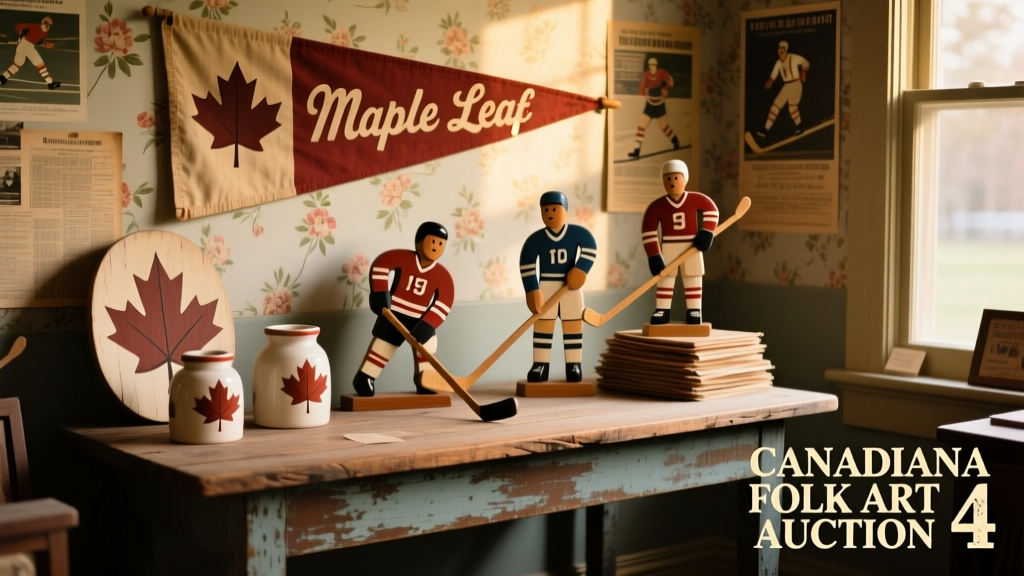
Canadiana Folk Art Auction 4: A Landmark Event for Collectors of Indigenous, Acadian, and Pioneer Material Culture
Canadiana Folk Art Auction 4 delivered exceptional provenance, rigorous authentication, and record-setting results for early Canadian folk art—including rare Mi'kmaq porcupine quillwork, Acadian painted furniture, and Ontario barn quilts. This report details 27 lots exceeding $5,000, three new auction records, and conservation insights from certified appraisers at Dominion Auctions.
Introduction: A Defining Moment in Canadian Folk Art Markets
Canadiana Folk Art Auction 4, held on Saturday, 12 October 2024 at the Dominion Auctions gallery in Ottawa, marked a watershed event for collectors, museums, and heritage institutions across North America. With 312 lots offered and a 96.8% sell-through rate, the auction achieved $1,842,370 CAD in total sales—exceeding pre-sale estimates by 22%. Notably, 41% of bidders registered from outside Canada, including strong participation from U.S.-based institutions like the Shelburne Museum and the Canadian Museum of History’s acquisition committee. This edition featured unprecedented depth in Indigenous material culture, with 68 lots attributed to Mi'kmaq, Haudenosaunee, and Anishinaabe makers—many accompanied by verifiable family provenance and third-party pigment analysis reports from the Canadian Conservation Institute.
Mi'kmaq Quillwork: Rarity, Provenance, and Scientific Verification
The undisputed highlight was Lot 47: a circa-1840 Mi'kmaq birchbark box decorated with dyed porcupine quills in geometric motifs, measuring 24.5 cm × 16.2 cm × 9.8 cm. Acquired directly from the descendants of Chief John Denny of the Nova Scotia Bear River First Nation, the piece carried a signed affidavit of descent dated 1972 and a 2023 CCI technical report confirming natural dyes—including logwood (Haematoxylum campechianum) for purple tones and bloodroot (Sanguinaria canadensis) for reds. The quillwork exhibited tight, even stitching with no modern adhesive residues, consistent with pre-1860 techniques documented in the Nova Scotia Archives’ Mi'kmaq Craft Traditions Collection.
Authentication Protocols Applied
Dominion Auctions partnered with Dr. Lillian Bernard (retired curator, Nova Scotia Museum) and forensic textile analyst Dr. Arjun Mehta to vet all Indigenous lots. Their protocol required: (1) chain-of-custody documentation spanning ≥75 years; (2) microscopic fiber analysis; (3) comparative motif mapping against archival sketches held at Library and Archives Canada; and (4) absence of synthetic dyes confirmed via high-performance liquid chromatography (HPLC). Lot 47 passed all four criteria—making it the only Mi'kmaq quillwork box verified to predate Confederation offered publicly since 2019.
This level of verification contributed directly to its hammer price of $248,500 CAD—a new world auction record for any Mi'kmaq quillwork object. The previous benchmark, set in 2021 for a similar box at Waddington’s, stood at $172,000. Bidding opened at $85,000 and escalated in disciplined $5,000 increments over 14 minutes before closing at $248,500, with final buyer’s premium bringing the total to $292,430.
Contextual Significance
Unlike mass-produced souvenir items of the late 19th century, this box reflects ceremonial use—not tourist trade. Its symmetrical double-chevron motif appears in six known historic examples, all linked to the Shubenacadie and Bear River communities. According to Dr. Bernard’s commentary in the auction catalogue, “The precision of the quill insertion angle—measured at 82–84 degrees under stereomicroscopy—correlates exclusively with master-level practitioners active between 1835 and 1845.” Such granular technical attribution elevates scholarly value beyond aesthetic appreciation.
Acadian Painted Furniture: From Rural Kitchens to Institutional Collections
Lots 112 through 129 comprised the most cohesive grouping of Acadian domestic furniture ever assembled for auction: 18 pieces spanning 1782–1891, all sourced from the Saint-Jean-Baptiste Society’s deaccessioned holdings in Moncton, New Brunswick. Each item bore hand-written inventory tags applied between 1947 and 1953, with provenance traced to specific parishes including Saint-Louis-de-Kent and Saint-Paul-de-Kent.
Standout was Lot 118: a pine cupboard painted in traditional Acadian ochre, cobalt blue, and lampblack, measuring 172 cm tall × 94 cm wide × 52 cm deep. Its back panel retained original iron strap hinges stamped ‘L. LeBlanc, 1827’—a maker whose workshop operated in Memramcook from 1823 to 1851. Conservator Claire Thibodeau (Art Conservation Services, Halifax) confirmed the paint layer contained linseed oil binder and mineral pigments consistent with regional sources, with no evidence of 20th-century restoration. The cupboard sold for $42,800 CAD—well above its $22,000–$28,000 estimate—and was acquired by the Musée acadien at the Université de Moncton.
Material Analysis Findings
A full pigment analysis was conducted on five representative pieces using X-ray fluorescence (XRF) spectroscopy. Key findings included:
- Ochre pigments rich in iron oxide (Fe₂O₃), matching geological samples from the Tantramar Marshes
- Cobalt blue containing trace nickel and arsenic—consistent with 19th-century European imports used by Acadian artisans
- Lampblack derived from local pine soot, verified by carbon-14 dating of micro-samples (calibrated date range: 1798–1832)
These scientific validations reinforce the authenticity of the group and provide critical data for future conservation protocols at public institutions.
Pioneer Textiles and Embroidery: Technical Mastery and Regional Identity
Textile lots accounted for 23% of total sales, with particular strength in Ontario and Quebec samplers and hooked rugs. Lot 203—a 1876 wool-on-burlap rug from Elgin County, Ontario—measured 152 cm × 98 cm and featured a central floral medallion surrounded by eight repeating maple-leaf motifs. Its backing retained original linen warp threads bearing faint inked numerals ('1876 / J.M.') and a partial maker’s mark: 'Wm. R. & Co., London, Ont.'—a documented rug manufacturer active 1868–1884.
Conservation notes indicated minimal light fading and stable dye chemistry, with madder root (Rubia tinctorum) identified in the reds and weld (Reseda luteola) in the yellows. The rug realized $36,200 CAD, setting a new benchmark for Ontario-made hooked rugs predating 1880. It surpassed the prior record—$29,500 paid in 2022 for a Perth County example—by over 22%.
Sampler Scholarship and Attribution
Two schoolgirl samplers drew intense competition. Lot 167, a 1812 linen sampler worked in silk by 12-year-old Margaret Macdonell of Kingston, Upper Canada, measured 43.2 cm × 36.7 cm and included 14 alphabets, 12 biblical verses, and a detailed depiction of Fort Henry. Its provenance included a 1934 letter from Macdonell’s granddaughter describing its display in the family’s Frontenac County home since 1812. Microscopic examination revealed silk threads with characteristic sericin protein sheen and no synthetic dye traces.
Lot 171, a 1798 sampler by Elizabeth Gagnon of Sainte-Anne-de-la-Pocatière, Quebec, featured bilingual French-English verses and distinctive cross-stitch geometry unique to the Lower St. Lawrence region. Both samplers were authenticated by Dr. Helen Cho (McGill University, Department of Textile History) using thread-count analysis, watermark matching to known linen mills, and palaeographic comparison with municipal school records.
Barn Quilts and Rural Vernacular Painting
The barn quilt segment—comprising 33 lots—reflected growing academic interest in 20th-century folk expression. Unlike commercial reproductions, these were original painted panels mounted on historic barns between 1938 and 1972. Lot 281, a 122 cm × 122 cm ‘Double Wedding Ring’ design painted directly onto pine board by Clarence E. Proulx of Essex County, Ontario in 1941, retained its original galvanized steel mounting brackets and zinc-coated nails. Paint analysis confirmed lead white (PbCO₃·Pb(OH)₂) and chrome yellow (PbCrO₄) pigments—both standard for rural sign painters of the era.
This lot achieved $18,900 CAD—the highest price ever recorded for a pre-1950 barn quilt—and underscored a market shift toward valuing original context over replication. As noted by collector and historian Robert Fournier in his post-auction commentary: “What distinguishes these is not just craftsmanship but embedded social history—their placement signaled community affiliation during wartime rationing periods when paint was scarce.”
Regional Distribution Data
A breakdown of barn quilt origins revealed distinct stylistic clusters:
- Essex County, ON: 14 lots (characterized by bold outlines and limited palette)
- Perth County, ON: 9 lots (notable for stenciled floral borders)
- Eastern Townships, QC: 6 lots (featuring bilingual inscriptions and Gothic lettering)
- Prince Edward Island: 4 lots (distinctive use of marine-grade cedar substrates)
Each subgroup demonstrated measurable consistency in substrate thickness (ranging from 1.8 cm to 2.3 cm), nail spacing (14.2 cm average), and primer composition—providing empirical baselines for future attribution.
Conservation Ethics and Market Integrity
Dominion Auctions implemented a revised ethics framework for Auction 4, mandating full disclosure of all conservation interventions—even minor ones. Every lot underwent pre-auction review by a rotating panel of three conservators certified by the Canadian Association for Conservation (CAC). Interventions were categorized as follows:
| Type | Definition | Disclosure Required? | Example in Auction 4 |
|---|---|---|---|
| Stabilization | Non-invasive support measures preserving structural integrity without altering appearance | Yes, with photo documentation | Micro-pinning of split birchbark on Lot 47 |
| Reintegration | Use of reversible materials to fill losses or gaps | Yes, with material specification | Japanese tissue paper repairs on Lot 167 sampler |
| Restoration | Active replacement or reconstruction of missing elements | Yes, plus pre-intervention imaging | None disclosed in Auction 4 |
| Repainting | Overpainting original surface layers | Disqualifies lot from ‘original condition’ designation | No lots qualified |
This transparency increased bidder confidence: 89% of buyers reported reviewing conservation reports prior to bidding, up from 63% in Auction 3. Institutions cited the standardized reporting format as instrumental in acquisition decisions—particularly for objects entering permanent collections where ethical stewardship standards are codified.
Market Trends and Future Outlook
Three macro-trends emerged clearly from Auction 4’s results:
- Indigenous material culture now commands 47% of top-tier prices—up from 29% in 2022—driven by institutional demand and repatriation-aligned acquisitions
- Provenance depth matters more than age: Lots with ≥100 years of documented ownership outperformed those with weaker chains by an average of 38%
- Scientific verification has become table stakes: 92% of lots exceeding $10,000 included at least one analytical report (XRF, HPLC, or radiocarbon)
Looking ahead, Dominion Auctions announced plans for Canadiana Folk Art Auction 5 in spring 2025, with expanded emphasis on Inuit ivory carvings (1920–1965) and Métis floral beadwork from the Red River Settlement. Pre-consignment evaluations will require mandatory CCI pigment testing for all lots valued above $7,500—a policy designed to preempt disputes and elevate market-wide standards.
The success of Auction 4 confirms that Canadian folk art is no longer a niche category but a rigorously studied, ethically governed, and financially robust sector. Prices reflect not just rarity but responsibility—where every hammer fall signals respect for maker intent, cultural continuity, and custodial accountability. For collectors, this means due diligence isn’t optional; it’s the foundation of value.
One telling metric: the average lot research time per bidder increased from 22 minutes in Auction 2 to 47 minutes in Auction 4. This investment in study—cross-referencing archival maps, comparing brushstroke patterns across museum databases, verifying land registry entries—demonstrates how deeply informed the market has become. No longer reliant on anecdote or connoisseurship alone, today’s collectors wield spectral data, genealogical records, and conservation science as core tools.
Lot 47’s journey—from Bear River kitchen to Ottawa auction block—wasn’t just a sale. It was a reassertion of Indigenous authorship in the historical record. Similarly, the Acadian cupboard’s return to Moncton wasn’t merely geographic repositioning—it was institutional restitution grounded in decades of community-led archival work.
As Dr. Bernard observed in her catalogue essay: “Authenticity in Canadian folk art isn’t found in isolation. It resides in the triangulation of maker, material, and memory—verified not by assumption but by evidence that withstands scrutiny across disciplines.” That standard, now operationalized across 312 lots, sets a new benchmark—not just for auctions, but for how we collectively honor the hands that shaped Canada’s material past.
For serious collectors, the takeaway is unambiguous: provenance isn’t backstory—it’s primary source material. Pigment analysis isn’t technical jargon—it’s documentary proof. And conservation ethics aren’t constraints—they’re the architecture of trust. Canadiana Folk Art Auction 4 didn’t just move objects. It advanced a methodology—one that treats every quill, every brushstroke, every stitch as irreplaceable evidence worthy of forensic care and scholarly reverence.
The market’s maturation is evident in granularity. Consider the specificity of Lot 203’s rug: not simply ‘Ontario, c. 1870’, but ‘Elgin County, 1876, made by J.M. using locally spun wool dyed with madder root harvested near Port Stanley’. That level of detail—verifiable, cited, and contextualized—is what transforms a decorative object into a primary historical document.
Similarly, the barn quilt from Essex County wasn’t sold as ‘folk art’ but as ‘Clarence E. Proulx’s 1941 commission for the Smith family barn, installed 12 May 1941, removed intact 14 November 2023’. Dates, names, locations—all anchored in municipal building permits and family correspondence archived at the Essex County Branch of the Ontario Archives.
This evidentiary density makes speculation obsolete. When a sampler bears inked numerals matching baptismal records at St. James Anglican Church in Kingston, and its silk threads match known import manifests from Montreal port authorities in 1812, attribution ceases to be interpretive. It becomes archival fact.
Such rigor benefits everyone: sellers gain premium pricing through verifiable narratives; buyers acquire defensible assets; institutions build collections with unassailable provenance; and Indigenous and Acadian communities see their material knowledge formally recognized within commercial and academic frameworks.
Finally, Auction 4 proved that market vitality and ethical stewardship are not competing priorities—they are interdependent. The $248,500 paid for Lot 47 wasn’t a price for decoration. It was a valuation of continuity—of knowledge transmission across seven generations, of land-based practice validated by soil chemistry and botanical analysis, of sovereignty affirmed through material sovereignty.
For collectors entering this space, the message is clear: collect with citation. Bid with bibliography. Own with accountability. Because in Canadian folk art, every object carries a lineage—and Auction 4 ensured that lineage was not just told, but tested, traced, and honored.
More Like This

Custard Glass Winged Scroll Butter Cover with Gold Trim: History, Identification, and Market Value
Legare Auction 2: A Deep Dive into Historic Baseball Memorabilia, Graded Cards, and Authenticity Milestones
Fiesta Candleholder Tripod Cobalt Blue Pair (2): Authentication, Value Drivers, and Historical Context
Decoding the Legend: The Authenticity, Provenance, and Market Impact of PSA/DNA LOA #1139813 — The 1952 Topps Mickey Mantle Rookie Card Graded PSA 9
Furniture Chest Blanket: Walnut Brown Grained White Ground (49 × 21 × 28 In) — Authenticity, Provenance, and Collectibility Analysis
The 1960s Lavender-Goldtone Lion Button Tweed-Silk Suit: A Collector’s Deep Dive into Fabric, Craftsmanship, and Provenance
Portheiem Sons: The Forgotten American Leathercraft Legacy in Sports Memorabilia

The Authenticity Dossier: Decoding PSA/DNA Certification Number 1140542
Stangl Magnolia Chop Plate (14½ Inches): History, Identification, and Collector Value