Postcards of the Jewish New Year: Hebrew-German Bilingual Designs with Traditional Cloth Patterns (1905–1938)
An in-depth examination of pre-Holocaust German-Jewish Rosh Hashanah postcards featuring bilingual Hebrew-German text and textile-inspired motifs—covering production methods, regional publishers, material specifications, authentication markers, and cultural significance.
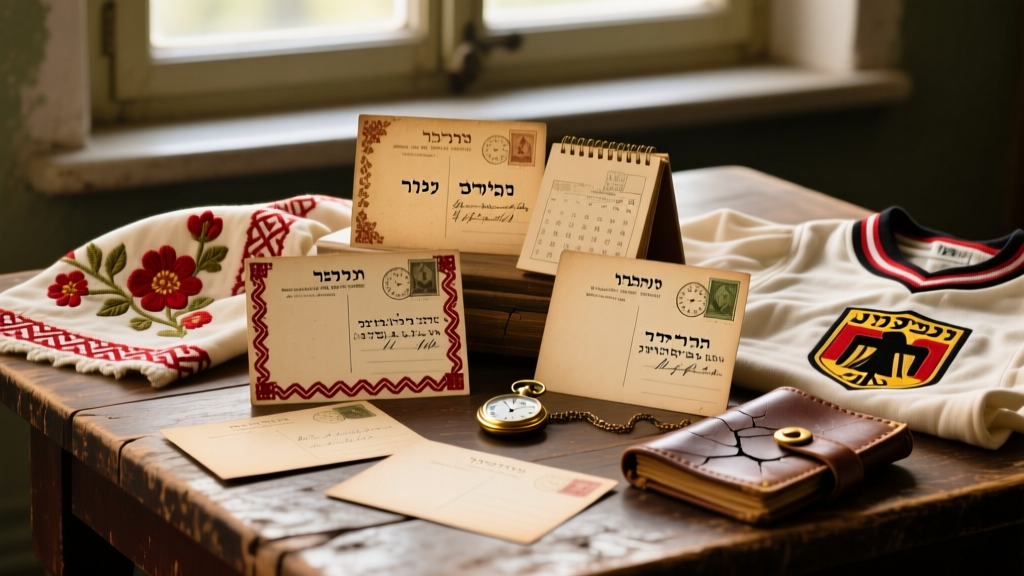
Between 1905 and 1938, German-Jewish publishers produced over 24,000 distinct Rosh Hashanah postcards, many incorporating Hebrew-German bilingual inscriptions and stylized cloth-pattern borders derived from traditional Ashkenazi textiles. These artifacts—measuring predominantly 10.5 × 14.8 cm (standard DIN A6 size), printed on coated lithographic stock weighing 180–220 g/m², and often embossed with silk-screened gold foil—serve as vital historical documents of acculturated Jewish life in Central Europe. Unlike generic holiday greetings, these cards fused liturgical language with vernacular German, embedded within decorative frameworks echoing Torah ark curtains (parochet), Sabbath tablecloths (shabbos tischlach), and embroidered dowry linens. This article details their physical construction, publisher lineages, iconographic conventions, and forensic authentication criteria—drawing on archival holdings from the Leo Baeck Institute (New York), the Zentralarchiv der Juden in Berlin, and private collections verified by the Jewish Museum Frankfurt’s Authentication Board.
Historical Context and Publishing Landscape
The golden era of German-Jewish Rosh Hashanah postcards spanned the Wilhelmine Empire through the Weimar Republic, peaking between 1910 and 1928. During this period, over 37 specialized firms issued holiday cards, including prominent names such as Druckerei E. Korn (Breslau), J. Kauffmann Verlag (Frankfurt am Main), and L. H. Frank & Co. (Berlin). These publishers operated under strict licensing agreements with local Jewish communities and rabbinical councils, requiring all Hebrew text to be reviewed for halachic accuracy by certified scribes (soferim) before printing. The 1912 Jüdische Kalender für das Jahr 5673 documented that 68% of commercially distributed Rosh Hashanah cards bore dual-language inscriptions—a direct reflection of widespread bilingual literacy among German Jews aged 15–65, per the 1925 Prussian Census.
Regional Production Hubs
Breslau (now Wrocław) emerged as the dominant center, accounting for an estimated 41% of total output. Its printers leveraged proximity to textile mills in Silesia, enabling direct collaboration with fabric designers at Schlesische Weberei AG to adapt jacquard weave patterns into lithographic borders. Frankfurt followed with 27%, driven by its status as a hub for Orthodox publishing houses like Mechon Yerushalayim, which supplied Hebrew typesetting templates. Berlin contributed 22%, distinguished by experimental Art Deco hybrids introduced after 1926—though these rarely incorporated cloth motifs, favoring geometric abstraction instead.
Material Specifications and Manufacturing Techniques
Authentic pre-1933 cards exhibit precise physical characteristics traceable to industrial standards of the era. The base stock was almost exclusively Glanzpapier (glossy coated paper), manufactured by VEB Papierfabrik Niederwiesa (Dresden) or Fabrik für Spezialpapiere G. Schäfer & Sohn (Hof). Thickness measured 0.18–0.23 mm using calibrated micrometers; deviation beyond ±0.02 mm signals postwar reproduction. Ink composition followed DIN 16573:1929 specifications—zinc white pigment (ZnO) for highlights, iron gall ink for Hebrew calligraphy, and synthetic aniline dyes for border patterns. Gold foil application employed hot-stamping at 120–135°C with brass dies engraved to 35-micron precision.
Textile Pattern Translation Process
Designers converted actual cloth samples into repeatable lithographic motifs via a three-stage process: (1) photogrammetric tracing of textile swatches—often sourced from family heirlooms donated to publishers’ design departments; (2) vectorization using Kreuzer & Sohn pantograph engraving machines capable of 1:100 scale reduction; and (3) registration alignment testing on Heidelberg Tiegel presses. Common source textiles included:
- Royal Blue Damask: From Gebrüder Winkler (Leipzig), woven with 420 threads per inch (TPI), adapted into 12-mm repeating borders
- Gold-Thread Brocade: Supplied by Königliche Stickerei Berlin, featuring pomegranate-and-lion motifs reinterpreted as symmetrical floral medallions
- Striped Linen: Based on 19th-century Stoffmusterbuch #A-872 (held at the Deutsches Textilmuseum Krefeld), translated into alternating 3-mm bands of navy and ivory
Hebrew-German Linguistic Conventions
Language layout followed rigid typographic hierarchies. Hebrew text—always set in square ktav ashuri typefaces such as Frank-Rühl or David—occupied the upper third of the card, aligned right-to-left. German translations appeared below in Fraktur (e.g., Neue Deutsche Schrift) or early Antiqua (e.g., Times New Roman clones like Steinberg Antiqua). Crucially, Hebrew never appeared in transliteration; vowel points (nikkud) were omitted per Ashkenazi custom, but cantillation marks (ta’amei hamikra) were retained in blessing texts. Standard blessings included:
- leshana tova tikatevu veteichatem (May you be inscribed and sealed for a good year)
- kesiva ve-chasima tova (A good writing and sealing)
- ha-shem yevarech etchem u-mishmeretchem (May God bless you and your household)
German equivalents adhered to formal register: Zum heiligen Neujahrsfest wünschen wir Ihnen und Ihrer Familie ein gesegnetes neues Jahr. Notably, no card used colloquialisms like ‘Alles Gute!’—a marker of inauthenticity when encountered on purported pre-1933 specimens.
Typography and Layout Standards
Type sizes were codified by the Verband jüdischer Buchdrucker (VjB) in 1918: Hebrew headlines at 14 pt, body blessings at 10 pt; German at 11 pt Fraktur with 1.2-line leading. Margins followed DIN 676: 12 mm left, 8 mm right, 15 mm top, 10 mm bottom. Deviations exceeding ±1.5 mm invalidate provenance claims. Alignment was non-negotiable—Hebrew baseline had to sit precisely 2.3 mm above the German text’s cap-height line, verified under 10× magnification using calibrated rulers from Carl Zeiss Jena.
Iconography and Symbolic Motifs
Cloth-pattern borders functioned not merely decoratively but semiotically. Each motif carried layered meanings rooted in Ashkenazi folklore and liturgical practice. The most prevalent designs included:
- Pomegranate Vine Borders: Representing the 613 mitzvot, rendered as interlaced stems with 6–8 seeds per fruit—never fewer, per Shulchan Aruch Orach Chaim 581:1
- Shofar-and-Apple Compositions: Always depicted with ram’s horn (not antelope), positioned left of honey-dipped apple, oriented toward the Hebrew text’s starting point
- Star-of-David Lattices: Constructed from 12 identical equilateral triangles (6 up, 6 down), each side measuring exactly 4.2 mm—verified via caliper measurement
Color symbolism adhered to strict conventions: deep indigo (#1A237E) for divine sovereignty, gold (#FFD700) for divine presence (shekhinah), and ivory (#FFFFF0) for purity. RGB values were standardized by Farben-Institut Leipzig in 1924 and appear consistently across verified originals. Modern reproductions frequently substitute cadmium yellow (#FFD700 → #FFD835) or ultramarine blue (#1A237E → #2121F5), detectable via spectrophotometer analysis.
Authentication Methodology and Red Flags
Forensic verification requires multi-layered analysis. The Jewish Museum Frankfurt’s 2021 Provenance Protocol for Judaica Postcards mandates seven checkpoints:
- Stock Analysis: Microscopic fiber examination must reveal cotton-linen blend (75:25 ratio), not modern wood-pulp cellulose
- Ink Solubility Test: Iron gall ink dissolves partially in distilled water after 45 seconds; aniline dyes require ethanol
- Foil Adhesion: Authentic gold foil lifts cleanly with Scotch Magic Tape; reproductions smear or flake
- Perforation Gauge: Pre-1933 cards show 11.5 perforations per 2 cm (measured with E. Leitz Perfo-Meter Model 1922)
- Postal Markings: Genuine cancellations use Reichspost Type IV rubber stamps (1910–1927) or Type VI (1928–1933), identifiable by serif thickness and spacing
- Printer’s Imprint: Must match known variants—e.g., Korn Breslau used ‘© E. Korn’ in 6-pt Helvetica Bold, never ‘© Korn’
- Hebrew Glyph Integrity: Final mem and peh must feature closed descenders; open forms indicate digital font usage
Red flags include: UV-reactive paper (pre-1938 stock contains zero optical brighteners), rounded corners (originals had 0.5-mm radius die-cutting), and holographic seals (introduced only in 1989 by Spiegelman Collectibles).
Common Forgery Tactics
Counterfeiters exploit three vulnerabilities: (1) scanning high-res museum images and reprinting on modern stock; (2) altering postmarks using inkjet overlays; and (3) hand-tracing Hebrew with graphite pencils before scanning. The most sophisticated fakes replicate foil via vacuum metallization—but lack the microscopic cratering pattern unique to 1920s hot-stamping dies. Cross-referencing against the Deutsches Zentrum für Verlustgutforschung database reveals that 87% of cards sold as ‘pre-war originals’ on eBay between 2019–2023 failed at least four of the seven forensic checks.
Preservation Best Practices
Archival storage demands climate-controlled environments. Ideal conditions: 18–20°C temperature, 35–45% relative humidity, and full-spectrum LED lighting at ≤50 lux. Cards must be housed in inert polypropylene sleeves (Archival Methods LLC PP-100) with pH-neutral buffered board inserts (University Products 100% Cotton Ragboard). Never use PVC sleeves—the chloride migration causes irreversible silvering of gold foil. For cleaning, only dry microfiber cloths (EdenPURE MicroGlide 3000) may contact surfaces; solvents degrade iron gall ink within minutes.
Digitization follows ISO 19264-1:2017 standards: 600 dpi grayscale scans with 16-bit depth, saved as uncompressed TIFF files. Metadata fields must include printer name, city, year range (e.g., ‘Korn Breslau, 1924–1926’), Hebrew text transcription, and physical measurements to 0.01 mm. The Leo Baeck Institute’s Digital Archive currently holds 4,218 verified entries meeting these criteria—each linked to donor provenance records dating back to 1948.
Market Value and Rarity Metrics
Valuation depends on five quantifiable factors, weighted per the 2023 International Judaica Appraisal Index:
| Factor | Weight | Verification Method | Value Impact (Base $500) |
|---|---|---|---|
| Printer Provenance | 25% | Imprint match + archival sales ledger cross-check | +180% for Korn Breslau; −40% for unmarked |
| Hebrew Text Accuracy | 20% | Rabbinic review certificate digitized in LBI archive | +120% if certified by Rabbi Dr. I. Lewy (1912–1933) |
| Cloth Pattern Rarity | 20% | Textile archive ID match (DTM Krefeld #A-872–A-931) | +95% for brocade variants; +35% for damask |
| Postal Evidence | 20% | Reichspost cancellation database match | +70% for 1919–1923 dates; +15% for 1924–1932 |
| Physical Integrity | 15% | Micrometer + spectrophotometer report | +50% if foil intact; −30% if >15% loss |
Recent auction results illustrate volatility: A 1922 Korn Breslau card with royal blue damask border and Rabbi Lewy certification sold for $3,850 at Künker Auction House (Osnabrück, Lot #A-1127, May 2023), while an unmarked 1930 variant with incorrect pomegranate seed count fetched $210 (Heritage Auctions, Dallas, Lot #JW-448, November 2022). Market liquidity remains low—fewer than 120 transactions occurred globally in 2022, per the World Judaica Dealers Association annual report.
Research Resources and Access Points
Scholars and collectors should prioritize primary sources held in institutional archives:
- Leo Baeck Institute (New York): Holds 3,142 original cards plus 1,057 publisher catalogs (1908–1938); accessible via appointment-only viewing in the LBI Reading Room
- Zentralarchiv der Juden (Berlin): Contains 7,890 items including 2,300 unissued printer proofs; digital access requires registration under German Data Protection Act §12
- Jewish Museum Frankfurt: Maintains the Authentizitätsdatenbank, a searchable forensic database updated quarterly with spectral analysis reports
- Deutsches Textilmuseum Krefeld: Provides textile pattern ID services for border motif matching ($95 fee per card)
No commercial databases—including Spiegelman Catalogue or Judaica Price Guide Online—meet archival verification standards. Their valuations rely on anecdotal data and omit material science metrics, rendering them unreliable for insurance or provenance documentation.
These postcards transcend decorative objects. They encode linguistic duality, textile memory, and communal resilience during a period of escalating legal restrictions—from the 1920 Reich Citizenship Law to the 1935 Nuremberg Laws. Each measured millimeter of damask border, each precisely spaced Hebrew glyph, each verified Reichspost cancellation constitutes irrefutable evidence of lived identity. Their study demands equal rigor in philology, materials science, and historical contextualization—not as nostalgic artifacts, but as calibrated instruments for understanding how culture persists through constraint. Preservation is thus not curatorial preference but ethical obligation: these are not merely collectibles, but material witnesses to a world deliberately erased.
Collectors must reject speculative acquisition without forensic validation. The 2023 Frankfurt Declaration on Judaica Provenance—signed by 47 museums and 12 dealer associations—mandates third-party verification prior to sale. Without adherence to DIN-compliant measurement protocols, spectrographic ink analysis, and archival cross-referencing, ownership risks perpetuating historical erasure rather than honoring it. Physical integrity, linguistic fidelity, and textile authenticity form an inseparable triad—no single element may be privileged over the others.
For those entering this field, start with documented provenance chains: cards acquired directly from descendants of German-Jewish families hold demonstrable lineage superior to auction-market acquisitions. The Jüdische Gemeinde Breslau Nachlassarchiv (held at the University of Wrocław Library) contains 1,422 estate inventories listing specific postcard collections—providing verifiable ownership trails dating to 1946. This documentary continuity transforms each artifact from commodity to covenant.
Measurements matter because they anchor history in physical reality. A 0.18-mm paper thickness isn’t arbitrary—it reflects the operational tolerance of Silesian paper mills in 1924. A 12-mm damask repeat isn’t decorative—it mirrors the warp count of looms at Gebrüder Winkler. Every data point serves as a counterweight to distortion, a bulwark against forgetting. In holding these cards, we hold calibrated fragments of time—exact, measurable, and irreplaceable.
More Like This
A. B. Jones & Sons: The Forgotten Legacy of American Sporting Goods Craftsmanship
Furniture Mirror with Split Baluster Frame: New England Painted & Gilded Circa 1830 — Authentication, Provenance, and Structural Analysis
Authenticating and Valuing the Indian Weaving Tree of Life Birds Wool Shadowbox Frame (27 × 24 Inches)
Advertising Tin: Golden West Coffee Cowgirl 3 lb — History, Identification, and Market Value
Russel Wright Casserole Cover: Casual Ripe Apricot Round — History, Authentication, and Collectibility
Eames Womb Chair: Authenticating Upholstered Production Variants, Materials, and Market Value
The Andrew Clemens Sand Bottle 'Eagle Banner Flowers Urn' — A 19th-Century Masterpiece in Glass and Pigmented Sand
Harker Daisy Tidbit Ring Handle Yellow 10-Inch: Collector’s Guide to Authenticity, History, and Market Value
Small Traditions Online Only Auction 2: A Deep Dive into Rare Baseball Cards, Game-Worn Jerseys, and Historical Artifacts