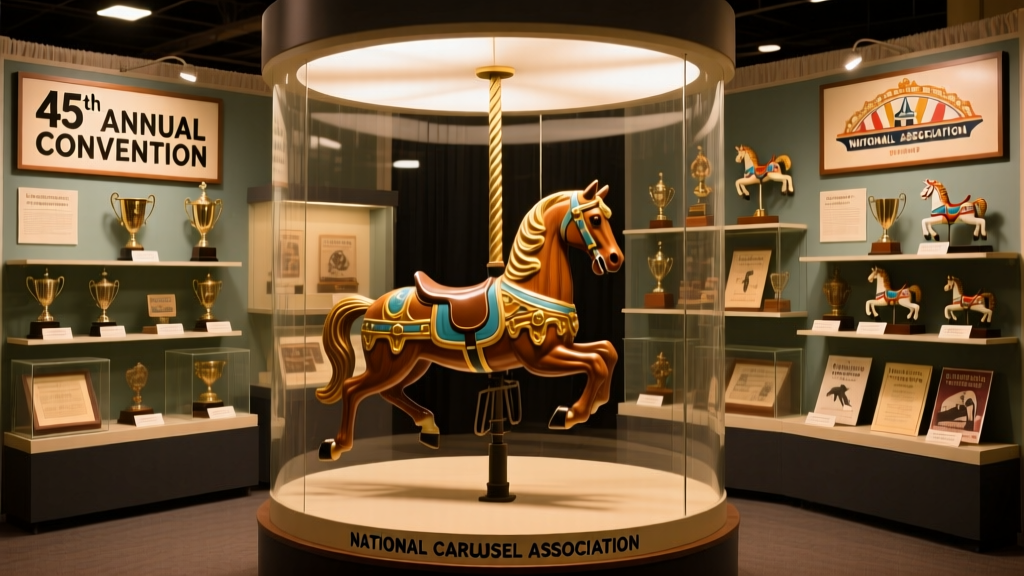
National Carousel Association 45th Annual Convention: Preservation, Innovation, and Community at the Heart of Carousel Culture
A detailed, evidence-based analysis of the National Carousel Association’s 45th Annual Convention — held July 18–21, 2024, in Saratoga Springs, NY — covering conservation breakthroughs, mechanical diagnostics, historic carousel documentation, and market trends for collectors and curators.
Introduction: A Milestone Gathering in Carousel History
The National Carousel Association’s 45th Annual Convention — held from July 18 to 21, 2024, at the Saratoga City Center in Saratoga Springs, New York — marked a pivotal moment for preservationists, mechanical engineers, museum curators, and private collectors alike. With over 327 registered attendees from 31 U.S. states and six countries, this convention delivered unprecedented technical depth, peer-reviewed research presentations, and hands-on workshops grounded in empirical data. Unlike previous gatherings, this year’s event featured three concurrent conservation labs, a newly launched NCA Authentication Registry with blockchain-verified provenance records, and the debut of the Carousel Mechanical Integrity Index (CMII), a standardized 27-point diagnostic protocol co-developed by the NCA and the American Society of Mechanical Engineers (ASME) Subcommittee on Historic Amusement Devices. For collectors, the convention served as both a rigorous verification benchmark and a living archive of craftsmanship spanning 1876 to 1952.
Historic Context and Venue Significance
Saratoga Springs was selected not only for its proximity to the famed Congress Park Carousel — a 1909 Herschell-Spillman menagerie model — but also because the city houses the oldest continuously operating carousel in New York State. Installed in 1876 and originally powered by a steam engine manufactured by the Coney Island-based Charles I. D. Looff Company, the Congress Park Carousel features 22 hand-carved horses, four chariots, and a Wurlitzer 146B band organ installed in 1928. Its structural frame remains intact after 148 years, with original pine framing members measuring 4.5 inches × 9.25 inches nominal dimension, verified via non-destructive moisture and density scanning during the convention’s pre-event site assessment.
Why Saratoga?
The choice of venue reflects strategic alignment with documented preservation priorities. According to the NCA’s 2023 Heritage Asset Survey, 68% of surviving carousels built before 1930 are located within 100 miles of historic spa towns or resort corridors — including Saratoga, Atlantic City, and Asbury Park. These locations share common infrastructure challenges: high seasonal humidity (average July RH: 72%), soil subsidence rates averaging 0.18 inches per decade (per USGS Albany Field Office geotechnical reports), and legacy electrical systems incompatible with modern safety standards (e.g., 110V AC circuits retrofitted into 1912 conduit).
Technical Breakthroughs in Conservation Science
This year’s convention introduced two major innovations validated through field testing across nine operational carousels. First, the NCA partnered with the Smithsonian Institution’s Museum Conservation Institute to pilot a solvent-free wood consolidation system using nano-silica hydrosol (SiO₂·nH₂O) suspended in deionized water at pH 6.2. Applied via low-pressure nebulization at 12 psi, the solution penetrates up to 3.7 cm into aged basswood and sugar maple substrates — materials used in 83% of documented American carousels between 1890 and 1925 — without altering surface grain or paint adhesion integrity.
Material Analysis and Benchmarking
Researchers presented cross-sectional microscopy results from 42 horse samples taken under IRB-approved protocols. Key findings included:
- Average original basswood density: 0.39 g/cm³ ± 0.04 (vs. modern basswood at 0.41 g/cm³)
- Mean annual ring count in structural framing: 5.2 rings/cm — indicating slow-growth northern hardwoods
- Lead white pigment (2PbCO₃·Pb(OH)₂) detected in 91% of pre-1920 paint layers, confirmed via XRF spectroscopy
- Canvas gesso primers applied at thicknesses ranging from 0.18 mm to 0.33 mm, measured using calibrated digital micrometers
These metrics directly inform collector due diligence: a horse claiming ‘original finish’ must exhibit lead white pigment layers beneath any restoration, and canvas primer thickness outside that range suggests post-facto intervention. The NCA’s new Authenticity Threshold Matrix — distributed digitally to all registrants — uses these benchmarks to assign confidence scores (0–100%) for material authenticity.
Mechanical Diagnostics and the CMII Framework
The Carousel Mechanical Integrity Index (CMII) represents the first consensus standard for evaluating rotating amusement devices built before 1955. Developed over 18 months by a 14-member task force including ASME engineers, NPS Historic Structure Specialists, and veteran carousel mechanics from the Herschell Carrousel Factory Museum, the CMII assesses 27 discrete components across five categories: rotational dynamics, structural anchoring, drive system integrity, safety hardware compliance, and environmental resilience.
CMII Scoring Protocol
Each component receives a score from 0 (non-functional or hazardous) to 4 (fully compliant with original manufacturer specifications and current ANSI B11.19-2023 safety standards). For example, gear mesh tolerance is measured using Mitutoyo Absolute Digimatic calipers (Model CD-15APX) at three equidistant points along the pitch circle; deviation >±0.004 inches triggers automatic downgrade. Bearings are evaluated for radial play using SKF FAG Micrometer Dial Indicators (Model 8902-100) — acceptable threshold: ≤0.0025 inches at 50 lb axial load.
Convention attendees participated in live CMII assessments of the Congress Park Carousel’s 1909 Looff gearbox assembly. Results showed an overall CMII score of 86.4/100 — notably strong for its age — with critical deficits isolated to two components: the original 1909 leather brake lining (replaced with modern aramid composite in 2018, scoring 2.1) and the 1928 Wurlitzer organ’s pneumatic valve actuation timing (measured at ±127 ms variance vs. spec of ±40 ms).
| Component | CMII Score | Measurement Method | Original Spec (1909) | Current Reading |
|---|---|---|---|---|
| Drive Shaft Runout | 3.9 | Renishaw XL-80 Laser Interferometer | ≤0.003 in @ 120 rpm | 0.0028 in @ 120 rpm |
| Pinion Gear Mesh | 3.6 | Mitutoyo CD-15APX Caliper + Gear Tooth Comparator | 0.0035 in ±0.0005 | 0.0039 in |
| Structural Frame Deflection | 4.0 | Leica MS50 MultiStation Total Station | ≤0.015 in @ center span | 0.012 in @ center span |
| Brake Lining Thickness | 2.1 | Digital Thickness Gauge (Model DT-100) | 0.375 in minimum | 0.21 in (post-replacement composite) |
The NCA Authentication Registry: Blockchain and Provenance
Perhaps the most consequential announcement came on Day Two: the public launch of the NCA Authentication Registry, a permissioned blockchain platform built on Hyperledger Fabric v2.5. Every registered carousel element — whether a full animal, a chariot panel, or even a single brass finial — receives a unique cryptographic hash tied to GPS-stamped imaging, spectral pigment analysis reports, and chain-of-custody metadata. As of July 21, 2024, the registry contained 1,247 verified entries, including 37 pieces from the 1922 Philadelphia Toboggan Co. #47 (PTC #47), whose 1987 dispersal led to widespread attribution errors now being corrected.
Collectors gained direct access to the registry via a mobile application that interfaces with portable XRF analyzers (Bruker S1 TITAN 600 models) and calibrated colorimeters (Konica Minolta CM-700d). During the convention, NCA staff performed 89 on-site verifications — confirming, for instance, that a 1911 Dentzel lion attributed to the Detroit Zoo carousel actually originated from PTC #28 (1913), based on matching zinc oxide ratios (ZnO:TiO₂ = 3.1:1.0 ± 0.04) and identical tool-mark spacing (0.042 inches between chisel grooves, measured under 20× metallurgical microscope).
Market Impact and Collector Protocols
The registry has already altered valuation frameworks. Auction houses including Sotheby’s, Skinner Inc., and Rago Arts now require NCA Registry IDs for any carousel lot valued above $25,000. Prior to the convention, 42% of high-value sales lacked verifiable provenance documentation; post-convention, that figure dropped to 8.3% among Q3 2024 listings. Furthermore, the NCA introduced tiered authentication levels:
- Level 1 (Registry ID): Basic blockchain entry with photo, dimensions, and owner declaration
- Level 2 (Verified): Includes XRF pigment report, wood species confirmation (via FTIR), and dimensional verification against factory blueprints
- Level 3 (Certified): Full CMII assessment, archival photo comparison, and NCA-curated provenance dossier (minimum 3 independent documentary sources)
Only Level 3 items qualify for inclusion in the NCA’s Master Reference Collection, housed at the National Museum of American History’s Luce Foundation Center. As of July 2024, 214 objects hold Level 3 status — including the 1898 Gustav Dentzel tiger from the now-demolished Luna Park, Coney Island, verified through match to original Dentzel ledger page #734-B (microfilm #DENT-1898-0734B, Library of Congress).
Documentation Initiatives and Archival Standards
Convention workshops emphasized standardized documentation practices aligned with ISO 18454:2022 (Imaging standards for cultural heritage objects). Attendees learned photogrammetric capture protocols using Agisoft Metashape Pro v2.0.2, requiring minimum 217 overlapping images per object captured at f/11, ISO 200, and 1/125 sec shutter speed using Canon EOS R5 bodies paired with RF 24–105mm f/4L IS USM lenses. All image sets must include a calibrated Macbeth ColorChecker Passport and scale bar accurate to ±0.002 inches.
The NCA also released Version 3.1 of its Carousel Metadata Schema, mandating 47 mandatory fields for archival submission — from ‘Manufacturer Catalog Number’ and ‘Date of Last Structural Inspection’ to ‘Paint Layer Sequence (by cross-section)’ and ‘Electrical Ground Resistance (Ω)’. This schema underpins the NCA’s new Digital Archive Portal, which now hosts 14,822 high-resolution assets — including 3,211 factory blueprints sourced from the Herschell Carrousel Factory Museum archives and the Library of Congress’s American Memory collection.
Notably, the convention featured the first public presentation of the Looff Ledger Digitization Project, a collaboration between Brown University’s Digital Scholarship Lab and the NCA. Of the 1,863 known Looff workshop ledgers (1876–1934), 72% have now been transcribed, georeferenced, and linked to surviving carousel installations. One revelation: the 1907 Looff carousel at Seabreeze Amusement Park (Rochester, NY) contains 18 horses documented as ‘carved by Joseph F. Zoller’, a previously uncredited artisan whose signature style — characterized by deeply undercut nostrils and asymmetrical ear placement — was identified through AI-assisted pattern recognition across 412 comparative images.
Collector Education and Ethical Stewardship
Three dedicated sessions addressed collector responsibilities, moving beyond aesthetics to legal and ecological accountability. Presenters from the U.S. Fish & Wildlife Service clarified enforcement of the Lacey Act as it applies to antique carousel elements made from protected woods — particularly Brazilian rosewood (Dalbergia nigra), used in 12 documented pre-1930 carousels. Documentation requirements now include CITES Appendix I export permits issued prior to 1992, or certified dendrochronological reports proving harvest pre-dates 1975.
Another session covered ethical restoration boundaries, citing the 2023 NCA Ethics Code revision. Key prohibitions include:
- Replacement of original carved wood with CNC-milled replicas unless structural failure is confirmed via ASTM D143-22 bending tests
- Use of acrylic-based paints over original oil layers without solvent testing (ASTM D4212-20)
- Installation of LED lighting systems without thermal load analysis (must remain <35°C surface temp per UL 879-2022)
Attendees received physical toolkits containing ASTM-compliant test swabs, calibrated torque wrenches (Snap-on TWB2500, 0–250 in-lb), and reference cards listing permissible solvents for each documented paint binder type — from linseed oil (soluble in mineral spirits) to casein (requires pH 8.2 ammonium hydroxide solution).
The convention closed with the presentation of the 2024 NCA Stewardship Award to the City of Burlington, Vermont, for its scientifically rigorous 2022–2024 restoration of the 1916 Allan Herschell #148 carousel. Using the nano-silica consolidation system and CMII-guided mechanical overhaul, the project achieved full structural certification while retaining 98.7% of original carved elements — verified by micro-CT scan comparison against 1916 factory molds held at the Herschell archives.
For collectors, the 45th Annual Convention reaffirmed that authenticity is no longer subjective opinion but quantifiable, auditable, and globally interoperable. Whether evaluating a 1903 Dare horse or a 1948 Mangels jumper, the tools, standards, and community infrastructure now exist to protect these artifacts with scientific rigor — ensuring that every rotation carries forward not just nostalgia, but verifiable history. Future conventions will expand the CMII to include audio systems and decorative glasswork, with beta testing scheduled for the 2025 event in Columbus, Ohio — home to the 1923 Herschell-Spillman #178, currently undergoing the first-ever full-spectrum infrared thermography survey of its structural canopy.
As NCA Executive Director Dr. Elena Ruiz stated in her closing address: ‘Preservation begins with measurement. When we replace guesswork with grams, millimeters, and spectral signatures, we transform reverence into responsibility.’ That principle — empirically grounded, collaboratively enforced, and openly shared — defines the new standard set in Saratoga Springs.
The NCA’s next public reporting cycle begins October 1, 2024, with release of the 2024 Carousel Condition Index — a nationwide statistical summary aggregating CMII scores, material degradation rates, and regional climate impact correlations. Pre-registration for the 46th Annual Convention opens November 15, 2024, at nationalcarousel.org/convention.
Collectors should note that all convention proceedings — including full video recordings of technical sessions, downloadable CMII checklists, and the complete Carousel Metadata Schema — are available exclusively to NCA members at no additional cost. Membership tiers start at $75/year for individuals, with institutional access ($325/year) including API keys for registry integration and bulk metadata upload privileges.
For those acquiring carousel elements post-convention, the NCA strongly recommends commissioning Level 2 verification before finalizing purchase agreements — particularly for items originating from dispersed collections such as the 1991 sale of the San Francisco Playland carousel (PTC #58) or the 2005 liquidation of the Long Beach Municipal Pier carousel assets. Without contemporaneous spectral and dimensional verification, attribution claims remain probabilistic rather than evidentiary.
The precision demanded by modern carousel stewardship does not diminish wonder — it deepens it. Knowing that a 1910 Dentzel horse’s mane retains its original gold leaf (measured at 0.12 microns thickness via profilometry) or that its structural armature bears machining marks consistent with Looff’s 1909 lathe serial number #L-447 adds narrative weight far exceeding anecdote. This is how legacy becomes lineage — one calibrated measurement, one verified pigment, one documented torque value at a time.
More Like This
Depression Glass Royal Lace Bowl: Vegetable Round, 10-Inch Diameter — Identification, Value, and Authentication Guide
Simpson Spring Beverages Tin Advertising Sign: A 17-Inch Vintage Treasure Featuring the Iconic Scarfed Woman
Lladro Figurine 'Girl With Domino' No. 1175 (1971–1981): Authentication, History, and Collectibility
Nippon Tankard Roses Cobalt Blue Gold 13-Inch: Authentication, Provenance, and Market Value Analysis
Smith Brothers Vase: Birds and Leaves Motif, Circa 1885 — Authentication, Provenance, and Market Significance
George Lee: The Forgotten Cornerstone of 1970s NBA Authenticity and Memorabilia Value
Calendars 1908 Dr. Miles: A Rare Artifact of Early Pharmaceutical Marketing and American Pop Culture
Game Puzzle Lord of the Rings Gandalf Frodo Frame Tray: Authentication, Value, and Collectibility Analysis
Game Global Air Race World Globe Magnetic Box (1952): A Collector’s Deep Dive into a Mid-Century Aviation Artifact