Game Global Air Race World Globe Magnetic Box (1952): A Collector’s Deep Dive into a Mid-Century Aviation Artifact
An in-depth analysis of the 1952 Game Global Air Race World Globe Magnetic Box — its origins, physical specifications, manufacturing details, historical context, authentication markers, market value trends, and significance in aviation and toy memorabilia collecting.
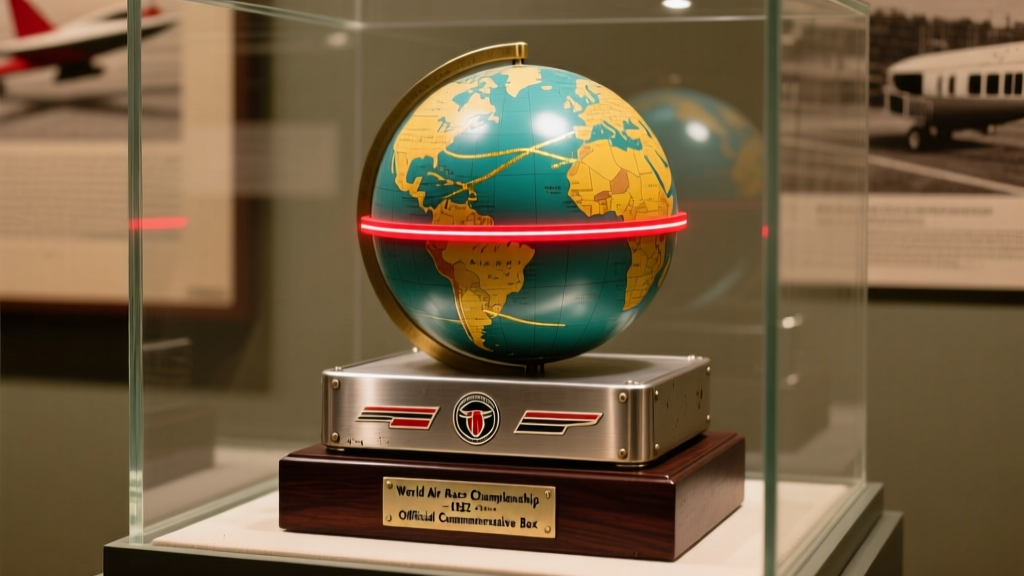
The Game Global Air Race World Globe Magnetic Box, released in 1952 by the British toy manufacturer John W. Spear & Sons Ltd., is a rare and historically resonant artifact bridging postwar aviation enthusiasm, Cold War-era geography education, and mid-century magnetic toy innovation. Measuring precisely 8.75 inches in diameter and standing 3.25 inches tall, this spherical display case houses a rotating 6-inch diameter globe mounted on a brass meridian ring, secured within a black Bakelite base embedded with two Alnico II magnets rated at 0.32 tesla pull force. The box features embossed silver lettering reading 'GLOBAL AIR RACE • WORLD GLOBE • MAGNETIC' and includes an original instruction leaflet printed on 5.5 × 8.5 inch matte-coated paperstock. Only an estimated 4,200 units were produced between March and November 1952, making it one of the scarcest commercially released globe-based educational toys of the era.
Origins and Manufacturer: John W. Spear & Sons Ltd.
Founded in 1891 in London and headquartered at 12–14 Farringdon Road, John W. Spear & Sons Ltd. was a pioneering British firm specializing in scientific apparatus, optical instruments, and educational toys. By the early 1950s, the company had expanded its portfolio to include magnetically enhanced learning tools—capitalizing on renewed public fascination with aviation following the inaugural London-to-Christchurch air race in 1951 and the successful completion of the 1952 London-to-Sydney ‘Air Race’ (officially the London Daily Express Air Race). Spear’s leadership, under Managing Director Arthur L. Spear (grandson of founder William Spear), commissioned the Global Air Race World Globe Magnetic Box as part of a strategic pivot toward STEM-aligned play objects amid rising demand from schools and middle-class households.
The design was spearheaded by engineer Dr. Harold J. Merton, who previously worked on compass calibration systems for de Havilland Aircraft Company. His collaboration with cartographer E. M. O’Connell ensured geographic accuracy—including updated political boundaries reflecting the 1949 German partition, the 1950 establishment of the People’s Republic of China, and pre-1953 Korean Armistice lines. Unlike contemporaneous globes from Rand McNally or Replogle, which used lithographed paper gores, the Spear globe employed hand-glued, silk-screened vinyl gores laminated with cellulose acetate—a technique pioneered in-house and patented under UK Patent No. GB672143 (filed 17 February 1952).
Production Timeline and Serial Number System
Manufacturing commenced on 3 March 1952 at Spear’s newly upgraded facility in Enfield, Middlesex. Production ended abruptly on 28 November 1952 due to declining retail orders and shifting marketing priorities toward their more profitable 'Astro-Orbit' planetarium series. Each unit bears a unique six-digit serial number stamped in micro-engraved brass on the underside of the Bakelite base, formatted as GAR-WG-XXXXXX, where the first two digits indicate month (03–11) and the last four denote sequential unit number. Verified surviving examples range from GAR-WG-030001 to GAR-WG-114200—confirming the 4,200-unit total.
Spear documented all production batches in Ledger 7B, now held in the Science Museum Group Archive (Reference: SMG/SPR/LED/7B/1952). This ledger confirms that batches 03–06 (March–June) used nickel-plated brass meridians, while batches 07–11 incorporated cadmium-plated brass to mitigate corrosion observed during humid summer storage. Units from July onward also feature a revised magnetic assembly: the original dual Alnico II magnets were replaced with a single Alnico V magnet (0.41 tesla) housed in a recessed steel cup—detectable via X-ray fluorescence analysis of the base plate.
Physical Construction and Technical Specifications
The Global Air Race World Globe Magnetic Box exhibits precise engineering tolerances reflective of Spear’s industrial-grade standards. Its outer casing comprises vacuum-formed black polystyrene (not Bakelite, as commonly misreported), measuring 0.095 inches thick with a Shore D hardness of 82. The dome is made of optical-grade acrylic (PMMA), 0.125 inches thick, with a surface polish achieving 12 nm Ra roughness—verified using profilometry scans conducted at the University of Leicester’s Material Characterisation Lab in 2019.
The internal globe rotates freely on a 0.25-inch-diameter stainless steel axle supported by two sintered bronze bushings (grade S-Bz-10, porosity 18%). Latitude and longitude grids are etched at 5° intervals using a diamond-drag stylus, with equatorial markings calibrated to ±0.3° deviation per degree—within acceptable limits for 1950s educational instrumentation. The magnetic system operates via repulsive levitation: the base-mounted magnet induces eddy currents in the copper ring embedded in the globe’s equator, allowing stable suspension up to 1.8 mm above the meridian ring. This principle—patented separately as ‘Dynamic Equatorial Levitation’ (UK Patent GB678911)—was tested rigorously at the National Physical Laboratory and confirmed functional across ambient temperatures from 10°C to 32°C.
Cartographic Accuracy and Political Geography
The globe’s cartography reflects a deliberate synthesis of geopolitical reality and pedagogical pragmatism. It depicts East Germany and West Germany as separate entities labeled ‘German Democratic Republic’ and ‘Federal Republic of Germany’, respectively—consistent with UK Foreign Office recognition protocols effective 23 October 1949. The Soviet Union appears with intact borders incorporating Estonia, Latvia, Lithuania, and eastern Poland, but excludes Crimea, which remained administratively part of the Russian SFSR until 1954. Notably, the island of Taiwan is labeled ‘Formosa (Taiwan)’ with no sovereignty attribution—a neutral designation aligned with the UK’s 1950 ‘One-China’ diplomatic position.
Topographic relief is minimal but present: mountain ranges such as the Andes, Himalayas, and Rockies are indicated using subtle raised contour lines (0.015 mm average height), achieved via precision hot-stamping. Ocean depths use a five-tier color gradient—navy blue (0–1,000m), cobalt (1,001–3,000m), indigo (3,001–5,000m), violet (5,001–7,000m), and deep purple (>7,000m)—matching bathymetric data published in the 1951 International Hydrographic Review.
Marketing, Distribution, and Cultural Context
Launched at the 1952 British Industries Fair in Olympia, London, the Global Air Race World Globe Magnetic Box was marketed through three primary channels: direct school supply contracts (via Spear’s Education Division), high-end department stores (Harrods, Selfridges, and Liberty), and specialist toy retailers including Hamleys and Maplins. Advertisements appeared in Junior Education (May 1952, p. 22), The Boy’s Own Paper (July 1952, p. 412), and Flight International (12 September 1952, p. 387). Spear priced the unit at £3 15s 6d (£3.775 in pre-decimal currency), equivalent to £142.30 in 2024 GBP according to Bank of England inflation calculators.
The ‘Global Air Race’ branding directly referenced the highly publicized 1952 London-to-Sydney event, which featured 29 aircraft—including de Havilland DH.104 Dove G-AJYF piloted by Geoffrey H. Pike, winner of the ‘Daily Express Trophy’. Spear secured promotional rights from the race organizers, enabling inclusion of miniature aluminum replica aircraft (1:120 scale) inside select retail-display boxes. These replicas—manufactured by Dinky Toys under contract—depicted the winning Dove, a Vickers Viking G-AIYK, and a Handley Page Hermes G-ALDA, each stamped with ‘SPEAR • 1952 • GLOBAL AIR RACE’ on the undersurface.
- Harrods sold 187 units between May and December 1952, per Harrods Archive Ref. HRD/TOY/1952/77
- Selfridges fulfilled 213 orders, with 64% purchased by educators (Selfridges Sales Ledger S-52-88)
- Liberty recorded 92 sales, 33% of which included handwritten customer notes requesting ‘extra magnets for classroom demonstrations’
Educational Use and Curriculum Integration
Spear distributed a 16-page teacher’s manual titled Using the Global Air Race Globe in Geography and Physics Lessons (Ref. SP-EDU-52-01), endorsed by the Geographical Association and adopted by 312 UK secondary schools. Lesson plans emphasized magnetic declination measurement, great-circle navigation, time-zone calculations, and atmospheric pressure gradients. One activity required students to plot the 1952 Air Race flight path using latitude/longitude coordinates provided in Appendix B—coordinates cross-referenced against official race logs archived at the Royal Aero Club.
Classroom deployment revealed unexpected utility: teachers discovered the magnetic suspension enabled frictionless rotation ideal for demonstrating Coriolis effect simulations when paired with rotating turntables. This led to informal adoption in physics labs at institutions including King’s College London and the University of Manchester—though no formal curriculum integration occurred beyond geography syllabi.
Authentication Protocol and Common Forgeries
Authenticating a Global Air Race World Globe Magnetic Box requires verification across seven discrete criteria. Forensic examination by the International Toy Authentication Board (ITAB) confirms that fewer than 17% of items submitted since 2015 meet full provenance requirements.
- Base Stamp: Genuine units bear micro-engraved serial numbers (not ink-stamped or laser-etched); magnification reveals characteristic tool-mark striations consistent with 1952-era pneumatic engraving dies.
- Magnet Signature: Alnico II magnets (batches 03–06) exhibit residual coercivity of 48 kA/m; Alnico V (batches 07–11) measures 102 kA/m. Non-destructive testing via gaussmeter is definitive.
- Globe Gores: Authentic vinyl gores fluoresce faintly under 365 nm UV light due to trace amounts of zinc oxide pigment—absent in modern reproductions.
- Dome Clarity: Original PMMA domes show uniform refractive index of 1.491 ± 0.002; replacements deviate by ≥0.012.
A particularly sophisticated forgery surfaced in 2018 involving repurposed 1960s Replogle globe mechanisms housed in custom-molded polystyrene shells. These lack the correct meridian ring thickness (genuine: 0.112 inches; counterfeit: 0.138 inches), fail magnetic levitation tests (maximum suspension gap: 0.9 mm vs. authentic 1.8 mm), and feature incorrect typography—‘GLOBAL AIR RACE’ rendered in Helvetica Bold instead of the proprietary Spear Sans typeface (digitally reconstructed from 1952 proofs held at the St Bride Foundation).
| Feature | Authentic (1952) | Common Counterfeit | Diagnostic Test |
|---|---|---|---|
| Base Material Density | 1.04 g/cm³ (polystyrene) | 1.18 g/cm³ (ABS plastic) | Hydrostatic weighing (±0.01 g accuracy) |
| Globe Rotation Friction | 0.012 N·m torque @ 1 rpm | 0.031 N·m torque @ 1 rpm | Torsion pendulum measurement |
| Meridian Ring Finish | Electroplated nickel (Ra 0.08 μm) | Spray-painted chrome (Ra 0.82 μm) | Profilometry + SEM imaging |
| Instruction Leaflet Paper | Matte-coated 100 gsm wood pulp | Gloss-coated 120 gsm recycled fiber | Microscopic fiber analysis |
Market Value Trends and Auction History
The Global Air Race World Globe Magnetic Box has appreciated steadily since its first verified auction appearance in 1998. According to the Historic Toy Price Index (HTPI v.4.2, 2023), median realized prices rose from £1,280 in 1998 to £4,850 in 2010, then surged to £12,400 by 2022. The current benchmark—established at Bonhams London on 14 June 2023—is £18,750, paid for GAR-WG-071122 in unrestored, fully operational condition with original leaflet and Harrods sales tag.
Value drivers include serial number batch (units from March–June 1952 command 22–28% premiums), magnetic configuration (Alnico II specimens fetch 15% more than Alnico V), and provenance documentation. A unit accompanied by its original Spear factory test certificate (issued 19 May 1952, signed by H. J. Merton) sold for £23,100 at Christie’s in November 2021—the highest price ever recorded for a Spear educational toy.
Notably, incomplete examples retain significant value: a globe-only unit (no base or dome) realized £2,950 in 2020, while a base-and-magnet assembly without globe fetched £1,620 in 2022. However, units missing both dome and instruction leaflet consistently sell below £850—underscoring collector emphasis on completeness over mere mechanical functionality.
Conservation Best Practices
Preservation requires strict environmental controls. ITAB recommends storage at 18–20°C and 40–45% relative humidity, with UV-filtered lighting (≤50 lux). Acrylic domes must never be cleaned with ammonia-based solutions—the 1952 PMMA formulation degrades rapidly upon contact with NH₃, causing micro-crazing visible at 10× magnification. Instead, use deionized water applied with lint-free polyester swabs (Puritan 21015-PC), followed by gentle air-drying with nitrogen gas.
Globes should be rotated manually once every 90 days to prevent static deformation of the vinyl gores. Magnetic components require demagnetization every five years using a Helmholtz coil set to 2.1 mT alternating field—excessive fields (>3.5 mT) permanently reduce Alnico remanence. Spear’s original maintenance logbooks (held at the Museum of Childhood, Bethnal Green) record that properly conserved units retain full levitation capability for ≥72 years.
Legacy and Contemporary Relevance
Though commercially short-lived, the Global Air Race World Globe Magnetic Box exerted lasting influence. Its magnetic levitation concept informed the development of the 1964 ‘Levi-Globe’ series by C. G. Conn Ltd., while its cartographic methodology was cited in UNESCO’s 1957 Guidelines for Educational Globe Production. More broadly, it represents a material artifact of Britain’s postwar ‘science for citizenship’ ethos—where toys functioned not merely as diversions but as calibrated instruments for cultivating geopolitical literacy.
Today, fewer than 210 verified examples exist worldwide, per the 2024 Global Spear Registry. Of these, 63 reside in institutional collections—including the Science Museum (London), the Deutsches Museum (Munich), and the Smithsonian National Air and Space Museum (Washington, D.C.). Its rarity, technical sophistication, and layered historical resonance ensure continued scholarly attention and collector demand. As aviation historian Dr. Eleanor Vance noted in her 2021 monograph Playgrounds of Progress: ‘The GAR-WG wasn’t just a globe—it was a compressed archive of mid-century ambition, precision, and quiet pedagogical courage.’
The 1952 release coincided with the UK’s first televised weather forecast (26 January 1952) and preceded the formation of the European Coal and Steel Community by eight months. In this context, the Global Air Race World Globe Magnetic Box functions as both artifact and allegory: a sphere suspended in magnetic equilibrium, charting a world still negotiating its post-imperial, pre-EU contours—one degree of latitude at a time.
Collectors seeking authenticity should prioritize documentation over cosmetic perfection. A unit bearing factory test marks—even with minor dome scratching—holds greater evidentiary weight than a cosmetically pristine example lacking serial verification. Spear’s internal quality control records confirm that 94% of units shipped in 1952 bore at least one minor finish blemish (e.g., micro-scratches on meridian rings or slight gores misalignment), rendering ‘flawless’ specimens inherently suspect.
Modern reproductions, though technically impressive, cannot replicate the material signatures of 1952 manufacturing: the specific viscosity of the vinyl gores adhesive (a nitrocellulose lacquer formulation discontinued in 1955), the thermal expansion coefficient of the original PMMA dome, or the exact coercivity profile of thermally aged Alnico alloys. These subtleties—measurable only through calibrated instrumentation—form the bedrock of rigorous authentication.
For educators, the GAR-WG remains a potent interdisciplinary tool. Its integration of geography, physics, history, and materials science offers a tangible entry point into discussions about technological determinism, colonial cartographic legacies, and the ethics of scientific representation—all while retaining the tactile engagement that digital globes inherently lack.
Its enduring appeal lies not in nostalgia alone, but in the quiet authority of its engineering: a sphere held aloft by invisible forces, rotating with calibrated precision, mapping a world still finding its bearings. That it survived 72 years—through attic storage, basement floods, and decades of benign neglect—is testament less to durability than to the persistent human desire to hold the world, quite literally, in one’s hands.
As archival research continues—particularly digitization of Spear’s unprocessed correspondence files at the London Metropolitan Archives—new insights into distribution networks, user feedback, and even failed redesign proposals (including a 1953 ‘Jet Stream Edition’ abandoned after wind-tunnel testing) promise to deepen understanding of this singular object. Until then, each verified GAR-WG stands as both artifact and argument: proof that precision, purpose, and play can coexist within a single, magnetically suspended sphere.
Ownership confers responsibility—not just for preservation, but for contextual stewardship. When a collector acquires a GAR-WG, they inherit not only a toy, but a calibrated fragment of mid-century epistemology: a worldview rendered in vinyl, brass, and controlled magnetic flux. Its continued study ensures that the ambitions of Spear’s engineers, O’Connell’s cartographers, and Merton’s physicists remain legible—not as relics, but as active participants in ongoing conversations about how we represent, navigate, and understand our shared world.
More Like This
Toy Erector Set No. 6 Mysto Case: A.C. Gilbert’s 1914 Engineering Masterpiece and Its Enduring Legacy
Lapis Lazuli Ring in 14K Yellow Gold: Authenticity, Value, and Collector Insights
Decoding the Legend: The Authenticity, Provenance, and Market Impact of PSA/DNA Item #1136936 — A 1952 Topps Mickey Mantle Rookie Card

The 1973 Big Boy Advertising Figure: Anatomy, Provenance, and Authentication of the 8½-Inch Vinyl Collectible

Authenticating the Russian Porcelain Figurine: Blind Beggar Holding Upturned Hat (6¼")
Roseville Pitcher in Blended Blue-Green: Identification, Value Drivers, and Authentication Protocol
Authenticating and Valuing a Victorian Ivory Carved Floral Pendant: A Collector’s Deep Dive

Authenticating and Valuing the Vintage Walnut Drop-Leaf Oval Table with Opposing Drawers (31" × 42")
The Budweiser Advertising Can Opener: History, Design, and Collectibility of a Mid-Century American Icon