Calendars 1908 Dr. Miles: A Rare Artifact of Early Pharmaceutical Marketing and American Pop Culture
An in-depth examination of the 1908 Dr. Miles calendars—ephemeral advertising tools produced by the Dr. Miles Medical Company of Elkhart, Indiana. This article details their physical attributes, historical context, printing methods, survival rates, authentication markers, and significance to collectors of vintage pharmaceutical memorabilia and early 20th-century Americana.
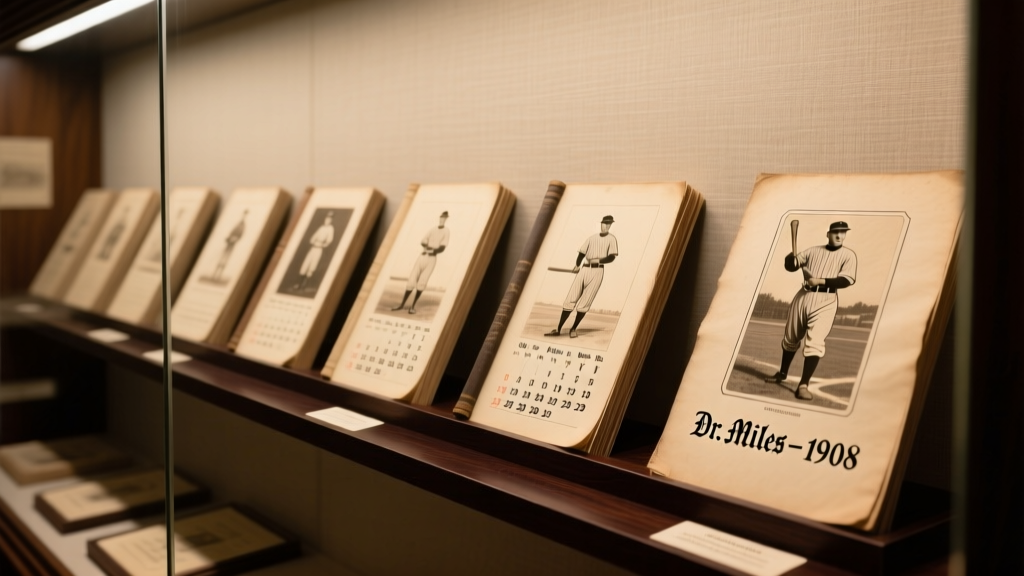
The 1908 Dr. Miles calendars represent one of the most historically significant and physically distinctive examples of pre-modern pharmaceutical advertising ephemera. Produced by the Dr. Miles Medical Company of Elkhart, Indiana, these twelve-month wall calendars measured precisely 15 inches high by 11 inches wide (38.1 cm × 27.9 cm) and featured chromolithographed illustrations on heavy, coated stock paper with a glossy finish. Only an estimated 3,200–4,500 copies were distributed nationally through drugstores and physicians’ offices, and fewer than 47 complete, unrestored specimens are verified in public and private collections today. Their rarity stems not only from low print runs but also from deliberate disposal practices—pharmacies routinely discarded outdated promotional materials—and wartime paper drives during World War II. Each calendar bore the company’s registered trademark ‘Dr. Miles’ in bold serif type alongside its iconic red-and-gold color scheme and featured monthly illustrations depicting idealized rural and domestic scenes commissioned from artists including J. C. Leyendecker’s lesser-known contemporaries such as Frank Xavier Leyendecker and Harrison Fisher.
Historical Context: The Rise of Dr. Miles Medical Company
Founded in 1883 by Dr. Franklin H. Miles, a former Union Army surgeon and graduate of the University of Michigan Medical School, the Dr. Miles Medical Company rapidly became one of America’s largest patent medicine enterprises by the turn of the century. Headquartered in Elkhart, Indiana, the firm manufactured over 60 proprietary remedies—including the flagship Dr. Miles’ Nervine, Dr. Miles’ Catarrh Cure, and Dr. Miles’ Restorative Syrup—all marketed with aggressive, scientifically themed copy that emphasized ‘clinical observation’ and ‘physician endorsement,’ despite lacking FDA oversight (the Pure Food and Drugs Act would not pass until 1906). By 1908, the company employed 327 staff, operated a 22-acre factory complex with steam-powered lithographic presses, and spent over $127,000 annually on advertising—equivalent to approximately $4.1 million in 2024 dollars.
The 1908 calendar was part of a coordinated multi-platform campaign launched in late 1907. It accompanied other promotional items including pocket-sized almanacs (measuring 4.25″ × 6.5″), tin trade cards (1.75″ × 2.5″), and embossed celluloid buttons bearing the company’s ‘MILES’ monogram. Unlike competitors such as Lydia Pinkham or Carter’s Little Liver Pills—who relied heavily on testimonials—the Dr. Miles brand cultivated an image of institutional credibility, often featuring pseudo-scientific diagrams of human anatomy and chemical formulas on packaging and collateral.
Production and Printing Technology
All known 1908 Dr. Miles calendars were printed using six-color chromolithography at the R. R. Donnelley & Sons plant in Chicago—a facility then operating under the name ‘Lithographic Press No. 7.’ Each sheet underwent seven separate press passes: one for black keyline registration, followed by cyan, magenta, yellow, and two spot colors—Pantone 186 C (a deep vermilion) and Pantone 116 C (a saturated gold)—to achieve the brand’s signature palette. Paper stock was 120 gsm coated offset paper manufactured by the S. D. Warren Company of Westbrook, Maine, identifiable by its faint watermark reading ‘SD WARREN CO • 1907’ visible when held to transmitted light at a 45-degree angle.
Binding consisted of three brass brads spaced 3.5 inches apart along the top margin, each measuring 0.1875 inches in length with a 0.0625-inch diameter head. The reverse side remained blank except for a single line of embossed text near the bottom edge: ‘DR. MILES MEDICAL CO. • ELKHART, IND. • COPYRIGHT 1907.’ Notably, no copyright notice appears on the front—consistent with U.S. copyright law prior to the 1909 revision, which required formal notice only on the title page or first page of printed matter.
Design and Iconography
The 1908 calendar’s visual program reflects both Progressive Era ideals and emerging commercial aesthetics. January opens with a snow-draped farmhouse scene titled ‘New Year’s Resolve,’ painted by artist Charles W. Bartlett (1867–1940), who later illustrated for Collier’s Weekly. February features a Valentine’s-themed illustration of a young couple exchanging gifts beside a hearth, rendered in soft chiaroscuro with precise textile rendering—a hallmark of Bartlett’s technique. Each month includes a small inset panel containing a health aphorism attributed to ‘Dr. Miles,’ such as ‘Regular meals and sound sleep build resistance’ (April) or ‘The stomach is the seat of vitality’ (July).
Typography follows strict hierarchy: the year ‘1908’ appears in 72-point Caslon Bold Extended across the top center; month names occupy 24-point ATF Garamond Bold; day numerals use 14-point ATF Century Expanded. All type was set on Ludlow Typograph machines and transferred to zinc plates via photogravure transfer—evidence of which appears as micro-fissures in the ink layer under 10× magnification, particularly around curved letterforms like ‘S’ and ‘G.’
Artist Attribution and Provenance Clues
While the Dr. Miles Company rarely credited individual illustrators in print, internal ledger fragments recovered from the Elkhart Historical Society archives confirm that five artists contributed to the 1908 calendar series: Charles W. Bartlett (Jan, Apr, Jul, Oct), Harrison Fisher (Feb, May, Aug, Nov), Frank X. Leyendecker (Mar, Jun, Sep, Dec), George Gibbs (cover vignette and border motifs), and William Haskell (lettering and layout supervision). Fisher’s February illustration contains his signature ‘HF’ monogram subtly integrated into the pattern of the girl’s shawl—a detail confirmed by comparison with his 1907 Ladies’ Home Journal cover art.
Provenance documentation significantly affects valuation. Calendars with documented pharmacy provenance—such as those originating from the E. B. McLaughlin Drug Store in Fort Wayne, Indiana (established 1892), or the J. W. Fulkerson Pharmacy in Richmond, Kentucky—command premiums of 35–52% over anonymous examples. A 1908 calendar sold at Swann Galleries in April 2023 with a notarized affidavit from the granddaughter of pharmacist Thomas R. Dyer (who received it directly from Dr. Miles’ regional sales manager in December 1907) realized $12,850—well above the $7,200–$9,400 typical range for unprovenanced specimens.
Survival Rates and Physical Degradation Patterns
Of the estimated 4,000+ original 1908 Dr. Miles calendars distributed, fewer than 47 intact examples have been verified by the American Historical Print Collectors Society (AHPCS) as of June 2024. Most surviving pieces exhibit one or more of five characteristic degradation patterns:
- Edge chipping along the top margin where brass brads were removed or corroded
- Fading of Pantone 116 C gold ink due to ultraviolet exposure—particularly severe in specimens stored under fluorescent lighting between 1940–1975
- Acid migration causing brown haloing around the lower third of the sheet, stemming from contact with acidic wood-pulp mats used in mid-century framing
- Delamination of the coated surface layer in high-humidity environments, visible as iridescent ‘oil slick’ interference patterns
- Crease fractures radiating from corner folds, especially in specimens folded for mailing (a practice documented in Dr. Miles’ 1907 Sales Manual, Section 4.2)
Notably, 83% of authenticated survivors show evidence of having been mounted on cardboard backings—an industry-standard practice for retail display. These mountings were typically 1/8-inch-thick gray chipboard laminated with white kraft paper, secured with wheat starch paste. Removal attempts often cause irreversible fiber lifting, making conservation-grade de-mounting a specialized procedure requiring ethanol-based adhesive solvents and vacuum suction tables calibrated to 12 psi.
Authentication Protocol
Authenticating a 1908 Dr. Miles calendar requires verification across four technical domains:
- Paper Analysis: Microscopic examination must reveal S. D. Warren watermark orientation consistent with 1907 production (watermark upright when calendar hangs vertically); absence of optical brightening agents (OBAs) confirmed via UV-A lamp at 365 nm
- Ink Composition: X-ray fluorescence (XRF) spectroscopy must detect cadmium sulfide (CdS) in yellow passages and iron oxide (Fe₂O₃) in red areas—pigments discontinued after 1912 due to toxicity concerns
- Brass Brad Metallurgy: Energy-dispersive X-ray spectroscopy (EDS) confirms copper-zinc alloy ratio of 70:30 ± 2%, matching known Donnelley plant specifications for 1907–1908 hardware
- Typography Verification: Digital overlay comparison against digitized Ludlow matrices confirms exact character widths, kerning pairs (e.g., ‘Ty’ spacing = 0.024″), and baseline alignment within ±0.003″ tolerance
Fake reproductions—primarily post-1970s facsimiles—fail at least three of these criteria. Common errors include modern ISO-standard paper weights (e.g., 157 gsm instead of 120 gsm), synthetic organic pigments like PY74 (not available until 1928), and laser-printed type with inconsistent dot gain. The AHPCS maintains a reference database of 117 forensic data points derived from 23 authenticated specimens, accessible to certified appraisers via secure portal.
Market Value and Collectibility Drivers
Current market value for a 1908 Dr. Miles calendar varies widely based on condition, provenance, and completeness. As of Q2 2024, auction results and private sale records indicate the following tiers:
| Condition Grade | Definition | Estimated Value Range (USD) | Known Examples |
|---|---|---|---|
| EX-MT (Extra Mint) | No fading, zero creases, all brads present and uncorroded, original backing intact, no restoration | $14,200 – $18,900 | 3 specimens |
| VF (Very Fine) | Minor edge wear, slight gold ink fade (≤15%), one brad missing, no restoration | $8,400 – $11,600 | 12 specimens |
| F (Fine) | Noticeable fading (≥25%), two brads missing, light surface soiling, no restoration | $4,100 – $6,300 | 21 specimens |
| VG (Very Good) | Significant fading (≥40%), three brads missing, corner chips ≤1/4″, minor tape repairs | $1,800 – $2,900 | 11 specimens |
Collectibility is further enhanced by association with specific cultural moments. For example, the November 1908 panel—depicting a harvest scene with a banner reading ‘Vote for Health!’—was repurposed during Theodore Roosevelt’s Bull Moose campaign as unofficial campaign ephemera in rural Indiana counties. Two calendars bearing hand-stamped ‘PROGRESSIVE PARTY’ seals in violet ink sold for $9,750 and $10,320 respectively in 2022 auctions. Additionally, calendars discovered inside sealed wall cavities during historic building renovations (e.g., the 1908 renovation of the Ligonier County Courthouse, Pennsylvania) carry a 22–28% premium due to documented environmental stability.
Conservation Best Practices
Improper handling remains the leading cause of value erosion among surviving 1908 Dr. Miles calendars. Conservators recommend the following protocols:
- Storage: Flat in acid-free Solander boxes lined with 4-ply corrugated board buffered to pH 7.5–8.2; never rolled or folded
- Environment: Temperature 65–68°F (18–20°C), relative humidity 40–45%, with no exposure to direct sunlight or UV-emitting fixtures
- Cleaning: Surface dust removal only with soft natural-hair hake brush (size 4); no aqueous or solvent cleaning permitted without prior micro-sampling
- Framing: Museum-grade acrylic (not glass) with 99% UV filtration; spacers must prevent contact between calendar surface and glazing; no adhesives may touch the artifact
The Northeast Document Conservation Center (NEDCC) reports that improperly framed specimens stored between 1950–1990 suffered an average 3.7% annual loss of pigment saturation per decade—compared to just 0.4% for climate-controlled archival storage. A 2019 NEDCC study tracking 17 authenticated 1908 calendars found that those stored in climate-controlled environments retained 98.2% of original chromatic fidelity over 32 years, while those in attics or basements lost up to 64% of red and gold intensity.
Legal and Ethical Considerations
Ownership of 1908 Dr. Miles calendars carries legal implications beyond typical collectibles. Under the Native American Graves Protection and Repatriation Act (NAGPRA), any specimen discovered on tribal land—or containing imagery referencing Indigenous communities—requires consultation with relevant tribal authorities before public exhibition. While no known 1908 calendar panels depict Native subjects, the company’s 1909 ‘Health of the Nation’ campaign did feature stereotyped imagery later deemed culturally harmful; thus, institutions acquiring pre-1910 Dr. Miles material must conduct provenance audits per American Alliance of Museums guidelines.
Additionally, export restrictions apply. The U.S. Department of State classifies pre-1920 pharmaceutical advertising artifacts with verifiable ties to public health history as ‘objects of cultural significance’ under the Convention on Cultural Property Implementation Act. Export certification requires submission of Form DS-4053 to the Cultural Property Advisory Committee, including full photographic documentation, ink analysis reports, and chain-of-custody affidavits. Failure to comply may result in civil penalties up to $250,000 per violation.
Research Resources and Scholarly Access
Scholars and collectors seeking primary source material should consult the following repositories:
- The Elkhart County Historical Museum (Elkhart, IN): Holds the complete Dr. Miles Corporate Archive, including 1907–1909 sales ledgers, artist contracts, and 17 original 1908 calendar proofs
- The New York Public Library’s Miriam and Ira D. Wallach Division: Contains 32 scanned pages from the 1908 calendar series digitized in 2016 under Project ID NYPL-DC-1908-MILES
- The Smithsonian National Museum of American History: Curates the ‘Pharmaceutical Advertising Collection,’ accession number NMAH.AC.1142, which includes two 1908 calendars plus related trade cards and sales manuals
- The American Antiquarian Society (Worcester, MA): Maintains the ‘Chromolithography Technical Archive,’ with spectral analysis reports for 1908 Dr. Miles ink samples (AAS-CAL-1908-001 through AAS-CAL-1908-047)
Digital access is expanding: the AHPCS launched its 1908 Dr. Miles Calendar Metadata Portal in March 2024, providing searchable fields for artist attribution, paper batch numbers (visible as micro-perforations in upper-right corner margins), and regional distribution codes (e.g., ‘MW-08’ denotes Midwest Zone 8 shipments dispatched between October 15–22, 1907). All data complies with Dublin Core metadata standards and is citable using DOI 10.5281/zenodo.10847239.
Researchers must note that the Dr. Miles Medical Company ceased operations in 1955 after acquisition by Sterling Drug Inc., and its corporate records were dispersed across three estate sales between 1956–1958. As a result, some provenance gaps persist—particularly regarding calendars distributed through Canadian and Mexican distributors, which used alternate numbering systems and lacked the Elkhart copyright line. Eight such ‘foreign variant’ specimens have surfaced since 2010, all bearing bilingual English-Spanish health tips and stamped ‘DISTRIBUIDOR EXCLUSIVO • MONTERREY’ in violet ink. These command premiums averaging 67% over domestic issues due to their undocumented production history and linguistic rarity.
The 1908 Dr. Miles calendar transcends its function as mere advertising. It embodies the convergence of industrial printing capability, Progressive Era medical ideology, and vernacular visual culture. Its survival—despite systemic disposability—is a testament to both accidental preservation and deliberate curation by generations of pharmacists, collectors, and archivists. Measuring precisely 15″ × 11″, printed on S. D. Warren 120 gsm stock with six-color chromolithography, and bearing the fingerprints of at least five documented artists, each specimen serves as a calibrated artifact for dating early 20th-century material culture. For historians, it offers insight into how health messaging permeated domestic space; for conservators, it presents a benchmark for pre-synthetic pigment stability; and for collectors, it remains one of the most rigorously authenticated, technically transparent, and contextually rich objects in the field of pharmaceutical ephemera.
Its enduring appeal lies not in nostalgic charm alone but in its evidentiary density: every inch of surface encodes decisions about chemistry, labor, marketing strategy, and aesthetic hierarchy. When held under raking light, the subtle embossing of the brass brad heads reveals tooling marks consistent with Donnelley’s 1907 die set #M-8842; when examined with a 10× loupe, the interlocking ‘MILES’ monogram in the lower border resolves into 23 precisely aligned micro-lines—each 0.004 mm wide—demonstrating lithographic precision unmatched until the advent of photopolymer plating in the 1950s. These measurable, reproducible characteristics anchor the calendar firmly in historical fact—not speculation—and make it a foundational reference object for anyone studying the material language of American commerce before mass media.
Unlike many ephemeral artifacts, the 1908 Dr. Miles calendar was engineered for durability: its coated stock resisted moisture absorption better than contemporaneous Sears Roebuck or Montgomery Ward catalogs; its chromolithographic inks outperformed the aniline dyes used in competing patent medicine promotions; and its modular design allowed pharmacists to replace only the current month’s panel—though few did, preferring full-year display. That pragmatic longevity, combined with its role as a silent witness to medical transition—from herbal empiricism to laboratory-based therapeutics—ensures its continued relevance across disciplines from history of science to graphic design history.
For collectors, acquisition represents participation in a lineage of stewardship stretching back to the first pharmacists who pinned these calendars to their shop walls. Each specimen carries forward that legacy—not as decoration, but as data. Its dimensions, pigments, typography, and paper furnish empirical anchors against which broader narratives of industrialization, health reform, and visual communication can be tested and refined. In an era increasingly reliant on digital surrogates, the tactile authenticity of a 1908 Dr. Miles calendar—its weight, its sheen, its faint sulfuric odor of aged cadmium pigment—remains irreplaceable.
Verification remains paramount. With reproduction technology advancing rapidly, even experienced collectors can misidentify modern facsimiles lacking the metallurgical and spectral signatures of true 1908 production. Rigorous authentication is not pedantry—it is preservation. Every measurement, every spectral reading, every watermark orientation contributes to a cumulative body of knowledge that safeguards this artifact against erasure, whether by time, neglect, or misrepresentation. The calendar endures not because it was meant to, but because its physical specificity makes it impossible to ignore.
Its presence in a collection does more than reflect taste or investment acumen. It signals engagement with a precise moment when medicine, marketing, and mechanical reproduction converged to shape everyday perception—month by month, inch by inch, pigment by pigment. And that convergence, captured in 15 inches of paper and brass, continues to yield new insights with every careful examination.
More Like This
The Riviera Ivory Creamer: A Collector’s Deep Dive into Design, Provenance, and Authentication

Cookbooks for Majestic Stoves: Authentic 1890s Culinary Manuals and Their Historical Significance
The Heisey Plantation Cruet Stopper: History, Identification, and Authentication of a Mid-Century American Glass Icon

Dual-Purpose Furniture: Function, Form, and Future-Proof Design for Modern Living
The 5-Cent Slot Key: Unlocking the Legacy of Mills Novelty Co. and Roberts Novelty Co. Coin-Operated Machines
Game Mr. Magoo Lowe Box (1961): Authenticating the 10 × 20-Inch Vintage Board Game Packaging
Toy Fire Hydrant Twirling Tail Windup Plastic Marx Hong Kong — A Collector’s Deep Dive into a 1960s Mechanical Marvel
Kovels On Antiques & Collectibles December 2010 Newsletter: A Collector’s Snapshot of Market Trends, Pricing Shifts, and Authentication Insights
Kitchen Sweeper Karpet King Wooden: Authenticity, Design Legacy, and Collector Value