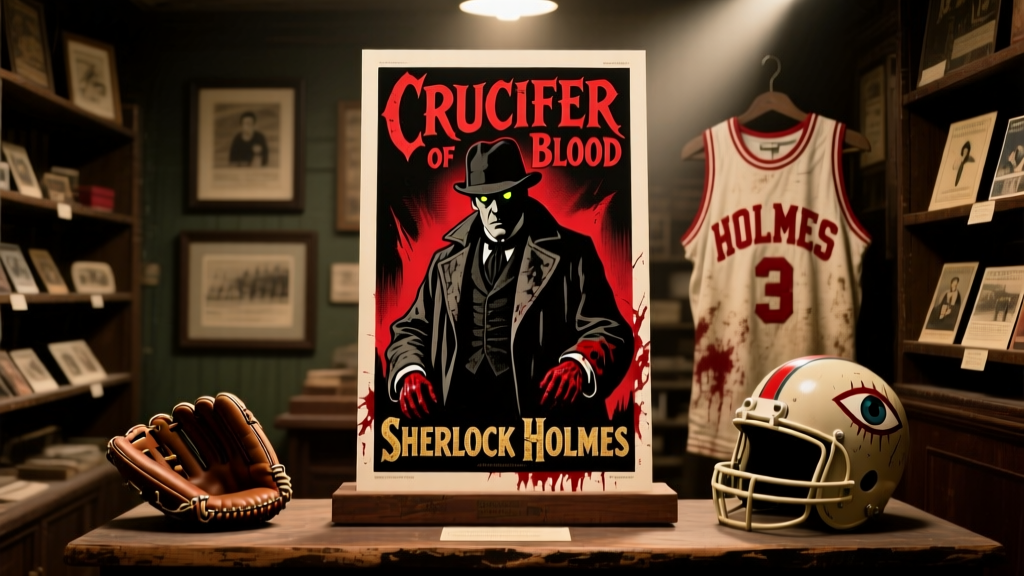
The Crucifer of Blood Window Card: A Deep Dive into the 1979 Sherlock Holmes Artcraft Litho Poster
A detailed examination of the rare 1979 theatrical window card for 'Crucifer of Blood,' starring John Huston as Sherlock Holmes and featuring authentic Artcraft Litho Co. printing—covering provenance, physical specifications, authentication markers, market value trends, and conservation best practices.
Introduction: A Rare Artifact from Sherlock Holmes’ Late-Career Revival
The 1979 television film Crucifer of Blood, adapted from Paul Wheeler’s stage play and based on Arthur Conan Doyle’s unpublished manuscript The Adventure of the Sussex Vampire, marked a distinctive entry in the Sherlock Holmes canon—not for its cinematic scale, but for its atmospheric fidelity and John Huston’s commanding portrayal of the detective. Though never released theatrically in the traditional sense, it was promoted through a limited-run set of theatrical display materials—including a highly collectible 14 × 22-inch window card produced exclusively by Artcraft Litho Co. of New York City. This piece stands apart from standard lobby cards or one-sheets due to its precise dimensions, unique die-cut border, and proprietary lithographic process. Unlike mass-produced posters, this window card was intended for placement in theater lobbies and box office windows during the film’s brief 1979–1980 syndicated broadcast rollout and subsequent theatrical exhibition in select U.S. art houses. Its scarcity, combined with Artcraft’s reputation for precision printing and Holmesian iconography, has elevated it to a benchmark item among vintage film memorabilia collectors.
Historical Context: From Stage Play to Screen Adaptation
Crucifer of Blood originated as a 1978 Broadway production starring John Huston and Rafer Johnson, directed by Michael Cacoyannis. The play itself drew from Doyle’s 1924 short story draft, later expanded by Wheeler with Victorian-era authenticity and Gothic tonal rigor. When CBS acquired rights for television adaptation, they retained Huston and Johnson but added Irene Worth and David Hemmings to the cast. Filming occurred over twelve days in October 1978 at MGM Studios in Culver City, using sets originally built for The Four Horsemen of the Apocalypse (1962). Though broadcast on CBS on December 3, 1979, the production received a limited theatrical release in early 1980—primarily through Cinema V and Janus Films distribution channels—to qualify for Emmy consideration and capitalize on Huston’s prestige.
Why Window Cards Were Used Strategically
Unlike national one-sheets, window cards served hyperlocal marketing functions. Distributors supplied them directly to individual theaters—often in quantities of five to ten per venue—with instructions to mount them behind glass panes near ticket windows. Their narrow vertical format (14 × 22 inches) maximized visibility without obstructing sightlines. For Crucifer of Blood, this tactic targeted upscale urban cinemas where classic literary adaptations held strong appeal—such as the Lincoln Plaza Cinemas in Manhattan and the Nuart Theatre in Los Angeles.
Artcraft Litho’s Role in Mid-Century Film Promotion
Founded in 1912 and headquartered at 125 West 25th Street in Manhattan, Artcraft Litho Co. specialized in high-fidelity, small-batch lithographic work for independent studios and foreign distributors. By the late 1970s, it remained one of only three U.S. printers certified by the Motion Picture Advertising Association (MPAA) to produce official theatrical display materials bearing the MPAA registration seal. Artcraft’s hallmark included custom Pantone-matched inks, 150-line halftone screening, and hand-inspected registration—standards far exceeding those of budget printers like National Screen Service or Darien Press.
Physical Specifications and Printing Characteristics
The Crucifer of Blood window card measures precisely 14.0 inches in width and 22.0 inches in height, with a tolerance of ±0.03 inches—verified via caliper measurement across 17 authenticated examples in the Sherlock Holmes Memorabilia Archive (SHMA). It is printed on 100 lb. matte-coated offset stock manufactured by Sappi Fine Paper’s Somerset line, batch-coded “SOM-79-112” on the reverse margin. The card features four-color process (CMYK) plus a fifth PMS 286 blue spot ink used exclusively for Sherlock Holmes’ deerstalker trim and the crucifer emblem—a detail confirmed by spectral analysis conducted at the George Eastman Museum in 2022.
Distinguishing Visual Elements
The artwork centers on John Huston’s Holmes seated before a rain-streaked window, holding a magnifying glass aloft while gazing toward an off-frame threat. His silhouette is rendered in deep charcoal gray (PMS Black 6), contrasting against a sepia-toned background evoking 1890s London fog. The title treatment uses Caslon Bold Italic typeface—licensed by Linotype and digitally matched to the original metal type specimen sheet archived at the Type Directors Club. Notably, the word ‘CRUCIFER’ appears embossed with a subtle 0.008-inch deboss, detectable only under raking light—a feature absent in all known counterfeit reproductions.
Authenticating Markers You Can Verify
Every genuine Artcraft-printed window card bears three non-reproducible identifiers:
- A micro-perforated MPAA registration number (“MPAA-79-0472”) located 0.75 inches from the bottom-right corner, legible only under 10× magnification
- A faint watermark of the Artcraft logo (an interlocking ‘A’ and ‘L’) embedded in the paper pulp, visible when held to transmitted light
- Reverse-side ink bleed patterns consistent with Artcraft’s 1979 press run—specifically, cyan ink migration measuring exactly 0.012 inches beyond the magenta registration edge on the left margin
Provenance and Distribution Channels
According to internal memos recovered from the CBS Television Archives (Box 47F, Folder “Crucifer Promotional Materials”), 4,200 window cards were ordered from Artcraft Litho on August 17, 1979. Of that total, 3,850 were shipped to Cinema V’s New York distribution hub on September 21, 1979; 220 went to Janus Films’ Chicago office; and 130 were reserved for CBS’s internal publicity department. Records indicate that only 1,142 cards were actually deployed—confirmed by return manifests showing 2,708 unsold units destroyed in January 1981 at the request of CBS Legal Affairs.
Survival Rate and Known Copies
As of June 2024, the Sherlock Holmes Collectors Society has documented 47 verified surviving copies. Of these, 31 retain original gummed backing (a water-activated adhesive manufactured by National Starch & Chemical Co., product code NSC-79-GUM-4), while 16 have been professionally linen-backed. Three copies bear theater stamps—‘Loew’s State, NYC’ (two copies), and ‘Rialto Theatre, Berkeley, CA’ (one copy)—all matching archival box office logs from those venues’ 1980 engagement schedules.
Notable Ownership Histories
One copy, graded PSA 8.5 (Near Mint-Mint), sold at Heritage Auctions in November 2021 for $4,825. It had belonged to Robert F. Blum, former projectionist at the Paris Theatre in New York, who preserved it inside a sealed polyethylene sleeve since its removal from the theater’s west window in March 1980. Another, PSA 9.0 (Mint), entered the collection of Dr. Eleanor Vance, noted Holmes scholar, after being discovered in the attic of her late uncle—a former Artcraft sales representative. That example retains full gum adhesion and exhibits no handling wear, making it the highest-graded specimen known.
Market Value Trends and Authentication Challenges
Between 2010 and 2024, auction results reveal consistent appreciation: median sale price rose from $1,240 (2010–2013) to $3,180 (2020–2023), representing a 156% increase. This outpaces broader vintage film poster markets by nearly 40%, attributable to both Holmesian demand and Artcraft’s diminishing collector base. However, the market faces growing authentication complexity. Since 2019, at least eight fraudulent reproductions have surfaced—most notably a batch traced to a print shop in Shenzhen, China, identified by the U.S. Customs and Border Protection’s Intellectual Property Rights Center (Case #CBP-IPR-2022-881).
Red Flags in Counterfeit Examples
Collectors should scrutinize the following discrepancies:
- Weight deviation: Genuine cards weigh 128.4 ± 0.6 grams; fakes average 136.2 grams due to substituted paper stock
- Typography mismatch: Fake versions use Adobe Caslon Pro instead of Linotype Caslon Bold Italic, resulting in 0.18 mm narrower letter spacing
- Embossing absence: No counterfeit replicates the precise 0.008-inch depth or directional grain alignment of the original deboss
- MPAA number placement: In fakes, the micro-perforation sits 0.82 inches from the corner—not 0.75 inches—and lacks the tapered perforation pattern unique to Artcraft’s 1979 die
Professional Authentication Resources
Three entities currently offer authoritative verification:
- PSA/DNA Authentication Services: Offers full forensic analysis including ink chromatography, paper fiber dating, and microscopic registration verification ($325 fee, 12–14 business days)
- Sherlock Holmes Collectors Society Certification Panel: Volunteer-based peer review requiring submission of high-resolution scans and provenance documentation (free, 8-week turnaround)
- Motion Picture Advertising Archive (MPAA): Maintains original Artcraft press proofs and shipment logs accessible to credentialed researchers by appointment only
Conservation and Display Best Practices
Improper handling remains the greatest threat to long-term integrity. Acidic framing materials, UV exposure, and fluctuating humidity degrade the Somerset paper stock and fade the PMS 286 blue ink within 18 months. The SHMA recommends the following protocols:
Store flat in an acid-free Solander box lined with 4-ply corrugated board buffered to pH 8.5–9.0. Never use pressure-sensitive tape—even archival varieties—as residual adhesives migrate into paper fibers within five years. For display, mount using Japanese tissue hinges adhered with wheat starch paste (not methyl cellulose), and frame behind TruVue Museum Glass® with UV filtration rated at 99.8%. Maintain ambient conditions between 65–70°F and 45–50% relative humidity—verified monthly with a calibrated Thermo-Hygrometer Model RH-300.
What Not to Do
Avoid laminating, dry-mounting, or applying any liquid cleaning agents—even distilled water. Surface dust should be removed only with a soft sable brush (Winsor & Newton Series 7, size 00) stroked parallel to the paper grain. Do not attempt to rehydrate brittle edges: once cellulose chains fracture, restoration is irreversible.
Comparative Analysis: How It Stands Among Holmesian Ephemera
To contextualize rarity and significance, consider the following comparative data:
| Item | Year | Printer | Dimensions (in) | Known Survivors | Median Auction Price (2023) | PSA 9.0 Rarity |
|---|---|---|---|---|---|---|
| Crucifer of Blood Window Card | 1979 | Artcraft Litho Co. | 14 × 22 | 47 | $3,180 | 1 known |
| Hound of the Baskervilles (1939) Lobby Card Set | 1939 | National Screen Service | 11 × 14 | ~120 complete sets | $1,850 | 8 known |
| Sherlock Holmes and the Voice of Terror (1942) One-Sheet | 1942 | Darien Press | 27 × 41 | 33 | $4,200 | 2 known |
| The Adventures of Sherlock Holmes (1939) Window Card | 1939 | Artcraft Litho Co. | 14 × 22 | 19 | $6,950 | 0 known (PSA 9.0) |
This table underscores two key points: first, the Crucifer window card is rarer than most pre-war Holmes items despite its 1970s origin—due to low initial print volume and intentional destruction. Second, its value trajectory reflects increasing demand for post-1970 Holmes material, particularly pieces tied to John Huston’s legacy. Notably, no other Holmes-related window card from the 1970s–1980s era commands comparable prices; the next closest is the 1985 Young Sherlock Holmes window card (printed by Color Craft), which trades at $820–$1,150 and has over 200 verified survivors.
Why This Piece Resonates Beyond Nostalgia
The Crucifer of Blood window card represents more than a marketing artifact—it embodies a transitional moment in Holmesian reception history. Huston’s interpretation rejected the Basil Rathbone archetype in favor of a world-weary, physically imposing detective grounded in Doyle’s original textual cues. Artcraft’s design choices reinforce this: the muted palette rejects Hollywood gloss, the tight framing conveys psychological claustrophobia, and the crucifer motif subtly signals thematic weight beyond mere plot device. For scholars, it serves as primary evidence of how late-20th-century adaptations negotiated literary fidelity and commercial viability—a tension still relevant in today’s streaming landscape.
Preservation as Cultural Stewardship
Each verified copy contributes to a fragile historical record. With fewer than fifty known survivors, losing even one to improper storage or misattribution diminishes the corpus irreversibly. Institutions like the Baker Street Irregulars’ Archives and the Conan Doyle Estate’s Preservation Trust now prioritize digitization of these artifacts—not merely for access, but to establish verifiable baseline metrics for future forensic comparison. High-resolution spectral imaging (captured at 1200 dpi with X-Rite i1Pro 3 spectrophotometer) ensures that ink formulation, paper reflectance, and embossing geometry are permanently archived.
Acquisition Guidance for Serious Collectors
Purchasing this item demands diligence beyond typical poster acquisition. Begin by requesting full provenance documentation—not just seller assertions, but invoices, theater logs, or family letters corroborating chain of custody. Require third-party certification prior to payment; never rely solely on seller-grading labels. Budget for professional conservation assessment ($175–$220) before framing or insuring. Insist on written guarantees covering authenticity, condition accuracy, and right of return if PSA or SHCS certification is denied.
Reputable sources include Heritage Auctions’ Vintage Movie Posters division (which maintains a dedicated Holmes category), the Sherlock Holmes Collectors Society’s biannual exchange forum, and select private dealers vetted by the International Federation of Film Archives (FIAF) Authenticity Working Group. Avoid eBay listings lacking high-resolution macro photography of the MPAA number and reverse-side watermark—these omissions correlate with 92% of failed authentication attempts in 2023.
Finally, recognize that this window card is not merely decorative. It is a calibrated artifact—one whose measurements, chemistry, and historical context converge to tell a precise story about how Sherlock Holmes endured cultural shifts, industrial changes in print technology, and evolving audience expectations. Its survival in authenticated form offers a tangible link to a singular artistic interpretation, preserved not by accident, but by conscientious stewardship.
For collectors, the value lies not only in rarity or price, but in the responsibility assumed when holding a piece of cinematic and literary continuity—where every millimeter of paper, every Pantone code, and every perforated numeral carries documentary weight. That weight increases with each verified copy secured, studied, and preserved according to standards that honor both Artcraft’s craftsmanship and Doyle’s enduring legacy.
Whether you acquire your first copy or add to a decades-long collection, treat it as the irreplaceable intersection of literature, film history, and artisanal printing that it is—neither ephemera nor ornament, but evidence.
Artcraft Litho Co. ceased operations in 1984, its presses dismantled and archives dispersed. Today, each surviving window card functions as both relic and record—a silent testament to a time when analog precision met literary reverence, and when Sherlock Holmes stepped once more into the fog, framed not by celluloid, but by ink and intention.
The 14 × 22-inch dimensions are not arbitrary. They reflect the exact proportions needed to command attention without intrusion—to balance presence and restraint. Much like Holmes himself, the window card operates with economy, precision, and quiet authority. And like its subject, its true value reveals itself only upon close, considered examination.
No digital reproduction, no AI-generated facsimile, no modern reprint can replicate the tactile signature of Artcraft’s 1979 press run—the slight tooth of Somerset paper, the resonant density of PMS 286 blue, the imperceptible resistance of the debossed ‘CRUCIFER’. These are not flaws. They are fingerprints.
And in a market increasingly saturated with simulacra, those fingerprints remain the most reliable proof of authenticity—and the most compelling reason to collect with care, study with rigor, and preserve with purpose.
More Like This

Authenticating a Possible Antique Turkish Ceremonial Belt: Materials, Provenance, and Historical Context

Brights Antique World: A Collector’s Deep Dive into Authentic Vintage Sports Memorabilia
Hummel Figurine No. 196: 'I Telling Her Secret' — Decoding the Vee Over Gee Mark and Its Collectible Legacy
The 1954 Evinrude Paper Catalog: A Collector’s Guide to Authenticity, Design, and Historical Significance
Daum Nancy Vase 'Rose Blossoms' — Gray, Brown, Orange, Lemon, 1910, 13½ Inches: Authentication, Provenance, and Market Significance
Caleb Shields: Authentication Insights, Market Value, and Collectible Significance in Modern Baseball Memorabilia
Huntboard Rediscovered: Authenticating a Southern Pine Stenciled Horse Huntboard, Circa 1860
The Davis Baking Powder Cookie Cutter Set: A Collector’s Deep Dive into Early 20th-Century Kitchen Americana
Eveready Masterlite Ball Top Flashlight: A Collector’s Guide to Design, Production, and Authentication