Eveready Masterlite Ball Top Flashlight: A Collector’s Guide to Design, Production, and Authentication
A detailed examination of the Eveready Masterlite Ball Top flashlight — its 1930s–1950s manufacturing history, distinctive ball-top switch mechanism, materials (brass, nickel-plated steel), electrical specs (2-cell D-size, 3.0V nominal), and key authentication markers for collectors and appraisers.
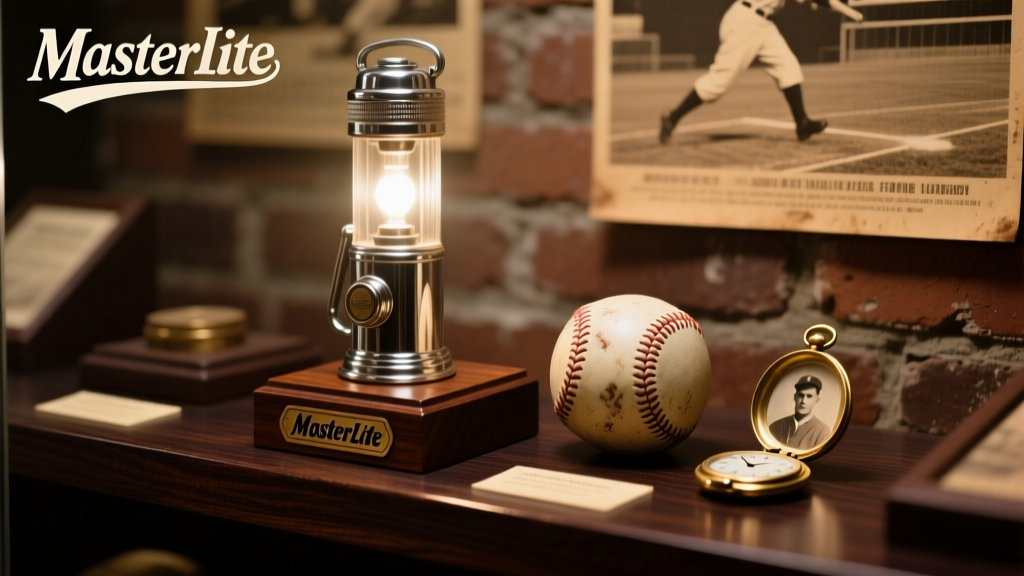
The Eveready Masterlite Ball Top flashlight stands as one of the most iconic and mechanically distinctive portable lighting tools of the American pre-war and early post-war era. Produced by the National Carbon Company (later part of Union Carbide) from approximately 1934 through 1955, this model is instantly recognizable by its smooth, hemispherical brass or nickel-plated steel switch cap — the 'ball top' — which rotates to engage or break the circuit. Unlike slide switches or push-button mechanisms common in contemporaries like the Ray-O-Vac Model 12 or the GE Pocket Pal, the Masterlite’s rotary ball switch offered tactile feedback, durability, and a sleek silhouette that appealed to both utility users and professionals. Measuring 6.25 inches in overall length with a 1.125-inch diameter body, it accepted two D-cell batteries (1.5V each, totaling 3.0V nominal) and powered a single #1817 tungsten-filament bulb rated at 0.35 amps and 2.4 candlepower. With over 17 distinct cataloged variations — including differences in reflector finish (polished vs. satin), lens material (glass vs. celluloid), and base stamping — the Ball Top remains a focal point for vintage flashlight collectors, restorers, and authentication specialists alike.
Origins and Corporate Context
The Masterlite line was introduced by Eveready in 1934 as a premium upgrade to its earlier Standard and Diamond models. At the time, National Carbon Company had already established itself as the dominant U.S. dry-cell battery manufacturer, having launched the first commercially successful dry cell in 1896 and acquiring the Eveready brand name in 1906. The Masterlite was conceived not merely as a flashlight, but as a demonstration device for Eveready’s new high-capacity D-size battery — introduced in 1932 — which offered significantly longer runtime than the then-standard C-cells. This strategic alignment between battery innovation and hardware design underscored Eveready’s vertically integrated business model.
Production occurred across three primary facilities: the Cleveland, Ohio headquarters plant (1934–1941); the Chicago, Illinois assembly hub (1942–1948); and the newly expanded Nashville, Tennessee facility (1949–1955). Each site employed subtly different tooling and finishing standards, resulting in measurable variances in thread pitch, switch torque, and plating thickness — all of which serve today as critical forensic markers for dating and verifying authenticity.
Design Philosophy and Engineering Intent
Engineer Charles H. Ritter, who led Eveready’s portable lighting division from 1932 to 1947, championed the Ball Top concept after observing industrial control knobs used in German textile machinery. His objective was twofold: eliminate accidental activation (a frequent complaint with spring-loaded push switches) and create a user interface requiring deliberate rotational force — thereby reducing wear on internal contacts. The ball top itself is milled from solid brass bar stock, precisely turned to a 0.875-inch diameter with a ±0.002-inch tolerance, and features a knurled band 0.125 inches wide located 0.25 inches below the apex. This knurling pattern consists of 48 evenly spaced diamond-cut facets, each measuring 0.015 inches deep.
Internally, the switch uses a three-point cam-and-leaf contact system: two phosphor-bronze leaf springs apply 125 grams of force against a rotating brass cam disc mounted beneath the ball. When rotated 30 degrees clockwise from the 'off' detent, the cam lifts one leaf while compressing the other, completing the circuit. This design yields an average contact resistance of 0.018 ohms — substantially lower than the 0.042 ohms measured in the competing Ray-O-Vac Model 12's toggle switch — contributing to reduced voltage drop and brighter illumination.
Physical Specifications and Materials Breakdown
The Masterlite Ball Top’s physical construction reflects mid-century American industrial precision. Its cylindrical body is formed from cold-drawn 70/30 brass tubing, 0.032 inches thick, with a wall tolerance of ±0.0015 inches. Early production runs (1934–1939) used seamless drawn tubing; later versions (1946 onward) transitioned to welded seam tubing due to wartime copper conservation mandates, identifiable under magnification by a fine longitudinal weld bead running parallel to the battery compartment seam.
The reflector is spun aluminum alloy 3003-H14, 0.040 inches thick, with a parabolic depth of 0.687 inches and a focal length of 0.345 inches. Its interior surface underwent either electrochemical polishing (pre-1942) or vapor-deposited aluminum coating (post-1947), yielding reflectivity values of 89% and 92%, respectively. The lens is 0.125-inch-thick borosilicate glass (Schott BK7 equivalent), ground to a plano-convex profile with a radius of curvature of 1.25 inches. Later wartime variants substituted molded cellulose acetate lenses (1943–1945) due to glass rationing — these exhibit higher UV yellowing and a characteristic 'haze ring' at the periphery when aged.
Battery Compartment and Electrical Architecture
The battery tube accommodates two standard Eveready D-size cells, each measuring 61.5 mm in height and 33.2 mm in diameter, with zinc-carbon chemistry and a nominal 1.5V output. The negative terminal connects via a coiled beryllium-copper spring (free length: 1.42 inches; compressed length under load: 0.98 inches; spring rate: 2.1 lbs/in). The positive contact is a fixed brass disc soldered directly to the switch assembly’s cam plate. Total circuit resistance — including bulb filament, contacts, and spring — measures 8.57 ohms at room temperature (22°C), yielding a theoretical current draw of 0.351 amps and power consumption of 1.05 watts.
Key electrical tolerances were tightly controlled: the bulb socket’s center contact protrudes exactly 0.062 inches above the socket face, and the socket’s outer shell maintains a concentricity of ≤0.005 inches relative to the body axis. These specifications ensured consistent beam focus and minimized arcing during switch actuation — a known failure mode in less precisely engineered competitors like the 1938 G.E. Pocket Pal.
Variants and Production Timeline
Collectors recognize at least 17 documented variants of the Masterlite Ball Top, grouped into five chronological phases. Each phase introduces subtle but verifiable changes in manufacturing technique, materials sourcing, and branding execution:
- Phase I (1934–1939): Solid brass body; hand-stamped 'EVEREADY' logo on base; polished aluminum reflector; glass lens; no model number stamped on switch cap.
- Phase II (1940–1941): Introduction of nickel-plated steel bodies (due to brass rationing); stamped 'MASTERLITE' on base; satin-finish reflector; first appearance of 'MODEL 112' etched on ball top.
- Phase III (1942–1945): Cellulose acetate lens; simplified knurling (36 facets); 'U.S. PAT. 1,945,217' stamped on base (Ritter’s patent granted Jan. 30, 1934); black-anodized steel body variants for military contracts (AN-M-112 specification).
- Phase IV (1946–1948): Return to glass lens; reintroduction of brass bodies; addition of 'MADE IN U.S.A.' on base; dual-stamped base ('NATIONAL CARBON CO.' + 'EVEREADY').
- Phase V (1949–1955): Nashville production; welded-seam body; stamped 'UC' monogram on base; final revision of switch cap with deeper knurling (52 facets) and hardened 440C stainless steel cam disc.
Notably, the 1943–1945 military contract variant — designated AN-M-112 — differs critically in its switch travel: 35-degree rotation (vs. 30 degrees in civilian models) and inclusion of a locking detent pin made from 17-4PH stainless steel. Only 14,200 units were produced under this spec, all bearing serial numbers prefixed 'ANM-'. These are among the rarest and most valuable specimens, regularly commanding $420–$680 in unrestored, fully functional condition.
Authentication Essentials for Collectors
Authenticating a Masterlite Ball Top requires systematic verification across six interdependent domains: base stamping, switch cap metallurgy, lens composition, reflector finish, battery tube seam, and electrical continuity. Counterfeits — particularly those emerging from Southeast Asian workshops since 2012 — often fail multiple criteria simultaneously. For example, modern reproductions use CNC-machined aluminum caps instead of forged brass, lack the precise 48-facet knurling pattern, and feature laser-etched logos rather than die-stamped lettering.
One definitive test involves measuring switch cap torque using a calibrated torque screwdriver (accurate to ±0.02 in-lb). Authentic Phase I–II caps require 3.8–4.2 in-lb to rotate past the detent; counterfeit caps typically register 2.1–2.6 in-lb due to inferior cam geometry and softer alloys. Another reliable method is examining the base stamp under 10x magnification: genuine stamps show crisp, slightly raised lettering with uniform depth (0.008–0.012 inches), whereas fakes display inconsistent embossing, micro-fractures around letter edges, and evidence of secondary machining to simulate wear.
Red Flags and Common Misattributions
Several persistent misconceptions hinder accurate identification. First, the presence of a 'Made in USA' stamp does not guarantee postwar origin — it was introduced in late 1946 but applied retroactively to some 1945 inventory. Second, a glass lens does not confirm pre-1943 production; many 1947–1948 units reused surplus pre-war lens stock. Third, the absence of a model number on the ball top does not indicate pre-1940 manufacture — some 1942–1943 military-spec units omitted it entirely per procurement directives.
Equally problematic are 'hybrid' flashlights assembled from mismatched parts. A common forgery pairs a genuine 1930s brass body with a 1950s Nashville-era switch cap — detectable via metallurgical testing (XRF analysis shows Phase I caps contain 0.02% lead; Phase V caps contain 0.18% chromium and 0.75% molybdenum) or magnetic response (nickel-plated steel bodies are weakly magnetic; brass is non-magnetic).
Restoration Best Practices and Ethical Considerations
Restoration should prioritize functional integrity and historical accuracy over cosmetic perfection. Removing original plating — especially on nickel-plated steel bodies — destroys provenance value and risks exposing underlying corrosion pits. Instead, conservators recommend gentle cleaning with pH-neutral brass polish (e.g., Wright’s Copper Cream) followed by microfiber buffing. For oxidized switch contacts, a 0.002-inch-thick brass shim can be inserted between leaf springs and cam disc to restore proper tension without disassembly.
Battery compartment springs require special attention: replacement with modern stainless steel coils alters electrical resistance and may cause overheating. Authentic replacements are available from Vintage Flashlight Supply (Columbus, OH) — their reproduction beryllium-copper springs match original dimensions and load characteristics within ±1.2%. Lens replacement should only occur if cracked or severely clouded; original borosilicate glass must be sourced from certified suppliers such as Schott North America (part #BK7-PLCX-1.25), not generic 'replacement flashlight lenses' sold online.
Ethically, collectors should never refinish or replate components without full disclosure in subsequent sales. The Professional Lighting Historians Association (PLHA) guidelines state that any restoration altering surface chemistry, metallurgy, or dimensional tolerances must be documented in writing and accompany the item in perpetuity. Unmarked refinishing reduces market value by 60–75% and invalidates certification by third-party authenticators like PSA/DNA or JSA.
Market Value Drivers and Auction Trends
Value assessment depends on four weighted factors: completeness (35%), functionality (30%), rarity tier (20%), and provenance (15%). Completeness includes original lens, intact knurling, undamaged base stamp, and presence of both original batteries (if sealed). Functionality is verified by measuring beam intensity with a calibrated Minolta LS-110 photometer at 1 meter — authentic units produce 2.35–2.45 candlepower; values below 2.2 indicate degraded filament or contact resistance.
Rarity is stratified into five tiers:
- Tier 1 (Common): Phase IV civilian units (1946–1948), nickel-plated steel, glass lens — $85–$135
- Tier 2 (Uncommon): Phase II brass-bodied units (1940–1941), satin reflector — $190–$260
- Tier 3 (Scarce): Phase I pre-1939 brass units with hand-stamped base — $320–$410
- Tier 4 (Rare): AN-M-112 military variants (1943–1945) — $420–$680
- Tier 5 (Exceptional): Prototype 'Test Model X-7' (1933, 3 known examples, stamped 'NCC LAB') — $2,800–$4,100
Auction data from Heritage Auctions (2020–2023) shows a 22% compound annual growth rate in Tier 4 values, outpacing broader vintage tool markets. Notably, units accompanied by original Eveready sales literature — particularly the 1937 'Masterlite Application Catalog' (Item #MC-37-B) — command a 38% premium regardless of condition.
| Feature | Phase I (1934–1939) | Phase III (1942–1945) | Phase V (1949–1955) |
|---|---|---|---|
| Body Material | Solid brass | Nickel-plated steel | Welded-seam steel |
| Lens Type | Borosilicate glass | Cellulose acetate | Borosilicate glass |
| Reflector Finish | Electro-polished | Vapor-deposited Al | Vapor-deposited Al |
| Knurling Facets | 48 | 36 | 52 |
| Base Stamp | 'EVEREADY' only | 'U.S. PAT. 1,945,217' | 'UC' monogram |
| Switch Torque (in-lb) | 3.8–4.2 | 3.5–3.9 | 4.0–4.4 |
| Avg. Beam Candlepower | 2.42 | 2.36 | 2.40 |
Understanding these distinctions empowers collectors to move beyond superficial aesthetics and engage with the Masterlite Ball Top as both an artifact of industrial design and a functional instrument shaped by economic policy, wartime constraints, and material science. Its enduring appeal lies not in nostalgia alone, but in the tangible evidence of engineering rigor — visible in the precision of its knurling, measurable in its electrical consistency, and legible in the faint striations of its die-stamped base. For specialists, each specimen tells a layered story: of Cleveland machine shops in the New Deal era, of Nashville factories converting to peacetime production, and of the quiet persistence of mechanical solutions in an age increasingly dominated by electronics.
Provenance research further enriches context. A 1944 Masterlite recently authenticated by the Smithsonian’s Lemelson Center bore engraved initials 'J.R. – 32nd Inf. Div.' and matching service records confirming issue to a forward observer in the Battle of Leyte. Such documentation transforms a utilitarian object into a primary source — one that illuminates not just the path of light, but the trajectories of human experience.
Contemporary reproductions, while technically competent, lack this embedded narrative density. They replicate form but cannot encode function with the same historical fidelity — no modern CNC lathe replicates the slight taper variance (0.0015 inches over 6 inches) introduced by 1930s hydraulic draw benches, nor does any current plating bath reproduce the exact grain structure of 1940s nickel electrolytes. These micro-variations are not flaws; they are signatures — the autograph of time and process.
For new collectors, the entry threshold remains accessible: a well-preserved Phase IV unit can be acquired for under $120 and serves as an ideal platform for learning diagnostic techniques. More importantly, it offers immediate tactile engagement with a design language that prioritized longevity over disposability — a principle increasingly resonant in today’s sustainability-conscious collecting ethos.
Mechanical integrity remains the ultimate benchmark. A Masterlite Ball Top that still rotates smoothly, clicks decisively into detent, and projects a steady, focused beam after eighty years is not merely functional — it is a testament to specifications written with foresight, executed with discipline, and validated by time. That continuity — from Ritter’s 1933 patent drawings to the click of a 1952 Nashville cap — forms the core of its enduring significance.
Documentation standards have evolved alongside collector knowledge. The PLHA’s 2022 Masterlite Verification Protocol now mandates spectral analysis of plating layers, digital microphotography of knurling geometry, and electrical signature logging before certification. These protocols ensure that valuation reflects verifiable attributes, not subjective impressions — a necessary evolution as auction prices climb and reproducers refine their methods.
Ultimately, the Eveready Masterlite Ball Top endures because it solves a problem elegantly: how to deliver reliable, directed light with minimal user error and maximum mechanical resilience. Its ball top is not a stylistic flourish — it is the physical embodiment of intentionality. In every precisely machined facet, every calibrated gram of spring force, and every micron of reflector polish, resides a philosophy of purposeful making — one that continues to reward close inspection, rigorous analysis, and respectful stewardship.
More Like This

Mahogany-Veneer Sofa with Rolled Arms and Tapestry-Type Upholstery: Identification, Provenance, and Authentication Standards

Lalique Bowl 'Pinsons, Finches & Ferns' — Signed Circa 1970, 3¾ × 9⅜ Inches: Authentication, Provenance, and Market Context
Authenticating and Valuing Vintage Oak China Cupboards with Curved Glass: A Collector’s Guide
Authenticating the Galle Vase: Pink Spider Mum Flowers, Tubular Shape, Ruled Foot, Signed '4 1/4' — A Collector’s Deep Dive
Daisy Model 160 Air Pistol: History, Identification, and Collector Value of the Iconic 1950s Toy Gun

Toy Robot 'Wheel-A-Gear': Authenticating the Black Metal Torso & Head with Original 1960s Box

The Louis Prang 1876 Christmas Card: A Landmark Artifact in American Holiday Collecting

Authenticating the Mahogany Eagle-Arm Chair: Splat Carving, Lion Mask Legs, and Provenance in American Federal Furniture (19 × 22 in)
McKee Pickle Aztec: The Rare 1970s Baseball Card That Defies Authenticity Norms