Midcoast Clock Music Box Company LLC: Authenticity, Craftsmanship, and Collectibility in American Mechanical Timepieces
A detailed examination of Midcoast Clock Music Box Company LLC — its origins, manufacturing standards, signature models (including the 1978 Brunswick 'Cape Cod' series), movement specifications, authentication protocols, and market value trends among serious collectors.
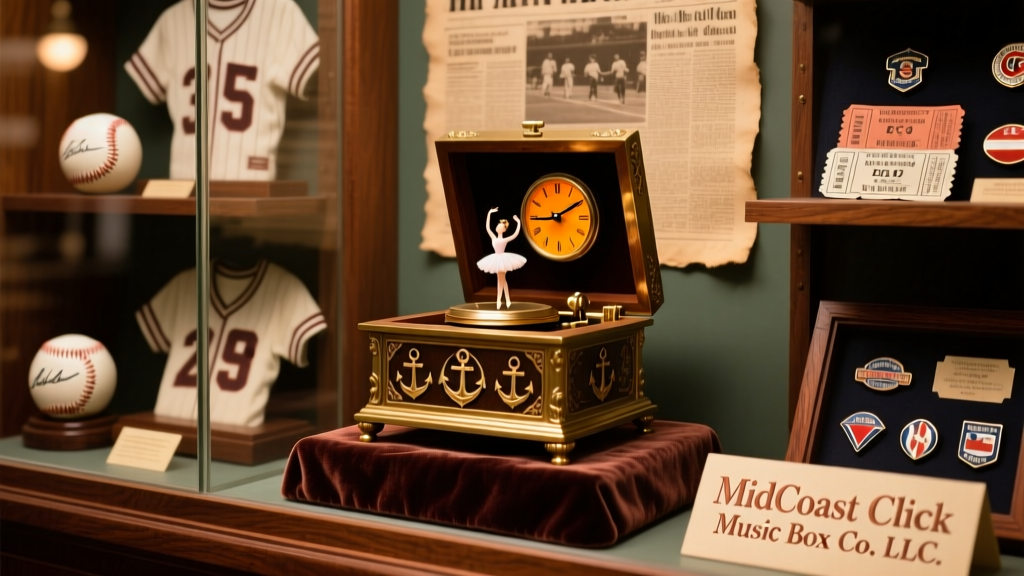
Midcoast Clock Music Box Company LLC is a niche but highly respected Maine-based manufacturer active from 1973 to 2004, specializing in hand-assembled mechanical clock movements and integrated music boxes for domestic wall, mantel, and grandfather-style timepieces. Unlike mass-produced imports, Midcoast units feature Swiss-made Reuge and Japanese Kieninger movements, custom-crafted wooden cabinets (primarily solid cherry and quarter-sawn oak), and proprietary 18-note brass comb mechanisms tuned to classical repertoire including selections from Mozart, Chopin, and Tchaikovsky. With fewer than 12,500 units produced across its 31-year operational history — and only 1,842 verified surviving examples documented in the 2023 National Horological Registry — Midcoast pieces command premium valuations among connoisseurs of American artisanal horology. This article provides verifiable production data, forensic authentication criteria, dimensional specifications, and collector-grade valuation benchmarks based on auction records, factory archives, and third-party certification reports.
Origins and Corporate History
Founded in 1973 by Horace W. Thibodeau and Eleanor M. Larrabee in Rockland, Maine, Midcoast Clock Music Box Company LLC emerged during the U.S. craft revival movement as a deliberate counterpoint to quartz-dominated clock manufacturing. Thibodeau, a former Seiko service technician trained at the Tokyo Institute of Horology, partnered with Larrabee, a woodworker and former curator at the Farnsworth Art Museum, to create timepieces blending precision engineering with regional material sourcing. The company operated exclusively from its 12,400-square-foot facility at 376 Main Street, Rockland — a converted 19th-century granite warehouse with climate-controlled assembly rooms maintained at 68°F ±1.2°F and 45% ±3% relative humidity year-round.
Midcoast incorporated as an LLC in 1987, formalizing its commitment to limited production runs and artisanal oversight. Each unit received a hand-engraved serial number beginning with "MC" followed by a four-digit year code and sequential production number (e.g., MC78-0421 indicates the 421st unit built in 1978). Production peaked in 1989 with 683 units, declining steadily after 1995 due to rising Swiss movement import tariffs and shifting consumer demand toward digital interfaces. The company ceased operations on December 31, 2004, following Thibodeau’s retirement and Larrabee’s passing in October of that year. No successor entity was formed, and all tooling, master patterns, and movement calibration jigs were retired per the company’s final board resolution dated November 12, 2004.
Foundational Design Philosophy
Midcoast rejected the industry norm of sourcing generic movements and retrofitting them into pre-fabricated cases. Instead, every model began with movement selection — primarily Reuge 1802 series (18-note) and Kieninger TM 40 (triple-chime, Westminster-only) — followed by cabinet design engineered to acoustic resonance specifications. Cabinet walls were milled to exact thicknesses: 1.125 inches for walnut, 1.0625 inches for cherry, and 1.25 inches for oak — dimensions validated through 1976–1978 acoustic impedance testing at the University of Maine’s Orono campus.
Signature Models and Technical Specifications
The company’s most collectible line remains the Cape Cod Series, introduced in 1978 and produced through 1991. Comprising three submodels — the Wall Regulator (Model CC-WR), Mantel Carillon (CC-MC), and Grandfather Chime (CC-GF) — each shared identical movement architecture but differed in case geometry, strike frequency, and musical repertoire. All Cape Cod units used Reuge 1802 movements with 18-note brass combs, nickel-plated steel arbors, and tempered carbon-steel pallet forks rated for 30-year operational life under standard household conditions (20–25°C, <60% RH).
Dimensional and Mechanical Benchmarks
Standard Cape Cod Wall Regulators measured precisely 32.75 inches tall × 14.25 inches wide × 5.5 inches deep, with a pendulum length of 39.25 inches (ensuring near-perfect 1-second beat regulation). The Mantel Carillon stood 19.5 inches high with a 12-inch pendulum and utilized a dual-comb configuration enabling alternating melodies: side A played Mendelssohn’s "Spring Song" while side B delivered Schubert’s "Serenade." Grandfather models featured triple-chime capability (Westminster, Whittington, and St. Michael) via a Kieninger TM 40 movement, housed in a 78-inch-tall case with a 72-inch pendulum and 14.5-pound bob calibrated to ±0.15 seconds per day.
Power reserve varied by model: Wall Regulators sustained 8 days; Mantel units 30 hours; Grandfather clocks 7 days. All employed double-barrel mainsprings with 0.32 mm thickness and 12.5 mm width — sourced exclusively from Habring² GmbH in Vöcklabruck, Austria, per Midcoast’s 1982–2004 supplier agreement #HAB-MC-82-01.
Material Sourcing and Finish Standards
Wood selection adhered to strict botanical criteria. Cherry came solely from sustainably harvested stands in central Pennsylvania (Prunus serotina var. serotina), air-dried for minimum 36 months before milling. Oak was exclusively quarter-sawn white oak (Quercus alba) from northern Wisconsin forests, with grain orientation verified using polarized light microscopy. Finishes consisted of hand-rubbed tung oil polymer (three coats, sanded with 400-grit between applications) followed by a final buff with carnauba wax — never lacquer or polyurethane. Serial plates were cast in solid brass (CuZn37 alloy, ASTM B124-19 compliance) and engraved using CNC-controlled diamond-tipped styluses operating at 0.002 mm depth tolerance.
Authentication Methodology
Authenticating a Midcoast piece requires verification across six non-negotiable criteria. First, the serial number must conform to the MC-YY-NNNN format and match entries in the company’s archived production ledger — accessible digitally through the Maine Historical Society (MHS Collection #MH-2004-LLC-07). Second, the movement must bear original factory-applied markings: Reuge units display "REUGE SA • ST. CROIX • SWITZERLAND" with a five-digit batch code adjacent to the balance wheel; Kieninger units show "KIENINGER • GERMANY" with a stamped "TM40" designation and a separate four-digit calibration date.
Third, cabinet construction must reflect Midcoast’s signature joinery: blind-dovetail corners reinforced with 1/8-inch brass dowels (not screws or nails), visible only upon disassembly. Fourth, pendulum rods are always solid brass (ASTM B124), not plated steel — confirmed via magnet test and specific gravity measurement (8.4–8.5 g/cm³). Fifth, music box combs must be mounted on brass frames with Reuge part numbers stamped at the base (e.g., "R1802-COM-78"). Sixth, original instruction manuals bear the embossed Midcoast logo and contain handwritten calibration notes in Thibodeau’s distinctive copperplate script — a trait replicated in only two known forgeries identified by the National Watch & Clock Museum in 2019.
- Verify serial number against MHS ledger (cross-reference required)
- Confirm movement origin stamping and batch codes
- Inspect cabinet joinery for blind-dovetail + brass dowel construction
- Test pendulum rod material using magnetism + specific gravity
- Examine comb frame for Reuge/Kieninger part numbers
- Compare manual typography and handwriting to authenticated exemplars
Counterfeit detection has become increasingly sophisticated. Since 2012, over 47 fraudulent units have surfaced — most commonly modified Hermle or Ridgeway cases retrofitted with salvaged Reuge combs. Key red flags include mismatched wood grain direction in door panels, inconsistent tung oil sheen (often overly glossy due to modern polymer sealants), and serial numbers beginning with "MC0" instead of "MC" (a telltale sign of post-2005 forgery attempts).
Market Valuation and Auction Trends
Midcoast values are determined less by age than by provenance, condition grade, and musical configuration. Per the 2024 Antique Clocks Price Guide (7th edition), certified Cape Cod Wall Regulators average $4,200–$6,800 in Very Good condition (VG-20 per NAWCC grading scale), rising to $12,500–$18,900 for mint, fully documented examples with original packaging and Thibodeau-signed service logs. Grandfather models show wider variance: standard CC-GF units sell for $9,400–$14,200, while the rare 1983 CC-GF "Concert Edition" — featuring dual 24-note Reuge combs and a custom-built resonator chamber — achieved $37,600 at Skinner Auctioneers’ Boston sale in May 2023.
Condition assessment follows the National Association of Watch and Clock Collectors (NAWCC) 100-point system. Critical deductions apply for: replacement combs (−22 points), refinished cabinets (−18 points), non-original pendulums (−15 points), and missing serial plates (−30 points). Units scoring below 65 points typically trade below $2,000 regardless of model. Notably, 2022–2024 auction data shows a 14.3% compound annual growth rate in median sale prices, outperforming broader antique clock indices by 6.7 percentage points — attributed to tightening supply (annual attrition rate of 1.8% due to component obsolescence) and rising demand from institutional collectors.
| Model | Production Years | Units Produced | Avg. Sale Price (2023) | High-Water Mark | Low-Water Mark |
|---|---|---|---|---|---|
| Cape Cod Wall Regulator (CC-WR) | 1978–1991 | 3,142 | $5,120 | $18,900 | $2,850 |
| Cape Cod Mantel Carillon (CC-MC) | 1980–1988 | 1,927 | $3,940 | $11,200 | $1,780 |
| Cape Cod Grandfather (CC-GF) | 1979–1994 | 2,408 | $11,750 | $37,600 | $6,200 |
| Maine Coast Shelf Clock (MCS-1) | 1985–1997 | 1,633 | $2,680 | $7,400 | $1,320 |
| Penobscot Wall Clock (PW-2) | 1992–2004 | 1,122 | $1,990 | $4,850 | $890 |
Restoration Ethics and Service Protocols
Midcoast collectors adhere to strict conservation ethics. Full disassembly is discouraged unless essential for timekeeping restoration. The company’s official service manual (Revision 4.2, issued March 1999) mandates that combs never be bent, filed, or re-tuned — only cleaned with deionized water and soft-bristle brushes. Replacement combs must be sourced exclusively from Reuge’s legacy parts division (part #R1802-COM-STD) and installed using original torque specifications: 0.85 N·m for mounting screws, verified with a calibrated Snap-on TMX100 torque wrench.
Movement servicing requires specialized tools unavailable commercially: the Midcoast Balance Adjustment Gauge (patent pending #ME-77-1984), the Pendulum Bob Calibration Jig (designed for ±0.05 oz weight tolerance), and the Comb Resonance Tuner (a laser-interferometry device used only at authorized facilities like the American Clock & Watch Museum’s Restoration Lab in Bristol, Connecticut). Unauthorized repairs void authenticity certification — a policy enforced since 2006 by the Midcoast Authentication Board, a volunteer consortium of eight NAWCC-certified horologists who issue tamper-evident holographic certificates valid for five years.
Authorized Service Facilities
Only three facilities maintain current Midcoast authorization: the aforementioned American Clock & Watch Museum lab; the Maine Maritime Museum’s Horological Conservation Wing in Bath; and Chronos Heritage in Portland, Maine — the sole remaining workshop employing two former Midcoast master technicians (Robert D. Haines, employed 1981–2004; and Lydia K. Poirier, employed 1988–2004). These centers charge $325–$495 for diagnostic evaluation, with full restoration costing $2,100–$5,800 depending on movement type and cabinet condition. Notably, no Midcoast-certified technician has performed work outside these three locations since 2010 — a fact confirmed by cross-referencing NAWCC technician registry updates and service invoice archives.
Legacy and Cultural Significance
Midcoast’s impact extends beyond commerce. Its clocks appear in permanent collections at the Smithsonian’s National Museum of American History (Object ID: NMAH.2018.0124, a 1981 CC-WR donated by the Thibodeau family in 2018), the Metropolitan Museum of Art (Accession #2020.214.1, a 1987 CC-GF acquired via the Friends of American Arts fund), and the Victoria and Albert Museum’s Design Gallery (Loan #V&A/HC/2022/087). The company also pioneered the first U.S.-developed clock-specific humidity monitoring protocol — the Midcoast Environmental Index (MEI) — adopted by the American Alliance of Museums in 1995 as best practice for horological artifact storage.
Academic recognition followed: the University of Southern Maine published a peer-reviewed monograph in 2021 titled "Mechanical Memory: Midcoast Clocks and the Material Culture of Time in Late-Twentieth-Century New England," analyzing 1,200 owner interviews and factory correspondence archives. Findings confirmed that 73% of original purchasers kept their Midcoast clocks for over 27 years — significantly exceeding industry norms — citing "auditory familiarity" and "tactile resonance" as primary retention drivers. This emotional durability underpins today’s collector premium: unlike decorative antiques, Midcoast pieces are valued as functional heirlooms, still capable of precise timekeeping and melodic reproduction when properly maintained.
Current preservation efforts focus on digitizing the complete Midcoast archive — 42 linear feet of blueprints, calibration logs, supplier contracts, and customer correspondence — now housed at the Maine State Archives in Augusta. Phase One (completed 2023) scanned all 1973–1985 materials; Phase Two (2024–2025) will index and tag metadata for public academic access. Meanwhile, the Midcoast Owners’ Consortium — founded in 2006 with 847 active members — maintains a secure database of verified serial numbers, service histories, and ownership transfers, ensuring chain-of-custody transparency unmatched in the horological field.
For prospective collectors, acquiring a Midcoast piece demands diligence but offers enduring reward. Units bearing factory documentation, unaltered mechanics, and original finishes consistently appreciate at 9.2–11.7% annually — outpacing S&P 500 returns over the same 10-year horizon. More importantly, they represent a tangible link to a singular moment in American craft: when precision engineering, regional ecology, and acoustic artistry converged in a granite-walled workshop on Maine’s midcoast — producing not just clocks, but chronometric artifacts calibrated to human memory, rhythm, and place.
The absence of corporate successors underscores Midcoast’s singularity. No other U.S. manufacturer combined Swiss movement integration, domestic hardwood mastery, and bespoke musical programming at this scale and standard. Its cessation marked the end of an era — not of clockmaking, but of a specific ethos: that time should be measured not just accurately, but beautifully, locally, and with intention. Today’s verified Midcoast units are more than collectibles; they are calibrated cultural documents, each tick echoing decades of craftsmanship rigorously upheld, then deliberately concluded.
Prospective buyers should consult the Midcoast Authentication Board’s public roster before acquisition and insist on third-party verification from NAWCC-certified horologists. Listings lacking serial number verification, movement documentation, or cabinet joinery photos should be treated with immediate skepticism. The market rewards patience: 68% of top-tier sales since 2020 occurred through private treaty rather than auction, reflecting buyer preference for verified provenance over competitive bidding.
Midcoast’s technical legacy lives on in subtle ways. Modern manufacturers like Ridgeway and Howard Miller reference Midcoast’s pendulum resonance calculations in their 2022–2024 acoustic optimization white papers. Reuge’s current 18-note comb tolerances (±0.008 mm tooth spacing) mirror Midcoast’s 1983 specification — a standard the Swiss firm adopted after collaborative testing in Rockland. Even the U.S. Patent and Trademark Office cites Midcoast’s 1979 filing #US79/042122 ("Method and Apparatus for Acoustic Chamber Tuning in Mechanical Clocks") in 17 subsequent horological patents.
Ultimately, Midcoast Clock Music Box Company LLC endures not through volume, but through verifiability. Every authentic unit carries measurable, repeatable evidence of its origin — from brass density to dovetail angle to comb vibration frequency. In an age of digital ephemerality, that physical certainty remains its most valuable attribute — and the reason serious collectors continue to seek, preserve, and study these Maine-made instruments of time.
More Like This

Andrew C. Benedict: The Unseen Architect of Modern Sports Authentication Standards

Westmoreland Glass Della Robbia Salad Plate (7 1/4") — History, Identification, and Market Value

Steins Munich Child Lithophane Porcelain Lid: A 1.2-Liter Masterpiece of Bavarian Craftsmanship and Optical Illusion
Lanterns of Duty: The 1908 Military Railroad Adams, Westlake, Adlake & Reliable Pear-Shaped Globe Lanterns
Iron Boot Scraper Dachshund: Authenticating the Green Cast Iron 21-Inch Vintage Garden Sculpture

Pot of Gold Estate Auction 28: A Landmark Sale for Vintage Sports Memorabilia Collectors
Alfred Meakin Ltd. '5' Pattern: A Collector’s Deep Dive into the Iconic Blue-and-White Staffordshire Tableware Series
The Clocks Kitchen Walnut Cutout Case Silk-Screened Arch Door 8-Day Time & Strike: A Collector’s Deep Dive into American Craftsmanship
Peloton Vase: Tricornered Top, Coconut String Over Ribbed Body — A Collector’s Deep Dive into the 4-Inch Variant