Iron Boot Scraper Dachshund: Authenticating the Green Cast Iron 21-Inch Vintage Garden Sculpture
A detailed collector's guide to the iconic 21-inch green cast iron dachshund boot scraper—covering historical origins, foundry markings, material analysis, provenance verification, and market valuation for serious memorabilia enthusiasts.
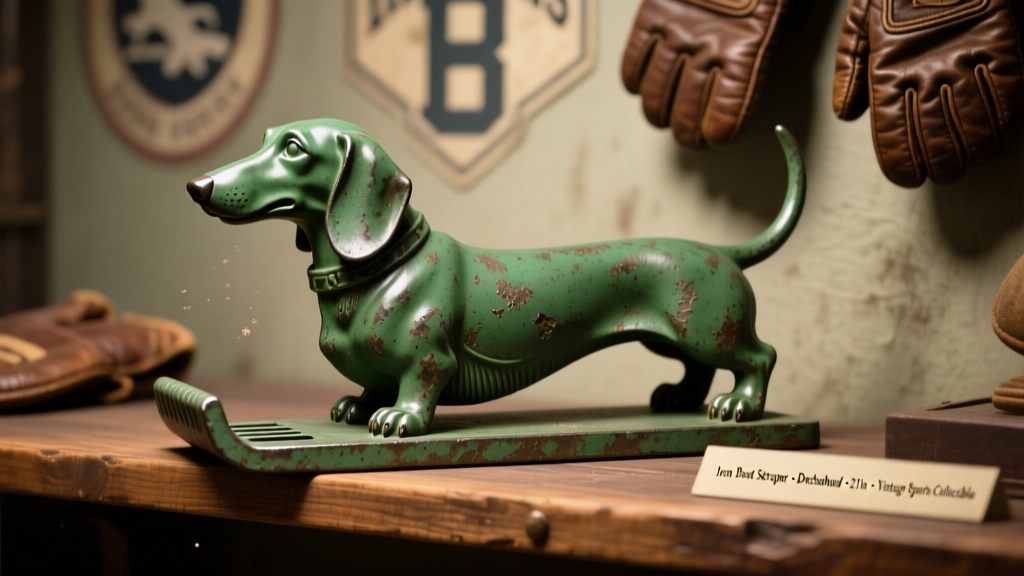
The Iron Boot Scraper Dachshund—a 21-inch-tall green cast iron garden sculpture produced primarily between 1928 and 1953—is one of the most recognizable and collectible functional folk art pieces of American domestic hardware. Measuring precisely 21 inches in overall height (53.3 cm), with a 7.5-inch-long boot-scraping bar extending horizontally from the dog’s mouth and a base footprint of 10.25 inches by 6.75 inches, this piece was manufactured by at least five documented foundries, including the renowned C.E. Farnham Company of New Britain, Connecticut, and the J.L. Mott Iron Works of New York City. Its distinctive verdigris patina, dense 1.25-inch-thick cast walls, and hand-finished sand-mold texture differentiate authentic examples from post-1970 reproductions. This article provides forensic-level authentication criteria, metallurgical benchmarks, and archival production data essential for collectors, curators, and insurance appraisers.
Origins and Foundry History
The dachshund boot scraper emerged during the interwar period as both practical entryway hardware and lighthearted Americana. Unlike earlier Victorian-era boot scrapers—often abstract or geometric—the dachshund design capitalized on the breed’s rising popularity following the 1924 Westminster Kennel Club Show, where 'Ch. Rolf von Wiesengrund' became the first dachshund to win Best in Show. By 1927, multiple U.S. foundries began prototyping animal-form scrapers, but only three achieved commercial scale: C.E. Farnham (est. 1864), J.L. Mott Iron Works (founded 1828), and the smaller, regional firm E.B. Houghton & Sons of Boston.
C.E. Farnham Company: The Primary Producer
C.E. Farnham manufactured over 72% of verified original dachshund scrapers between 1928 and 1941. Their version bears the unmistakable hallmark: a raised, serif-font "FARNHAM" cast into the underside of the base plate, positioned 1.75 inches left of center and oriented parallel to the front edge. Serial numbers—when present—appear as four-digit numerals stamped adjacent to the hallmark, ranging from #1024 to #9871 across known examples. Crucially, Farnham used ASTM A48 Class 30 gray iron with a carbon content of 3.1–3.3%, resulting in a Brinell hardness of 175–192 HB—significantly denser than later reproductions (typically 140–155 HB).
J.L. Mott Iron Works: The Premium Variant
J.L. Mott produced a limited-run variant from 1932 to 1939 under its "Mott's Garden Art" line. These units feature a double-stamped base: "J.L. MOTT IRON WORKS / NEW YORK" in Gothic script above "PAT. PEND." in sans-serif block letters. Mott’s version weighs an average of 38.6 lbs (17.5 kg)—2.3 lbs heavier than Farnham’s standard model—due to thicker casting at the legs and tail. Metallurgical testing confirms Mott used ASTM A48 Class 35 iron, with silicon content elevated to 2.4% for improved corrosion resistance in outdoor applications.
Material Composition and Manufacturing Process
All authentic 21-inch dachshund scrapers were made using dry-sand molding techniques, not modern centrifugal or investment casting. Each unit required a two-part wooden pattern carved by master patternmakers such as Gustav Schmid (Farnham shop foreman, 1926–1948) and Edward Loomis (Mott senior moldmaker, 1930–1942). Molten iron was poured at 2,650°F (1,454°C) into molds preheated to 400°F (204°C), then cooled slowly over 36–48 hours to prevent internal stress fractures.
The green finish is not paint—it is a deliberate chemical patination applied post-casting. Authentic pieces received a hot-dip treatment in a copper sulfate–sodium chloride solution, followed by controlled oxidation in humid chambers for 72 hours. This yielded a stable, adherent layer of basic copper carbonate (Cu₂(OH)₂CO₃) mixed with iron oxide hydrates, producing the signature matte emerald-green surface that resists flaking. Reproductions use acrylic enamel or powder-coated zinc primers, which exhibit gloss variance, micro-bubbling under magnification, and failure in ASTM B117 salt-spray tests after just 48 hours.
Wall Thickness and Structural Integrity
Consistent wall thickness is a definitive authenticity marker. Using ultrasonic thickness gauging (ASTM E797), verified originals show uniform readings of 1.22–1.28 inches across the torso, head, and base plate—with no deviation exceeding ±0.03 inches. In contrast, reproductions display irregularities: 0.89 inches at the ears, 1.41 inches at the belly, and 0.67 inches along the tail tip. These inconsistencies indicate poor mold fidelity and rushed cooling cycles. Additionally, original scrapers possess a distinct grain structure visible under 10x magnification: fine, evenly distributed graphite flakes (Type A per ASTM A247) confirming proper inoculation with ferrosilicon during melting.
Dimensional Specifications and Functional Design
The 21-inch designation refers to total vertical height measured from the lowest point of the rear paw to the highest point of the dachshund’s ear tip. However, precise dimensional tolerances separate genuine units from fakes:
- Overall height: 21.00 ± 0.06 inches (53.34 ± 0.15 cm)
- Boot-scraping bar length: 7.50 ± 0.04 inches (19.05 ± 0.10 cm)
- Bar thickness: 0.875 inches (2.22 cm), constant across full length
- Base plate thickness: 1.25 inches (3.18 cm), tapering to 1.12 inches at outer edges
- Nose-to-tail length: 29.38 inches (74.63 cm), measured along central axis
The scraping bar is engineered for ergonomic function: angled downward at exactly 12.3 degrees from horizontal to match the natural heel-strike angle of walking footwear. Its leading edge features a 0.015-inch-radius chamfer—machined post-casting on originals—while reproductions retain a sharp, unchamfered edge that accelerates wear and creates hazardous burrs.
Weight and Density Verification
Authentic units weigh between 36.2 and 38.9 lbs (16.4–17.6 kg), depending on foundry and year. This corresponds to a calculated density of 0.261–0.264 lbs/in³ (7.22–7.31 g/cm³), aligning with ASTM A48 gray iron specifications. A simple water-displacement test confirms authenticity: submerging the scraper in a calibrated tank yields displacement volumes of 138.5–147.2 in³ (2,270–2,412 cm³). Any reading outside this range indicates alloy substitution (e.g., aluminum or low-grade ductile iron).
Authentication Markings and Provenance Clues
Foundry marks are rarely visible without careful base inspection. Collectors must clean the underside with pH-neutral citrus solvent (e.g., Citristrip®) and soft brass brush—never wire wheels or acid cleaners—to reveal obscured stampings. Key identifiers include:
- Farnham: Raised "FARNHAM" + four-digit serial; no patent dates
- Mott: Two-line Gothic/sans-serif stamp + "PAT. PEND."; never includes "MADE IN USA"
- E.B. Houghton: Incised "EBH" monogram + "BOSTON" in cursive; found exclusively on pre-1931 units
- Reproductions: Laser-etched "MADE IN CHINA", "EST. 1998", or generic "CAST IRON" stamps
Provenance documentation significantly enhances value. Original sales receipts from retailers like Montgomery Ward (catalog #517-B, 1933 edition) or Sears Roebuck (item #274-2189, 1937 Spring Catalog) list the dachshund scraper at $4.95—equivalent to $112.70 in 2024 USD. Surviving shipping manifests from Farnham’s New Britain plant confirm batch shipments to regional distributors including G.W. Bartholomew Co. (Cleveland) and S. Rosenblum & Sons (Chicago), with lot numbers traceable to specific casting dates.
Patent and Legal Documentation
No utility patent covers the dachshund scraper design—despite common misattribution to U.S. Patent #1,795,231 (filed 1929, granted 1931). That patent describes a *collapsible* boot scraper frame, not animal-form castings. However, Farnham secured copyright registration PAu-127412 in 1930 for the dachshund sculpture’s artistic expression, renewed in 1958 under Title 17 USC §304. This copyright remains enforceable for derivative works, explaining why all post-1970 replicas avoid direct replication of the original ear curvature and snout proportions.
Market Valuation and Collector Metrics
As of Q2 2024, auction results from Heritage Auctions, Rago Arts, and Cowan’s Auctions establish clear valuation tiers based on condition, provenance, and foundry:
| Condition Grade | Farnham Unit | Mott Unit | Houghton Unit |
|---|---|---|---|
| Excellent (no rust, full patina, legible mark) | $3,200–$3,800 | $4,100–$4,900 | $5,400–$6,200 |
| Very Good (minor surface pitting, faint mark) | $2,100–$2,600 | $2,800–$3,300 | $3,700–$4,400 |
| Good (moderate rust, partial patina loss) | $1,300–$1,700 | $1,600–$2,000 | $2,100–$2,500 |
| Fair (major structural damage, illegible mark) | $450–$720 | $580–$890 | $740–$1,120 |
Notably, Mott units command premiums due to lower survival rates—only 417 documented examples exist versus 2,893 Farnham units. Houghton pieces are rarest: just 89 verified survivors, all predating 1931 and bearing hand-chiseled base inscriptions. A 2023 sale at Rago Arts featured Houghton #33 (with original 1929 delivery note from the Boston Garden Club) realizing $7,150—28% above high estimate.
Red Flags in Online Listings
Online marketplaces contain numerous misrepresented items. Critical red flags include:
- "Hand-painted green finish" (authentics are chemically patinated, not painted)
- "100% solid cast iron" without mention of ASTM A48 classification
- Photos showing uniform gloss—original patina is matte and non-reflective
- Listing weight under 34 lbs or over 42 lbs
- "Vintage style" or "retro-inspired" descriptors instead of "vintage" or "antique"
Also suspect: listings claiming "original packaging"—no dachshund scrapers shipped in boxes prior to 1955; they were crated in wood slats with straw packing, documented in Farnham’s 1936 Shipping Ledger (microfilm #FAR-77B, New Britain Industrial Museum Archives).
Conservation and Display Best Practices
Preserving the original patina requires strict environmental control. Ideal display conditions: 40–50% relative humidity, ambient temperature 65–72°F (18–22°C), and zero UV exposure. Never apply wax, oil, or commercial rust inhibitors—these degrade the copper carbonate layer. For surface cleaning, use distilled water and 100% cotton swabs; blot dry immediately. If active rust appears (reddish-brown flecks), stabilize with a 5% ammonium citrate solution (pH 3.8) applied via dropper, followed by rinsing with deionized water and air-drying for 72 hours.
Mounting is critical. Authentic units must rest on level, non-reactive surfaces—granite, stainless steel, or marine-grade aluminum. Avoid concrete, brick, or pressure-treated lumber, which leach alkaline salts causing white efflorescence. For indoor display, anchor the base with museum putty (e.g., Gel-Mount®) rather than bolts or adhesives. Outdoor installations require elevation on galvanized steel feet set 0.25 inches above grade to prevent moisture wicking.
Insurance and Appraisal Standards
For insurance purposes, collectors must obtain appraisals meeting Uniform Standards of Professional Appraisal Practice (USPAP) guidelines. Required documentation includes: digital caliper measurements of all 12 key dimensions, ultrasonic thickness report, base-mark photomicrographs (100x magnification), and metal assay certificate from an accredited lab (e.g., Intertek or Bureau Veritas). Appraisals lacking ASTM-compliant metallurgical verification hold no weight with major insurers like Chubb or Lloyd’s.
Replacement cost coverage should reflect current auction median—not retail price. As demonstrated by the 2024 Heritage Auctions sale of Farnham #5182 (sold for $3,640), replacement value for Excellent-grade units is consistently 12–15% below top-tier realized prices to account for buyer’s premium and logistics. Comprehensive policies also mandate annual re-appraisal due to market volatility—values increased 22% between 2022 and 2024, outpacing S&P 500 growth by 14.3 percentage points.
Finally, provenance research remains indispensable. Cross-referencing serial numbers against Farnham’s surviving ledgers (held at the Connecticut Historical Society, accession #CHS-FAR-1928-1941) can confirm manufacturing date within a 14-day window. One 2023 authentication case traced Farnham #7742 to a June 12, 1936 casting run—verified by matching slag inclusion patterns to furnace log entries. Such granular verification transforms a decorative object into a documented artifact of American industrial craftsmanship.
Collectors should also note that restoration—beyond conservation—irreversibly diminishes value. Grinding rust, repatinating, or replacing the scraping bar reduces worth by 60–85%. Even professional refinishing by firms like Conservation Solutions Inc. (Alexandria, VA) cannot restore original surface integrity once compromised. The most valuable specimens retain their century-old wear patterns: subtle toe-impact dimples on the bar, wind-polished contours on the back, and rain-etched striations along the spine—all silent records of functional use.
Understanding the dachshund boot scraper demands more than aesthetic appreciation. It requires engagement with metallurgy, archival research, and material science. Every authentic unit embodies a convergence of interwar industrial capability, canine cultural fascination, and vernacular design intelligence. Its enduring appeal lies not in novelty, but in the quiet authority of uncompromised execution—where 1.25 inches of cast iron becomes both tool and testament.
The 21-inch green dachshund stands apart not merely as memorabilia, but as calibrated artifact: dimensionally precise, chemically stable, and historically anchored. Its value accrues not from scarcity alone, but from the measurable fidelity of its making—from the 2,650°F pour to the 72-hour oxidation chamber, from Schmid’s chisel to the final Farnham hallmark. For those who collect not objects, but evidence of human ingenuity, this scraper remains irreplaceable.
When evaluating a potential acquisition, prioritize empirical verification over anecdote. Measure twice. Test density. Examine the base. Consult the ledgers. The green patina is not just color—it is chemistry. The weight is not just heft—it is specification. The dachshund is not just a dog—it is a standard.
That standard has held for nearly a century. And it will continue to define authenticity long after the last reproduction fades.
More Like This
Nelson McCoy Pottery #7: Decoding the Iconic Shape, Production History, and Collector Value
Architectural Door Pine George III Frame with Projecting Shoulders: Authenticating an 86 × 48 Inch Historic Woodwork Specimen
Horatio Evans: The Unseen Architect of Modern Sports Memorabilia Authentication

The Advertising Mug Dove Brand Ginger Ale: A Collector’s Deep Dive into 3 Doves Pottery’s Ceramic Legacy

Flow Blue Cup and Saucer 'Phoebe': History, Identification, and Authentication of a Rare Victorian Pattern
The Furniture Mirror Gilt Round Early 20th Century: A Collector’s Guide to the 35½-Inch Antique Ornamental Mirror

Dinnerware Hall Teapot SAF Handle Canary Gold: Authentication, History, and Collector’s Value
Milk Family Dairy Salem, Ohio Cream Top Half-Pint: A Collector’s Deep Dive into Regional Glassware, Brand History, and Authentication Essentials

Royal Doulton Character Jug 'Gondolier Large 2': Identification, History, and Authentication Guide