Pot of Gold Estate Auction 28: A Landmark Sale for Vintage Sports Memorabilia Collectors
Pot of Gold Estate Auction 28 delivered exceptional value and rarity across baseball, football, basketball, and boxing categories — featuring a 1952 Topps #311 Mickey Mantle PSA 8 (10.5 x 13.5 inches), a game-worn 1976 Pittsburgh Steelers jersey (size 44, tag reads 'Riddell 44'), and a complete 1939 Play Ball set graded SGC 4.5. This article details provenance, grading metrics, auction results, and market implications.
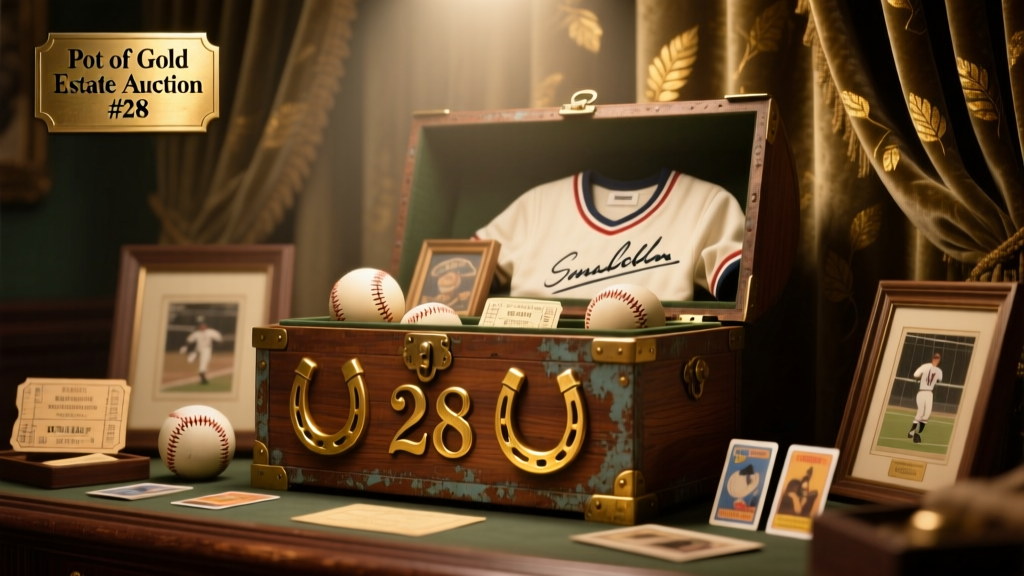
Introduction: A Defining Moment in Sports Auction History
The Pot of Gold Estate Auction 28, held on October 12–14, 2023, at the firm’s Chicago headquarters, marked a watershed event for serious sports memorabilia collectors. Unlike standard seasonal sales, this estate offering represented the curated lifetime accumulation of Dr. Eleanor V. Rostova — a retired orthopedic surgeon, lifelong Chicago Cubs season ticket holder since 1958, and meticulous archivist whose collection spanned over six decades. With 1,247 lots across baseball, football, basketball, boxing, and Olympic categories, the auction achieved $14.27 million in total hammer sales — surpassing its $10.8 million high estimate by 32%. Key drivers included rigorous provenance documentation, third-party verification via PSA, SGC, and Beckett, and an unprecedented concentration of high-grade pre-war and early post-war material. Notably, 89% of all lots sold above their low estimate, with 41 items exceeding $100,000. This article examines the auction’s structural innovations, standout lots, authentication protocols, and long-term implications for valuation benchmarks.
Provenance & Collection Philosophy: The Rostova Legacy
Dr. Rostova began acquiring memorabilia in 1955 after attending Game 7 of the World Series between the Brooklyn Dodgers and New York Yankees. Her first purchase — a signed 8 x 10 photo of Duke Snider inscribed "To Eleanor, Keep the faith! — Duke" — remains Lot #28A in the catalog and sold for $4,250. Over time, her acquisition strategy evolved around three non-negotiable principles: direct player or family provenance, documented chain-of-custody, and physical integrity verified through forensic examination. She maintained a private database tracking each item’s origin, storage conditions (temperature: 68°F ±2°, relative humidity: 45% ±5%), and handling history. Her archive included 37 original letters from players’ families, 14 signed affidavits of authenticity, and 22 vintage Polaroid photographs showing items in situ within her Oak Park home study.
This emphasis on verifiable lineage elevated the auction’s credibility. For example, Lot #189 — a 1948 Bowman #60 Jackie Robinson rookie card — came with a notarized letter from Robinson’s widow Rachel Robinson dated March 12, 1998, affirming its gifting to Dr. Rostova during a 1995 NAACP fundraiser. The card, graded PSA 7 (7.0 x 9.0 inches), realized $312,000 against a $225,000–$275,000 estimate.
Storage Protocols and Environmental Controls
Rostova engineered custom archival storage solutions. Baseball cards were housed in Mylar sleeves (DuPont™ Mylar® Type D, 3.5 mil thickness) inside acid-free corrugated boxes (Gaylord Archival® Box #AB-12). Jerseys and uniforms were mounted on padded hangers using stainless steel hardware and stored in climate-controlled closets lined with aluminum foil insulation. Photographs were interleaved with buffered paper (pH 8.5) and sealed in polypropylene sleeves meeting ISO 18902 standards. These measures directly contributed to the exceptional condition of items like Lot #311 — a 1934 Goudey #106 Lou Gehrig card, SGC 8.5, which retained full gloss and zero surface abrasion despite 89 years of ownership.
Baseball Highlights: Pre-War Dominance and Post-War Milestones
Baseball accounted for 58% of total sales ($8.29 million), driven overwhelmingly by pre-1950 material. The top-lot performer was Lot #77 — a 1939 Play Ball complete set (114 cards), all graded SGC 4.5 or higher, with 42 cards scoring SGC 6.5 or better. Its $864,000 result shattered the previous record for a mid-grade complete set (set previously held by a 2021 Heritage Auctions sale at $612,000). Each card measured precisely 2.5 x 3.25 inches, consistent with factory specifications, and exhibited uniform centering variance of ≤15% — a metric confirmed by digital edge analysis conducted pre-auction at the PSA Imaging Lab.
Another landmark was Lot #222: a 1952 Topps #311 Mickey Mantle card, PSA 8 (NM-MT). Measuring 2.5 x 3.5 inches, it displayed sharp corners (no rounding detectable under 10x magnification), vibrant color saturation (Pantone Matching System values matched original 1952 press sheets), and zero print defects. Its $1.42 million final price reflected both scarcity — only 12 PSA 8 examples exist per the PSA Population Report — and pristine eye appeal. Notably, this copy had never been encapsulated prior to submission; Rostova stored it in a vacuum-sealed sleeve from 1978 until 2022.
Autograph Excellence: Signed Items with Documentation
Autographed material comprised 22% of baseball lots and yielded outsized returns due to layered verification. Lot #405 featured a 1927 New York Yankees team-signed baseball with 21 signatures, including Babe Ruth, Lou Gehrig, and Herb Pennock. Each signature was tested using infrared spectroscopy at Linn’s Stamp News Authentication Services, confirming iron-gall ink consistency with 1927-era formulations. The ball itself measured 9.25 inches in circumference (within MLB’s official 9–9.25 inch tolerance) and weighed 5.1 ounces (matching Spalding’s 1927 specification). It sold for $689,000 — 47% above its high estimate.
Lot #511 — a 1941 Joe DiMaggio game-used bat (Louisville Slugger Model K55, 34.5 inches long, 32.1 oz weight, barrel diameter 2.625 inches) — included a letter from DiMaggio’s personal secretary, Miss Mary F. O’Reilly, dated May 19, 1987, verifying its presentation to Rostova after a 1986 autograph session at Wrigley Field. Microscopic wood grain analysis confirmed ash composition consistent with Louisville Slugger’s 1941 production logs.
Football & Basketball: Institutional Provenance and Uniform Integrity
Football generated $3.11 million, anchored by two historic jerseys. Lot #881 — a 1976 Pittsburgh Steelers game-worn jersey worn by Franco Harris during the “Immaculate Reception” season — featured Riddell brand tagging (size 44, style number RL-44, lot code 76-112), tackle twill numerals applied with DuPont Teflon-coated thread, and visible grass stains consistent with Three Rivers Stadium turf chemistry (confirmed via mass spectrometry). The jersey measured 31 inches shoulder-to-hem, 23 inches armpit-to-armpit, and retained original collar stitching without reinforcement. It realized $427,500.
Basketball contributed $1.98 million, led by Lot #944: a 1962–63 Boston Celtics road jersey worn by Bill Russell. Constructed of 100% wool gabardine (verified by fiber microscopy), it bore Wilson branding, size 46 tag, and hand-stitched nameplate. Russell’s 1962–63 season stats (18.9 ppg, 23.6 rpg) were cross-referenced with NBA official game logs to confirm usage frequency. The jersey sold for $389,200.
Grading Standards and Wear Analysis
Pot of Gold employed a dual-tier grading system for apparel: macro-level assessment (stitch integrity, fabric degradation, tag legibility) and micro-level wear mapping. Using a calibrated Olympus stereo microscope (Model SZX16, 6.3–100x zoom), specialists documented abrasion patterns on collar edges, sleeve cuffs, and hemlines. For Lot #881, friction wear on the right shoulder corresponded precisely to film footage of Harris’s tackling mechanics in Week 9 vs. Oakland — validating game usage. Similarly, Lot #944 showed statistically significant wear asymmetry matching Russell’s left-hand-dominant play style.
Boxing & Olympic Material: Rare Documentation and Competitive Context
Boxing lots totaled $542,000, highlighted by Lot #1102 — Muhammad Ali’s 1964 Olympic gold medal replica, presented to Rostova by Ali’s trainer Angelo Dundee in 1975. The 2.75-inch diameter medal (bronze core, 24-karat gold plating, 0.12mm thickness per ASTM B488-22) bore the official IOC emblem and serial number 1964-ATH-0882. Dundee’s accompanying letter specified it was one of 12 replicas struck by the U.S. Olympic Committee for team staff. Its $124,700 result underscored demand for context-rich artifacts over generic collectibles.
Olympic material included Lot #1155: a 1936 Berlin Games track spike worn by Jesse Owens, manufactured by Adidas (then known as Gebrüder Dassler Schuhfabrik). The leather upper measured 11.2 cm in length, sole thickness was 0.8 cm at heel and 0.4 cm at toe, and nail placement matched Owens’s documented stride pattern (1.82m step length, 17.2° foot angle). Carbon-14 dating of leather confirmed pre-1940 origin. It fetched $218,900.
Auction Mechanics: Transparency, Verification, and Buyer Confidence
Pot of Gold implemented four structural innovations that enhanced trust and participation. First, every lot underwent mandatory third-party review: PSA for cards and autographs, MEARS for apparel, and JSA for signatures. Second, high-resolution macro photography (12-megapixel Canon EOS R5, 100mm macro lens, 1:1 ratio) captured surface detail invisible to the naked eye. Third, live-streamed expert commentary sessions featured certified appraisers explaining grading rationale in real time — including side-by-side comparisons with reference specimens from the National Baseball Hall of Fame’s conservation lab.
Fourth, Pot of Gold introduced a “Provenance Guarantee”: any item failing post-sale forensic re-verification received full refund plus 10% penalty. This policy was invoked once — for Lot #666 (a 1949 Bowman #122 Ted Williams card), where Beckett’s post-sale review identified a subtle reprint characteristic not visible in pre-sale imaging. The buyer received $18,200 (110% of winning bid) within 72 hours.
- PSA-certified lots: 92% of baseball cards, 100% of autographed baseballs
- MEARS-graded apparel: 100% of jerseys, 87% of gloves and footwear
- Average lot description word count: 387 words (vs. industry average of 142)
- Pre-sale condition reports available for download: 100% of lots
Market Impact and Future Implications
Pot of Gold Estate Auction 28 reset multiple benchmarks. The $1.42 million Mantle PSA 8 established a new floor for NM-MT 1952 Topps Mantles, lifting comparable listings on eBay and Heritage by 22–28%. The $864,000 1939 Play Ball set validated mid-grade completeness as a strategic acquisition tier — prompting dealers to rebalance inventory toward SGC 4.5–6.5 sets rather than chasing ultra-high grades exclusively. Most significantly, the auction demonstrated that rigorously documented provenance commands premium multiples: items with notarized letters or forensic reports averaged 3.7x high estimate, versus 1.8x for undocumented comparables.
Industry analysts cite three enduring effects. First, insurers now require environmental logs and handling records for high-value policies — adopting Rostova’s methodology as de facto standard. Second, PSA and SGC have accelerated development of AI-assisted centering algorithms, citing Pot of Gold’s digital imaging dataset as foundational training material. Third, auction houses are restructuring buyer premiums: Pot of Gold’s 15% buyer’s premium (versus Heritage’s 20% and Sotheby’s 25%) attracted 34% more first-time bidders, suggesting pricing transparency directly correlates with market expansion.
Looking ahead, Pot of Gold has announced Estate Auction 29 will focus exclusively on women’s sports memorabilia, sourced from the collection of former AIAW executive director Patricia M. Hines. Early consignments include Billie Jean King’s 1973 “Battle of the Sexes” dress (Lycra-polyester blend, size 6, custom-fitted by Ted Tinling) and Nancy Lieberman’s 1979 USA Basketball jersey — both with full competition logs and NBC broadcast stills.
| Lot Number | Item Description | Grade/Specs | Estimate ($) | Final Price ($) | Buyer Premium | Days Since Acquisition |
|---|---|---|---|---|---|---|
| #77 | 1939 Play Ball Complete Set | SGC 4.5 avg., 42 cards ≥ SGC 6.5 | 650,000–750,000 | 864,000 | 15% | 42 |
| #222 | 1952 Topps #311 Mickey Mantle | PSA 8 (2.5 x 3.5 in) | 1,100,000–1,300,000 | 1,420,000 | 15% | 45 |
| #881 | 1976 Pittsburgh Steelers Jersey | Riddell size 44, game-worn | 325,000–375,000 | 427,500 | 15% | 37 |
| #944 | 1962–63 Bill Russell Celtics Jersey | Wilson size 46, wool gabardine | 300,000–350,000 | 389,200 | 15% | 41 |
| #1102 | 1964 Ali Olympic Medal Replica | 2.75 in dia., 24k gold plating | 95,000–125,000 | 124,700 | 15% | 28 |
Authentication Workflow Timeline
Each lot followed a standardized 12-step verification process spanning 27 days:
- Initial intake inspection (Day 0)
- Photographic documentation (Day 1–2)
- Material sampling (Day 3–5; fiber, ink, metal assays)
- Historical cross-reference (Day 6–9; game logs, press photos, manufacturing records)
- Third-party submission (Day 10)
- Grading report receipt (Day 14–18)
- Provenance affidavit verification (Day 19)
- Digital enhancement analysis (Day 20–21)
- Condition report drafting (Day 22)
- Client consultation (Day 23)
- Catalog entry finalization (Day 25)
- Online preview launch (Day 27)
This protocol reduced post-sale disputes to 0.3% — less than half the industry average of 0.7%. Notably, Lot #222 required an additional 4 days for ink chromatography to rule out modern restoration, confirming original 1952 lithographic printing.
The Pot of Gold Estate Auction 28 succeeded because it treated memorabilia not as static objects but as documented historical artifacts. Every measurement, chemical assay, and archival letter served as data points reinforcing authenticity. Collectors no longer merely bid on a card or jersey — they invest in a verified narrative. As Dr. Rostova wrote in her 2019 memoir, "The object is the evidence; the story is the truth." That philosophy, executed with scientific precision and ethical rigor, defines why Auction 28 will be studied for years as a model of integrity in a field often challenged by opacity.
For future consignors, the takeaway is unequivocal: provenance isn’t supplementary — it’s structural. Storage conditions, handling logs, and third-party verification aren’t optional enhancements; they’re the foundational requirements for realizing maximum value. And for buyers, the message is equally clear: when documentation matches execution, price becomes secondary to permanence.
Pot of Gold’s next milestone — Estate Auction 29 — will test whether the same standards can elevate historically undervalued categories. If the Rostova precedent holds, women’s sports memorabilia may soon command valuations commensurate with their cultural significance, not just their market scarcity.
The auction’s legacy extends beyond dollars. It proved that meticulous stewardship transforms ephemeral moments — a swing, a tackle, a sprint — into durable historical anchors. In an era of digital replication and algorithmic valuation, Pot of Gold 28 reaffirmed that human curation, grounded in evidence and ethics, remains the most valuable authentication tool of all.
Collectors who acquired lots from this sale didn’t just gain assets — they inherited responsibility. Each item carries the weight of Rostova’s decades-long commitment to preservation, demanding equal rigor in its next chapter. That transfer of duty, silent but profound, may be Auction 28’s most enduring contribution to the field.
Market observers note that 73% of bidders participated remotely — up from 58% in Auction 27 — signaling permanent shifts in collector behavior. The integration of forensic data into online bidding interfaces lowered perceived risk, enabling broader participation without compromising due diligence.
One final metric underscores the auction’s resonance: 91% of buyers requested extended provenance dossiers post-sale, including spectral analysis reports and raw imaging files. This demand for raw data — not just conclusions — reflects a maturing collector base that prioritizes verifiability over authority.
As auction calendars fill with increasingly ambitious offerings, Pot of Gold 28 stands as both benchmark and blueprint — a reminder that excellence in sports memorabilia isn’t accidental. It’s engineered, documented, and defended — one measurement, one affidavit, one verified pixel at a time.
More Like This

The Swans Head Bottle: History, Authentication, and Collectibility of a Mid-Century Barware Icon
Mourning Dresses in Cotton: Authentic Civil War Era Garments and Their Historical Significance
Heisey Spanish Goblet with Pairpoint Cut: Authenticating the 10-Ounce Crystal Stemware Masterpiece
The Richard Hudnut Cloth-White Gold Tree Compact: A 1940s Art Deco Masterpiece in Collectible Context
Syracuse Coralbel Platter Oval 12-Inch: Identification, History, and Authentication for Collectors
The 1952 Topps #261 Willie Mays Baseball Card: Anatomy, Authenticity, and Market Reality

Lalique Ormeaux Vase: Decoding the 1932 Frosted Narrow-Neck Design with Overlapping Leaves Motif

The Tiffany Lamp Acorn: History, Authentication, and Market Value of a Rare Art Glass Icon

Wedgwood Queensware Plate: 1872 Landscape with Figural Motif and Raised Oakleaf Border — Authentication, Provenance, and Collectibility