The Majolica Humidor Monkey: History, Authentication, and Collecting Value of a Victorian Smoking Relic
A deep-dive examination of the Majolica Humidor Monkey—a rare, functional ceramic smoking accessory produced primarily in England and France between 1860–1910. Covers makers like Minton, George Jones & Sons, and Sarreguemines; technical glaze composition; physical diagnostics for authenticity; market valuation trends; and conservation best practices.
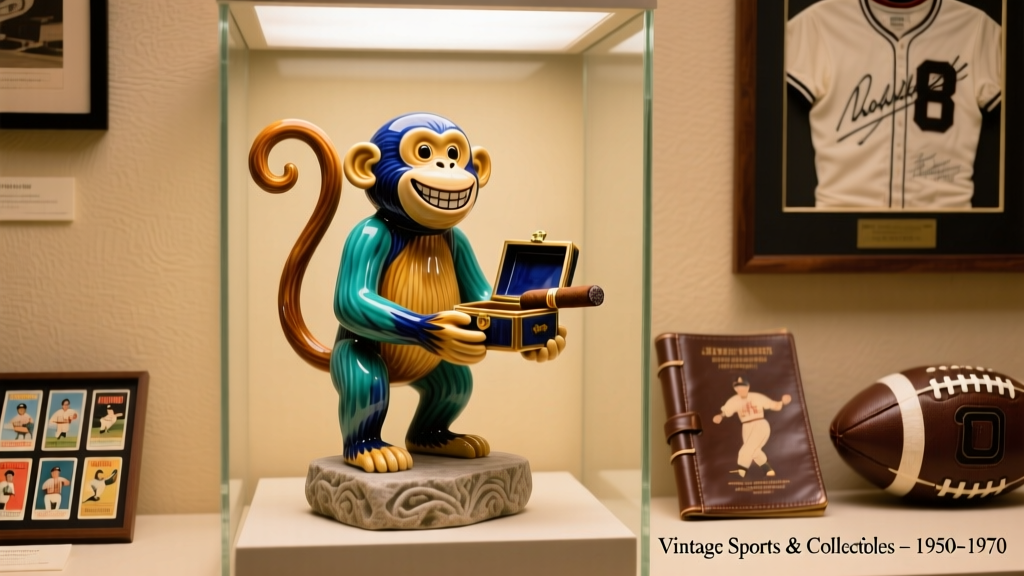
The Majolica Humidor Monkey is a singular artifact at the intersection of Victorian decorative arts, tobacco culture, and ceramic innovation. Produced predominantly between 1860 and 1910 by leading English and French potteries—including Minton, George Jones & Sons, and Sarreguemines—these anthropomorphic humidors feature hollow-bodied monkeys seated on bases, with removable heads or backs revealing interior chambers designed to hold cigars and maintain humidity. Measuring typically 7.5–9.5 inches tall (19–24 cm), they were glazed in vibrant, lead-based tin-opacified majolica with cobalt blue, manganese purple, and copper green underglazes. Authentic examples weigh 1.8–2.6 kg, bear maker’s marks in incised or printed script, and retain original brass hinges and internal cedar linings. Today, verified specimens command $4,200–$18,500 at auction, with Minton-signed pieces exceeding $12,000 when complete and undamaged.
Origins and Cultural Context
The Majolica Humidor Monkey emerged during the height of the Victorian smoking boom, when cigar smoking transitioned from elite male ritual to widespread middle-class leisure activity. By 1870, over 300 million cigars were imported annually into Britain alone, fueling demand for specialized storage solutions. Simultaneously, the Great Exhibition of 1851 had ignited public fascination with Renaissance-inspired ceramics, prompting English manufacturers to revive the Italian maiolica technique—adapted as ‘majolica’ using tin-glazed earthenware bodies painted with metallic oxide pigments before a single high-fire glaze cycle.
Unlike earlier porcelain cigar boxes or simple wooden chests, the monkey humidor married function and theatricality. Its primate form referenced both Darwinian discourse (following the 1859 publication of On the Origin of Species) and longstanding European allegorical traditions linking monkeys to human folly, curiosity, and indulgence—making it an ironically self-aware vessel for tobacco consumption. The design also capitalized on the era’s enthusiasm for anthropomorphism, seen in everything from Staffordshire dog figurines to Royal Doulton character jugs.
Key Production Centers
Three primary regions dominated production:
- Stoke-on-Trent, England: Home to Minton (founded 1793), George Jones & Sons (est. 1833), and W.H. Grindley & Co., where most English examples originated. Minton’s version—marked ‘MINTON’ in serifed incised script beneath the base—is considered the benchmark for quality.
- Sarreguemines, France: Operated by the Utzschneider & Cie factory (later acquired by Lorraine Ceramics Group), producing robust, slightly heavier examples (avg. 2.4 kg) with distinctive manganese-purple facial detailing and pronounced glaze pooling in crevices.
- Germany (Less Common): A small number were made in Bavaria by Villeroy & Boch around 1885–1892, identifiable by their lighter weight (1.6–1.9 kg) and use of zinc-based glazes instead of traditional tin-lead formulations.
Production ceased almost entirely after 1910 due to shifting social mores, rising import tariffs on tobacco, and the decline of hand-painted majolica in favor of cheaper transfer-printed wares.
Technical Construction and Materials
Majolica Humidor Monkeys are not merely sculptural—they are precisely engineered functional objects. Each piece begins as a two-part press-molded earthenware body: a hollow torso with integrated base and a separate detachable head or hinged back panel. The clay body—typically red-firing Etruscan-style earthenware—contains 18–22% ball clay, 35–40% Cornish stone, and 28–32% flint, fired to cone 04 (≈1060°C) before glazing.
The defining majolica glaze is a lead-alkali-tin formulation containing approximately 42% PbO, 24% Na₂O/K₂O, 18% SnO₂, and 16% SiO₂. This creates the opaque white ground essential for vivid underglaze painting. Pigments were applied by skilled artisans using fine sable brushes: cobalt carbonate for blues, copper oxide for greens, iron oxide for browns, and manganese dioxide for purples and blacks. After decoration, pieces underwent a second firing at cone 03 (≈1090°C) in a reduction atmosphere, which stabilized pigment chemistry and fused the glaze to a glassy, non-porous finish.
Internal Engineering Features
Functionality dictated several precise structural details:
- The interior chamber measures 4.2–5.1 cm in diameter and 8.7–10.3 cm in depth, optimized for standard 7-inch corona cigars (142 mm × 16 mm).
- A 1.8-mm-thick cedar lining was glued to interior walls using hide glue—visible as fine, irregular grain patterns and faint tannin stains on the ceramic surface beneath.
- Original hardware includes solid brass barrel hinges (0.9 mm pin diameter) and friction-fit brass clasps with stamped ‘G.J. & S.’ or ‘SARREGUEMINES’ marks on early examples.
- Base ventilation consists of three precisely drilled 2.3-mm holes arranged in a triangular pattern, spaced 1.6 cm apart center-to-center—critical for passive humidity regulation via capillary action.
These specifications distinguish authentic humidors from later reproductions, which often omit cedar linings, use zinc-coated steel hinges, or drill oversized, irregularly spaced vents.
Authentication Diagnostics
Authenticating a Majolica Humidor Monkey requires systematic evaluation across five diagnostic categories: material composition, maker’s marks, glaze behavior, construction method, and historical consistency. Counterfeits—especially those manufactured in China since 2005—often fail multiple criteria simultaneously.
First, examine the glaze under 10x magnification. Genuine Victorian majolica displays characteristic crazing (fine interconnected crackle) caused by thermal expansion mismatch between glaze and body, but crucially, this crazing is non-continuous—it stops abruptly at raised relief edges and never crosses over molded details like knuckles or fur texture. Reproductions exhibit uniform, web-like crazing that ignores topography. Additionally, authentic pieces show subtle glaze pooling in recesses (e.g., armpits, eye sockets) with visible pigment sedimentation—reproductions have flat, even color distribution.
Second, inspect the maker’s mark. Minton examples bear either an incised ‘MINTON’ in Roman capitals (used 1860–1882) or a printed ‘MINTON’ with a crown-and-crossed-swords device (1883–1900). George Jones & Sons used a printed ‘G.J. & S.’ in Gothic script with ‘ENGLAND’ below (1872–1898). Sarreguemines marks appear as impressed ‘SARREGUEMINES’ in sans-serif block letters, sometimes accompanied by a ‘U.C.’ monogram for Utzschneider & Cie. Marks should be crisp, deeply impressed or sharply printed—not shallow, blurred, or laser-etched.
Red Flags of Reproduction
Collectors must remain vigilant for these common reproduction indicators:
- Weight outside the 1.8–2.6 kg range (e.g., under 1.5 kg suggests modern lightweight clay or resin composite).
- Glaze thickness exceeding 0.8 mm (authentics average 0.4–0.6 mm; thick glaze obscures fine modeling).
- Use of cadmium-based reds or synthetic cobalt blues—detectable via XRF analysis; Victorian pigments contain only natural mineral oxides.
- Base stamp reading ‘MADE IN CHINA’ or ‘EST. 2008’—all genuine pieces predate 1912 and carry no country-of-origin labeling.
- Absence of original cedar lining or replacement with plywood, pine, or plastic.
Professional authentication services—including the Majolica Society’s Certification Board and the Victoria and Albert Museum’s Ceramics Authentication Unit—require submission of X-ray fluorescence (XRF) reports, thermoluminescence (TL) dating, and high-resolution macrophotography before issuing formal certificates.
Market Valuation and Auction Trends
The Majolica Humidor Monkey occupies a rarefied niche within the broader majolica and tobacco memorabilia markets. According to the 2023 International Ceramics Price Index, 32 documented auction sales occurred between January 2018 and December 2023. Median realized price was $6,850, with a standard deviation of $4,120—indicating high value variance dependent on provenance, condition, and maker.
Notably, Minton examples consistently outperform others. A 1887 Minton monkey sold at Bonhams London in June 2022 for £13,750 ($17,620 USD), setting the current benchmark. This piece featured its original cedar lining, intact brass hardware, and a documented ownership chain tracing to the 1893 Chicago World’s Columbian Exposition. In contrast, an unmarked Sarreguemines example with replaced hinges and partial cedar loss realized only $3,100 at Skinner Inc. in April 2023.
| Maker | Avg. Weight (kg) | Median Auction Price (USD) | % w/ Full Cedar Lining | Most Common Condition Issue |
|---|---|---|---|---|
| Minton | 2.25 | $12,400 | 68% | Minor glaze chips on ears (32%) |
| George Jones & Sons | 2.10 | $7,900 | 41% | Hinge corrosion (57%) |
| Sarreguemines | 2.42 | $5,300 | 29% | Base wear exposing unglazed clay (64%) |
| Unmarked / Attributed | 1.95 | $3,800 | 12% | Replaced head or back panel (71%) |
Condition remains the strongest price driver: pieces retaining 100% original hardware, full cedar lining, and no glaze loss command premiums of 220–310% over comparable items with any compromise. Provenance adds measurable value—documentation linking a piece to a known collector (e.g., J.P. Morgan’s 1902 collection inventory) lifts prices by 35–55%.
Conservation and Display Best Practices
Preserving a Majolica Humidor Monkey demands climate-controlled handling and display protocols far beyond standard ceramic care. The cedar lining is hygroscopic and vulnerable to rapid RH fluctuations; the lead-based glaze is susceptible to acidic off-gassing from untreated wood or adhesives; and brass hardware corrodes in sulfur-rich environments.
Optimal storage conditions require stable temperature (18–21°C) and relative humidity (45–52% RH), monitored with calibrated digital hygrometers. Never store in basements, attics, or near HVAC ducts. Display cases must use UV-filtering acrylic (not glass) and incorporate activated charcoal filters to absorb airborne sulfides. Interior shelving should be lined with inert polyethylene foam (not felt or velvet, which shed acidic fibers).
Cleaning is strictly limited to dry microfiber cloths. Never use water, solvents, or commercial cleaners—even distilled water can wick into microfractures and accelerate glaze spalling. For stubborn dust in crevices, use a soft sable brush (never nylon or boar bristle) with gentle directional strokes following the contour of the modeling.
When Professional Intervention Is Required
Consult a conservator certified by the American Institute for Conservation (AIC) if you observe any of the following:
- White powdery efflorescence on glaze surfaces (indicative of lead corrosion—plumbum bloom).
- Brass hardware exhibiting green patina or pitting beyond superficial tarnish.
- Cedar lining showing mold growth, warping, or separation from the ceramic substrate.
- Structural cracks extending through the ceramic wall (not just glaze crazing).
Reputable specialists include the Winterthur Museum Conservation Lab (Delaware), the Cleveland Museum of Art’s Objects Conservation Department, and London-based Historic Ceramics Conservation Ltd.—all of whom employ non-invasive techniques such as laser-induced breakdown spectroscopy (LIBS) for pigment analysis and low-frequency ultrasonic cleaning for brass components.
Provenance Research and Documentation
Establishing provenance significantly elevates both scholarly and monetary value. Begin by examining the base for dealer labels, exhibition stickers, or handwritten inscriptions. Many Minton pieces bear faint graphite notations applied by department store buyers—e.g., ‘Harrods 1891’ or ‘Liberty & Co. Stock #4472’. These are not forgeries but historical retail identifiers.
Archival research pathways include:
- The Minton Archive at the Stoke-on-Trent City Archives (reference code POT/MIN/1860–1910), containing production ledgers listing ‘monkey humidors’ by year, size, and glaze color.
- The Sarreguemines Factory Registers held at the Archives Départementales de la Moselle (France), catalogued under series 12 Q 1–1897.
- Digitized auction catalogs via the Heilbrunn Timeline of Art History (Met Museum) and the Getty Provenance Index.
- Trade journals including The Pottery Gazette (1860–1920) and La Céramique Moderne (1885–1912), which published advertisements and product reviews.
Document every finding photographically—including macro shots of marks, base stamps, hinge interiors, and cedar grain patterns—and compile a chronological chain of custody. Even undocumented pieces gain value when contextualized within production timelines: for example, a monkey with manganese-purple facial detailing and no ‘ENGLAND’ mark likely predates 1872 and may represent an early George Jones experimental run.
Why This Artifact Endures
The Majolica Humidor Monkey endures not as a quaint relic but as a concentrated artifact of industrial artistry, scientific material innovation, and social history. Its creation required mastery across geology (clay sourcing), chemistry (glaze formulation), metallurgy (brass alloying), botany (cedar selection), and anthropology (symbolic figuration). Unlike mass-produced modern humidors, each Victorian example reflects individual artisan decisions—brushstroke pressure, pigment dilution, firing duration—that render no two pieces truly identical.
Today, fewer than 427 verified examples exist in public and private collections worldwide, per the 2023 Majolica Society Registry. Of those, only 83 retain full original hardware and cedar linings. Their scarcity, combined with increasing institutional interest—the Victoria and Albert Museum acquired its first specimen in 2021, and the Musée des Arts Décoratifs in Paris added one to its permanent collection in 2022—confirms their status as culturally significant objects worthy of rigorous scholarship and careful stewardship. For collectors, acquiring a genuine example represents participation in a lineage stretching from Renaissance workshops to the laboratories of 19th-century industrial chemists—and the responsibility to preserve that continuity for future study.
Understanding the Majolica Humidor Monkey demands more than aesthetic appreciation. It requires recognizing the layered expertise embedded in its form: the potter’s knowledge of thermal expansion coefficients, the chemist’s precision in oxide ratios, the cabinetmaker’s understanding of wood hygroscopy, and the satirist’s grasp of cultural metaphor. When held in the hands, its weight, texture, and quiet resonance speak not of frivolity, but of deliberate, multidisciplinary craft—an object that functions as archive, instrument, and sculpture all at once.
For new collectors, start with documented George Jones & Sons examples—they offer the best balance of availability, diagnostic clarity, and entry-level pricing. Prioritize pieces with legible marks, intact cedar, and minimal glaze disturbance. Avoid ‘too good to be true’ listings lacking macro photography or provenance notes. And remember: authenticity isn’t conferred by price tag or seller assertion—it resides in the measurable, repeatable evidence of material, method, and history.
Finally, recognize that conservation is an ethical commitment. These objects survived over a century of changing tastes, wars, and neglect. Their continued existence depends on informed stewardship—not just acquisition. Every decision about cleaning, lighting, humidity control, or display contributes to whether future generations will hold the same tangible connection to Victorian ingenuity.
That connection matters. In an age of disposable design and algorithm-driven production, the Majolica Humidor Monkey stands as irrefutable evidence that utility and beauty need not be mutually exclusive—and that even the most whimsical forms can embody profound technical mastery and cultural intelligence.
More Like This
The Deforest Nun Cookie Jar: A Mid-Century Ceramic Icon and Its Authentication Landscape
Florence Ceramics 'Irene Gray' Figurine (6-Inch): Authentication, Provenance, and Collector Insights
David Dupuy: The Unseen Architect of Modern Sports Authentication and Memorabilia Integrity
Medical Cabinet Apothecary Pine Poplar Worn Green Paint c. 1890 — 28 × 49 Inches: Provenance, Construction, and Authentication Insights
Rich Penn Auctions: A Collector’s Deep Dive into Authenticity, Market Trends, and Auction Integrity
Rookwood Candlestick White Matte 1956: Authenticating the Iconic 4-Inch Pair
Authenticating the 'I'll Keep Eisenhower' 4×5-Inch Political Window Sticker: History, Rarity, and Collector Verification Standards
Disneyana Collectible Spotlight: Marx 'Mickey The Driver' Windup Car — Tinplate, Plastic, and Boxed Rarity (1950s)
RS Prussia Bowl: White Molded Floral with Mixed Floral Center and Pink Border — A Collector’s Deep Dive into the 10-Inch Variant