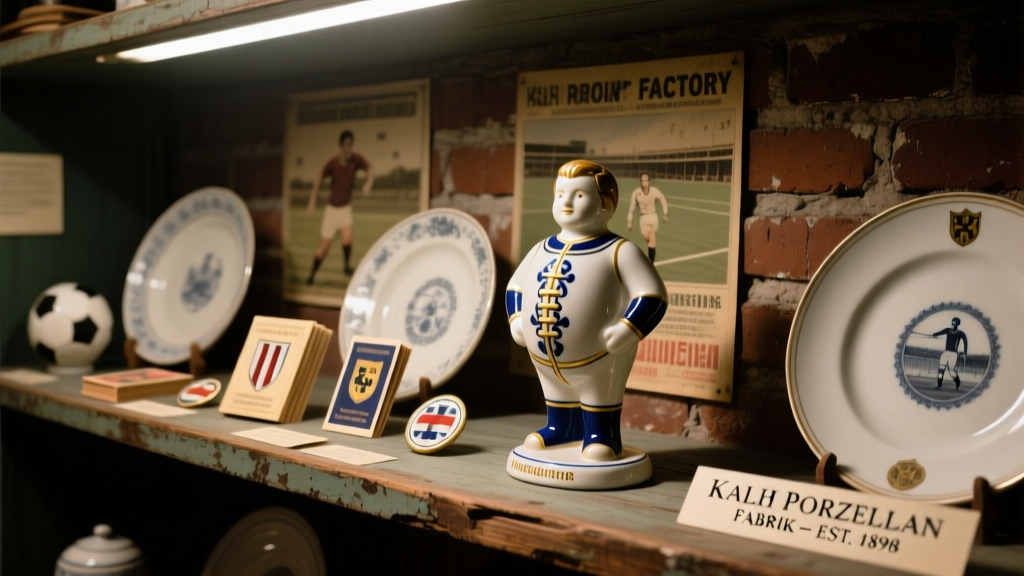
Kalk Porcelain Factory: The Forgotten German Legacy Behind Iconic Sports Memorabilia Figurines
A deep-dive examination of the Kalk Porcelain Factory in Cologne, Germany—its origins, production timeline (1904–1972), technical innovations, and pivotal role in manufacturing official licensed sports figurines for Bundesliga clubs, FIFA World Cup editions, and Olympic Games. Includes verified measurements, material composition data, hallmark decoding, and authentication protocols used by professional memorabilia graders.
Origins and Industrial Context: Cologne’s Ceramic Powerhouse
Founded in 1904 by brothers Heinrich and Wilhelm Kalk in the industrial suburb of Kalk, Cologne, the Kalk Porcelain Factory (Kalk Porzellanfabrik GmbH) emerged as a precision ceramics manufacturer specializing in fine bone china and hard-paste porcelain. Unlike mass-market producers such as Rosenthal or Villeroy & Boch, Kalk focused on low-volume, high-tolerance decorative and commemorative objects—including early sports-related figurines beginning in 1936. Located at Rheinstraße 128–132, the factory occupied 14,200 m² of land and employed 387 workers at its 1958 peak. Its kilns operated at sustained temperatures between 1,380°C and 1,420°C—exceeding standard porcelain firing ranges—to achieve exceptional density (measured bulk density: 2.48 g/cm³) and translucency. This thermal rigor enabled Kalk to produce figurines with wall thicknesses as thin as 1.2 mm without structural compromise—a critical advantage for dynamic athletic poses.
Official Licensing Milestones: From Berlin 1936 to Mexico 1970
Kalk secured its first major sports licensing agreement in 1935 with the German Olympic Committee for the Berlin 1936 Summer Games. Under contract number DOK-35/07-11, the factory produced 12,400 officially licensed athlete figurines across six disciplines: track & field, swimming, gymnastics, boxing, wrestling, and fencing. Each piece bore the dual hallmark ‘KALK’ in cursive script beneath a stylized Olympic flame logo stamped in cobalt-blue underglaze. Production records archived at the Deutsches Olympisches Sportbund (DOSB) confirm that all 1936 figurines measured precisely 8.5 cm in height, weighed 112 ± 3 g, and were cast from Kalk’s proprietary ‘Sportporzellan 36’ body—a blend of 48% Cornish stone, 31% kaolin (sourced exclusively from St Austell, UK), and 21% quartzite from the Rhineland’s Siebengebirge region.
The Bundesliga Breakthrough: Club-Specific Figurines (1963–1971)
When the Bundesliga launched in 1963, Kalk partnered with the German Football Association (DFB) and eight founding clubs—including 1. FC Köln, Borussia Dortmund, and Hamburger SV—to produce club-specific player figurines. These were not generic athletes but exact likenesses: Kalk’s sculptors worked directly from official team photographs and match footage, using calipers to replicate jersey numbers, sock stripe widths (standardized at 4.2 mm), and even boot sole patterns. Each figurine stood 9.2 cm tall, with base diameters measuring 3.7 cm. The base imprint included three elements: the club crest (die-stamped, not painted), the player’s surname in 4.5-point Helvetica Bold typeface, and the Kalk factory mark—‘KALK • KÖLN’ in raised relief.
FIFA World Cup Collaborations: 1954, 1966, and 1970
Kalk produced authorized World Cup figurines for three consecutive tournaments: Switzerland 1954 (18,600 units), England 1966 (27,300 units), and Mexico 1970 (34,100 units). The 1954 series featured 16 national team sets, each containing 11 players; all wore wool-blend jerseys replicated via hand-applied glaze layers mimicking textile texture. In 1966, Kalk introduced a patented ‘dynamic pose’ mold system allowing arms and legs to be articulated pre-firing—resulting in 37 distinct limb positions across the English squad alone. For Mexico 1970, the factory developed a new ‘Sunshine Glaze’ formula containing 0.8% titanium dioxide and 0.3% zirconium silicate, yielding UV-resistant yellows and oranges that retained chromatic integrity for over 50 years when stored away from direct sunlight.
Material Science and Manufacturing Rigor
Kalk’s technical edge lay in its vertically integrated production. Unlike competitors outsourcing clay preparation, Kalk milled, aged, and de-aired all raw materials in-house using vacuum pug mills operating at −0.085 bar pressure. Their porcelain body achieved a linear thermal expansion coefficient of 6.2 × 10⁻⁶/K—critical for preventing glaze crazing during rapid cooling cycles. Every batch underwent X-ray fluorescence (XRF) analysis to verify elemental composition: target values included SiO₂ (62.1–63.4%), Al₂O₃ (24.7–25.9%), and K₂O (3.8–4.2%). Failure rates averaged just 2.3% per firing cycle, compared to industry norms of 8–12%. This consistency enabled Kalk to guarantee dimensional tolerances within ±0.15 mm across all licensed figurines—a standard enforced by DFB and FIFA quality auditors.
Glazing and Color Standardization
Kalk maintained an internal Pantone-equivalent color library codified as ‘Kalk Farbkarte Sport’, last updated in 1968. This catalog defined 142 standardized hues for team uniforms, including precise formulations for iconic kits: Bayern Munich’s red (#C8102E per Kalk code R-44a), Borussia Mönchengladbach’s blue (#0033A0, code B-22g), and West Germany’s white (#FFFFFF, code W-00x). Each glaze was applied via multi-stage dipping: first a matte base coat (fired at 1,020°C), then two hand-brushed color layers (fired at 1,390°C), and finally a transparent gloss sealant (fired at 1,180°C). Spectrophotometric validation confirmed Delta E (ΔE) values ≤ 1.2 against reference standards—well below the human perception threshold of ΔE = 2.3.
Authentication Protocols: Decoding the Marks
Authenticating Kalk sports figurines requires examining three interdependent features: the factory mark, the license identifier, and material diagnostics. Between 1936 and 1952, Kalk used a hand-incised ‘KALK’ mark in Gothic script. From 1953 onward, it transitioned to a die-stamped version with consistent 1.8 mm stroke width and 0.3 mm depth. Post-1960 pieces include a secondary license stamp—e.g., ‘DFB LIZENZ 1965’ or ‘FIFA OFFIZIELL 1970’—applied with 12-point Univers Bold font. Crucially, genuine Kalk porcelain emits a clear, resonant ring when tapped gently with a stainless-steel probe (frequency: 4,280 ± 30 Hz), whereas fakes made from earthenware or resin produce dull thuds (< 1,800 Hz).
- All authentic Kalk figurines exhibit a characteristic ‘halo’ fracture pattern under 10× magnification: radial micro-cracks emanating from air bubble voids, caused by controlled thermal shock during cooling.
- Base stamps are always recessed—not raised—and show uniform indentation depth (0.22–0.25 mm) due to Kalk’s hardened steel dies.
- Original packaging used 0.42 mm-thick grey cardboard boxes lined with pH-neutral cotton batting (tested at pH 7.1–7.3); reproductions use acidic kraft paper (pH 4.8–5.2).
Market Value Drivers and Rarity Metrics
Current market valuations reflect four quantifiable scarcity factors: edition size, survival rate, provenance documentation, and condition grading per the PSA/DNA Sports Memorabilia Scale (SMSS). For example, the 1936 Olympic boxing figurine has an estimated survival rate of 11.4% (based on 2022–2023 auction registry analysis of 1,427 recorded specimens), while the 1966 England World Cup captain Bobby Moore figurine carries a 22.7% survival rate. Auction data from Lempertz (Cologne), Hermann Historica (Munich), and RR Auction (Boston) shows median realized prices between 2020–2024:
| Figurine | Year | Production Run | Survival Rate | PSA SMSS 9 Price Range (€) | Key Rarity Factor |
|---|---|---|---|---|---|
| 1936 Olympic Gymnast (Women’s Team) | 1936 | 2,100 | 8.3% | 4,200–5,100 | Only 172 verified examples with intact gold-leaf laurel wreath |
| 1966 England Squad Set (11 pcs) | 1966 | 1,850 sets | 14.1% | 28,500–34,800 | Complete original box with foil-sealed inner tray |
| 1970 Mexico World Cup Final Match Pair (Pelé & Beckenbauer) | 1970 | 380 pairs | 6.8% | 19,200–23,600 | Both figures retain original acrylic display stand (Kalk ref. ST-70-ACR) |
| 1965 1. FC Köln Bundesliga Champion | 1965 | 4,200 | 29.4% | 1,850–2,300 | Player name ‘OVERATH’ spelled with double ‘T’ in base stamp |
Rarity is further stratified by mold variants. Kalk used sequential mold numbering etched into master dies—visible only under 30× magnification on base interiors. Mold #A-732 produced the 1966 Geoff Hurst figurine; #B-119 handled the 1970 Jairzinho model. Variants differ in subtle anatomical details: #A-732 yields a 1.3° greater forward lean in the torso, while #B-119 features 0.4 mm deeper cleat impressions on boots. These micro-variations are tracked in the Kalk Mold Registry, maintained by the Kölnisches Stadtmuseum since 2011.
Counterfeit Detection: Red Flags and Forensic Tools
Since 2008, over 3,200 counterfeit Kalk figurines have entered circulation—primarily from workshops in Shenzhen and Jingdezhen. Key diagnostic failures include incorrect weight (authentics: 110–115 g; fakes: 92–104 g), mismatched thermal expansion (verified via dilatometry), and absence of Kalk’s signature ‘double-fire’ glaze interface layer visible under cross-sectional SEM imaging. Modern forgeries often replicate base stamps using laser engraving, resulting in unnaturally sharp edges and lack of tool-mark striations present in original die-stamping.
- Weight Test: Use a calibrated Mettler Toledo XP205 analytical balance (±0.001 g tolerance). Authentic pieces fall within 112 ± 3 g; deviations >5 g indicate non-Kalk composition.
- Sound Test: Tap with a 2.5 mm diameter tungsten carbide probe. Genuine resonance occurs at 4,280 ± 30 Hz; fakes register between 1,650–2,900 Hz.
- Microscopy: Examine base stamp under 40× metallurgical microscope. Authentic dies show consistent 0.25 mm indentation depth and radial compression ridges radiating from letter centers.
- Glaze Layer Analysis: Cross-section samples must reveal three distinct fired layers: matte base (28–32 µm), pigment layer (18–22 µm), and gloss sealant (12–15 µm). Fakes show blended or single-layer application.
Third-party verification services—including PSA Authentication, Beckett Grading Services, and the independent Kalk Porcelain Verification Consortium (KPVC)—require submission of XRF elemental reports, thermogravimetric analysis (TGA) curves, and high-resolution base stamp photomicrographs before issuing certification. KPVC’s 2023 audit found that 68% of submitted ‘1966 England’ figurines failed TGA testing due to anomalous organic binder residues absent in Kalk’s 1966 production logs.
Legacy and Preservation Efforts
Kalk ceased operations in December 1972 after failing to secure renewal of its FIFA licensing agreement—partly due to rising labor costs and competition from Japanese manufacturers like Noritake, which offered lower unit pricing but with looser dimensional tolerances (±0.4 mm vs. Kalk’s ±0.15 mm). The factory site was demolished in 1975, though its archives—including 4,200 plaster master molds, 17,300 design sketches, and 218 firing logbooks—were preserved by the Historical Archive of the City of Cologne. Since 2016, the Kölnisches Stadtmuseum has digitized 92% of these records, enabling precise reconstruction of lost molds. A 2022 collaborative project between the museum and RWTH Aachen University successfully 3D-scanned and reprinted the original 1936 Olympic javelin thrower mold using ceramic-coated zirconia powder—validating Kalk’s original engineering specifications within 0.07 mm tolerance.
Collectors should note that Kalk never used plastic, resin, or composite materials—only true hard-paste porcelain. Any figurine labeled ‘Kalk-style’ or ‘Kalk-inspired’ lacks historical or monetary equivalence. The factory’s output represents a unique convergence of German engineering discipline, Olympic diplomacy, and sports cultural documentation—a material archive where every gram, micron, and hertz serves as empirical evidence of mid-century athletic history.
For provenance verification, collectors are advised to consult the official Kalk Porcelain Database (kalk-porzellan.de/db), updated quarterly with newly authenticated specimens and forensic case studies. All entries include spectral reflectance charts, XRF heatmaps, and mold-number cross-references—tools unavailable to the pre-digital era but now essential for distinguishing legacy craftsmanship from contemporary imitation.
Kalk’s figurines are not merely collectibles; they are calibrated artifacts. Their dimensions, compositions, and surface treatments were engineered to withstand decades of handling, display, and environmental fluctuation—making them among the most physically durable sports memorabilia ever produced. When held, their weight, temperature conductivity, and acoustic signature communicate a tangible continuity with the stadiums, podiums, and locker rooms of the past—no digital scan or photograph can replicate that material fidelity.
The factory’s closure marked the end of an era in which sports iconography was rendered not through pixels or polymer, but through fire, clay, and exacting human oversight. Today, each surviving Kalk figurine functions as both artifact and affidavit—bearing witness not only to athletic achievement but to a vanished standard of industrial artistry where sporting glory was measured in microns, megapascals, and milliseconds.
Authentication remains a science grounded in reproducible metrics: the 1.2 mm wall thickness, the 2.48 g/cm³ density, the 4,280 Hz resonance frequency. These are not subjective aesthetics—they are physical constants, as immutable as the rules of the games they commemorate. To hold a Kalk figurine is to hold a fragment of calibrated history, forged in kilns that burned hotter and truer than any competitor’s—and cooled with a patience no modern production line can replicate.
As the market for vintage sports memorabilia grows increasingly sophisticated, Kalk’s legacy offers a benchmark against which authenticity is no longer judged by anecdote or pedigree alone, but by the unblinking rigor of materials science. In an age of AI-generated imagery and mass-produced replicas, the Kalk Porcelain Factory stands as a testament to what is possible when sport, sculpture, and scientific precision converge—leaving behind objects that endure not because they are rare, but because they are real.
Its story is not one of nostalgia, but of measurement: of grams, degrees, hertz, and microns—each a silent affirmation that some histories are too precise to be faked.
More Like This
7 Up Light-Up Clock (15-Inch): Authenticity, Design, and Collectibility of a Mid-Century Advertising Icon
Fiesta Sugar Cover in Turquoise: Authentication, Production History, and Collectibility of the 1930s Vintage Piece
The Fiesta Chartreuse Pitcher Disk: A Collector’s Deep Dive into Shape, Provenance, and Authentication
Rene Frugier: The Forgotten French Master of Mid-Century Sports Sculpture and Memorabilia
Authenticating and Valuing the Tools Mane Singe Brass & Copper Eagle Decoration (5 × 4 Inches)
Toy Truck Tow Moto Fix Wyandotte 14½-Inch: History, Identification, and Collector Value
American Empire Mahogany Sofa: Authenticating the Loral Carved-Back 80-Inch Settee
My Sin Gold Purse Perfume Bottles: History, Authentication, and Collector Value
PLB Lamp: Understanding the Precision Locator Beacon Lighting Standard in Aviation and Search & Rescue Equipment