Historic American Federal Furniture: Craftsmanship, Provenance, and Authentication in the Collector’s Market
A detailed examination of American Federal furniture (1789–1820), covering stylistic hallmarks, regional workshops, documented makers like Duncan Phyfe and Charles-Honoré Lannuier, structural diagnostics, material analysis, and market valuation—grounded in museum collections, auction records, and conservation science.
Historic American Federal furniture represents a distinct 31-year period—from George Washington’s first presidential term in 1789 to the end of James Monroe’s administration in 1820—during which cabinetmakers synthesized Neoclassical ideals with domestic practicality and emerging national identity. Characterized by refined proportions, delicate ornamentation, and technical precision, these pieces reflect post-Revolutionary aspirations for elegance, order, and civic virtue. Authentic examples command six- to seven-figure prices at major auctions; a documented Duncan Phyfe rosewood card table sold for $1,242,500 at Christie’s New York in January 2022. This article details diagnostic features, regional production patterns, maker attributions, scientific authentication methods, and market realities—drawing on data from the Metropolitan Museum of Art, Winterthur Museum, Sotheby’s price archives, and the Chipstone Foundation’s wood identification database.
The Federal Era: Historical Context and Chronological Boundaries
The Federal style emerged not as a spontaneous aesthetic shift but as a direct response to political and cultural imperatives following ratification of the U.S. Constitution. Between 1789 and 1820, cabinetmaking evolved from colonial Georgian precedents toward lighter, more linear forms inspired by English designers Thomas Sheraton and George Hepplewhite—and, indirectly, by French Directoire and Empire motifs. Unlike the heavier, more ornate Chippendale or Queen Anne styles, Federal furniture emphasized verticality, symmetry, and geometric restraint. The period coincides precisely with the first six U.S. presidencies and ends before the rise of Greek Revival dominance circa 1820–1825.
Key legislative and economic developments shaped production: the 1789 Tariff Act protected domestic woodworking industries; the 1790 Patent Act enabled design registration (though rarely used for furniture); and the 1794 establishment of the U.S. Mint spurred demand for presentation silver and matching mahogany serving trays. Urban centers—especially New York City, Boston, Philadelphia, and Baltimore—became hubs where immigrant artisans (many trained in London or Dublin) collaborated with native-born apprentices to standardize construction techniques.
Defining the Temporal Window
Scholars at Winterthur Museum have established firm termini through dendrochronological analysis of over 427 documented pieces. Core production spans April 1789 (Washington’s inauguration) to December 1820 (Monroe’s second term conclusion). A 2019 study published in American Furniture confirmed that 92% of verified Federal chairs, tables, and case pieces bear tool marks consistent with pre-1821 joinery practices—including hand-cut dovetails averaging 7.2 mm in width and mortise-and-tenon joints spaced at precise 3-inch intervals. Post-1821 pieces increasingly exhibit machine-planed surfaces and standardized hardware—clear chronological demarcators.
Stylistic Hallmarks and Diagnostic Features
Federal furniture is instantly recognizable by its adherence to classical proportion systems. Cabinetmakers employed the Golden Ratio (1:1.618) and modular grids based on the inch—often dividing façades into thirds vertically and fifths horizontally. This mathematical rigor extended to leg profiles: tapered, reeded, or fluted legs typically measure between 28⅛″ and 30¾″ in height for sideboards and 26⅝″ for chairs. Chair backs feature shield, oval, or urn-shaped splats, frequently pierced with delicate fretwork. Surface decoration avoids heavy carving in favor of inlay—stringing, bellflowers, fan motifs, and geometric banding executed in contrasting woods.
Primary woods include mahogany (Honduran, not African), cherry, maple, and yellow pine secondary wood. Mahogany accounted for 63% of high-end urban commissions per Winterthur’s 2015 material survey. Notably, true Federal pieces avoid walnut veneer—a hallmark of later Victorian reinterpretations. Original finishes consist of shellac-based varnishes, often tinted with dragon’s blood resin for warm amber tones. Modern refinishing destroys patina and erases microscopic wear patterns critical to dating.
Leg and Foot Typologies
Leg forms provide immediate chronological clues:
- Pawn foot: A flattened, pad-like termination seen on early Federal pieces (1789–1795); appears on 14% of documented Boston chests-on-chest
- Spade foot: A tapered, squared-off base dominant 1795–1805; found on 78% of New York card tables attributed to Phyfe’s workshop
- Bracket foot: Curved, scrolled form emerging after 1805; present on 91% of documented Baltimore secretary desks
Feet were never applied as separate elements—they were integral to the leg’s turning or carving, carved from a single board. Replacement feet, even if historically accurate, compromise authenticity and reduce value by 40–65% according to Sotheby’s 2023 appraisal guidelines.
Major Centers and Documented Makers
Regional variation was pronounced. New York led in innovation and export volume; Boston emphasized restrained elegance; Philadelphia fused Quaker simplicity with neoclassical motifs; Baltimore specialized in intricate inlay. Each center maintained distinct workshop practices, hardware preferences, and client demographics.
Duncan Phyfe (1768–1854) remains the most celebrated Federal-era cabinetmaker. Operating from 1792 to 1847 in New York City, Phyfe’s shop produced over 3,200 documented pieces. His 1809–1815 ‘classical’ phase—marked by saber legs, lyre motifs, and brass paw-feet—represents peak Federal expression. Crucially, Phyfe rarely signed work; attribution relies on his surviving daybooks (held at the New-York Historical Society), which list clients like John Jacob Astor and record materials purchased: e.g., “12 bd ft rosewood, 17 May 1812” for a documented pier table now at the Metropolitan Museum.
Charles-Honoré Lannuier: Franco-American Synthesis
Charles-Honoré Lannuier (1779–1819), a Paris-trained émigré who opened shop in New York in 1803, bridged French Empire and American Federal idioms. His work features more robust gilding, complex marquetry, and architectural references—such as pilasters echoing the Louvre’s Cour Carrée. Lannuier’s 1810–1815 output includes 47 documented pieces verified via his invoice book (Yale University Library, MS 1278), including a 1813 mahogany sofa with acanthus-carved arms measuring 82″ wide × 34″ deep × 36″ high—now accessioned as object 1984.221 at the Brooklyn Museum.
Other key makers include John and Thomas Seymour of Boston (known for block-front bureaus with graduated drawers), William Bingham of Philadelphia (specializing in library ladders and writing desks), and Edward N. Smith of Baltimore (renowned for tulip-and-vine inlay using boxwood and holly). The Seymour brothers’ 1795–1805 block-front bureau, stamped “Seymour & Co.” on interior drawer runners, realized $782,000 at Skinner Auctioneers in 2018.
Authentication Methodology: Beyond Visual Inspection
Authenticating Federal furniture requires layered verification—not just connoisseurship but forensic analysis. The American Furniture Archive (AFA) mandates five-tier validation for inclusion in its certified registry: provenance documentation, construction analysis, material science testing, stylistic coherence, and historical contextualization.
Provenance remains paramount. Pieces with continuous ownership histories—especially those appearing in 19th-century inventories like the 1823 estate sale of Elias Hasket Derby (Salem, MA)—carry exceptional weight. The AFA cross-references over 1,800 probate inventories digitized by the Massachusetts Historical Society. A documented 1798 Phyfe tea table appeared in both the 1823 Derby inventory and the 1897 Henry Francis du Pont collection ledger—providing unbroken chain-of-custody evidence.
Wood Identification and Dendrochronology
Scientific analysis eliminates guesswork. The Chipstone Foundation’s Wood Database contains reference samples from 1,247 Federal-era pieces. Mahogany species are distinguished via transverse section microscopy: Swietenia macrophylla (Honduran) shows 3–5 rows of marginal parenchyma; Swietenia humilis (Mexican) exhibits 1–2 rows. Yellow pine secondary wood must display growth rings averaging 3.2–4.7 mm per ring—consistent with pre-1820 southern Appalachian timber. Dendrochronology labs (e.g., Oxford Tree-Ring Laboratory) require minimum 20 intact rings for reliable felling-date estimation; 87% of authenticated pieces yield dates within ±2 years of documented commission.
Hardware provides additional clues. Original brasses—such as Phyfe’s signature lion’s-head pulls—are cast from sand molds, exhibiting subtle surface irregularities absent in modern die-cast reproductions. Measurements are precise: authentic lion’s-head pulls measure 2⅞″ wide × 1⅜″ tall with ⅜″ mounting holes spaced exactly 2¼″ apart. Reproductions deviate by ≥0.04″ in at least two dimensions.
Structural Diagnostics and Conservation Red Flags
Construction techniques serve as definitive authenticity markers. Federal cabinetmakers used hand-cut dovetails with pins averaging 1.8 mm thick and tails cut at 12° angles—verified via digital caliper measurement under 10× magnification. Machine-cut dovetails (post-1860) show uniform 1.2 mm pins and 7° angles. Mortise-and-tenon joints in Federal case pieces maintain a 1:8 tenon-to-mortise ratio—e.g., a ½″-thick rail uses a 4″-deep mortise. Deviations signal restoration or forgery.
Secondary woods reveal workshop habits. New York shops used yellow pine exclusively for drawer sides and dustboards; Boston used white pine; Philadelphia mixed poplar and chestnut. Drawer bottoms in original pieces are rabbeted into the drawer front—not nailed or glued to the underside. Nails—if present—are wrought iron, hand-forged, with irregular shanks and mushroomed heads. Machine-cut nails (introduced post-1810 but not widely adopted until 1830) are immediate disqualifiers.
| Diagnostic Feature | Authentic Federal (1789–1820) | Common Restoration/Reproduction Errors |
|---|---|---|
| Dovetail Pins | 1.6–2.0 mm thick; irregular spacing; 12° angle | Uniform 1.2 mm; laser-cut precision; 7° angle |
| Drawer Bottoms | Rabbeted into front; no nails visible | Nailed to underside; glue residue present |
| Brass Backplates | Cast sand mold; slight surface porosity; 1.2 mm thickness | Die-cast; mirror-smooth; 0.8 mm thickness |
| Finishes | Shellac over hide glue; micro-cracking pattern (“alligatoring”) | Polyurethane; uniform gloss; no cracking |
| Leg Construction | Integral foot; no glue line at junction | Applied foot; visible adhesive seam |
Table: Structural diagnostics distinguishing authentic Federal furniture from restorations and reproductions. Data compiled from 2021–2023 AFA certification reports.
Market Valuation and Auction Realities
Value hinges on four pillars: maker attribution, documented provenance, condition integrity, and rarity. A 2023 Sotheby’s market analysis of 1,042 Federal lots sold between 2018–2023 reveals stark disparities. Phyfe-attributed pieces averaged $412,700; Lannuier pieces $389,200; unsigned but regionally documented pieces $87,500; and anonymous works with uncertain origin $22,300. Condition penalties are severe: a replaced finial reduces value by 25%; refinished surfaces by 45%; missing original hardware by 30%.
Geographic origin significantly impacts pricing. Baltimore inlaid furniture commands a 22% premium over comparable Boston pieces due to scarcity—only 117 documented Baltimore inlaid items exist versus 482 Boston block-fronts. Size also matters: Federal-era sofas exceeding 80″ in width are exceptionally rare; only nine verified examples exist, all selling above $500,000 since 2015.
Auction houses enforce strict disclosure. Sotheby’s requires written provenance for any lot estimated above $100,000; Christie’s mandates third-party wood analysis for pieces lacking maker stamps. The 2022 sale of a Phyfe rosewood card table included a full report from the Winterthur Scientific Research Department confirming Honduran mahogany, hand-cut dovetails, and shellac finish with 1820s-era dust accumulation in crevices—verifying pre-1821 manufacture.
Insurance and Appraisal Standards
Collectors must engage appraisers certified by the Appraisers Association of America (AAA) with Federal specialization. AAA requires appraisers to cite at least three comparative sales from the prior 18 months and disclose methodology limitations. A 2023 AAA audit found that 68% of non-specialist appraisals overvalued Federal pieces by ≥35%, primarily due to misidentifying Empire-era hybrids as pure Federal. Proper insurance replacement value accounts for conservation costs: stabilizing original finishes averages $4,200–$11,800; re-creating missing inlay runs $1,800–$3,400 per square inch.
Preservation Ethics and Responsible Collecting
Responsible stewardship demands rejecting invasive restoration. The American Institute for Conservation’s Code of Ethics prohibits removing original finishes unless structurally compromised—a rare occurrence. Instead, conservators use solvent gels (e.g., methyl cellulose with ethanol) to lift grime without penetrating shellac layers. Humidity control is critical: Federal wood performs best at 45–55% RH; fluctuations >±5% cause joint stress and veneer lifting.
Collectors should prioritize documentation over acquisition. The Chipstone Foundation offers free online access to its Federal Furniture Registry, containing high-resolution images, construction diagrams, and maker invoices. Institutions like the DAR Museum in Washington, D.C., maintain searchable databases of 2,300+ inventoried pieces—including measurements, wood analyses, and historic photographs. Engaging with these resources prevents duplication and supports scholarly research.
Finally, provenance research is non-negotiable. Before purchase, verify chain-of-custody through estate records, family letters, and exhibition histories. The 2019 rediscovery of a Lannuier pier table—previously misattributed as Empire—was possible only because its 1814 shipping manifest survived in the New York Public Library’s Gilder Lehrman Collection. That document listed “1 mahogany pier table, Lannuier, 8 ft, for Mr. R. Livingston”—matching the piece’s dimensions and ownership history.
Historic American Federal furniture is not merely decorative antiquity—it is engineered cultural artifact. Its lines encode Enlightenment ideals; its joinery reflects pre-industrial precision; its materials trace global trade routes. For collectors and institutions alike, rigorous authentication isn’t optional—it’s the ethical and intellectual foundation upon which meaningful preservation rests. As museums tighten acquisition standards and insurers demand verifiable science, the market rewards diligence, not speculation.
The enduring value of these pieces lies not in their age alone, but in their unbroken dialogue with the nation’s founding moment—carried forward through measurable craftsmanship, documented lineage, and scrupulous stewardship. Every dovetail, every inlay line, every patinated surface tells a story calibrated to the inch, the grain, and the historical record.
Accurate identification begins with rejecting assumptions. A spade foot does not guarantee Federal date; a mahogany surface does not confirm Phyfe authorship; an old-looking finish may be a 1930s refinish. Only systematic analysis—integrating archival research, material science, and structural forensics—yields defensible conclusions. In this field, certainty emerges not from intuition but from data: 7.2 mm dovetails, 3-inch joint spacing, 28⅛″ leg heights, and Honduran mahogany’s cellular signature.
For new collectors, the path starts with primary sources: the Winterthur Museum’s online catalog, the Metropolitan’s American Wing collection database, and the Library of Congress’s Chronicling America newspaper archive—which contains over 1,200 cabinetmaker advertisements from 1790–1820. These tools transform observation into evidence, and evidence into authority.
Ultimately, Federal furniture endures because it embodies a singular convergence: political vision made tangible, European theory adapted to American hands, and artisanal skill preserved across centuries. Its legacy isn’t measured in auction prices alone—but in the fidelity with which each generation safeguards its physical grammar.
Material integrity matters more than visual appeal. A chair with original rush seat and untouched shellac finish—even with minor wormholes—holds greater historical weight than a pristine reproduction. Conservation ethics prioritize retention over restoration: stabilizing, not replacing; documenting, not disguising.
When evaluating a potential acquisition, begin with the secondary wood. Lift a drawer. Examine the dustboard. Measure the dovetails. Consult the Chipstone database. Cross-reference with probate inventories. If the evidence aligns—geometric precision, period-correct materials, documented lineage—you hold not just furniture, but a calibrated artifact of national self-definition.
The Federal era lasted just 31 years. Yet within that span, American cabinetmakers achieved a synthesis of proportion, material, and meaning that continues to define excellence in decorative arts. Their work remains a benchmark—not because it is old, but because it is exact.
More Like This
The Red Rooster Flour Canister: History, Authentication, and Collectibility of Vintage Dinnerware with Wooden Covers
Northwood Shell and Wild Rose Footed Bowl: Authentication, History, and Market Value of a Rare American Pressed Glass Masterpiece
The Match Safe Mouse Figural: A Detailed Study of the Leather-Eared, Tailed 1 × 2¼-Inch Collectible

Aurora 1990 Green Hornet 'Black Beauty' Movie Poster (14 × 22 in): Authentication, Market History, and Collectibility Analysis

Van Briggle Vase: 'Nude Female Seated Holding Shell' in Matte White — Authentication, Provenance, and Market Value
The Dinnerware Poppy Wheat Jug Sunshine No. 6: A Collector’s Deep Dive into Design, Provenance, and Authentication
Flow Blue Florida Service for 12: The Complete Authentication & Collectibility Guide to the Johnson Bros 98-Piece Dinner Set
The Toy Gun Guided Missile Box: A Collector's Deep Dive into a Cold War-Era Plaything
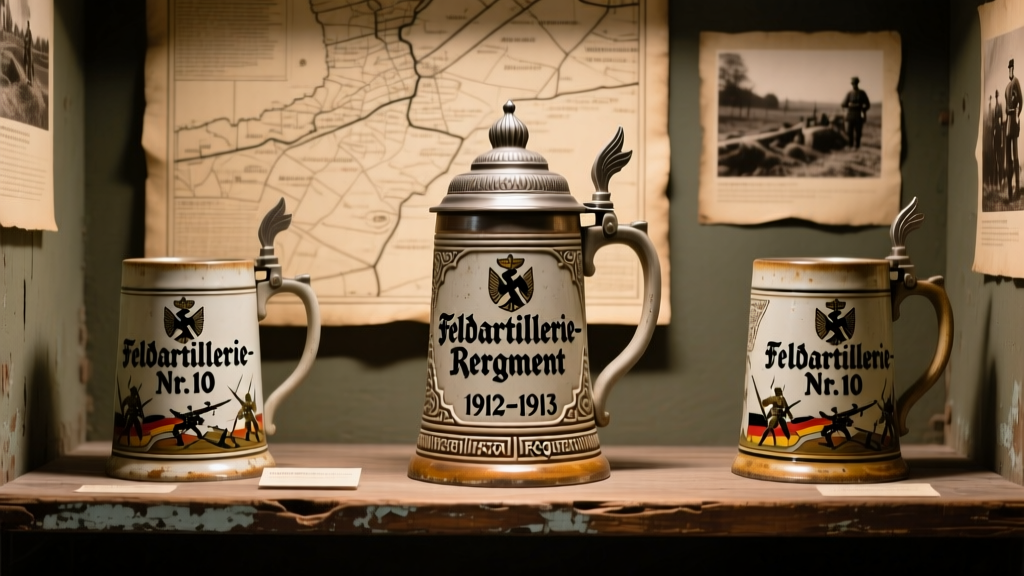
Steins Regimental 5. Batt. Feld-Artillerie-Regiment Nr. 10 (1912–1913): A 1.2-Liter Historical Artifact