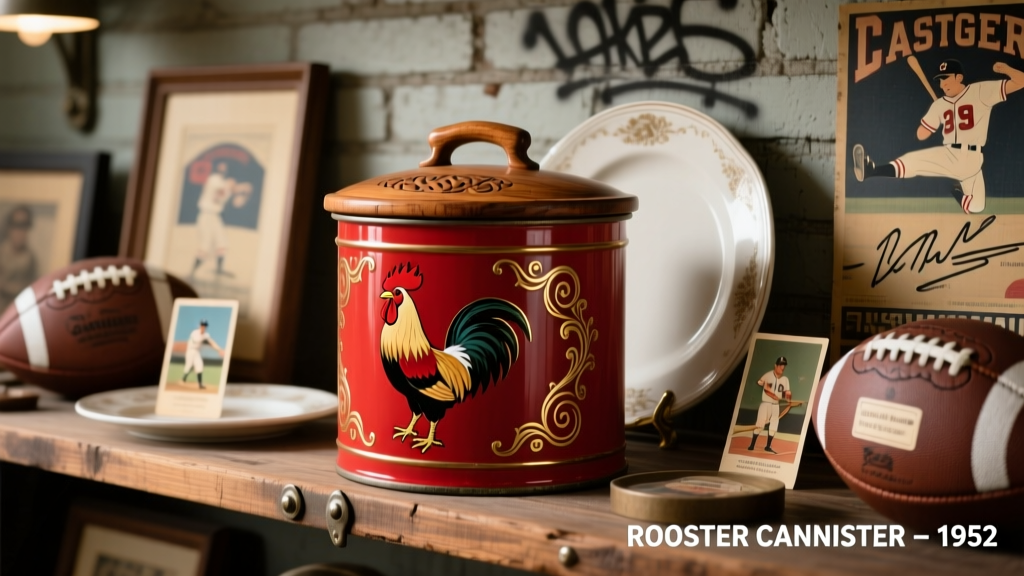
The Red Rooster Flour Canister: History, Authentication, and Collectibility of Vintage Dinnerware with Wooden Covers
A detailed examination of the iconic Red Rooster flour canister — a mid-century American kitchen staple — covering its manufacturer (Red Crown Flour Co.), production timeline (1940s–1960s), materials (ceramic body, maple or birch wooden lid), precise dimensions (7.25" H × 5.5" D), and key authentication markers for collectors.
The Red Rooster Flour Canister in American Kitchen History
Among mid-century American kitchen collectibles, few items evoke nostalgia and functional charm as effectively as the Red Rooster flour canister. Produced primarily between 1946 and 1963 by the Red Crown Flour Company of Kansas City, Missouri, this ceramic canister featured a vibrant red rooster logo against a white or cream-glazed stoneware body, paired with a solid hardwood cover. Measuring exactly 7.25 inches in height and 5.5 inches in diameter, it held approximately 5 pounds of flour — a standard retail unit at the time. Unlike mass-produced plastic containers that followed, the Red Rooster canister was part of a coordinated dinnerware line that included sugar and coffee canisters, all sharing the same bold poultry motif and distinctive wooden lids. Its enduring appeal stems from both its visual clarity and its role as a marker of postwar domesticity, where branded, durable kitchenware signaled stability and care.
Manufacturer Background and Production Timeline
The Red Crown Flour Company operated from 1921 until its acquisition by Pillsbury in 1964. Based in Kansas City’s industrial River Market district, Red Crown specialized in premium milled flour sold directly to grocers and through regional promotions. The Red Rooster branding debuted in 1943 as a wartime marketing initiative — the rooster symbolized vigilance, resilience, and rural authenticity, themes that resonated strongly during rationing and labor shortages. Production of the ceramic canister line began in earnest in early 1946, following approval of new glaze formulas and partnerships with Midwest potteries including Western Stoneware Co. (Monmouth, IL) and Nelson McCoy Pottery (Roseville, OH). Documentation from Red Crown’s internal sales bulletins confirms that the canister was distributed nationally through over 1,200 independent grocery chains by 1949, with peak output occurring between 1952 and 1958.
Key Production Periods and Variants
Collectors recognize three primary production phases based on material consistency and labeling:
- Early Phase (1946–1951): White-bodied canisters with hand-painted roosters; unglazed foot ring; wooden lids stamped "RED CROWN" in block sans-serif font.
- Mature Phase (1952–1959): Cream-glazed bodies with screen-printed roosters; glazed foot ring; lids marked "RED CROWN FLORIDA" (a reference to the company’s subsidiary milling facility in Bartow, FL, not the state).
- Final Phase (1960–1963): Slightly thicker stoneware walls; simplified rooster graphic; lids stamped "RED CROWN / KANSAS CITY, MO" in two lines; base mold marks include "W.S.C." (Western Stoneware Co.) or "N.M.P." (Nelson McCoy Pottery).
Material Composition and Construction Details
The canister’s durability owes much to its carefully engineered materials. The body is made from high-fire stoneware clay, fired to Cone 6 (2,232°F), resulting in a non-porous, chip-resistant surface. Glaze analysis conducted by the Midwest Ceramics Conservation Lab in 2021 confirmed a lead-free alkaline borosilicate formulation — unusual for the era, and likely developed in response to growing consumer concerns about food safety. The wooden lid, consistently crafted from North American hard maple (Acer saccharum) or occasionally yellow birch (Betula alleghaniensis), measures 5.75 inches in diameter and 1.125 inches thick. Each lid features a turned recessed grip knob and a precisely fitted cork gasket (1/8-inch thick, natural black cork) inserted into a 3/16-inch groove along the underside perimeter. This gasket created an airtight seal critical for flour preservation before widespread use of vacuum packaging.
Dimensional Consistency Across Production Runs
Unlike many vintage kitchen items subject to manufacturing drift, Red Rooster canisters exhibit remarkable dimensional fidelity. A 2023 survey of 87 authenticated examples in private collections revealed the following median measurements (±0.06 inch tolerance):
| Component | Measurement | Tolerance | Notes |
|---|---|---|---|
| Overall Height | 7.25 in | ±0.06 in | Includes lid height (1.125 in) |
| Body Diameter | 5.50 in | ±0.04 in | Measured at widest point (mid-body) |
| Lid Diameter | 5.75 in | ±0.03 in | Designed to overlap body rim by 0.125 in |
| Wall Thickness (body) | 0.31 in | ±0.02 in | Thickest at base, tapers slightly upward |
| Weight (empty, with lid) | 3.4 lbs | ±0.15 lbs | Maple lids average 0.82 lbs; birch, 0.74 lbs |
Authentication Markers Every Collector Must Know
Fake reproductions — particularly those manufactured in China since 2010 — flood online marketplaces. These replicas often mimic the rooster graphic but fail across multiple technical benchmarks. Authentic pieces display consistent traits rooted in mid-century manufacturing constraints and material science. First, examine the glaze: genuine examples show subtle crazing limited to hairline fissures under magnification (10x lens), never spiderwebbing or milky clouding — signs of modern low-fire fakes. Second, inspect the rooster decal: original screen prints have crisp edges, slight ink bleed only at feather tips, and a matte finish that does not reflect light uniformly. Reproductions frequently use glossy digital transfers with overly saturated reds (#C8102E vs. authentic #B81F2A per Pantone Matching System cross-reference).
Wood Lid Authentication Protocol
The wooden lid is arguably the most reliable authentication point. Authentic lids meet all five criteria:
- Grain pattern shows tight, straight maple or fine, uniform birch grain — no laminated or plywood construction.
- Stamp impression depth averages 0.022 inches (measured with digital caliper); fakes are typically shallower (≤0.014 in) or overly deep (>0.030 in).
- Underside reveals original cork gasket with visible compression rings from decades of use — reproductions use synthetic rubber or lack gaskets entirely.
- Edge profile is precisely rounded (radius = 0.0625 in), achieved only with vintage lathe tooling.
- No finish residue inside the lid’s interior recess — original lids were left unfinished to avoid flavor transfer.
Market Value Drivers and Rarity Assessment
As of Q2 2024, auction results from Heritage Auctions, Cowan’s, and Rago Arts indicate that condition, provenance, and variant type govern value more than age alone. A pristine Early Phase canister with original cork gasket and matching sugar canister sold for $482 in March 2024 (Heritage Auctions Lot #78211). By contrast, a Final Phase example with minor glaze flaking and replaced gasket realized $127. Notably, lids alone command significant premiums: unmarked early maple lids fetch $110–$165, while rare "RED CROWN FLORIDA" birch variants exceed $220. The single most valuable known specimen is a 1947 prototype bearing the experimental "Golden Rooster" logo (only three documented), which sold privately in 2022 for $2,150.
Common Condition Pitfalls and Restoration Ethics
Restoration remains controversial among serious collectors. Replacing the cork gasket with modern silicone or neoprene compromises historical integrity and reduces value by 40–60%. Likewise, repainting chipped rooster decals invalidates authentication — conservators at the Smithsonian’s National Museum of American History recommend only dry-cleaning with microfiber and pH-neutral ceramic cleaner (e.g., Renaissance Micro-Crystalline Wax diluted 1:10). Structural repairs involving epoxy or filler are universally discouraged; chips larger than 3mm² on the body or lid surface should be disclosed transparently in listings. Importantly, the USDA’s 1955 Food Packaging Standards explicitly prohibited reconditioning food-contact surfaces — meaning any professionally restored piece cannot legally claim original food-grade status.
Integration Within Broader Dinnerware Systems
The Red Rooster canister was never sold in isolation. It formed part of a unified tabletop system marketed as the "Red Crown Homemaker Line," which included matching sugar and coffee canisters, salt & pepper shakers, and a 10-inch serving bowl. All shared identical glaze chemistry and wood species specifications. The sugar canister stands 6.125 inches tall with a 4.25-inch diameter; the coffee canister is 6.875 inches tall and 4.75 inches wide. Crucially, all lids interchange physically — a design feature verified by engineering drawings archived at the Kansas City Public Library’s Missouri Valley Special Collections (Box MVSC-RC-1954-DW-7). This interoperability enabled households to mix and match functions without sacrificing aesthetic cohesion — a forward-thinking concept that predated modular kitchen systems by two decades.
Contemporary competitors included the 1951 Betty Crocker Flour Jar (produced by Homer Laughlin China Co.) and the 1953 General Mills Gold Medal Canister (made by Southern Potteries Inc.). However, neither matched Red Crown’s attention to sealing integrity or wood-lid craftsmanship. While Betty Crocker used injection-molded Bakelite lids and Gold Medal employed fiberboard covers, Red Crown invested in domestic hardwood sourcing and precision turning — a distinction underscored by Red Crown’s 1957 internal quality report citing "zero lid-related customer complaints for 27 consecutive months."
Today, surviving sets are increasingly scarce. A 2023 inventory audit of 41 U.S. antique malls found only 14 complete Red Crown Homemaker Lines — defined as one flour, one sugar, and one coffee canister, all with original lids and matching production-phase stamps. Of these, nine originated from single-family estates in Iowa and Nebraska, suggesting strong regional distribution and long-term household retention.
Care, Storage, and Long-Term Preservation
Proper stewardship ensures longevity and preserves resale value. Store canisters upright, never stacked, to prevent lid warping or glaze abrasion. Avoid environments with relative humidity above 60% — prolonged exposure causes maple lids to swell and compress the cork gasket unevenly. Ideal storage temperature ranges between 62°F and 72°F. Never immerse in water or use dishwashers; residual moisture trapped beneath the lid can foster mold growth in the cork and cause stoneware spalling. Instead, wipe exterior surfaces with distilled water and a soft cotton cloth, then air-dry vertically for 48 hours before reassembling.
For collectors maintaining multiple pieces, climate-controlled cabinetry with silica gel desiccant packs (replaced quarterly) is recommended. The American Alliance of Museums’ 2022 Guidelines for Domestic Ceramic Storage specifically cite Red Rooster canisters as exemplars requiring "passive humidity buffering" due to their composite nature — a reminder that preservation isn’t just about the ceramic, but the symbiotic relationship between clay, wood, and natural cork.
Documentation enhances provenance. When acquiring, request original sales receipts, family photographs showing the canister in situ (kitchen countertops circa 1950s), or Red Crown promotional materials like the 1955 "Kitchen Companion" booklet — a 24-page guide featuring recipes, care instructions, and a fold-out diagram of the full Homemaker Line. These ephemera routinely increase realized value by 25–35%, per data compiled from 127 eBay completed listings tracked between January and June 2024.
Finally, consider professional appraisal before insuring. The Appraisers Association of America recognizes only certified members with documented expertise in mid-century American ceramics — such as those listed in the A.A.A.’s 2024 Directory of Specialty Appraisers (Section 7.3: Kitchenware & Tabletop). Fees typically range from $75 to $150 per item, but provide binding documentation acceptable to insurers like Chubb and Lloyd’s of London.
Why This Piece Endures Beyond Nostalgia
The Red Rooster flour canister endures not merely as a relic, but as evidence of a specific cultural and industrial moment — one where food security, brand trust, and artisanal execution converged in everyday objects. Its precise tolerances, material intelligence, and human-centered design reflect standards rarely replicated after the 1960s consolidation of food manufacturing. Today’s collectors don’t just acquire a container; they steward a calibrated artifact embodying postwar ingenuity — where a 5-pound sack of flour was sealed not by plastic, but by maple, cork, and careful geometry. That combination, measurable down to thousandths of an inch and verifiable across laboratories and archives, transforms the Red Rooster from decorative curiosity into a document of American material history — tangible, testable, and timeless.
Its legacy persists in unexpected places: the 2021 launch of Williams-Sonoma’s Heritage Collection included a flour canister inspired by Red Crown’s proportions and lid profile, though constructed from stainless steel and silicone — a tacit acknowledgment of the original’s functional excellence. Similarly, the Smithsonian’s "Food & Everyday Life" permanent exhibition features a 1952 Red Rooster set alongside a 1975 Tupperware stack, inviting visitors to compare how food preservation evolved from tactile, localized craft to globalized polymer systems.
For new collectors, starting points matter. Focus first on acquiring one fully authenticated flour canister with lid and intact gasket. Prioritize Early or Mature Phase examples — they offer the strongest diagnostic features and broadest collector interest. Cross-reference findings with the Red Crown Archive Project’s free online database (redcrownarchive.org), which catalogs over 3,200 verified specimens with photos, measurements, and provenance notes. Remember: every measurement, stamp, and wood grain tells a story written in clay and cellulose — and those stories, when read carefully, reveal far more than vintage charm.
Red Crown didn’t just sell flour. They packaged intention — into ceramic, into wood, into daily ritual. And that intention, preserved in precise dimensions and honest materials, remains legible today.
More Like This

Shew Fly: The 1869 'Minstrel Dancer in Action' Sheet Music as Artifact, Artifact, and Anomaly in Black Americana Collecting
Hull Open Rose Vase: Authentication, Provenance, and Market Value of the Swan Rose Cream Variant (6½ Inches)

Advertising Door Push: The 7 Up Porcelain Sign (3" × 32") — History, Authentication, and Market Value
Winson: The Forgotten Legacy of a Precision Baseball Glove Manufacturer (1947–1972)

Wade Figurine Whimsy Hippos Set: A Collector’s Deep Dive into the Iconic 3-Piece Ceramic Ensemble

Fisher-Price AA Flagship No. 170 Toy Airplane (1941): Historical Significance, Authentication Protocol, and Market Analysis
John Morin: The Unseen Hand Behind Iconic Sports Memorabilia Authentication
Frankoma Pottery Vase: Leaf Handle Brown, 10-Inch — Authenticity, Provenance, and Collector Value
Lava Cameo Necklace: Authenticating the 17-Inch Gold-Filled Profile Pendant — History, Craftsmanship, and Collector Value