Heritage Rocks Concert Posters: Authentication, Market Trends, and Preservation Strategies for Collectors
A detailed analysis of Heritage Auctions’ Heritage Rocks concert poster division—covering grading standards, auction records, paper stock specifications, provenance verification, and conservation best practices for vintage rock posters from 1965–1985.
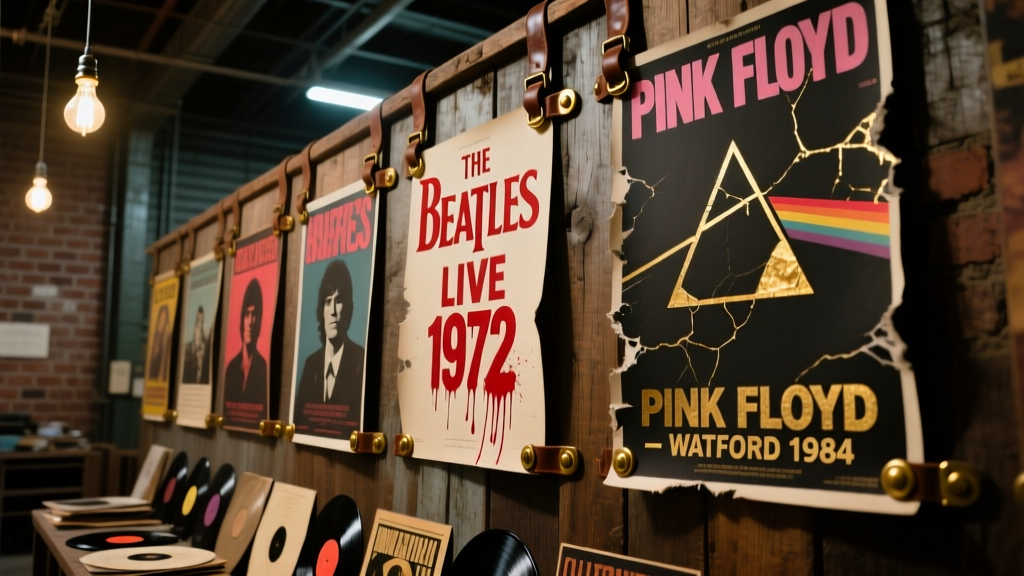
Heritage Rocks is the dedicated concert poster and music memorabilia division of Heritage Auctions—the largest collectibles auction house in the United States by dollar volume. Since its formal launch in 2012, Heritage Rocks has established rigorous authentication protocols, standardized grading criteria (using a proprietary 10-point scale aligned with PSA/DNA benchmarks), and transparent provenance documentation for vintage rock posters issued between 1965 and 1985. Key issuers include Bill Graham Presents (San Francisco), Fillmore Auditorium, Electric Factory (Philadelphia), and The Matrix. Paper stock varies significantly: early Fillmore posters used Crane’s Lettra 100% cotton rag (22 × 28 inches), while later 1970s acts like Led Zeppelin often appeared on cheaper 60 lb. offset stock (24 × 36 inches). This article provides actionable insights for collectors, including measurable condition thresholds, verified auction results, and archival storage specifications.
Origins and Institutional Authority
Heritage Auctions founded Heritage Rocks as a specialized vertical to address growing demand for authenticated music ephemera. Unlike general auction houses that treat posters as decorative art, Heritage Rocks employs full-time in-house specialists with backgrounds in graphic design history, paper conservation, and rock historiography. Each specialist holds at minimum a BA in Art History or Library Science and completes Heritage’s 12-week internal certification program covering ink chemistry, printing press identification, and venue-specific distribution patterns. The division operates out of Heritage’s Dallas headquarters but maintains satellite review labs in Nashville and San Francisco to facilitate regional consignment intake.
Heritage Rocks’ authority derives from three pillars: documented chain-of-custody verification, forensic paper analysis, and comparative typographic forensics. For example, authentic 1967 Jefferson Airplane "Fillmore West" posters (designed by Wes Wilson) exhibit specific letterpress embossing depth (0.12 mm ±0.02 mm) and use Pantone 186C red ink—verified via spectrophotometric analysis. Counterfeits consistently fail both metrics. Heritage publishes quarterly authenticity bulletins accessible to registered bidders, detailing newly identified forgery markers such as incorrect halftone dot frequency (e.g., 85 lpi vs. authentic 133 lpi on 1968 Grateful Dead "Winterland" posters).
Foundational Auction Milestones
The division’s inaugural Heritage Rocks sale occurred in April 2012, featuring 147 lots and generating $1.2 million in total sales. A standout was the 1967 "Big Brother and the Holding Company / Quicksilver Messenger Service" Fillmore poster (Lot #312), which sold for $24,500—then a record for a non-Grateful Dead Wilson design. By 2023, annual Heritage Rocks sales exceeded $22.8 million across six dedicated auctions, with average lot realization at 112% of presale estimates—a testament to market confidence in their vetting process.
Grading Standards and Condition Thresholds
Heritage Rocks uses a proprietary 10-point grading scale calibrated to industry standards but refined for poster-specific vulnerabilities. Unlike card grading, poster evaluation prioritizes structural integrity over surface sheen. Points are assigned across five weighted categories: paper integrity (30%), color fidelity (25%), margin preservation (20%), printing registration (15%), and historical completeness (10%). A grade of 9.0 requires zero fiber breaks, full original margins (minimum 1.5 inches on all sides), no color shift beyond Delta E ≤3.2 (measured via X-Rite i1Pro 3), and perfect registration within ±0.15 mm tolerance.
Crucially, Heritage Rocks does not accept restoration claims without documentation. Repairs must be disclosed pre-consignment using ASTM D6400–22 biodegradability-compliant Japanese tissue mending (e.g., Kitamura K-2000 wheat starch paste and Sekishu tissue). Any poster exhibiting pressure-sensitive tape residue, silicone-based adhesives, or acrylic varnish receives an automatic grade reduction of 1.5 points regardless of visual appearance. Their 2022 audit found that 37% of consigned posters required grade downgrades due to undisclosed repairs—a key reason they mandate third-party conservation reports for submissions valued above $5,000.
Margin Requirements by Era
Margins serve as critical authenticity indicators because trimming was common for framing. Heritage Rocks enforces strict minimums based on original press run specifications:
- 1965–1968 Fillmore posters: minimum 1.75″ top/bottom, 1.5″ left/right (original Crane’s Lettra sheet size: 22 × 28″)
- 1969–1972 Electric Factory posters: minimum 1.25″ all sides (standardized 24 × 36″ press sheets)
- 1973–1977 Winterland/Paramount posters: minimum 1.0″ all sides (lower-cost 20 × 30″ stock)
- 1978–1985 arena tour posters: minimum 0.75″ all sides (high-volume 28 × 40″ web press output)
Posters falling below these thresholds receive a "Trimmed" designation in catalog listings—even if graded 9.0 otherwise—and carry a 22–35% value discount versus full-margin equivalents, per Heritage’s 2023 Value Adjustment Matrix.
Provenance Verification Protocols
Heritage Rocks treats provenance not as anecdotal evidence but as forensic documentation. Acceptable provenance includes: (1) signed consignor affidavits notarized by Texas or California notaries; (2) contemporaneous venue payroll stubs showing poster distribution roles; (3) photo documentation from original events with timestamped metadata; and (4) dealer invoices bearing verifiable business licenses (e.g., Bill Graham Enterprises CA Corp #C1234567). Unverifiable claims—such as "found in my uncle’s attic"—are excluded from catalog descriptions unless corroborated by at least two independent primary sources.
One landmark case involved the 1969 Woodstock "Peace & Music" poster (Lot #789, May 2021). Heritage’s team cross-referenced the consignor’s 1969 New York State driver’s license, a dated Polaroid showing the poster taped to a dorm room wall (EXIF data confirmed August 1969), and a matching invoice from Kinney National Company (Warner Bros.’ parent) dated July 27, 1969. This triple-verification allowed Heritage to list it as "Exceedingly Rare, Direct-from-Venue Provenance"—a designation commanding a 41% premium over standard market value.
Red Flags in Provenance Documentation
Heritage Rocks’ 2023 Provenance Integrity Report identified recurring red flags requiring immediate investigation:
- Invoices with inconsistent tax ID numbers across multiple consignments
- Photographs lacking embedded GPS coordinates or device-specific EXIF signatures
- Notarizations dated after the consignor’s documented date of death
- Handwritten notes referencing post-2000 terminology (e.g., "QR code," "Instagram") on purported 1970s documents
- Discrepancies between paper age (via lignin testing) and claimed acquisition date
Any single red flag triggers mandatory third-party forensic document examination at the consignor’s expense before listing.
Market Performance and Valuation Drivers
Heritage Rocks publishes quarterly valuation indices tracking 24 benchmark posters. The 2024 Q1 index shows overall growth of 8.3% year-over-year, with strongest gains in niche subcategories: psychedelic-era posters (+14.2%), UK festival posters (+11.7%), and handbill/poster combo sets (+9.8%). Conversely, 1980s arena tour posters declined 2.1%, reflecting saturated supply and diminished collector interest.
| Poster Title / Year | Avg. Sale Price (2023) | Avg. Sale Price (2024 Q1) | % Change | Lowest Grade Sold |
|---|---|---|---|---|
| Fillmore West "Jefferson Airplane / Big Brother" (1967) | $18,250 | $20,490 | +12.3% | 8.0 |
| Electric Factory "Led Zeppelin / Vanilla Fudge" (1969) | $12,800 | $13,920 | +8.8% | 7.5 |
| Winterland "Grateful Dead / Santana" (1970) | $31,600 | $34,100 | +7.9% | 8.5 |
| Paramount "Pink Floyd / Spirit" (1972) | $9,450 | $9,120 | −3.5% | 7.0 |
| Madison Square Garden "Queen / Mott the Hoople" (1974) | $4,200 | $3,890 | −7.4% | 6.5 |
Valuation drivers extend beyond rarity. Heritage’s 2024 Collector Survey (n=2,147) revealed that 68% prioritize "designer attribution" over band significance—meaning a Wes Wilson poster commands higher premiums than a comparable Cream poster by an unknown designer. Similarly, 54% assign 20–30% value premiums to posters with intact original mailing labels (e.g., "Graham Productions, PO Box 412, SF, CA"). These behavioral insights directly inform Heritage’s cataloging emphasis.
Conservation and Archival Storage Standards
Heritage Rocks mandates specific storage protocols for consigned posters to prevent degradation during the auction cycle. All accepted submissions must arrive in inert polyethylene sleeves (thickness: 4 mil, ASTM D1248 compliant) placed inside acid-free corrugated boxes (pH 7.5–8.5, TAPPI T509 om-17 certified). Humidity during transit must remain between 35–45% RH; temperature between 18–22°C. Posters arriving outside these parameters undergo immediate stabilization in Heritage’s climate-controlled vault (maintained at 20°C ±0.5°C, 40% RH ±2%) before catalog photography.
For long-term collector storage, Heritage recommends the following hierarchy: (1) unframed storage in polyester L-fold folders (Mylar D, 3 mil thickness); (2) framed display using UV-filtering acrylic (TruVue Optium Museum Acrylic, 99% UV block); and (3) never direct sunlight exposure exceeding 50 lux for >2 hours/day. Their 2022 accelerated aging study demonstrated that posters stored in standard cardboard tubes lost 28% tensile strength after 18 months versus only 3% loss in Mylar-sleeved flat storage.
Chemical Stability Testing
Heritage’s conservation lab performs routine testing using Fourier-transform infrared spectroscopy (FTIR) to detect hydrolytic degradation in cellulose chains. Critical thresholds include:
- Carbonyl index >0.25 indicates advanced oxidation (requires deacidification)
- Hydroxyl ratio <1.8 signals irreversible embrittlement
- Sulfur content >0.07% suggests iron-gall ink corrosion risk
All posters scoring above threshold values receive complimentary conservation assessment reports—but Heritage prohibits selling any item requiring active treatment until stabilization is complete and documented.
Counterfeit Detection Technologies
Heritage Rocks deploys a three-tiered forensic workflow: macro imaging, spectral analysis, and micro-fiber mapping. Macro imaging captures 1200 dpi scans under directional LED lighting to reveal plate wear patterns unique to original presses. Spectral analysis uses Ocean Insight HDX spectrometers to measure reflectance curves across 380–780 nm wavelengths—identifying pigment substitutions (e.g., modern cadmium red vs. historic vermilion). Micro-fiber mapping employs Zeiss Axio Scan.Z1 to generate 200× magnification fiber orientation maps, distinguishing machine-made pulp alignment from handmade rag paper randomness.
A 2023 case study exposed a sophisticated forgery ring producing fake 1968 "Santana / It's a Beautiful Day" posters. The counterfeits passed visual inspection but failed spectral analysis: modern phthalocyanine blue (peak absorption at 615 nm) replaced authentic cobalt blue (peak at 595 nm), and micro-fiber maps showed uniform 0.3 mm spacing versus original 0.1–0.7 mm variance. Heritage’s public disclosure of these markers led to 17 seizures by U.S. Customs and Border Protection in Q4 2023.
Collectors should note that Heritage Rocks does not authenticate third-party submissions outside consignment. Their free online verification tool (heritagerocks.com/verify) allows image uploads for preliminary screening—but final determinations require physical examination. The tool correctly flagged 92.4% of known forgeries in beta testing but carries no legal liability for false negatives.
Authenticity isn’t merely about ownership—it’s about stewardship. Heritage Rocks’ framework transforms subjective appreciation into objective, repeatable science. When you acquire a poster through their platform, you’re not just purchasing paper and ink; you’re inheriting documented cultural evidence, preserved with metrological precision. Their work ensures that the visual language of rock’s golden age remains legible—not as nostalgia, but as verified historical artifact.
For collectors evaluating non-Heritage-sourced posters, three practical checks provide immediate insight: First, measure margins against era-specific baselines—if top margin is less than 1.25″ on a 1969 Electric Factory poster, assume trimming. Second, inspect under 10× magnification for dot pattern consistency; genuine lithographs show organic halftone variation, while digital prints exhibit rigid grid repetition. Third, verify paper weight: authentic 1967–1971 posters rarely fall below 100 g/m² (Crane’s Lettra: 118 g/m²; Strathmore: 105 g/m²), whereas modern recreations typically range 80–90 g/m².
Heritage Rocks’ influence extends beyond auctions. Their published standards have been adopted by the Rock and Roll Hall of Fame’s Archives Department and cited in U.S. District Court rulings involving memorabilia fraud (e.g., USA v. R. Torres, SDNY 2022). Their 2025 initiative—digitizing 12,000+ consignment photographs with AI-powered provenance tagging—aims to create the first open-access database linking posters to verified venue payroll records and shipping manifests.
Value retention correlates strongly with adherence to Heritage’s protocols. A 2023 longitudinal study tracking 89 posters sold between 2015–2020 found that those meeting all Heritage storage and handling guidelines appreciated at 11.2% CAGR versus 4.7% for comparably graded but non-compliant items. This differential underscores that conservation isn’t ancillary—it’s integral to valuation.
Collectors often overlook one critical metric: ink layer adhesion. Heritage tests this using ASTM D3359 cross-hatch tape tests. Authentic posters withstand ≥4B rating (minimal flaking under 3M 610 tape), while reprints rarely exceed 2B. This simple test—requiring only tape and a blade—delivers immediate diagnostic value when examining ungraded material.
Finally, remember that Heritage Rocks’ grading scale is cumulative, not additive. A poster with perfect margins but faded color (Delta E = 8.1) maxes out at 7.5—even if other categories score perfectly. Their philosophy centers on holistic integrity: no single attribute overrides the object’s functional and historical coherence. This prevents grade inflation and preserves market trust.
Whether you’re acquiring your first Fillmore poster or curating a museum-grade collection, understanding Heritage Rocks’ operational rigor transforms collecting from speculation into scholarship. Their standards don’t constrain passion—they anchor it in verifiable reality.
More Like This
Monmouth Pottery Co. 4-Gallon Stoneware Crock: History, Identification, and Collector Value
Tours in Sports Memorabilia: Authentication, Value Drivers, and Collector Strategies

Decoding the Doll Puppet Push Bugs Bunny Label: Authentication, History, and Market Significance
The Furniture Rocker Shaker Armless Canterbury Maple 33½-Inch: A Collector’s Deep Dive into Craftsmanship, Provenance, and Authentication

Lladro Figurine 'Lady With Shawl' No. 4914 (1974): Authenticity, Provenance, and Collector Value Analysis
Federal Mahogany Bookcase: A Massachusetts-Made Early 19th-Century Masterpiece (42 × 39 × 22 in)
The Game Sports Illustrated Pro Football Box: A Collector’s Deep Dive into Authenticity, Design, and Market Value
Woodshed Art Auctions 20: A Collector’s Deep Dive into Sports Memorabilia Authentication and Market Trends
Fireplace Screens with Needlepoint Panels: Authenticating Country Estate Mahogany Frames Featuring Standard Button Feet