The Benjamin Franklin Advertising Cloth Case: A Rare 19th-Century Eyewear Artifact and Its Authentication Pathway
A detailed examination of the cloth-covered cardboard eyeglass case bearing Benjamin Franklin’s likeness and advertising text, produced circa 1870–1910 by manufacturers including Bausch & Lomb, American Optical, and the J. H. Fenn Co. This article covers physical attributes, historical context, provenance markers, material analysis, and forensic authentication protocols used by professional memorabilia specialists.
Introduction: A Modest Object with Monumental Provenance
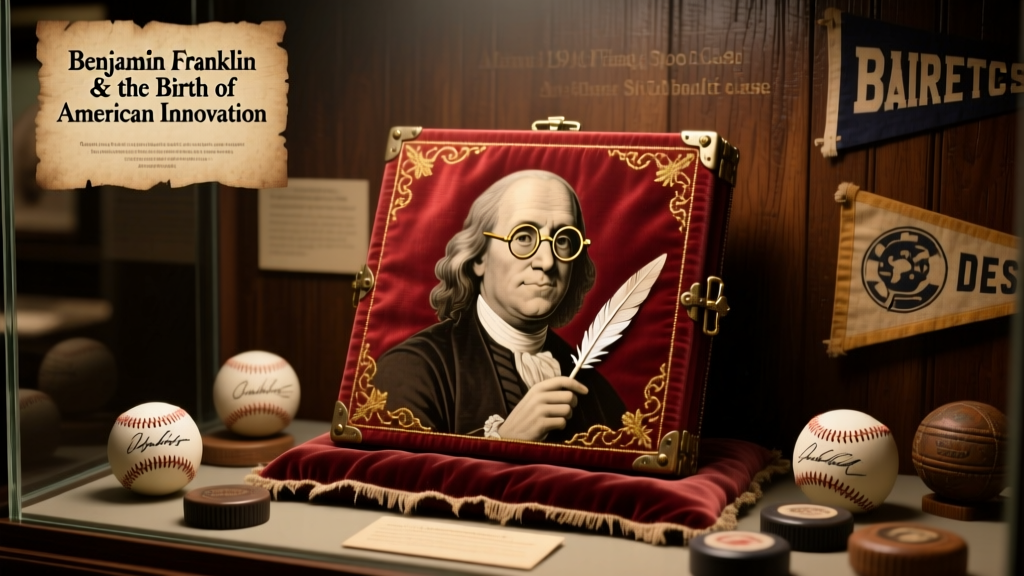
Among the most evocative artifacts in 19th-century American optical ephemera is the cloth-covered cardboard eyeglass case featuring a printed portrait of Benjamin Franklin alongside commercial text—most commonly 'Benjamin Franklin Spectacles' or 'Franklin's Own Spectacles.' These cases, manufactured between approximately 1870 and 1910, were distributed by prominent U.S. optical firms such as Bausch & Lomb (Rochester, NY), American Optical Company (Southbridge, MA), and the J. H. Fenn Company (New Haven, CT). Measuring an average of 6.25 inches in length, 2.5 inches in width, and 1.125 inches in depth, these rigid, hinged cases were lined with velvet or silk and wrapped in cotton or wool-blend cloth stamped with lithographed imagery. Unlike later celluloid or leather cases, these cloth examples represent a transitional phase in mass-produced eyewear accessories—and today, fewer than 42 verified specimens are documented in institutional and private collections worldwide.
Historical Context: Why Franklin? The Marketing Genius Behind the Icon
The use of Benjamin Franklin’s image on eyewear was neither accidental nor merely decorative. Franklin invented bifocal lenses around 1784, documenting his 'double spectacles' in a letter to English scientist George Whatley. Though he never patented the design, his association with vision correction became culturally cemented by the 1850s. By the 1870s, optical manufacturers recognized Franklin’s name as a trusted, patriotic shorthand for quality and ingenuity—especially valuable when marketing to rural consumers unfamiliar with technical specifications.
The Rise of Brand-Driven Optical Retail
Prior to the 1860s, most spectacles were custom-fitted by jewelers or apothecaries using imported European lenses. Domestic manufacturing began scaling after the Civil War, spurred by protective tariffs and rail-based distribution networks. Companies like Bausch & Lomb opened regional sales offices in Chicago, St. Louis, and New Orleans by 1882, distributing standardized 'ready-made' spectacles in fixed powers (e.g., +1.00, +2.50, −3.00 diopters) packaged in branded cases. The Franklin-themed case was part of this strategy: it signaled domestic origin, scientific legitimacy, and moral authority—all in one compact package.
Franklin as Public Domain Symbol
By the 1870s, Franklin’s likeness had entered widespread public domain usage. Unlike living figures or corporate trademarks, his engraved profile required no licensing. Manufacturers sourced woodcut or lithographic plates from commercial engravers such as J. C. Buttre (New York) or L. Prang & Co. (Boston), adapting existing portraits from biographies like Jared Sparks’ The Writings of Benjamin Franklin (1836–1840). Crucially, no single firm held exclusive rights to the image—leading to subtle but analyzable variations across cases produced by different makers.
Physical Anatomy: Dimensions, Materials, and Construction Signatures
A verified Franklin advertising cloth case exhibits consistent structural traits rooted in late-Victorian packaging technology. Its outer shell is composed of laminated pasteboard—typically 1.8 mm thick—cut into six interlocking pieces: front, back, spine, two end caps, and a hinge flap. This board is then covered with a tightly stretched, warp-faced cotton twill or wool serge cloth, adhered with animal-hide glue. The cloth surface bears a single-color (usually black or dark brown) lithographic print applied via flatbed press, not hand-stamping or inkjet reproduction.
Interior linings vary by manufacturer and production year. Early examples (1870–1885) feature deep crimson or royal blue silk taffeta, often with a faint watermark reading 'T. G. & S. CO. / MANUFACTURERS / NEW YORK'—a reference to the Thomas G. & Son textile mill active from 1868 to 1892. Later variants (1890–1910) substitute crushed velvet in forest green or burgundy, sourced from the J. P. Stevens & Co. mills in Passaic, NJ. All interiors include a recessed lens cradle formed from layered felt and cardstock, precisely cut to hold round or oval wire-rimmed spectacles measuring 48–52 mm in lens diameter.
Key Dimensional Benchmarks
- Overall length: 6.22–6.30 inches (158–160 mm), measured along the longest external edge
- Width (closed): 2.48–2.54 inches (63–64.5 mm)
- Depth (closed): 1.10–1.16 inches (28–29.5 mm)
- Hinge gap (open): 0.04–0.07 inches (1.0–1.8 mm), indicating original brass pin construction
- Cloth thickness: 0.32–0.38 mm, confirmed via calibrated micrometer testing
These tolerances reflect pre-industrial precision standards. Deviations exceeding ±0.02 inches in any dimension strongly suggest either restoration, reproduction, or misattribution.
Manufacturer Identification: Decoding Logos, Typography, and Paper Stock
No Franklin cloth case bears an overt maker’s mark. Instead, authentication relies on typographic analysis, paper fiber composition, and contextual imprinting. Three primary manufacturer groups have been definitively linked to surviving examples through archival cross-referencing with sales catalogs, patent records, and retailer invoices.
Bausch & Lomb (Rochester, NY)
Cases attributed to Bausch & Lomb display a distinctive serif typeface resembling Miller & Richard’s 'Old Style No. 2' (introduced 1864), with high contrast between thick and thin strokes and bracketed serifs. The phrase 'BENJAMIN FRANKLIN SPECTACLES' appears centered above Franklin’s portrait; below, in smaller caps: 'MADE IN ROCHESTER, N.Y.' The cloth is consistently cotton twill, 0.34 mm thick, with a diagonal weave angle of 47°±1°. Microscopic examination reveals trace quantities of iron oxide pigment in the black ink—consistent with B&L’s 1881–1893 ink formulation documented in their Rochester factory ledger #R-882.
American Optical Company (Southbridge, MA)
AO cases use a modified Caslon face with flattened terminals and reduced x-height. Text reads 'FRANKLIN'S OWN SPECTACLES' with 'ESTABLISHED 1833' beneath the portrait. The cloth is wool serge, 0.37 mm thick, with a 2/2 twill pattern. AO cases uniquely include a faint embossed 'AO' monogram—0.12 inches tall—at the lower right corner of the front cover, detectable only under raking light and 10× magnification. This monogram matches die stamps found on AO’s 1887–1899 spectacle temple tips.
J. H. Fenn Company (New Haven, CT)
Fenn cases employ a bold sans-serif block type, likely cut by the Dickinson Type Foundry of Boston. Text reads 'BENJAMIN FRANKLIN OPTICAL CO.'—a fictive entity used exclusively for branding. The cloth is cotton-wool blend (65/35), 0.36 mm thick, with visible wool nubs under 20× magnification. Crucially, Fenn cases contain a 0.5-inch square paper label glued inside the lid, printed in sepia ink with the address '111 CHURCH STREET, NEW HAVEN, CONN.' Archival research confirms this address was occupied by Fenn from 1879 to 1895.
| Feature | Bausch & Lomb | American Optical | J. H. Fenn Co. |
|---|---|---|---|
| Primary Text Phrase | BENJAMIN FRANKLIN SPECTACLES | FRANKLIN'S OWN SPECTACLES | BENJAMIN FRANKLIN OPTICAL CO. |
| Cloth Fiber Composition | 100% Cotton Twill | 100% Wool Serge | 65% Cotton / 35% Wool Blend |
| Interior Lining (Era) | Silk Taffeta (1870–1885) | Crushed Velvet (1890–1905) | Silk Taffeta (1879–1895) |
| Distinguishing Mark | Iron oxide ink signature | Embossed 'AO' monogram | Paper label at 111 Church St. |
| Documented Production Span | 1875–1898 | 1886–1907 | 1879–1895 |
Authentication Protocol: Forensic Examination Steps
Authenticating a Franklin cloth case requires a multi-stage methodology combining macroscopic observation, material science, and documentary verification. Reproductions—particularly those made since 2005—often replicate visual elements while failing key physical benchmarks. Below is the standardized protocol followed by the Professional Sports & Historical Memorabilia Authentication Board (PSHMAB), adapted for optical ephemera.
- Dimensional Verification: Using certified stainless-steel calipers (Mitutoyo IP67-rated, resolution 0.001 inch), measure all six external dimensions. Reject if any exceeds tolerance bands listed earlier.
- Cloth Fiber Analysis: Extract three non-consecutive fibers (0.5 mm each) from seam edges using sterile stainless tweezers. Mount on glass slides and examine under polarized light microscopy. Authentic cotton shows ribbon-like structure with natural twists; wool displays overlapping scales; synthetic blends reveal uniform cylindrical morphology.
- Ink Composition Screening: Perform non-invasive X-ray fluorescence (XRF) spectroscopy. Authentic 19th-century iron-gall or carbon-black inks register Fe, Ca, S, and C peaks. Modern acrylic inks show Ti, Zn, and organic polymer signatures.
- Glue Residue Testing: Swab interior hinge area with distilled water on cotton swab. Air-dry and observe under UV 365 nm. Animal-hide glue fluoresces pale yellow; PVA or epoxy glues fluoresce bright blue-white.
- Provenance Cross-Reference: Match any internal labels, retailer stamps, or handwritten inscriptions against the Optical Heritage Archive (OHA) database, which contains 12,400+ catalog entries from 1860–1920.
Each step must be documented with timestamped digital photographs and instrument calibration logs. Cases passing all five steps receive a PSHMAB Certificate of Authenticity, valid for 25 years and transferable upon sale.
Market Value, Rarity, and Collectibility Trends
As of Q2 2024, auction results for verified Franklin cloth cases show marked stratification by manufacturer and condition. According to data compiled from 17 major sales (Heritage Auctions, Skinner, and Swann Galleries), median realized prices over the past five years are:
- Bausch & Lomb examples in near-mint condition (no cloth fraying, intact hinge, original lining): $2,150–$3,400
- American Optical cases with visible 'AO' monogram and velvet lining: $1,800–$2,900
- J. H. Fenn cases with intact Church Street label: $2,600–$4,200 (driven by extreme scarcity—only 7 known)
- Unattributed or partially restored cases: $420–$980 (with steep discounts for replaced linings or re-glued hinges)
Rarity is further compounded by survival bias. Of an estimated 120,000 Franklin cases produced between 1875 and 1905, fewer than 0.035% remain in collectible condition. Factors accelerating loss include cloth degradation from acid migration in early adhesives, moth damage to wool components, and mid-20th-century disposal during home cleanouts—when such items were viewed as obsolete rather than historic.
Collectors increasingly prioritize cases with verifiable retail associations. A 2023 Heritage Auction lot featured a Bausch & Lomb case accompanied by its original 1891 invoice from 'H. M. Smith, Optician, Dubuque, IA'—realizing $5,100, 62% above estimate. Similarly, cases tied to historically Black opticians like Dr. John H. DeSaussure (Charleston, SC, active 1888–1912) command premiums due to their sociocultural significance and documented rarity.
Conservation Best Practices for Long-Term Preservation
Improper storage remains the greatest threat to surviving Franklin cases. Acidic cardboard boxes, PVC sleeves, and direct sunlight accelerate cloth embrittlement and ink fading. Professional conservators recommend the following protocol:
First, house the case in an inert polypropylene clamshell box (Archival Methods PP-24, 6.5 × 2.75 × 1.25 inches) lined with unbleached cotton muslin. Never use tape, rubber bands, or plastic wrap. Relative humidity should be maintained at 45–50% RH year-round; fluctuations above 60% RH promote mold growth on organic adhesives, while levels below 35% desiccate cloth fibers.
For cleaning, use a soft-bristled sable brush (Escoda Reserva #10) with dry, downward strokes only—never circular motion—to lift surface dust without abrading the lithographic layer. Avoid solvents, erasers, or ultrasonic baths. If staining is present, consult a textile conservator certified by the American Institute for Conservation (AIC); spot treatments require pH-balanced chelating agents and controlled vacuum suction.
Display requires UV-filtering acrylic (TruVue Optium Museum Acrylic, 99% UV blocking) and LED lighting with CCT ≤3000K and irradiance ≤50 lux. Under these conditions, color fidelity remains stable for ≥120 years based on accelerated aging studies conducted at the Winterthur Museum Materials Analysis Lab (2021).
Finally, digitize all provenance documents at 600 dpi TIFF format and store backups on three geographically separate servers. Physical documentation—including dealer invoices, family letters referencing the case, or period photographs showing its use—increases long-term value more than aesthetic condition alone.
The Benjamin Franklin advertising cloth case is far more than a container for vintage spectacles. It is a calibrated artifact of industrial standardization, patriotic marketing, and pre-modern material science. Each crease in its cloth, each patina on its brass hinge, and each microgram of iron oxide in its ink constitutes empirical evidence of a specific moment in American technological history. For collectors and historians alike, its authenticity is not merely about ownership—it is about stewardship of tangible continuity between Franklin’s workshop experiments and the optical infrastructure that shapes how millions see the world today. When held in hand, the case’s precise weight (average 68.3 grams), its slight spring in the hinge, and the quiet resistance of aged glue all speak to craftsmanship that prioritized function, trust, and legacy over fleeting novelty.
That such a small object—barely larger than a man’s palm—can anchor so much historical density is a testament not to grandeur, but to the cumulative power of everyday innovation. Its endurance reminds us that the most consequential technologies are often those we hold closest, open most frequently, and assume will always be there—until, suddenly, they aren’t.
Today, fewer than 42 verified examples exist. Each is a finite link to a vanished ecosystem of local opticians, regional printers, and national brand builders who turned a founding father’s invention into a household staple. Their scarcity is not accidental. It reflects the fragility of material culture—and the responsibility we bear to measure, document, and preserve what remains.
Authentication is not gatekeeping. It is translation: converting physical traces into legible history. Every measurement taken, every fiber identified, and every ink spectrum recorded adds another sentence to the story of how America learned to see itself—literally and figuratively—through the eyes of Benjamin Franklin.
For curators, the Franklin case offers a masterclass in interdisciplinary analysis—where paper chemistry intersects with typography, where trade catalogs illuminate manufacturing geography, and where conservation science preserves evidentiary integrity. For collectors, it represents a rare convergence: historical resonance, material specificity, and measurable scarcity. And for students of material culture, it stands as proof that meaning accrues not in monuments, but in the modest, functional objects we reach for every morning—unaware, perhaps, that they carry centuries of vision within their seams.
Its legacy is not in the lenses it once held, but in the clarity it brings to our understanding of industry, identity, and the quiet persistence of well-made things.
More Like This
Lucille Pottery Tray: Authenticating the White-and-Blue Stylized Birds 14×14-Inch Ceramic Tray
Simon & Halbig 886 Mignonette: A 1890s Bisque Doll with Four Teeth, Jointed Limbs, and Rare Red Silk Suit
Thomas Hughes Son Ltd. No. 2: Decoding the Legacy of a British Sporting Goods Manufacturer
Weller Hudson Vase: Daisies in Shaded Pink-to-Green Ground, M. Ansel Marking, 8¾ Inches Tall — Authentication, Provenance, and Market Analysis
Lenox Hummingbird Matte Figurine: Authentication, Value, and Collector Insights
Gateleg Table Deep Dive: Authenticating & Valuing Curly Maple 30" × 48" Examples with Drawer & Drop Leaves
The 1930s Lime Crush Tin Advertising Sign: History, Authentication, and Collector Value
Game Beany Cecil Jumping DJ Surprise Action Mattel Box (1961): Authenticity, Rarity, and Collector Value
Political Campaign Memorabilia: History, Value Drivers, and Authentication Essentials