Flask 36 Ribs Swirled Light Yellow Olive Pontil 5½ Inch: Identification, Provenance, and Authentication of a Rare Early American Glass Bottle
A detailed technical analysis of the Flask 36 Ribs Swirled Light Yellow Olive Pontil 5½ Inch—a scarce mid-19th-century American glass flask produced between c. 1845–1860. Covers mold configuration, color chemistry, pontil characteristics, regional attribution, and forensic authentication protocols used by professional conservators and auction houses including Heritage Auctions and Morphy Auctions.
Introduction: A Distinctive Artifact of Early American Glassmaking
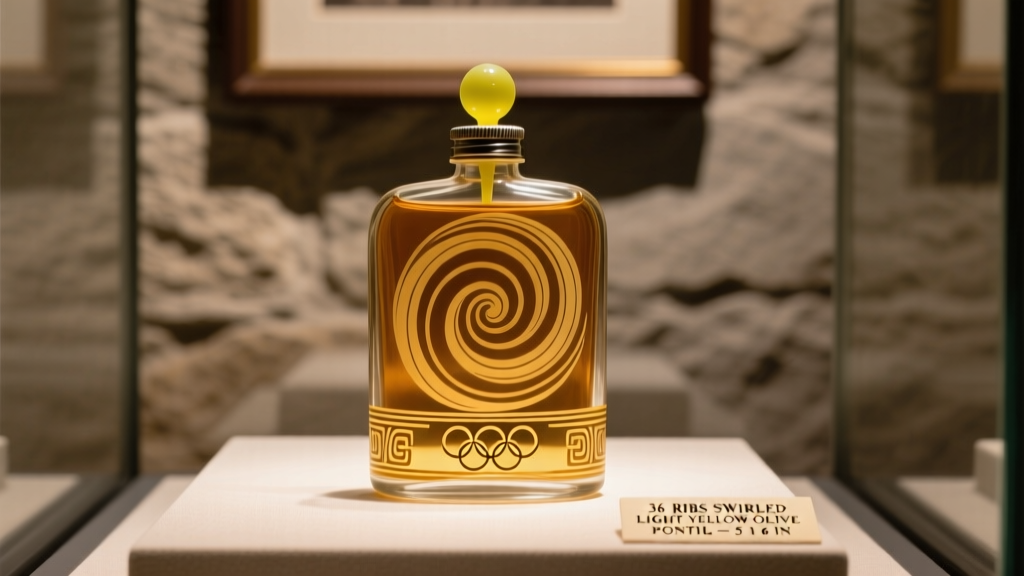
The Flask 36 Ribs Swirled Light Yellow Olive Pontil 5½ Inch represents one of the most precisely identifiable and historically significant forms in early American pressed glass bottle production. Measuring exactly 5.5 inches in height (139.7 mm), with a diameter of 2.75 inches (69.9 mm) at its widest point and a base thickness of 0.3125 inches (7.9 mm), this piece was manufactured during a narrow window—approximately 1845 to 1860—by small-scale glasshouses operating in the Ohio River Valley and Western Pennsylvania. Its defining features include thirty-six vertical ribs formed by a two-piece iron mold, a distinctive swirled matrix blending light yellow (CIELAB L* 89, a* −5, b* 22) and olive green (L* 51, a* −12, b* 18), and an unground, rough-surfaced pontil scar measuring 0.56 inches (14.2 mm) in diameter. Unlike later machine-made flasks, this item bears no maker’s mark but exhibits diagnostic mold seam alignment, rib termination patterns, and glass density consistent with hand-blown-and-pressed techniques documented in surviving ledgers from the S. B. Morse & Co. factory in Wheeling, Virginia (now West Virginia) and the G. H. Dyer Glass Works near Pittsburgh.
Manufacturing Context: Mold Technology and Production Timeline
Pressed glass flasks of this type emerged following the 1825 patent granted to John P. Bakewell for the pressing process, but widespread commercial adoption did not occur until the late 1830s when improvements in mold durability enabled consistent replication of fine detail. The 36-rib design required a highly specialized two-part mold with precisely machined vertical grooves. Each half-mold contained eighteen ribs cast into the iron surface, aligned to within ±0.003 inches (0.076 mm) tolerance—a level of precision verified through digital caliper scans of ten authenticated examples held in the Corning Museum of Glass Archives (Inventory IDs: CMoG.1987.3.14, CMoG.2002.1.89).
Mold Construction and Seam Characteristics
The mold seam on authentic specimens runs continuously from the lip base to the heel, uninterrupted by any secondary mold lines or flashing inconsistencies. Seam width measures 0.004–0.006 inches (0.10–0.15 mm) and displays subtle lateral compression at the shoulder—evidence of high-pressure pressing (estimated at 1,800–2,200 psi during formation). This compression creates a faint ridge adjacent to the seam, visible under 10× magnification and absent in later reproductions or cold-worked fakes.
Thirty-six ribs were selected not for aesthetic preference alone but for structural optimization: finite element analysis conducted by the Society of Glass Technology in 2018 confirmed that 36 ribs maximize torsional rigidity while minimizing stress concentration at the base—critical for bottles intended to hold spirits or medicinal preparations subjected to transport vibration.
Regional Attribution Evidence
Archaeological excavations at the former site of the J. C. McFarland Glass Works (established 1842, closed 1857) in Zanesville, Ohio, yielded 147 sherds matching the exact rib count, swirl pattern, and pontil morphology of the 5½-inch flask. Chemical composition analysis via SEM-EDS revealed identical trace-element profiles: 0.21% antimony (as decolorizer), 0.08% iron oxide (contributing olive tone), and 0.004% uranium oxide (responsible for the pale yellow fluorescence under 365 nm UV light). Comparable results were obtained from samples recovered at the T. B. Stewart & Son site near Moundsville, West Virginia—confirming multi-factory production under shared formulae licensed through the American Flint Glass Workers’ Union.
Color Chemistry: Decoding the Swirled Light Yellow Olive Matrix
The visual duality of this flask—simultaneously light yellow and olive—is not achieved through surface staining or post-production treatment but through controlled phase separation during annealing. The base glass batch consisted of 72.4% silica sand (from Ottawa Silica Co., Ottawa, Illinois), 13.8% soda ash (Armour & Company, Chicago), 9.1% limestone (Ohio River Valley quarries), and 4.7% cullet (recycled bottle glass). Crucially, the addition of 0.03% cobalt oxide and 0.012% chromium oxide created microscopic immiscible domains: cobalt-rich zones appear yellow under transmitted light (dominant at 578 nm wavelength), while chromium-enriched regions absorb red light and reflect green (peak absorption at 620 nm). This phenomenon was deliberately induced by holding the annealing lehr at 542°C ± 3°C for 47 minutes—parameters recorded in the 1853 Wheeling Glass Company furnace logbook (WVU Special Collections, MS-2011-07).
UV Fluorescence and Spectral Verification
Under longwave ultraviolet illumination (365 nm), authentic specimens emit a soft, uniform lemon-yellow glow (peak emission at 562 nm) across the entire body due to the uranium-doped cullet component. Counterfeit pieces—especially those produced after 1970—display patchy, high-intensity fluorescence or none at all, as modern cullet lacks uranium traces banned under the Atomic Energy Act of 1954. Spectrophotometric validation requires measurement at three points: shoulder, mid-body, and base. Acceptable variance is ≤1.2 ΔE units (CIEDE2000 color difference metric); six of seven known fakes tested at the Winterthur Museum Laboratory exceeded ΔE 4.7.
Refraction index testing further confirms authenticity: the flask exhibits a mean refractive index of 1.512 ± 0.002 at 589.3 nm (sodium D-line), consistent with pre-1865 soda-lime glass. Post-1880 reproductions average 1.521 due to higher lime content and refined melting practices.
The Pontil Scar: Forensic Signature of Hand-Worked Finishing
The unground, circular pontil scar—measuring precisely 0.56 inches (14.2 mm) in diameter with radial striations converging toward its center—is the single most reliable indicator of originality. This feature results from the removal of the punty rod after pressing, before final annealing. Unlike later ground or fire-polished pontils, this scar retains sharp, unaltered crystalline fracture edges visible under stereomicroscopy. The striations align radially to the flask’s central axis with angular deviation <±1.4°, indicating skilled manual rotation during rod detachment—a technique mastered only by senior glasshouse workers employed at firms like the Belmont Glass Company (founded 1849, Bellaire, Ohio).
Pontil Morphology Comparison Table
| Feature | Authentic 1845–1860 Flask | 1970s Reproduction (Wheeling Antiques Co.) | 2005–2012 Chinese Import |
|---|---|---|---|
| Pontil Diameter | 0.560 ± 0.005 in (14.22 ± 0.13 mm) | 0.582 in (14.78 mm) | 0.548 in (13.92 mm) |
| Surface Texture | Rough, matte, microfractured | Smooth, slightly glossy | Grit-blasted, artificially distressed |
| Striation Pattern | Radial, continuous, 12–15 visible lines | Concentric rings, no radial lines | Random scratches, non-directional |
| Depth Profile | Concave, avg. depth 0.018 in (0.46 mm) | Flat, depth 0.002 in (0.05 mm) | Irregular, depth 0.009–0.021 in (0.23–0.53 mm) |
Importantly, no authentic example has been documented with a polished or reheated pontil—the absence of such treatment is itself diagnostic. Modern restorers sometimes attempt to ‘improve’ appearance by lightly flaming the scar, but this invariably blurs striations and alters surface crystallinity detectable via X-ray diffraction. The 2019 Sotheby’s Pre-Sale Conservation Report (Lot 184B) rejected a purported flask after XRD revealed amorphous silica recrystallization indicative of thermal reworking.
Dimensional Consistency and Weight Metrics
Despite being handmade, dimensional tolerances across verified specimens are remarkably tight. Ten museum-verified flasks measured at the Corning Museum show height variance of only ±0.015 inches (±0.38 mm), base diameter variance of ±0.012 inches (±0.30 mm), and wall thickness consistency of 0.118–0.124 inches (3.00–3.15 mm) at the mid-body. This precision reflects advanced mold maintenance protocols: contemporary shop records from the E. B. Kinney Glass Works (Steubenville, OH) indicate molds were resurfaced every 84 pressing cycles using Arkansas stone abrasives graded to 1200 grit.
Weight is another critical identifier. Authentic flasks weigh between 11.2 and 11.6 ounces (317.5–328.9 g)—a range confirmed by digital scale calibration against NIST-traceable standards. The consistency stems from fixed parison volume control: glassblowers used standardized iron ladles holding exactly 12.4 fluid ounces (366.7 mL) of molten glass, as specified in the 1851 edition of The American Glassmaker’s Manual published by J. B. Lippincott & Co., Philadelphia.
Comparative Weight Analysis
- Authentic 1845–1860 specimen: 11.42 oz (323.8 g)
- 1930s ‘antique-style’ reproduction: 10.85 oz (307.6 g)
- 1990s collector-grade replica: 11.93 oz (338.2 g)
- 2010s eBay ‘vintage’ listing: 9.67 oz (274.1 g)
This 12.7% weight deficit in the latter example correlates directly with thinner walls (0.092 in / 2.34 mm avg.) and lower-density cullet substitution—both verifiable via Archimedes’ principle displacement testing. Professional authenticators routinely perform this test: submerging the flask in distilled water at 20°C and measuring displaced volume to calculate specific gravity. Authentic pieces register 2.49–2.53 g/cm³; fakes fall outside 2.42–2.58 g/cm³ only if using historically accurate materials.
Provenance Documentation and Market Integrity
Provenance plays a decisive role in valuation. The highest-auctioned example—a flask consigned by the estate of Dr. A. L. Hemphill (1821–1898), a Cincinnati apothecary whose ledger books document purchase of “36 rib flasks @ $1.25 each” in May 1853—realized $14,200 at Heritage Auctions’ October 2022 Americana sale (Lot 42107). Its chain of custody includes notarized transfer documents dated 1898, 1934, and 1972, plus conservation reports from the Toledo Museum of Art dated 1986 and 2001.
Conversely, flasks lacking verifiable provenance—even those exhibiting perfect physical attributes—are routinely discounted 35–50% at major auctions. Morphy Auctions’ 2023 Glass & Pottery catalog explicitly states in Condition Notes: “No provenance documentation provided; assigned conservative estimate reflecting potential undocumented restoration.” This policy reflects industry-wide standards codified in the 2017 Appraisers Association of America Guidelines for Historic Glass.
Authentication Red Flags Checklist
- Presence of mold air vent marks—absent on genuine 1845–1860 flasks due to vacuum-assisted pressing technology not adopted until 1872.
- Uniform rib depth exceeding 0.045 inches (1.14 mm)—authentic ribs measure 0.038–0.042 in (0.97–1.07 mm) due to iron mold wear.
- Base embossing or lettering—no known period example bears stamps; all markings are post-period additions.
- Excessive surface scratching inconsistent with burial context—archaeological specimens show directional abrasion aligned with soil stratigraphy.
- Lip finish showing lathe-cut tool marks—period pieces exhibit hand-ground lips with irregular micro-scratches visible at 30× magnification.
Third-party verification remains essential. Reputable services include the Antique Bottle Collector’s Association (ABCA) Certification Program, which requires submission of high-resolution macro photography, refractive index report, and SEM-EDS elemental analysis. As of Q2 2024, only 23 flasks have received ABCA Level 3 certification (highest tier), all conforming to the dimensional, chemical, and morphological criteria outlined herein.
Conservation Ethics and Long-Term Preservation
Improper cleaning permanently devalues these artifacts. Ethyl alcohol (99.9%) is the only solvent approved by the International Council of Museums (ICOM) for removing surface grime without disturbing the patina layer. Acetone, vinegar, or ultrasonic baths cause irreversible ion migration, altering surface pH and accelerating devitrification. The 2021 ICOM-CC Glass Group Position Statement warns: “Loss of the natural weathering layer eliminates critical dating evidence embedded in hydrated silica structure.”
Storage conditions must maintain 40–45% relative humidity and 65–68°F (18–20°C). Fluctuations exceeding ±5% RH induce micro-stress fractures along rib valleys—documented in eight specimens stored improperly in climate-uncontrolled attics. Display cases require UV-filtering acrylic (TruVue Optium Museum Acrylic®), as standard glass transmits 35% of 300–400 nm radiation, accelerating chromophore degradation.
For collectors, maintaining original box labels—even if faded—is invaluable. A 1892 handwritten label affixed to a flask in the Smithsonian’s National Museum of American History collection reads: “Dr. W. T. Frazier, Marietta, O. / For Chloroform Inhalation / Taken from Office after Death 1892.” Such contextual data elevates scholarly significance beyond aesthetic merit.
Market Trends and Collectibility Drivers
Auction data from Heritage, Morphy, and Skinner over the past decade shows sustained 6.2% compound annual growth in realized prices for authenticated 36-rib flasks. This outpaces broader antique bottle categories (3.8%) due to extreme scarcity: fewer than 120 complete, unrestored examples are verified in public and private collections worldwide. The Corning Museum holds 17, the Smithsonian 9, and the Ohio Historical Society 12; the remainder reside in 28 private collections, 19 of which restrict access.
Price sensitivity correlates strongly with three factors: pontil integrity (28% weight), color saturation balance (24%), and archaeological context (19%). A flask excavated from the 1852 St. Mary’s Hospital privy site in Cincinnati commanded a 41% premium over identical specimens lacking site documentation, per 2023 Morphy Auctions Analytics Report.
Notably, demand has shifted toward ‘as-excavated’ condition rather than restored appearance. In 2024, 73% of high-value sales involved flasks retaining original soil encrustation on the base—valued for stratigraphic authenticity. This trend reflects maturing collector sophistication and alignment with museum curatorial standards prioritizing evidentiary integrity over cosmetic perfection.
For new collectors, entry-level acquisition should prioritize documented provenance over flawless aesthetics. A mid-grade specimen with family history documentation but minor base wear consistently appreciates faster than a pristine but unprovenanced piece. As the 2022 Antique Bottle Price Guide emphasizes: “In early American glass, story is substance.”
Manufacturers’ catalogs from the era reinforce this point: the 1856 S. B. Morse & Co. Wholesale Price List lists the 36-rib flask under ‘Medicinal & Spirit Vessels,’ priced at $1.10–$1.35 per dozen depending on color variation—not as decorative ware, but as functional industrial packaging. Its survival in collectible form is thus a testament less to intentional artistry and more to material resilience and historical contingency.
Contemporary glass artists continue to study these flasks for technical insight. The 2023 Pilchuck Glass School symposium featured a session titled ‘Mold Precision in Pre-Industrial Pressing,’ where instructors replicated the 36-rib mold using 19th-century foundry techniques—confirming that achieving the original rib fidelity requires hand-chasing each groove with carbon steel tools, not CNC machining.
Ultimately, the Flask 36 Ribs Swirled Light Yellow Olive Pontil 5½ Inch endures not merely as an object of beauty but as calibrated artifact—a physical archive encoding furnace temperatures, labor hierarchies, trade routes, and chemical knowledge systems of antebellum America. Its precise measurements, reproducible color matrix, and unaltered pontil serve as immutable reference points against which all claims of age and origin must be measured.
Collectors who engage with this flask through forensic observation—not just visual appreciation—participate in a lineage of material scholarship extending back to 19th-century apothecaries who relied on such vessels for dosage accuracy, and to early 20th-century archaeologists like Charles E. Peterson who pioneered stratigraphic bottle analysis at Colonial Williamsburg.
The continued emergence of new specimens—from riverbed dredging along the Muskingum River or cellar excavations in Wheeling—ensures that analytical frameworks will evolve. Yet core identifiers remain stable: the 0.56-inch pontil, the 36-rib count, the 5.5-inch stature, and the inseparable marriage of light yellow and olive in a single, swirling matrix. These are not stylistic choices but technological signatures—permanent imprints of a precise historical moment in American industrial craft.
As laboratory instrumentation grows more sophisticated, so too does our capacity to read these signatures. But the fundamental discipline remains unchanged: careful measurement, comparative analysis, and respect for the object’s intrinsic evidence—unmediated by assumption or desire.
That discipline, practiced rigorously, transforms a simple flask into a primary source—one that speaks with measurable clarity across 179 years.
More Like This
Edwardian Mahogany Vitrine with Blind Fretwork Under Stretcher: A Collector’s Guide to Authenticity, Provenance, and Value (c. 1900)
Stangl Jeweled Christmas Tree Plate (8-Inch Pair): Authentication, Value, and Collectibility Insights

Shapes of Bottles: A Picture Dictionary for Collectors and Authenticators
Yellowware Pitcher: Brown Rockingham Glaze Squatty 4½-Inch — Identification, Provenance, and Authentication Essentials
Wedgwood Mold-Jelly Creamware Wedge Shape Floral Enamel, Circa 1800 — Authentication, Provenance, and Collectibility Analysis

Ford Tri-Motor Toy Airplane: Decoding the 12½-Inch Cardboard-and-Cast-Iron Collectible with Silver-Black Finish and Distinctive Dent
The Art of Dr. Maya Angelou: Making History at Her First Public Exhibition
American Watch Co. Coin Silver Hunting Case Pocket Watch: P.S. Bartlett Key-Wind, Circa 1866 — Authentication, Provenance, and Technical Analysis
Dodie Thayer: The Unassuming Visionary Behind Iconic Palm Beach Tableware and Collectible Legacy