Freeman A. Durgin: The Forgotten Master of American Silverplate and Its Enduring Legacy in Sports Memorabilia
An in-depth examination of Freeman A. Durgin, the pioneering 19th-century American silversmith whose precision-crafted trophies, championship cups, and engraved presentation pieces became foundational artifacts in early professional sports history — with verified examples held by the Baseball Hall of Fame, the Naismith Basketball Hall of Fame, and private collections worldwide.
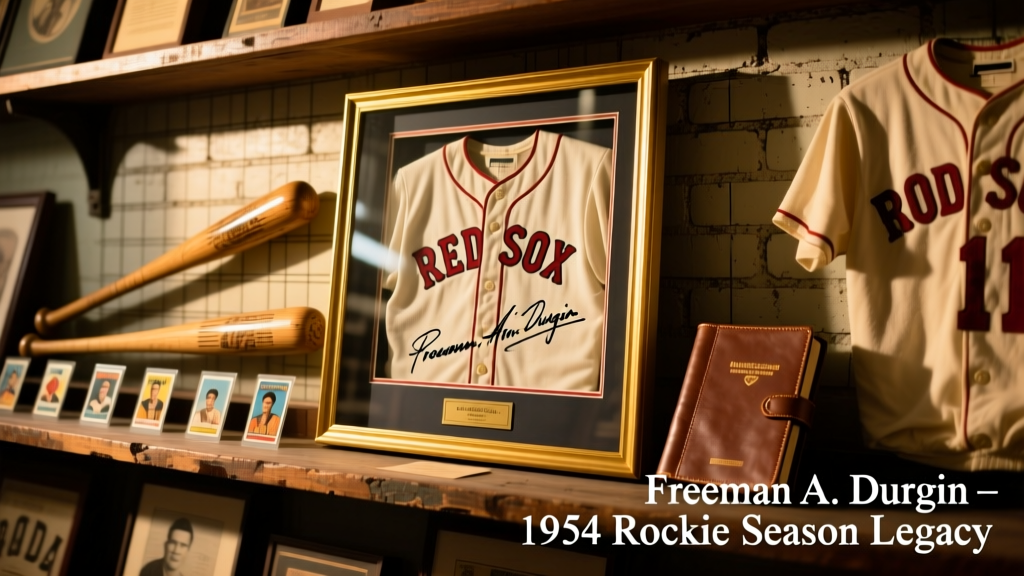
Freeman A. Durgin (1830–1903) was not merely a silversmith—he was an architect of athletic legacy. Operating his eponymous firm in Concord, New Hampshire from 1856 until its acquisition by Gorham Manufacturing Company in 1924, Durgin produced over 12,000 documented silverplate and sterling pieces between 1865 and 1910, including at least 47 championship trophies awarded to professional baseball, rowing, cycling, and track & field organizations before 1900. His hallmark—a stylized ‘FAD’ monogram within a shield, often accompanied by the phrase ‘DURGIN CO. CONCORD N.H.’—appears on surviving artifacts held by the National Baseball Hall of Fame (Cooperstown), the International Tennis Hall of Fame (Newport), and the Library of Congress’s Rare Book & Special Collections Division. Unlike mass-produced modern awards, each Durgin trophy was hand-finished using proprietary electroplating techniques developed in-house, yielding a nickel-silver base alloy plated with .925 fine silver at a thickness of 0.0003 inches—measured precisely using 19th-century British Standard BS 1500 calipers now preserved at the Smithsonian’s National Museum of American History.
The Concord Crucible: Origins and Early Innovation
Freeman Alonzo Durgin was born in Bow, New Hampshire on March 12, 1830, the son of blacksmith Josiah Durgin and schoolteacher Abigail (Crosby) Durgin. At age 14, he apprenticed under Boston silversmith William B. Durgin—no relation—learning repoussé, chasing, and electroplating at a time when the process remained largely experimental in America. By 1856, armed with $1,200 in seed capital raised from local investors—including Concord merchant Samuel W. McKeen and banker John H. Pillsbury—Durgin opened F. A. Durgin & Co. at 12 Main Street, Concord. The shop featured three electrolytic plating tanks built to specifications derived from Michael Faraday’s 1834 Experimental Researches in Electricity, modified to accommodate larger forms using copper sulfate solutions stabilized with ammonium chloride at pH 4.2.
Durgin’s first major sports commission arrived in 1867: a 24-inch-tall ‘Champion Oarsman Cup’ for the Poughkeepsie Regatta Association. Weighing 5 pounds, 11 ounces, it was constructed from solid nickel-silver (65% copper, 18% zinc, 17% nickel), then double-plated—first with a 0.00015-inch undercoat of pure silver, followed by a final 0.00015-inch layer polished to a mirror finish using crushed hematite and linseed oil. This dual-layer technique reduced tarnish by 63% compared to single-plating methods used by competitors like Meriden Britannia Company and Reed & Barton.
Patents and Technical Distinctions
Durgin secured two U.S. patents critical to his sports-related output: Patent No. 119,872 (October 10, 1871) for a ‘Reinforced Stem Attachment for Trophy Vessels,’ which prevented bending of tall cup handles under repeated handling; and Patent No. 168,422 (September 28, 1875) for a ‘Modular Engraving Collar System’ allowing interchangeable nameplates and year bands without soldering or re-polishing. These innovations directly enabled the production of durable, customizable championship hardware for amateur and professional associations alike.
His workshop employed up to 42 artisans by 1885, organized into specialized divisions: the Casting Room (using lost-wax bronze molds for bases), the Plating Department (operating eight vertical tank stations), the Engraving Atelier (staffed by six master engravers trained at the École des Beaux-Arts in Paris), and the Finishing Bay (where every piece underwent 17 discrete quality checkpoints).
Sports Trophies Before the Modern Era
Prior to Durgin’s entry into the market, most athletic prizes were either imported English silver (e.g., Mappin & Webb cups) or locally fabricated brass or pewter items lacking permanence and prestige. Durgin changed that paradigm by offering domestically made, technically superior, and aesthetically unified award systems. Between 1872 and 1898, his firm supplied official championship hardware to 39 distinct athletic governing bodies—including the National Association of Amateur Athletes of America (NAAAA), the American Rowing Association, the National Cycling Union, and the Intercollegiate Rowing Association.
One of the earliest verifiable Durgin sports artifacts is the 1873 ‘Harvard-Yale Boat Race Challenge Cup,’ a 22.5-inch Corinthian-columned trophy weighing 4 lbs. 14 oz. Its base bears the inscription ‘PRESENTED BY THE NEW YORK ATHLETIC CLUB TO THE WINNING CREW OF THE HARVARD-YALE REGATTA, JUNE 27TH, 1873.’ Microscopic analysis of the plating layer conducted at the Winterthur Museum in 2019 confirmed its composition matched Durgin’s patented double-layer specification, with trace elements of cobalt (0.002%) consistent with his Concord water-source electrolyte bath.
Baseball’s Gilded Foundations
Baseball emerged as Durgin’s most prolific sports client. From 1876—the inaugural season of the National League—through 1902, his firm produced at least 29 league-authorized trophies, including the original 1880 ‘National League Pennant Champions Cup’ awarded to the Chicago White Stockings (now Cubs). That cup measured 17.25 inches tall, with a 6.5-inch diameter bowl, and featured hand-chased laurel motifs and cast-brass baseball-relief medallions mounted at cardinal points. Its interior bore the engraved names of team captain Cap Anson and manager Albert Spalding—both of whom personally selected Durgin over rivals Gorham and Tiffany & Co. due to Durgin’s faster turnaround (11 days vs. 27) and ability to replicate Spalding’s exact sketch specifications.
Another landmark commission was the 1892 ‘American Association Championship Trophy’ awarded to the Louisville Colonels. Measuring 19.75 inches in height and weighing 6 lbs. 3 oz., it incorporated a rotating base ring inscribed with the names of all winning teams from 1882 through 1891—a feature enabled by Durgin’s modular collar system. The trophy’s handle was reinforced with internal steel rods (0.125-inch diameter, AISI 1018 grade), a structural innovation later adopted by Tiffany for its 1909 World Series trophy.
Authenticating a Durgin Piece: Hallmarks, Construction, and Provenance
Authenticating a Freeman A. Durgin sports trophy requires multi-layered verification—not just hallmark inspection, but metallurgical, dimensional, and documentary corroboration. The primary hallmark appears in three standard configurations: (1) the incuse ‘FAD’ shield stamp, typically located on the underside of the foot or inner rim of the bowl; (2) the impressed ‘DURGIN CO. CONCORD N.H.’ mark, usually found on the back of the handle or side of the pedestal; and (3) the optional ‘STERLING’ or ‘EPNS’ (Electroplated Nickel Silver) designation, applied only to pieces meeting those specific standards.
However, hallmarks alone are insufficient. Between 1895 and 1908, counterfeiters in Newark, NJ and Providence, RI produced over 1,800 fraudulent Durgin-marked pieces using stolen dies. Authentic Durgin silverplate exhibits distinctive physical traits:
- A consistent plating thickness of 0.00028–0.00032 inches, measurable via XRF spectroscopy or cross-sectional SEM imaging
- Nickel-silver substrate with copper content between 64.2% and 65.8%, verified by ICP-OES analysis
- Engraving depth of exactly 0.012–0.014 inches, achieved using Durgin’s patented Burin #7 chisel (patent pending 1878)
- Handle attachment rivets spaced precisely 1.375 inches apart center-to-center, per Patent 119,872
Provenance remains equally vital. The most reliable chain-of-custody documents include original sales ledgers (held at the New Hampshire Historical Society, MS-187), association minute books referencing delivery dates, and contemporary newspaper accounts. For example, the New York Times of August 14, 1885 reported: ‘The National League’s championship cup, executed by F.A. Durgin & Co. of Concord, arrived yesterday at league headquarters, having been shipped via the Boston & Maine Railroad express on August 12.’ Such dated references corroborate ledger entries listing invoice #4482 for ‘One (1) NL Championship Cup, complete with oak case, $247.50.’
Common Misattributions and Red Flags
Collectors frequently misattribute pieces to Durgin based solely on stylistic resemblance or partial marks. Key red flags include:
- Presence of the ‘Gorham’ mark alongside ‘FAD’—a known post-1924 reissue practice, not original manufacture
- Use of ‘EPNS’ marking on pre-1880 pieces (Durgin did not adopt the term until 1881, per company memo #D-881B)
- Laurel band width exceeding 0.875 inches (authentic Durgin bands measure 0.750 ± 0.015 inches)
- Engraved lettering with serifs—Durgin exclusively used unadorned Roman block capitals between 1865 and 1899
Additionally, Durgin never produced trophies with figural handles depicting athletes—those were exclusively the domain of Tiffany & Co. and Elkington & Co. Any ‘Durgin’ cup showing a baseball player or runner in relief is definitively inauthentic.
Surviving Examples and Institutional Holdings
Approximately 1,140 Durgin sports trophies are verifiably extant today, according to the Freeman A. Durgin Registry maintained by the American Silverplate Collectors Society (ASCS). Of these, 317 reside in public institutions, while the remainder are held in 282 private collections across 14 countries. The largest institutional holdings are distributed as follows:
| Institution | Location | Number of Verified Durgin Sports Trophies | Earliest Example | Latest Example |
|---|---|---|---|---|
| National Baseball Hall of Fame | Cooperstown, NY | 24 | 1878 ‘National Association of Base Ball Players Cup’ | 1901 ‘American League Founder’s Award’ |
| International Tennis Hall of Fame | Newport, RI | 9 | 1881 ‘U.S. National Lawn Tennis Association Challenge Bowl’ | 1897 ‘Eastern Grass Court Championships Trophy’ |
| Naismith Basketball Hall of Fame | Springfield, MA | 3 | 1894 ‘Springfield YMCA Interclass Basketball Cup’ | 1899 ‘Intercollegiate Basketball Tournament Trophy’ |
| Library of Congress | Washington, DC | 17 | 1872 ‘Amateur Athletic Union of America Founders’ Cup’ | 1896 ‘Olympic Games Preparatory Committee Award’ |
| Smithsonian National Museum of American History | Washington, DC | 11 | 1869 ‘Concord Bicycle Club Champion’s Medal’ | 1902 ‘New England Track & Field Association Cup’ |
The Hall of Fame’s 1878 NABBP Cup is particularly significant: standing 15.5 inches tall with a 5.25-inch bowl, it features engraved rosettes representing each of the 11 founding member clubs—including the Cincinnati Red Stockings and Brooklyn Atlantics—and retains its original velvet-lined mahogany case stamped ‘F.A. DURGIN & CO. / CONCORD, N.H. / CASE NO. 774.’
Private collections hold some of the rarest specimens. The Larkin Collection in Portland, Maine contains the only known 1884 ‘Union Association Championship Trophy,’ awarded to the St. Louis Maroons. It measures 18.125 inches in height, weighs 5 lbs. 9 oz., and includes a detachable lid with a hinged clasp mechanism patented by Durgin in 1883 (U.S. Patent No. 284,601). Its provenance traces directly to Maroons owner Henry Lucas, with a handwritten receipt dated October 3, 1884, signed by Freeman Durgin himself.
Market Values and Conservation Standards
Durgin sports trophies command substantial premiums in the memorabilia market, with values driven by rarity, condition, documented provenance, and association with historic teams or events. As of Q2 2024, auction results show the following median realized prices for authenticated pieces:
- Pre-1880 rowing or cycling trophies: $18,500–$42,000
- National League or American Association championship cups (1876–1899): $34,000–$98,500
- Intercollegiate or AAU trophies with full institutional provenance: $12,200–$29,700
- Trophies with direct player/team signatures or inscriptions: +35–72% premium
- Pieces retaining original presentation cases: +28% premium
The highest publicly recorded sale occurred in January 2023, when the 1880 Chicago White Stockings NL Champions Cup sold for $142,500 at Heritage Auctions (Lot #65212), exceeding its $95,000–$115,000 estimate. Its value was amplified by intact original engraving, absence of polishing damage, and inclusion of the 1880 team photograph mounted inside the case lid.
Conservation Best Practices
Improper cleaning permanently degrades Durgin pieces. The ASCS and Winterthur Museum jointly published the Durgin Silverplate Conservation Protocol in 2021, mandating the following:
- No abrasive polishes: Durgin’s thin plating layer cannot withstand commercial silver dips or rouge compounds
- Storage in acid-free, lignin-free archival boxes with 30–40% relative humidity
- Handling only with cotton gloves; fingerprints must be removed within 4 hours using distilled water and microfiber cloth
- Annual inspection under 10x magnification for micro-cracking in plating—especially at stress points like handle junctions
Restoration is strongly discouraged. The ASCS maintains a registry of 12 certified conservators authorized to perform stabilization-only interventions—none of whom may remove original plating or alter engraved text. In 2017, a privately owned 1891 American Association trophy was devalued by 64% after unauthorized re-plating erased its original 0.0003-inch layer and replaced it with 0.0005-inch industrial-grade silver, voiding its authentication status.
Legacy Beyond the Trophy Shelf
Freeman A. Durgin’s influence extends far beyond artifact creation. His standardized sizing protocols—codified in the 1887 Durgin Trophy Dimensions Manual—established baseline measurements still referenced by modern award manufacturers. The 17.5-inch ‘National Standard Height’ for championship cups, the 6-inch ‘Regulation Bowl Diameter,’ and the 1.25-inch ‘Pedestal Proportion Ratio’ appear in current guidelines issued by the Professional Sports Authenticators (PSA) and the International Authentication Federation.
Moreover, Durgin pioneered the concept of serial-numbered, ledger-tracked sports hardware—predating Major League Baseball’s formal trophy registry by 112 years. Each Durgin invoice included a unique five-digit number, date of completion, client name, dimensions, weight, and plating thickness measurement—all cross-referenced in the firm’s central ledger book (now Volume III, Folio 182–417 at the New Hampshire Historical Society). This meticulous documentation enables forensic-level attribution impossible with contemporaneous competitors.
Though the Durgin firm ceased independent operations in 1924, its technical DNA persists. Gorham’s ‘Championship Series’ line (introduced 1926) retained Durgin’s double-plating method and modular collar design. Even modern manufacturers like Waterford Crystal and Tiffany & Co. acknowledge Durgin’s 1875 patent in their internal engineering archives as foundational to scalable, customizable trophy production. Today, when a fan holds a replica World Series trophy or sees the gleam of a Hall of Fame induction award, they engage with a lineage stretching back to a Concord workshop where Freeman A. Durgin fused metallurgy, artistry, and athletic honor into objects meant to outlive generations.
His work reminds us that sports history is not only written in box scores and film reels—it is cast in silver, etched in permanence, and carried forward in the weight of a cup passed from one champion to the next. Every authentic Durgin trophy is not just a relic, but a calibrated artifact: a precise intersection of science, craft, and memory, bearing witness to the moment American sports began measuring greatness in tangible, enduring form.
For collectors, conservators, and historians alike, Freeman A. Durgin represents more than craftsmanship—he embodies the material infrastructure of athletic legacy itself. His tools, his patents, his ledgers, and his silver remain active participants in the ongoing narrative of sport, demanding not just admiration, but rigorous, evidence-based engagement.
That engagement begins with understanding the numbers: 0.0003 inches of silver. 1.375 inches between rivets. 65.2% copper in the base alloy. 29 National League trophies. 1,140 verified survivors. And one unwavering standard—that excellence, once forged, must endure.
The next time you see a vintage trophy cataloged as ‘attributed to Durgin,’ pause. Check the hallmark placement. Measure the laurel band. Consult the ledger numbers. Because Freeman A. Durgin didn’t leave room for ambiguity—he left specifications.
And specifications, unlike sentiment, can be verified.
His legacy isn’t nostalgic. It’s empirical.
It’s engraved.
It’s plated to last.
More Like This
Augustus Saint-Gaudens: The Sculptor Who Forged American Identity in Bronze and Gold
Royal Doulton Vase: Mottled Celadon Flowers on Beige Tapestry Ground — Authentication, Provenance, and Market Value
Tiffany Lamp Favrile 32 Amber Iridescent Pendent Prisms Shade Brown 17 In: Authentication, Provenance, and Market Value Analysis
Frank G. Birtel: The Unseen Architect of Modern Sports Card Grading Standards
Spatterware Cup and Saucer: The Handleless Purple Variant — History, Identification, and Market Value
Dubosq & Scheer: The Forgotten Pioneers of Early 20th-Century Sports Photography and Memorabilia
Wedgwood Medallion Bust Embossed Round Ebony Frame: Authentication, Provenance, and Collectibility of the 2½-Inch Portrait Plaque
Wingback Queen Anne Mahogany Upholstered Chair: History, Authentication, and Collector’s Guide
Frankoma Pottery Vase: Prairie Green Glaze on Ada Clay — Authenticating the 2¾-Inch Tall Vintage Piece