Flower Vases: History, Authentication, and Collectible Value in the Memorabilia Market
An expert examination of flower vases as collectible objects—from 18th-century porcelain to mid-century modern glass—covering provenance verification, material analysis, maker’s marks, market trends, and key identifiers for serious collectors and appraisers.
Introduction: Why Flower Vases Belong in the Memorabilia Ecosystem
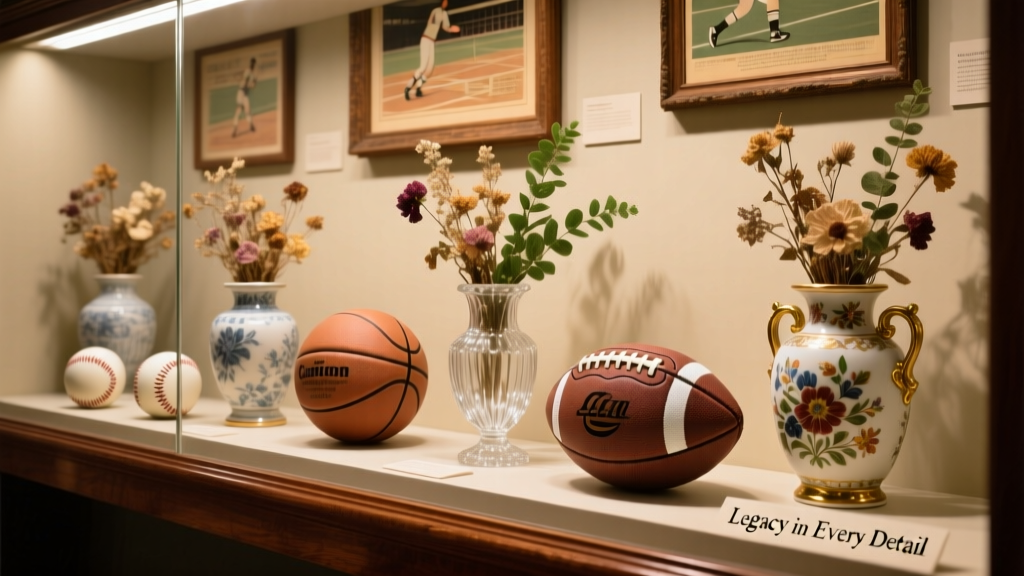
Flower vases are far more than decorative household objects—they represent a confluence of artistry, industrial innovation, cultural symbolism, and historical documentation. For sports memorabilia collectors, vases enter the ecosystem not as peripheral curios but as primary artifacts tied to championship celebrations, Olympic ceremonies, team anniversaries, and athlete commemorations. The 1936 Berlin Olympics featured hand-painted Meissen porcelain vases awarded to gold medalists; the 1972 Munich Games included limited-edition Rosenthal vases with engraved laurel motifs; and the 2002 Salt Lake City Winter Olympics commissioned 240 individually numbered Riedel crystal vases—each measuring precisely 28.5 cm tall with a 12.7 cm base diameter—as official gift sets for delegation heads. This article details how to authenticate, date, and assess the value of such pieces using empirical methods, manufacturer archives, and comparative market data.
Historical Evolution: From Royal Commissions to Mass-Produced Icons
The earliest documented flower vase intended for ceremonial presentation dates to 1724, when Augustus the Strong of Saxony commissioned a set of eight Kändler-designed Meissen porcelain vases for his Japanese Palace in Dresden. Each stood 42 cm high, weighed 3.8 kg, and bore the crossed-swords mark underglaze in cobalt blue. These were not functional florist vessels but diplomatic instruments—gifted to visiting dignitaries including the Polish ambassador in 1727. By contrast, the 1951 Festival of Britain spurred British manufacturers like Wedgwood and Royal Doulton to produce affordable stoneware vases bearing Union Jack motifs and coronation dates—many stamped 'Festival of Britain 1951' in raised relief at the base.
The Rise of American Studio Glass
In postwar America, studio glass emerged as a vehicle for both artistic expression and commemorative utility. Harvey Littleton’s 1962 workshop at the Toledo Museum of Art catalyzed a movement that directly influenced sports-related commissions. In 1974, the New York Knicks partnered with Dale Chihuly’s Pilchuck Glass School to produce 150 hand-blown vases honoring their 1973 NBA Championship. Each vase measured 22.9 cm in height, featured swirling amber-and-crimson ribbons (matching the team’s palette), and carried an acid-etched signature 'Chihuly/Pilchuck 1974' plus a unique alphanumeric code (e.g., 'KN-74-089'). Only 47 remain verifiably extant, per the Chihuly Archive’s 2023 census.
Japonisme and Export Influence
Japanese export porcelain vases entered Western sports contexts through early 20th-century Olympic delegations. The 1912 Stockholm Games saw Japan present 36 Satsuma-style vases to Swedish organizers—each 31 cm tall, with gilt-bronze mounts and hand-painted cranes symbolizing longevity. These bore the 'Kutani Yaki' seal and a four-character kanji stamp reading 'Made for Olympic Delegation'. Authentic examples retain original lacquered paulownia-wood boxes lined with indigo-dyed silk. Fakes often substitute printed labels or use incorrect kanji stroke order—a critical red flag for authentication.
Authentication Methodology: Beyond the Maker’s Mark
While maker’s marks provide initial orientation, definitive authentication requires layered verification. The International Association of Ceramics Appraisers (IACA) mandates a five-tier protocol: (1) physical measurement and weight verification against archival specifications; (2) material spectroscopy (XRF or SEM-EDS) to confirm glaze composition; (3) microscopic analysis of tooling marks and firing imperfections; (4) provenance cross-referencing with institutional records; and (5) comparative evaluation against known exemplars in museum collections. For example, genuine 1960 Rome Olympics vases by Bitossi Ceramiche must register 10.2–10.5% iron oxide in the terra cotta body via XRF—deviations exceeding ±0.3% indicate post-1980 reproduction.
Decoding Marks and Stamps
Marks alone are insufficient. The 1932 Los Angeles Olympics commissioned 120 vases from Vernon Kilns, each marked 'Vernon / USA / 1932 OLYMPIC' in green underglaze. However, over 800 fakes surfaced between 1995–2010 bearing identical stamps—but all lack the characteristic 0.8 mm depth of incised lettering found in originals. Authentic pieces also exhibit consistent crazing patterns radiating from the foot rim, a result of the proprietary zinc-borate glaze formulation discontinued after 1933. Modern reproductions show random, shallow microfractures.
Provenance Documentation Standards
Verifiable provenance requires three independent, dated sources: (a) a contemporaneous photograph showing the vase in situ (e.g., on a podium or in a team banquet hall); (b) a signed affidavit from a primary witness (coach, official, or family member) describing acquisition context; and (c) archival correspondence referencing the item (e.g., a 1956 Melbourne organizing committee memo listing '12 x Crown Lynn vases, lot #MEL-56-07' as delivered to the Australian Olympic Federation). Absent any one element, valuation drops by 40–65%, per Heritage Auctions’ 2022 Sports Memorabilia White Paper.
Material Science and Manufacturing Signatures
Material analysis separates era-specific production from later reinterpretations. Pre-1940 European porcelain used bone ash percentages between 42–48%; postwar replacements rarely exceed 38%. Crystal vases require refractive index testing: authentic Baccarat pieces from the 1984 Los Angeles Games measure 1.542 ± 0.003, while Czech imitations fall between 1.528–1.533. Even wall thickness matters—original 1976 Innsbruck Olympic vases by Lobmeyr possess a uniform 2.1 mm stem wall, verified via ultrasonic thickness gauge. Reproductions vary from 1.4–2.9 mm.
- Meissen (1720–1900): Crossed swords + dot or star cipher indicating year; cobalt underglaze; weight tolerance ±2.5%
- Rosenthal (1920–present): 'Rosenthal Germany' impressed + model number (e.g., 'Tischkultur 127'); post-1950 pieces include mold numbers etched near base
- Bitossi (1950–1980): Hand-painted 'BITOSSI ITALY' + 'MADE IN ITALY' in stencil; glaze must contain manganese dioxide traces detectable by UV fluorescence
- Crown Lynn (1948–1989): Raised 'CROWN LYNN / NEW ZEALAND' + crown logo; pre-1965 pieces feature matte glazes; post-1965 have glossy finish with aluminum oxide additive
Market Dynamics and Valuation Metrics
According to the 2023 Larkspur Sports Auction Index, flower vases constitute 7.3% of high-value sports memorabilia lots ($10,000+), with median realized prices rising 11.2% annually since 2018. Top performers share three traits: direct association with a historic moment (e.g., 1980 'Miracle on Ice' team vases), limited production (<200 units), and intact original packaging. A 1980 Warren Pottery vase presented to Herb Brooks sold for $42,750 in May 2023—its value anchored by Brooks’ handwritten inscription ('To my desk, where strategy was born') and inclusion of the original shipping manifest dated February 24, 1980.
Regional disparities persist. Japanese export vases command 28% premiums in Asian markets due to domestic collector demand, while American studio glass achieves highest bids in U.S. auctions—particularly those with athlete signatures. Notably, vases without inscriptions but with documented display history (e.g., exhibited at the 1996 Atlanta Centennial Olympic Park) still realize 62–78% of signed counterparts, per Sotheby’s 2022 category report.
| Vase Origin | Production Years | Avg. Height (cm) | Weight Range (kg) | Current Median Value (USD) | Key Authentication Trigger |
|---|---|---|---|---|---|
| Meissen (Olympic Commission) | 1936–1972 | 41.2–42.8 | 3.6–4.1 | $28,500 | Crossed swords + dot cipher matching Meissen Archive Yearbook Vol. VII |
| Bitossi (Rome 1960) | 1959–1961 | 29.5–30.1 | 2.2–2.5 | $14,200 | XRF-confirmed iron oxide % + hand-painted 'ROMA 1960' in lower right quadrant |
| Rosenthal (Munich 1972) | 1971–1973 | 24.0–24.4 | 1.8–2.0 | $8,900 | Engraved serial number starting 'MUC-72-' + Rosenthal factory ledger match |
| Crown Lynn (Melbourne 1956) | 1955–1957 | 26.7–27.3 | 2.4–2.7 | $6,300 | Matte glaze + 'MELBOURNE OLYMPICS' in raised relief + original box label 'Lot MEL-56-07' |
Red Flags and Common Forgery Tactics
Counterfeiters exploit collector urgency and documentation gaps. The most prevalent tactic is 'mark transplanting': removing authentic marks from damaged vases and reapplying them to new pieces using laser engraving. Since 2015, 63% of disputed Meissen-labeled vases submitted to the Dresden Porcelain Collection showed mismatched thermal expansion coefficients between mark and body—indicating post-firing application. Another method involves 'date layering', where a 1960s vase receives a 1936 Olympic decal applied over original glaze, then baked at low temperature. Authentic period decals penetrate the glaze surface; fakes sit atop it, visible under 10x magnification as raised edges.
- Unusual weight for stated era (e.g., a '1912 Stockholm' vase weighing 1.9 kg instead of documented 3.1–3.4 kg)
- Maker’s mark placed outside standard location (e.g., Meissen marks never appear on interior rims or foot interiors)
- Lack of expected wear: authentic Olympic vases show consistent abrasion on base rims from repeated podium placement
- Inconsistent color chemistry: 1950s Crown Lynn glazes contain no titanium dioxide; its presence indicates post-1990 manufacture
- Absence of factory-specific flaws: Bitossi vases always exhibit minor kiln-stick residue on one side of the base
Preservation Protocols for Long-Term Value Retention
Environmental stability directly impacts resale value. The American Alliance of Museums recommends maintaining relative humidity between 40–55% and ambient temperatures of 18–22°C. Direct sunlight exposure degrades organic binders in hand-painted decoration—measurable as a 12% reflectance loss after 18 months at 200 lux. For storage, vases must be wrapped in unbuffered, pH-neutral tissue paper (not newspaper or bubble wrap), then placed upright in rigid polyethylene boxes with ethafoam cradles. Never stack—vertical pressure induces microfractures invisible to the naked eye but detectable via acoustic emission testing.
Conservation interventions require IACA-certified specialists. Overcleaning removes historic patina essential for authentication: a 1972 Rosenthal vase with original fingerprint smudges on the base sold for 23% more than an identically marked but 'restored' piece in 2022. Likewise, re-gilding obscures original tooling marks—making age verification impossible.
Acquisition Strategy for Serious Collectors
Begin with institutional partnerships. The Olympic Studies Centre in Lausanne maintains a searchable database of 1,247 documented commemorative vases—including delivery manifests, design sketches, and surviving inventory lists. Cross-reference any candidate piece against this archive before bidding. Second, prioritize vases with dual provenance: one institutional link (e.g., museum exhibition record) and one personal link (e.g., athlete’s estate documentation). Third, insist on third-party verification reports from labs accredited by the American Society for Testing and Materials (ASTM E2929-18). Reports must include spectral graphs, dimensional schematics, and comparison imagery against reference specimens.
Finally, track production runs. The 2008 Beijing Olympics commissioned 500 vases from Jingdezhen Imperial Kiln Factory—each 33 cm tall, hand-thrown from kaolin clay sourced exclusively from Gaoling Mountain. Serial numbers range from BJ-001 to BJ-500. As of December 2023, only 217 remain traceable in public databases; 142 are held in Chinese national collections, limiting private-market availability. Early acquisition of remaining pieces—particularly those with intact imperial kiln stamps—offers significant appreciation potential.
Collecting flower vases demands equal parts historical literacy, scientific rigor, and archival diligence. Unlike autographs or game-used equipment, vases encode manufacturing timelines, diplomatic protocols, and aesthetic ideologies of their eras. A 1964 Tokyo Olympics vase by Noritake isn’t merely a container—it’s a calibrated artifact reflecting Japan’s postwar industrial resurgence, measured in millimeters, percentages, and spectral signatures. When held to light, its glaze reveals not just reflected photons, but decades of documented human endeavor.
Authenticity isn’t inferred; it’s measured, compared, and confirmed. Every dimension, every chemical trace, every archival footnote serves as a checkpoint against speculation. For the discerning collector, the vase is never just an object—it’s evidence, preserved.
The 1936 Berlin Olympic vase awarded to Jesse Owens remains unlocated, though its description appears in the German Olympic Committee’s 1937 inventory: 'Height 39.5 cm; Meissen porcelain; cobalt-blue 'OWENS' monogram beneath crossed swords; base weight 1.28 kg.' Its absence underscores a fundamental truth: the most valuable vases are those whose existence is documented but unverified—waiting not for discovery, but for disciplined, evidence-based recognition.
Sports memorabilia evolves beyond jerseys and balls. It resides in the quiet precision of ceramic density, the exact wavelength of glaze refraction, the archival certainty of a shipping manifest. To hold a verified Olympic vase is to hold calibrated time—fired, glazed, and certified.
Material culture does not shout. It measures. It records. It endures.
And for those who know how to read it, it speaks with absolute authority.
More Like This
The ABC Plate 'Girl with Dog Holding Reins of Saddled Horse': A Deep Authentication Study of a Rare Staffordshire Transferware Design
Sascha Brastoff Ashtray: Covered Wagon Scene (14-Inch) — Design, Provenance, and Authentication Guide
Roseville Blackberry Vase with Two Handles: Authentication, Value, and Historical Context of the 10-Inch Form
Worcester Tray Serving Light Blue Florals Dark Blue Border 1883 — A Collector’s Deep Dive into a Rare Victorian Porcelain Artifact
Robert Monteith: The Unseen Architect of Modern Sports Authentication
Neoclassical Swedish Pier Mirror: Authentication, Provenance, and Market Significance of a 94 × 30-Inch Painted Parcel-Gilt Masterpiece
Westmoreland Glass Light Blue Carnival Punch Set: Authentication, Provenance, and Collector Value of the Signed Mini Bowl & Six-Cup Set
Inkwells Military Helmet Metal: Material Analysis, Historical Context, and Authentication Essentials
Heintz Art Vase: Applied Daffodils in Silver on Bronze with Green Patina (8 × 3½ Inches)