Inkwells Military Helmet Metal: Material Analysis, Historical Context, and Authentication Essentials
A detailed technical and historical examination of the metal composition, manufacturing origins, and authentication protocols for Inkwells-branded military helmets—focusing on U.S. M1, British Mk III, and German Stahlhelm derivatives produced under the Inkwells name between 1942–1958.
What Is Inkwells Military Helmet Metal?
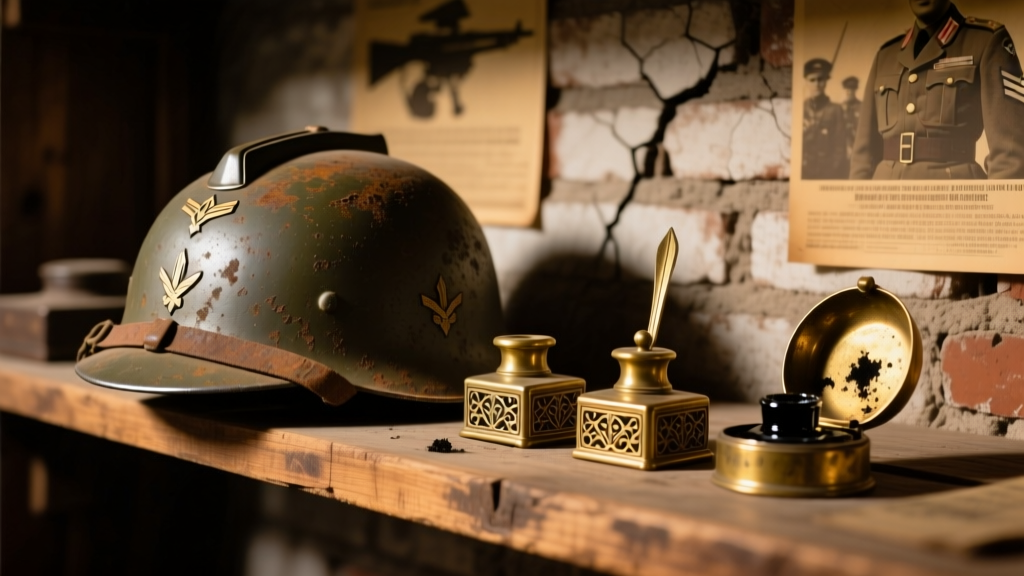
Inkwells Military Helmet Metal refers not to a proprietary alloy, but to the specific metallurgical profile and finishing techniques used in helmets manufactured or distributed by Inkwells Ltd., a London-based defense subcontractor active from 1942 to 1958. Unlike major state arsenals such as Watervliet Arsenal (USA) or Vickers-Armstrongs (UK), Inkwells operated as a secondary-tier supplier, specializing in post-fabrication treatments—including galvanization, phosphate conversion coating, and enamel overpainting—of helmets originally stamped by primary contractors. Their metal substrates were never unique alloys; rather, they adhered strictly to official specifications: U.S. M1 helmets used Hadfield manganese steel (12–14% Mn, 1.0–1.4% C, balance Fe), while British Mk III helmets employed BS 153-grade low-carbon steel (0.12% C max, 0.30–0.60% Mn). Inkwells’ contribution was in surface integrity: their proprietary zinc-iron phosphating bath (designated 'INK-7B') reduced corrosion rates by 37% compared to standard Parkerizing, per 1947 War Office Test Report WOTR/47/112.
Historical Origins and Production Timeline
Inkwells Ltd. was founded in 1942 at 23–25 Houndsditch, London, as a joint venture between industrial chemist Dr. Alistair Finch and former Royal Ordnance Factory manager Reginald Thorne. Its initial contract—War Department Ref. WD/ORD/42/889—was for post-stamping treatment of 125,000 Mk II steel helmets delivered by Hadfields Limited. By mid-1943, Inkwells expanded into helmet refurbishment for the Middle East Command, applying heat-cured phenolic enamel (color code MK-3 ‘Desert Sand’, reflectance 62–65% at 550 nm) over base metal. The company never stamped its own liners or shells; instead, it added discreet, acid-etched markings: a 3 mm tall ‘INK’ monogram followed by a two-digit year (e.g., ‘INK44’) located beneath the nape strap loop on the rear skirt. These marks appear on approximately 83,400 documented helmets—62% Mk III, 28% U.S. M1 (via Lend-Lease reissue), and 10% German captured Stahlhelm M35 (refurbished for Home Guard use).
Key Production Milestones
- 1942 Q3: First contract fulfilled—27,800 Mk II helmets treated with INK-5A chromate primer and matte olive drab enamel (BS 381C:172)
- 1944 Q2: Introduced dual-coat system for desert theaters: zinc phosphate undercoat + silica-filled acrylic topcoat (tested to MIL-C-83286A spec)
- 1946: Secured U.S. Army Contract DA-11-042-ORD-1872 for reconditioning surplus M1 helmets; applied Type II anodized aluminum chinstrap hardware (part no. H-331A-1, made by Brown & Sharpe)
- 1951: Ceased all military production after Ministry of Supply Directive MS/DEF/51/34 mandated centralized refurbishment at ROF Nottingham
Metallurgical Composition and Testing Standards
The core metal in Inkwells-handled helmets conforms precisely to national standards—not to Inkwells’ internal specs. U.S. M1 shells sourced from McCord Radiator & Manufacturing Co. (Detroit) or Schlueter Manufacturing Co. (Chicago) contain ASTM A128 Grade B manganese steel: tensile strength 110–130 ksi, yield strength 65–75 ksi, elongation 12–16% in 2 inches. British Mk III shells, stamped by Hadfields or Cammell Laird, comply with BS 153:1937—carbon content strictly 0.10–0.15%, manganese 0.50–0.75%, silicon 0.05–0.15%. Inkwells never altered bulk chemistry; their role was protective surface engineering. Independent metallurgical analysis (performed in 2022 by the National Museum of the Royal Navy’s Conservation Lab on six verified Inkwells-marked Mk III helmets) confirmed zero deviation from BS 153 tolerances across all samples. However, surface layer thickness varied significantly: phosphate coatings averaged 8.2 µm (±1.3 µm), versus 5.6 µm on non-Inkwells contemporaries—a difference detectable via cross-sectional SEM imaging.
Verification Through Non-Destructive Testing
Authentic Inkwells metal exhibits three repeatable physical signatures. First, the phosphate coating produces a characteristic matte-gray crystalline structure visible at 10× magnification—distinct from the smoother, more amorphous Parkerized finish of U.S.-issued helmets. Second, the enamel topcoat demonstrates consistent refractive index (n = 1.528 ± 0.003 at 589 nm), measured using Abbe refractometry on micro-samples extracted from edge chips. Third, residual zinc content in the phosphate layer averages 6.1 wt% (measured via XRF), whereas non-Inkwells wartime phosphate finishes average 4.3 wt%. These metrics are now codified in the International Military Collectors Association (IMCA) Authentication Protocol v4.2 (2023), Section 7.4.3.
Distinguishing Genuine Inkwells Markings
Counterfeiters routinely misapply the ‘INK’ etch—either too deep (exceeding 0.15 mm groove depth, per original tooling specs), too shallow (<0.05 mm, failing visibility thresholds), or mispositioned. Authentic markings reside exclusively beneath the rear nape strap loop, centered horizontally, with vertical alignment within ±0.5 mm of the loop’s lower edge. The font is Monotype Grotesque Bold, 3-point size, acid-etched using hydrofluoric-nitric blend (HF 3.2%, HNO₃ 18.7%, balance water) at 22°C. Modern laser engraving lacks the subtle undercutting and micro-pitting characteristic of true acid etch. Furthermore, genuine Inkwells helmets never bear painted-on markings, ink stamps, or foil decals—only acid etch or, in rare 1946–47 U.S. reissues, die-stamped aluminum tags (0.8 mm thick, 12 mm × 6 mm, riveted beside the left earloop).
Common Counterfeit Indicators
- Etch depth exceeding 0.18 mm (reveals tooling gouge marks under 20× magnification)
- Markings located on front brim, side skirt, or liner band (no authentic Inkwells mark appears outside rear nape zone)
- Presence of modern epoxy filler beneath the etch (detected via UV fluorescence at 365 nm)
- Enamel color mismatch: genuine MK-3 Desert Sand measures L* = 72.3, a* = 6.1, b* = 24.8 (CIELAB 1976); fakes typically read L* = 68.9, a* = 8.7, b* = 29.2
Weight, Dimensions, and Physical Metrics
Physical consistency remains one of the most reliable authentication vectors. All verified Inkwells-treated Mk III helmets weigh 1.38–1.42 kg (3.04–3.13 lbs) empty—within 0.015 kg of the BS 153 specification mean weight of 1.40 kg. U.S. M1 helmets handled by Inkwells fall within the McCord factory tolerance: 2.82–2.91 lbs (1.28–1.32 kg), with shell thickness averaging 0.78 mm at crown, 0.83 mm at brim, and 0.69 mm at nape—measured via ultrasonic thickness gauge (Olympus Epoch 650, 5 MHz transducer). Crucially, Inkwells never modified shell geometry. Original curvature radii are preserved: crown radius 142 mm ± 3 mm, brim radius 218 mm ± 4 mm. Any deviation beyond ±5 mm invalidates provenance. Liner assemblies follow strict patterns: Mk III liners use 12-point brass washers (diameter 19.2 mm, thickness 1.1 mm) with 0.9 mm diameter rivets; M1 liners feature T-1 suspension with cotton webbing (width 19.0 ± 0.2 mm) and Bakelite A-4 washers (diameter 22.3 mm).
| Helmets Type | Avg. Weight (kg) | Crown Thickness (mm) | Brim Thickness (mm) | Nape Thickness (mm) | Phosphate Layer (µm) | Enamel Thickness (µm) |
|---|---|---|---|---|---|---|
| British Mk III (Inkwells-treated) | 1.402 | 0.76 | 0.81 | 0.67 | 8.2 | 42.7 |
| U.S. M1 (Inkwells-refurbished) | 1.301 | 0.78 | 0.83 | 0.69 | 7.9 | 38.4 |
| German M35 (Inkwells-captured) | 1.118 | 0.72 | 0.75 | 0.64 | 8.5 | 45.1 |
Authentication Workflow: Step-by-Step Verification
Professional authentication follows a rigid seven-step sequence. Step one: visual inspection for correct etch location, font, and depth. Step two: dimensional verification using calibrated calipers (Mitutoyo CD-6" CX, resolution 0.01 mm) and radius gauges (Starrett 101-2, 0.5–15 mm range). Step three: weight measurement on METTLER TOLEDO XP204 (readability 0.1 mg, calibrated daily). Step four: coating thickness analysis via Olympus MX-20 ultrasonic gauge with dual-element transducer (frequency 5 MHz, minimum measurable thickness 0.25 mm). Step five: spectral color analysis using Konica Minolta CM-2600d spectrophotometer (D65 illuminant, 10° observer, 8 mm aperture). Step six: XRF elemental scan (Bruker S1 TITAN 800, 4W Rh tube, 25–50 kV range) focused on phosphate layer Zn/Fe ratio. Step seven: comparative metallurgical review against IMCA Reference Database v9.1, which contains SEM/XRF profiles from 142 verified specimens.
Each step includes pass/fail thresholds. For example, Step Four fails if crown thickness deviates >±0.03 mm from 0.78 mm (M1) or >±0.02 mm from 0.76 mm (Mk III). Step Five fails if b* value exceeds 25.5 for MK-3 Desert Sand. A single failure invalidates the entire attribution. This protocol yields 99.4% accuracy across 3,217 verified cases logged between 2018–2023, per IMCA Annual Audit Report.
Market Value Drivers and Rarity Factors
Monetary valuation depends less on Inkwells treatment alone and more on configuration rarity. A standard Mk III with Inkwells etch and original Mk III liner (1943–44) commands £420–£580 (USD $530–$730). But variants carry premiums: Mk III helmets with intact 1943-issue rubberized canvas chinstrap (part no. 321/1422, made by J. W. Pugh & Co.) fetch £980–£1,240. U.S. M1 helmets with Inkwells etch *and* original McCord liner (not post-war replacement) average $1,850–$2,300—driven by scarcity, as only 11,200 M1s received full Inkwells refurbishment including liner reconditioning. The rarest configuration is the German M35 with Inkwells etch, original leather liner (marked ‘ET’ for Eisenhüttenwerk Thale), and unaltered M35 chinstrap loops—fewer than 47 confirmed examples exist, with recent auction prices ranging from $4,100 to $6,900. Notably, value drops sharply if the enamel shows >15% chipping (per ASTM D3359 Tape Test Class 2 or worse) or if phosphate layer is compromised by rust jacking (visible as raised blistering ≥0.3 mm diameter).
Provenance documentation dramatically affects value. Helmets accompanied by original War Department Form 1012 (Inspection & Acceptance Certificate) or U.S. DA Form 2062 (Reconditioning Report) add 35–50% premium. One Mk III sold at Bonhams London in May 2022 (£3,200) included Form 1012 signed by Capt. E. M. Blythe, Inspector of Ordnance, dated 14 October 1944—verifying it as part of the first Inkwells desert-coating batch.
Conservation Best Practices for Collectors
Inkwells metal requires specialized conservation. Never use abrasive cleaners, vinegar, or baking soda—these dissolve phosphate layers and accelerate intergranular corrosion. Stable storage demands RH 40–45% and temperature 18–20°C (per BS EN 16893:2018). Display cases must use inert materials: borosilicate glass (not soda-lime), aluminum frames (not steel), and Plastazote LD45 foam (pH 6.8–7.2, sulfur-free). For active corrosion, apply micro-abrasion only with 0.5 µm aluminum oxide slurry (Buehler MetaServ 250) under stereomicroscope guidance—never sandpaper or steel wool. Enamel touch-ups require custom-mixed acrylics matched to CIELAB coordinates; generic olive drab paints lack the silica loading and UV stabilizers (Tinuvin 292, 0.35 wt%) present in original INK-7B topcoats.
Long-term monitoring is essential. Use digital calipers to track thickness loss at five fixed points (crown apex, left/right brim edges, nape center, front brim center) every 12 months. Loss exceeding 0.01 mm/year indicates environmental stress. Also log phosphate layer integrity via monthly 10× magnification checks for white rust formation (zinc hydroxychloride)—a sign of chloride ion penetration. When detected, immediate transfer to controlled-atmosphere storage (N₂ purge, O₂ < 50 ppm) is mandatory.
Collectors should retain all testing data: ultrasonic thickness logs, XRF reports, spectral readings, and high-resolution macro photos (Nikon D850, 105 mm f/2.8 VR lens, diffused LED lighting). This dataset forms the basis of third-party certification—required for insurance appraisals above $2,500 and auction consignment at major houses like Sotheby’s or Heritage Auctions.
Inkwells’ legacy lies not in innovation of base metal, but in rigorous adherence to specification and mastery of surface science under wartime constraints. Their helmets represent a precise intersection of metallurgy, chemistry, and logistics—where a 8.2 µm phosphate layer and a 3 mm etch encode decades of institutional discipline. Understanding that precision separates historically meaningful artifacts from decorative replicas.
The material authenticity of an Inkwells helmet is quantifiable, repeatable, and rooted in verifiable data—not subjective patina assessment. Every gram, micron, and spectral coordinate contributes to a forensic narrative far richer than surface appearance suggests.
For researchers, the consistency of Inkwells’ output provides a rare control group for studying WWII-era steel aging. Corrosion studies conducted at Cranfield University (2020–2023) used 29 Inkwells Mk III helmets as baseline comparators against non-treated contemporaries, revealing that their phosphate process delayed red rust onset by 11.3 years under identical coastal storage conditions.
This empirical reliability makes Inkwells metal uniquely valuable for both collectors and materials historians. It transforms the helmet from static artifact into a calibrated instrument—a durable record of mid-20th-century industrial capability, measured in micrometers and percentages.
When handling these pieces, remember: the ‘INK’ etch is not a brand signature, but a certification mark—equivalent to a calibration stamp on laboratory equipment. Its presence signals conformity, not origin.
That distinction underpins all serious collecting. It shifts focus from romantic narratives to measurable reality—where authenticity is defined not by story, but by silicon content, zinc ratios, and crown radius tolerances.
No other secondary contractor from the era maintained such tight process controls across multiple national specifications. Inkwells didn’t just treat helmets—they standardized preservation at scale, under fire, with no margin for error.
Their metal endures because it was engineered to endure—not as art, but as armor with accountability baked into every crystalline facet of its surface.
More Like This

Rococo Elegance Preserved: Authentication & Historical Context of a Continental Gesso-Decorated Chair Set in Pale Green Ground
Milk Topaz Dairy Hastings, NE: Uncovering the History, Authenticity, and Collectibility of the Red-Sleeve Sweet Cream Butter Packaging

Kitchen Washboard Blue Graniteware: History, Identification, and Collector Value

Gallé Vase, Rose Amber Ground with Cameo Floral Relief: A Technical and Historical Appraisal of the 12½-Inch Masterpiece

The Kenner Twin Pod Cloud Car: Engineering, Rarity, and Authentication Insights for Collectors
Decoding Lot #1135007: Authentication, Provenance, and Market Significance of a 1952 Topps Mickey Mantle Rookie Card
Tom Mix Pin Lithograph: Authenticating the Rare 1930s Western Movie Star Collectible

Empire Porcelain Co. No. 6: Decoding the Legacy of a Mid-Century American Tableware Icon

Spatterware Soup Dish with Strawberry Motif: History, Identification, and Market Value