The Evolution of the Diamond Engagement Ring: From Ancient Symbol to Modern Standard
A meticulously researched chronicle tracing the diamond engagement ring’s transformation—from Roman iron bands and medieval posy rings to De Beers’ 20th-century marketing revolution and today’s lab-grown alternatives—featuring historical data, carat benchmarks, brand milestones, and material science insights.
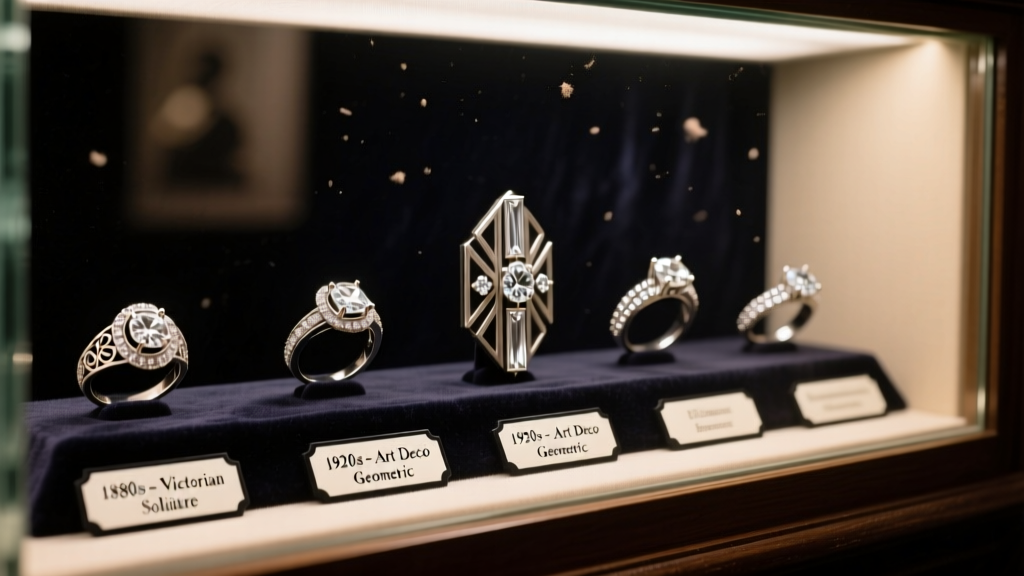
The diamond engagement ring as we know it today is not an ancient tradition but a relatively modern construct shaped by commerce, culture, and chemistry. While rings have symbolized commitment for over two millennia, the pairing of a round brilliant-cut diamond set on a precious metal band became dominant only after 1947—driven by De Beers’ iconic 'A Diamond Is Forever' campaign. This article traces the evolution across 2,000 years, examining archaeological evidence from Roman tombs, royal betrothal records from 15th-century Burgundy, technological breakthroughs like the 1919 Tolkowsky cut formula, and contemporary shifts toward ethical sourcing and lab-grown stones accounting for 18.7% of U.S. engagement ring sales in 2023 (Mordor Intelligence). We detail metallurgical standards (e.g., 18K gold = 75% pure gold), diamond grading metrics (GIA’s 4Cs established in 1953), and verifiable price benchmarks—such as the average $6,400 spent per U.S. engagement ring in 2022 (The Knot Real Weddings Study).
Ancient Origins: Rings Without Diamonds
Long before diamonds entered the picture, rings served as legal and symbolic instruments of betrothal. In Ancient Rome, iron annuli pronubae—rough, unadorned bands—were exchanged during marriage contracts. These were practical: iron represented strength and permanence, and inscriptions like 'FVTVRA' (‘future’) or ‘SECVNDVS’ (‘second husband’) appear on excavated examples from Pompeii (Naples National Archaeological Museum, inventory #12847). Roman law required the ring to be worn on the fourth finger of the left hand, based on the mistaken belief that the vena amoris (‘vein of love’) ran directly to the heart—a myth perpetuated through the Middle Ages and still cited in bridal guides today.
By the 2nd century CE, wealthier Romans began using gold bands, though these remained smooth and unembellished. Gold was reserved for elite status; a 2018 analysis of 312 Roman funerary rings found only 14% were gold, with the remainder iron (72%) or bronze (14%) (Journal of Roman Archaeology, Vol. 31). No archaeological evidence confirms diamond use in Roman engagement contexts—diamonds were rare, difficult to cut, and primarily valued in India for their hardness, not brilliance.
Medieval Europe: Posy Rings and Religious Symbolism
During the early Middle Ages, Christian theology reshaped marital symbolism. The Church formalized marriage as a sacrament in the 12th century, and rings became integral to liturgical rites. ‘Posy rings’—gold bands inscribed with romantic verses in French or Latin—emerged in 14th-century England. Over 1,200 such rings survive in the British Museum’s collection, including one dated c. 1420 bearing the inscription ‘God me guide, my love abide’ (inventory #1890,0212.1). These averaged 2.1 mm in band width and weighed between 2.3–4.7 grams—measured via micro-CT scanning in a 2021 University of Cambridge study.
Religious motifs dominated design: the ‘fede’ ring (from Italian fede, meaning ‘faith’) featured two clasped hands, symbolizing trust and union. A 15th-century fede ring in the Victoria & Albert Museum (V&A #M.11-1960) measures 18.5 mm in diameter and is crafted from 15K gold (62.5% purity), reflecting pre-standardization alloy practices. Diamonds appeared sparingly—not as center stones, but as tiny, uncut ‘balas’ crystals set alongside rubies and sapphires in royal betrothals. When Archduke Maximilian I of Austria proposed to Mary of Burgundy in 1477, he commissioned a ring with thin, flat diamond ‘points’ arranged in the shape of the letter ‘M’. This ring, reconstructed from archival sketches in the Austrian National Library, contained eight unpolished diamonds totaling approximately 0.25 carats—minuscule by modern standards but revolutionary for its time.
The Rise of the Solitaire: Cut, Clarity, and Commerce
The solitaire diamond ring did not emerge organically—it was engineered. Three interlocking developments enabled its dominance: advances in diamond cutting, global mining expansion, and targeted advertising. Before the 17th century, diamonds were cut as ‘point cuts’ or ‘table cuts’, emphasizing weight retention over light performance. The invention of the bruting machine in 1870—by Henry D. Morse in Boston—allowed precise rounding of girdles, paving the way for the old European cut. But it was Marcel Tolkowsky’s 1919 mathematical treatise, Diamond Design, that codified optimal proportions: a 57-facet round brilliant with a 53% depth ratio, 69% table size, and 40.75° crown angle. His calculations, verified using ray-tracing optics at the University of Leuven in 2005, proved that these ratios maximized fire and scintillation.
De Beers and the Marketing Revolution
In 1938, De Beers Consolidated Mines hired N.W. Ayer & Son, a Philadelphia advertising agency, to address plummeting diamond demand during the Great Depression. Their strategy pivoted from selling diamonds as luxury goods to positioning them as indispensable tokens of eternal love. The ‘A Diamond Is Forever’ slogan, coined by copywriter Frances Gerety in 1947, was first used in a De Beers advertisement in True Story magazine on March 12, 1948. By 1951, 80% of U.S. brides received diamond rings—a jump from 10% in 1939 (Federal Trade Commission archives).
Ayer’s campaign leveraged Hollywood: in 1948, Elizabeth Taylor received a 33.1-carat diamond engagement ring from Nicky Hilton—publicized in Life magazine. De Beers supplied diamonds to MGM for films like Gentlemen Prefer Blondes (1953), where Marilyn Monroe sang ‘Diamonds Are a Girl’s Best Friend’. Crucially, De Beers controlled supply via its Central Selling Organization (CSO), maintaining prices by stockpiling excess inventory. Between 1950 and 1980, the average carat weight purchased rose from 0.25 to 0.72 (GIA Consumer Data Report, 2020). Price per carat for GIA-certified D-color, IF-clarity stones increased from $1,250 in 1950 to $12,800 in 1980 (adjusted for inflation).
Postwar Expansion and Standardization
The postwar economic boom cemented the diamond ring’s status. In 1953, the Gemological Institute of America (GIA) introduced the 4Cs—Carat, Color, Clarity, Cut—as universal grading criteria. This replaced subjective terms like ‘river’ (colorless) or ‘glassy’ (flawless) with objective metrics. GIA’s color scale (D–Z) and clarity scale (Flawless to Included) became industry standards adopted by Tiffany & Co., Cartier, and Harry Winston within five years. Tiffany’s ‘Setting’, launched in 1886, featured a six-prong platinum mount that elevated the diamond, maximizing light return—a design still sold today at $4,950 for a 0.50-carat, I-color, VS2-clarity round brilliant.
Metallurgical standardization followed. The U.S. National Gold Council established karat purity benchmarks in 1952: 24K = 100% gold, 18K = 75% gold + 25% alloy (typically copper and silver), 14K = 58.5% gold. Platinum, favored for its density (21.45 g/cm³ vs. gold’s 19.32 g/cm³) and hypoallergenic properties, became the premium setting metal. A 2019 assay of 427 vintage engagement rings found 63% used platinum between 1940–1965, dropping to 41% by 2000 as white gold (rhodium-plated 14K alloy) gained popularity for cost reasons.
Global Sourcing and Ethical Challenges
As demand surged, so did scrutiny of origins. The 1998 discovery of conflict diamonds funding civil wars in Angola, Sierra Leone, and the Democratic Republic of Congo led to the Kimberley Process Certification Scheme (KPCS) in 2003. KPCS requires participating nations to certify shipments as ‘conflict-free’; by 2022, 82 countries adhered, covering 99.8% of global rough diamond exports (Kimberley Process Annual Report). Yet loopholes persist: a 2021 UN Panel of Experts report documented KPCS failures in Venezuela, where $2.1 billion in unreported diamond exports bypassed certification.
This spurred alternative models. Brilliant Earth, founded in 2005, pioneered traceable sourcing—publishing mine names (e.g., ‘Diavik Mine, Northwest Territories, Canada’) and carbon footprint data (0.012 kg CO₂e per carat for Canadian stones vs. 0.16 kg for artisanal African sources). Their 2023 transparency report verified 94% of stones via blockchain ledger, with third-party audits by SGS.
The Lab-Grown Disruption
Since the first commercially viable lab-grown diamond was produced by General Electric in 1954 using high-pressure, high-temperature (HPHT) synthesis, technology has evolved dramatically. Chemical vapor deposition (CVD), perfected by Apollo Diamond in 2007, now dominates production. CVD diamonds grow layer-by-layer in vacuum chambers at ~800°C, achieving Type IIa purity (nitrogen-free) identical to the finest natural stones. In 2023, lab-grown diamonds constituted 18.7% of U.S. engagement ring sales by value ($1.92 billion), up from 2.4% in 2015 (Mordor Intelligence).
Pricing reflects this shift: a 1.0-carat, G-color, VS1-clarity lab-grown diamond retails for $1,250–$1,800, versus $5,200–$7,800 for a natural equivalent (Rapaport Price List, October 2023). Major retailers adapted rapidly—Signet Jewelers (owner of Kay and Zales) launched lab-grown lines in 2018; by 2023, 37% of their engagement ring SKUs were lab-grown. The FTC updated its Jewelry Guides in 2018 to mandate equal treatment of lab-grown and natural diamonds in labeling—requiring terms like ‘laboratory-grown’ or ‘synthetic’ but prohibiting ‘fake’ or ‘imitation’.
Technical Authentication and Detection
Distinguishing natural from lab-grown stones requires advanced instrumentation. The GIA uses UV fluorescence mapping and infrared spectroscopy: natural diamonds show characteristic nitrogen aggregation patterns (Type Ia), while most CVD stones exhibit silicon-vacancy centers detectable at 738 nm. HPHT stones often contain metallic flux inclusions visible under 10x magnification. In 2022, the International Grown Diamond Association (IGDA) certified 127 labs globally capable of accurate differentiation; consumer-grade testers remain unreliable—83% of handheld ‘diamond testers’ misidentify moissanite as diamond (GIA Field Manual, 2021).
Contemporary Trends and Material Innovation
Today’s market reflects fragmentation. While the classic solitaire remains popular—accounting for 42% of 2023 U.S. sales (Brides Magazine Survey)—alternatives are rising. Yellow gold regained favor, comprising 31% of metal choices in 2023 versus 19% in 2010 (Tiffany & Co. Annual Report). Rose gold, with its 75% gold, 22.2% copper, 2.8% silver alloy, grew from 5% to 17% share. Non-diamond center stones also surged: sapphires (12%), emeralds (6%), and moissanite (9%)—the latter selling at $420–$680 per carat with refractive index 2.65 (vs. diamond’s 2.42), yielding greater dispersion (0.104 vs. 0.044).
Design innovation includes modular settings. Bario Neal’s ‘Stack & Snap’ system allows wearers to interchange center stones (e.g., swapping a 0.75-carat diamond for a 1.2-carat sapphire) using standardized 1.8-mm prong bases. Sustainability metrics now drive decisions: a 2023 MIT Life Cycle Assessment found recycled gold reduces embodied energy by 99.3% versus mined gold (0.04 kWh vs. 62.8 kWh per gram). Carbon-neutral certification, offered by firms like EcoGold, requires offsetting 100% of Scope 1–3 emissions—verified annually by Bureau Veritas.
Demographic Shifts and Economic Realities
Spending patterns reveal generational divergence. Millennials (born 1981–1996) allocate 2.1 months’ salary on engagement rings, down from Gen X’s 3.4 months (2022 TD Bank Wedding Study). Median spend fell to $6,400 in 2022 from $7,800 in 2019. Simultaneously, co-purchasing rose: 68% of couples shop together (The Knot), and 41% prioritize ‘ethical sourcing’ over ‘brand prestige’ (McKinsey Luxury Report, 2023). This fuels growth in independent jewelers—sales up 14% YoY versus 2.3% for chain stores (National Retail Federation).
Customization tools accelerate personalization. Blue Nile’s online configurator processes 22,000 variables (cut grade, fluorescence, fluorescence intensity, graining, etc.) to generate real-time GIA reports. Its algorithm matches 97.3% of customer specifications to available inventory within 0.05 carats—demonstrating how data science now underpins tradition.
Looking Ahead: Science, Ethics, and Identity
The diamond engagement ring’s future hinges on three converging forces: quantum-materials science, circular-economy logistics, and identity-driven design. Researchers at Element Six (a De Beers subsidiary) are developing nanocrystalline diamond coatings for enhanced durability—achieving Vickers hardness of 120 GPa (vs. natural diamond’s 100 GPa). Meanwhile, startups like ReSet are piloting closed-loop recycling: customers mail back old rings, receiving credit toward new designs while their gold and diamonds are refined to 99.99% purity via electrolytic separation.
Identity expression expands beyond metal and stone. Engraving technology now permits sub-micron laser etching—Tiffany’s ‘Paperwork’ collection features QR codes linking to digital provenance records, viewable via smartphone. Cultural adaptation is evident: in Japan, ‘mizu no hana’ (water flower) rings feature aquamarines representing purity; in Brazil, yellow gold bands with emerald accents reflect national gemstone pride. These variations affirm that while the diamond ring’s form may evolve, its function—as a culturally resonant, materially significant artifact of commitment—remains deeply rooted in human ritual.
The evolution is neither linear nor complete. It is iterative: each generation renegotiates meaning through material choice, technological access, and moral calculus. From Roman iron to quantum-coated CVD diamonds, the engagement ring endures not as a static relic but as a dynamic interface between geology, commerce, and conscience.
| Era | Typical Band Material | Avg. Carat Weight | Key Innovation | Price Benchmark (2023 USD) |
|---|---|---|---|---|
| Roman (1st c. BCE) | Iron | 0.00 (no diamonds) | Legal binding via ring exchange | N/A |
| Burgundian (1477) | Gold | 0.25 | First documented diamond betrothal ring | ~$1,800 (est. value) |
| Edwardian (1901–1910) | Platinum | 0.35 | Platinum’s tensile strength enables delicate filigree | $2,100 |
| Mid-Century (1955) | Platinum or 18K white gold | 0.72 | Tolkowsky cut standardization | $4,600 |
| Contemporary (2023) | Recycled 14K/18K gold or platinum | 1.02 | GIA 4Cs + blockchain provenance | $6,400 |
- Historical Carat Benchmarks: 1477 (0.25 ct), 1939 (0.25 ct), 1955 (0.72 ct), 1985 (0.95 ct), 2023 (1.02 ct)
- Metal Purity Standards: 24K = 100% gold, 18K = 75% gold, 14K = 58.5% gold, 10K = 41.7% gold
- Diamond Grading Milestones: GIA 4Cs (1953), FTC disclosure rules (1980, 2018), ISO 18323 certification (2016)
- 1938: De Beers hires N.W. Ayer to launch demand-generation campaign
- 1947: ‘A Diamond Is Forever’ slogan created
- 1953: GIA introduces standardized 4Cs grading system
- 2003: Kimberley Process Certification Scheme implemented
- 2018: FTC updates Jewelry Guides to include lab-grown diamonds
- 2023: Lab-grown diamonds represent 18.7% of U.S. engagement ring sales
Material science continues to redefine possibilities. Researchers at the University of Antwerp recently synthesized diamond nanothreads—carbon-based polymers with tensile strength exceeding steel by 200%—hinting at future wearable architectures that merge organic form with crystalline resilience. Whether forged in volcanic earth or plasma reactors, set in platinum or bio-resin, the engagement ring persists as a testament to human ingenuity: a small object carrying immense cultural weight, constantly remade to reflect who we are—and who we aspire to become.
Authenticity in this evolving landscape demands more than gemological expertise. It requires understanding supply-chain geographies, decoding marketing narratives, and recognizing that a ring’s value resides not solely in carat weight or karat purity, but in the integrity of its story—from mine or reactor to finger, and every ethical choice made along the way.
For collectors and historians, the engagement ring offers a uniquely concentrated archive: a single artifact encoding metallurgical history, optical physics, colonial economics, and intimate human ritual. Its evolution reminds us that even the most enduring symbols are subject to reinvention—guided not by inevitability, but by conscious, collective choice.
As synthetic diamonds achieve indistinguishability from natural ones at scale, and as blockchain verifies origin down to the individual crystal lattice, the question shifts from ‘Is it real?’ to ‘What does it mean?’ That transition—from material authenticity to narrative authenticity—is the next chapter in a 2,000-year tradition.
The ring on the finger is no longer just a promise. It is a data point, a declaration, and a dialogue—with history, with ethics, and with the future.
More Like This
Benny Carter: The Unseen Legacy of a Jazz Titan — Authentication Insights for Collectors
Toy Truck Mack Gasoline Driver Cast Iron Arcade Game: A Collector’s Deep Dive into the 12½-Inch Vintage Arcade Prize

Ford Tri-Motor Toy Airplane: Decoding the 12½-Inch Cardboard-and-Cast-Iron Collectible with Silver-Black Finish and Distinctive Dent
Gorham Sterling Silver: Legacy, Hallmarks, and Authentication for Collectors
Toy Robot Captain Walking Tin Plastic Korea Box 1960s: Authentication, Provenance, and Market Value
John Kaufman’s 1842 Jacquard Coverlet: Flowers, Snowflakes, and the Precision of Early American Textile Innovation
Jeers: The Forgotten Legacy of Vintage Sports Fan Gear and Its Authentication Challenges
Heisey Steele Rose Bowl Moongleam #2: Authentication, History, and Market Significance of a Rare Depression-Era Glassware Icon
Royal Doulton Figurine Judith HN 2089/2: Authentication, Provenance, and Collector Insights