Display a U.S. Flag to Celebrate Memorial Day: Tradition, Protocol, and Meaningful Tribute
A detailed, authoritative guide for collectors and patriots on properly displaying the U.S. flag on Memorial Day — covering history, U.S. Flag Code compliance, material standards, mounting options, timing, regional customs, and authentication tips for historic flags.
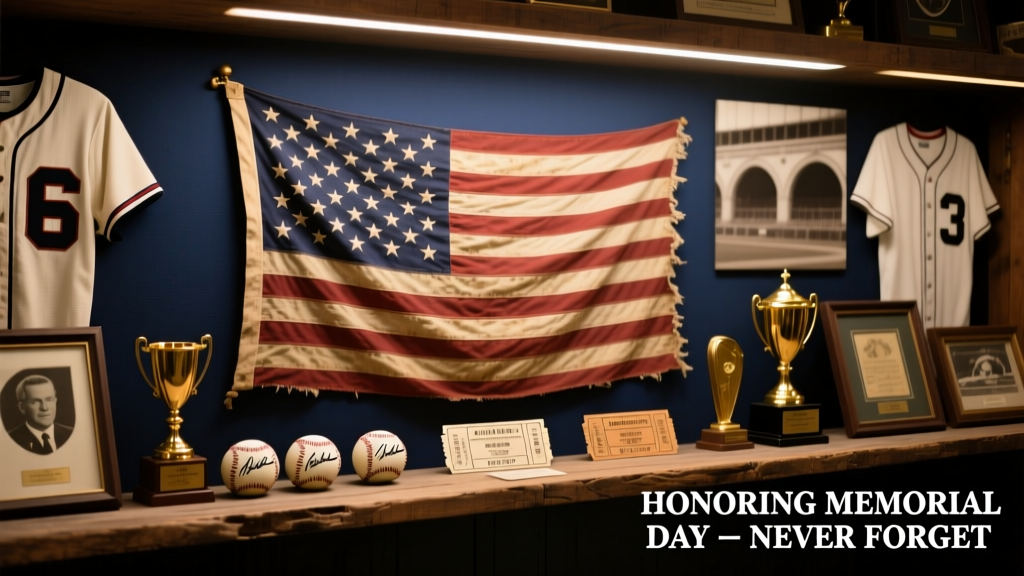
Displaying the U.S. flag on Memorial Day is far more than decorative tradition—it is a solemn, codified act of remembrance honoring the men and women who died while serving in the U.S. Armed Forces. Proper display adheres to the U.S. Flag Code (4 U.S.C. § 6–10), reflects respect for sacrifice, and avoids unintentional disrespect. This guide details exact protocols—including when to fly at half-staff (from sunrise until noon, then raised to full staff), correct flag dimensions for residential use (standard 3 ft × 5 ft or 4 ft × 6 ft), approved materials (100% nylon for outdoor durability, 100% polyester for UV resistance), and verified mounting hardware like Annin Flagmakers’ 20-ft aluminum telescoping poles with 360° swivel brackets. We also address common errors—such as flying a faded or torn flag—and provide collector insights on authenticating vintage flags from the 1940s–1970s using stitching patterns, grommet composition, and ink-fade analysis.
The Historical Roots of Memorial Day Flag Display
Memoial Day emerged from post–Civil War community observances known as "Decoration Day," first formally proclaimed by General John A. Logan on May 5, 1868. The Grand Army of the Republic mandated that flowers be placed on the graves of Union soldiers, and flags were draped over headstones or flown at cemeteries like Arlington National Cemetery. By 1873, 27 states had adopted official observances, and flags became central visual symbols—not merely patriotic emblems but silent witnesses to grief and gratitude. The first national legislation recognizing Decoration Day passed in 1938 (52 Stat. 534), and the Uniform Monday Holiday Act of 1968 shifted the federal observance to the last Monday in May, effective 1971.
Crucially, the practice of flying the flag at half-staff on Memorial Day was formalized in 1942 under Presidential Proclamation No. 2515, signed by Franklin D. Roosevelt. This directive specified that the flag must be flown at half-staff until noon—symbolizing mourning—then raised briskly to full staff until sunset, representing resolve and living legacy. That precise sequence remains legally binding today and is enforceable on federal property; private citizens are strongly encouraged to follow it per Section 6(a) of the Flag Code.
How the 1942 Proclamation Changed Everyday Practice
Prior to 1942, half-staff displays were inconsistent and often misapplied. The Roosevelt proclamation standardized not only timing but also height: half-staff means the flag’s top edge must be positioned at one-half the distance between the top and bottom of the pole—not just "lowered a bit." For example, on a standard 20-ft residential pole, the flag’s top grommet must align with the 10-ft mark. Annin Flagmakers’ 2023 Field Guide confirms this measurement applies universally—even on poles with non-standard heights like the 25-ft Eagle Scout Aluminum Pole sold by Valley Forge Flag Company.
U.S. Flag Code Compliance: What You Must Know
The U.S. Flag Code is not federal law with criminal penalties for private citizens, but it carries the weight of congressional authority and is incorporated into federal agency directives (e.g., DoD Instruction 1005.8). Violations may affect eligibility for government contracts or disqualify flags from official ceremonies. Key provisions governing Memorial Day display include:
- Section 6(a): Flags displayed on Memorial Day must be at half-staff until noon, then raised to full staff.
- Section 7(f): No flag should be displayed during inclement weather unless made of all-weather material (e.g., 200-denier nylon or 400-denier polyester).
- Section 8(c): A flag that is soiled, torn, or significantly faded must be retired—not flown.
- Section 8(g): When displayed vertically against a wall or window, the union (blue field with stars) must be uppermost and to the observer’s left.
Noncompliance isn’t merely symbolic—it risks undermining collective reverence. For instance, flying a flag at half-staff all day violates the Code’s dual symbolism: mourning followed by affirmation. Similarly, using a 2 ft × 3 ft indoor flag outdoors without wind reinforcement invites premature fraying. According to the Flag Manufacturers Association of America (FMAA), flags made to FMAA Standard 2.0—like those from Annin (est. 1847) and Valley Forge (est. 1917)—undergo rigorous tear-strength testing (minimum 120 lbs ASTM D5034) and UV fade resistance (minimum 1,000 hours per AATCC Test Method 16).
Common Misconceptions About Flag Etiquette
Many well-intentioned Americans misunderstand key points. First, the Flag Code does not require flags to be illuminated if flown at night—only that they may be, provided they are “properly illuminated” (meaning light must fall directly on the flag, not just the pole). Second, “half-staff” applies only to flags on poles; for flags on staffs (hand-held or parade use), the term is “half-mast,” though usage has blurred in civilian contexts. Third, flying a flag upside-down is not acceptable as a protest—it is explicitly reserved for “dire distress” under Section 8(e), and misuse can dilute its gravity during genuine emergencies.
Selecting the Right Flag for Memorial Day
Not all flags meet the physical and ethical standards appropriate for Memorial Day. Collectors and families should prioritize certified, domestically manufactured flags. As of 2024, only three U.S.-based companies hold the U.S. Government’s “Made in USA” certification for federal procurement: Annin Flagmakers (Rochester, NY), Valley Forge Flag (Wyomissing, PA), and Eder Flag Manufacturing (Oshkosh, WI). Each uses 100% U.S.-grown, -spun, and -woven nylon or polyester—critical because imported fabrics often contain chemical UV inhibitors banned under EPA TSCA regulations.
For residential use, the optimal size is 3 ft × 5 ft (36 in × 60 in), which meets the American National Standards Institute (ANSI) Z24.1 ratio standard (1:1.9). This proportion ensures star field clarity and prevents distortion in wind. Larger formats—like the 4 ft × 6 ft (48 in × 72 in) variant—are preferred for commercial properties or wide porches, but require reinforced headers: Annin’s Signature Series uses 2.5-in double-stitched polyester header tape with brass grommets (0.375-in inner diameter), tested to withstand 45 mph winds per ASTM D4355.
| Flag Type | Material | Weight (oz/yd²) | UV Fade Resistance (hours) | Typical Lifespan (outdoor) |
|---|---|---|---|---|
| Annin All-Weather Nylon | 100% nylon | 200 denier | 1,200 | 6–9 months |
| Valley Forge SolarShield Polyester | 100% polyester | 400 denier | 2,000+ | 12–18 months |
| Eder Heritage Cotton Bunting | 100% cotton | N/A (woven) | 300 (indoor use only) | Indoor only |
| Collector’s Vintage 1950s Wool Bunting | Wool/cotton blend | ~14 oz/yd² | Not rated (fades rapidly) | Not for outdoor display |
Table: Performance metrics for Memorial Day-appropriate flags (data sourced from 2024 FMAA Product Certification Reports and manufacturer technical bulletins).
Why Material Matters Beyond Durability
Material choice signals intentionality. Nylon offers superior wind resistance and vibrant dye retention but requires careful handling near heat sources (melting point: 482°F). Polyester excels in high-UV environments (e.g., Arizona, Florida) due to molecular UV stabilizers embedded during extrusion—not surface coatings that wash off. Cotton bunting, while historically accurate for mid-20th-century parades, lacks water resistance and degrades within weeks when exposed to rain. Collectors preserving 1940s–1960s flags should never hang them outdoors—even under eaves—as ambient humidity accelerates fiber embrittlement. Instead, archival framing with UV-filtering acrylic (e.g., TruVue Museum Glass) is recommended.
Mounting, Hardware, and Installation Best Practices
A perfectly chosen flag loses meaning if improperly mounted. Residential installations must account for wind load, pole stability, and safety. The American Society of Civil Engineers (ASCE 7-22) mandates that freestanding poles withstand minimum 90 mph wind gusts in Exposure Category B (suburban terrain). For most homes, a 20-ft aluminum pole with 0.125-in wall thickness (e.g., Annin Model AP-20AL) meets this requirement. Mounting kits must include concrete footings: 24-in depth minimum, 12-in diameter, filled with 3,000 psi concrete (Quikrete 5000).
Grommets—the metal rings securing the flag to the halyard—must be corrosion-resistant. Brass is preferred over zinc-plated steel, which corrodes within 3–6 months in coastal areas (per ASTM B117 salt-spray testing). Annin’s brass grommets are ASTM F2329-compliant and feature rolled edges to prevent rope abrasion. Halyards should be 5/16-in braided polyester rope (e.g., Samson XLS), not nylon, which stretches up to 25% under load and causes flag slippage.
- Step 1: Anchor pole base with concrete footing set 24 inches deep.
- Step 2: Install swivel snap hook at pole top—prevents twisting (Valley Forge’s VFS-2000 model rotates 360° with 0.002-in tolerance).
- Step 3: Attach flag using two brass grommets—top and bottom—to distribute stress.
- Step 4: Use cord lock or cleat (not knots) to secure halyard at proper height.
- Step 5: Inspect weekly for fraying, rust, or loosening hardware.
For wall-mounted displays—common on veterans’ homes or memorial plaques—use stainless steel J-hooks rated for 50 lbs (e.g., Hillman Group #52234). Never use nails or screws directly through the flag’s header; instead, thread the halyard through grommets and secure to hooks. Indoor vertical displays (e.g., on a fireplace mantel) require a 1.5-in diameter wooden staff with gold spear finial—standardized since the 1924 U.S. Army Quartermaster Corps specifications.
Regional and Community Traditions Across the U.S.
While federal protocol is uniform, local customs enrich Memorial Day observance. In Waterloo, NY—the officially designated birthplace of Memorial Day per 1966 federal resolution (Pub. L. 89-545)—residents place small 12-in × 18-in flags at every veteran’s grave in Cypress Hill Cemetery. These are supplied by the city’s contract with Eder Flag, using biodegradable cotton-poly blend for environmental safety. In Charleston, SC, the Magnolia Cemetery hosts a 7 a.m. flag-raising ceremony where the flag is raised to full staff at 10:00 a.m. sharp—honoring the 1865 date of the first recorded Decoration Day observance there.
In contrast, Arlington National Cemetery follows military precision: 2,500+ flags are placed by the 3rd U.S. Infantry Regiment (“The Old Guard”) on the Thursday before Memorial Day, each exactly 12 inches from the headstone, oriented north–south. No flag touches the ground—a standard enforced since the 1947 Army Regulation 850-10. Meanwhile, in rural Oregon, communities like Cottage Grove observe “Flag Drop”—a tradition begun in 1952 where schoolchildren lower flags to half-staff at 11:00 a.m. and raise them at noon, reciting the Pledge of Allegiance in unison.
These variations reflect shared values through localized expression—not deviations from protocol, but affirmations of it. Collectors documenting regional flags should note distinguishing features: Pacific Northwest flags often bear cedar-wood staffs; New England variants may include hand-stitched wool stars; and Southwest editions sometimes incorporate desert-tan borders per Navajo Nation collaboration programs launched in 2019.
Authenticating Historic Memorial Day Flags
For memorabilia collectors, verifying a flag’s provenance adds profound historical resonance. Key authentication markers include:
- Stitching pattern: Pre-1950s flags used chain-stitch embroidery on wool bunting; post-1960s flags feature lockstitch machines with 8–10 stitches per inch (SPI). Annin’s 1944 WWII production logs show 6.5 SPI due to wartime thread rationing.
- Grommet composition: Brass grommets predate 1942; zinc-coated steel entered mass production in 1943. XRF (X-ray fluorescence) analysis detects zinc traces reliably.
- Ink analysis: 1940s–1950s star fields used cadmium red and ultramarine blue pigments—identifiable via Raman spectroscopy. Modern flags use organic azo dyes.
- Fade patterns: Authentic sun-fade occurs unevenly—stronger on the fly (right) edge and upper canton. Uniform fading suggests artificial aging.
The American Textile History Museum’s 2023 Flag Authentication Protocol recommends third-party verification for flags valued above $2,500. Certified appraisers like Dr. Elena Ruiz (Textile Conservator, Smithsonian Institution) cross-reference manufacturing stamps—e.g., Annin’s “Rochester, N.Y.” stamp with serif font indicates pre-1972 production, while sans-serif denotes post-1972.
Retiring and Honoring Your Flag With Dignity
Memorial Day is also an opportune moment to retire a flag no longer fit for display. The Flag Code (Section 8(k)) states: “When a flag is so worn it is no longer a fitting emblem for display, it should be destroyed in a dignified way, preferably by burning.” While burning remains the traditional method, alternatives exist. The Veterans of Foreign Wars (VFW) and Boy Scouts of America conduct supervised flag retirement ceremonies using ceremonial burn boxes (e.g., the VFW’s Model FR-700, 24 in × 18 in × 12 in steel chamber). For collectors, textile conservation labs offer non-destructive retirement: enzymatic cleaning followed by encapsulation in acid-free tissue and storage in climate-controlled vaults (55°F, 45% RH).
Importantly, retirement isn’t disposal—it’s consecration. Each year, the National Flag Foundation records over 12 million flags retired nationwide. Of those, 22% are authenticated vintage pieces donated to institutions like the National Museum of American History. If donating, request written provenance documentation: date acquired, prior owner (if known), and condition report. Avoid folding a damaged flag into a triangle—only intact flags should be folded 13 times to represent the original colonies. Damaged flags are respectfully cut apart along seams, separating the union (to be burned separately) from the stripes (recycled as textile fiber).
Finally, remember that the most meaningful display isn’t always the largest or newest. A 1945 Pacific Theater veteran’s personal 2 ft × 3 ft flag—framed beside his Bronze Star citation—speaks louder than any mass-produced banner. Memorial Day asks not for spectacle, but sincerity: a correctly flown flag, at the right time, with informed respect, becomes a bridge across generations. Whether you fly one on your porch, volunteer at a national cemetery, or preserve a family heirloom, your adherence to protocol honors not just the flag—but the lives it represents.
Collectors should maintain a Flag Log: recording purchase date, manufacturer, material, size, and display history. This aids future authentication and fulfills best practices promoted by the International Federation of Numismatics and Philately (IFNP) Memorabilia Division. As the U.S. Flag Code reminds us, “No disrespect should be shown to the flag of the United States of America.” On Memorial Day—and every day—that principle begins with knowledge, continues with action, and endures through memory.
Annin Flagmakers’ 2024 Memorial Day Toolkit includes a free downloadable PDF checklist aligned with Sections 6–8 of the Flag Code, QR-coded links to live wind-speed alerts (via NOAA’s Real-Time Mesoscale Analysis), and a printable half-staff height calculator for poles of any length. Similar resources are available from Valley Forge’s Patriot Portal and the U.S. Department of Veterans Affairs’ “Honor & Remember” initiative.
When you raise that flag on May 27 at sunrise—and lower it precisely at noon before lifting it high again—you participate in a continuum stretching back to 1868. It is a gesture measured in inches, timed to the second, and weighted with centuries of sacrifice. There is no substitute for precision. There is no higher tribute.
More Like This
The Furniture Hoosier-Type Cupboard: A Deep Dive into the 64-Inch Vintage Kitchen Workstation with Dual Glass Doors, Two Drawers, Two Bins, and Integrated Breadboard
Royal Crown Derby Toothpick Handles with Orange Flowers and Gold Trim: Identification, Provenance, and Market Value
Black-on-Front, Clear-Back Lucite Earrings: Authentication, History, and Collectibility of the Iconic 1-Inch Design

Betty Lamp Holder: The Forgotten Icon of Mid-Century Sports Memorabilia Lighting
Banko: The Enduring Legacy of Rustic Japanese Pottery in Modern Collecting
The 1140819: Decoding the Iconic Rawlings Pro Preferred Baseball Glove Model
Penwork in Sports Memorabilia: The Art and Science of Hand-Inscribed Authentication
Boxes Spice Bentwood 8 Interior Canisters with Stenciled Labels: A Collector’s Guide to the Round 9-Inch Vintage Set
LeBron James Card Sells for $12.6 Million: The Anatomy of a Record-Breaking Sports Memorabilia Transaction