Currier & Ives Midnight Race on the Mississippi: Authentication, Provenance, and Market Value of the Large Folio Lithograph
A definitive analysis of the Currier & Ives 'Midnight Race on the Mississippi' large folio lithograph—covering historical context, production details, physical characteristics, authentication markers, conservation standards, and current market benchmarks based on verified auction records and institutional holdings.
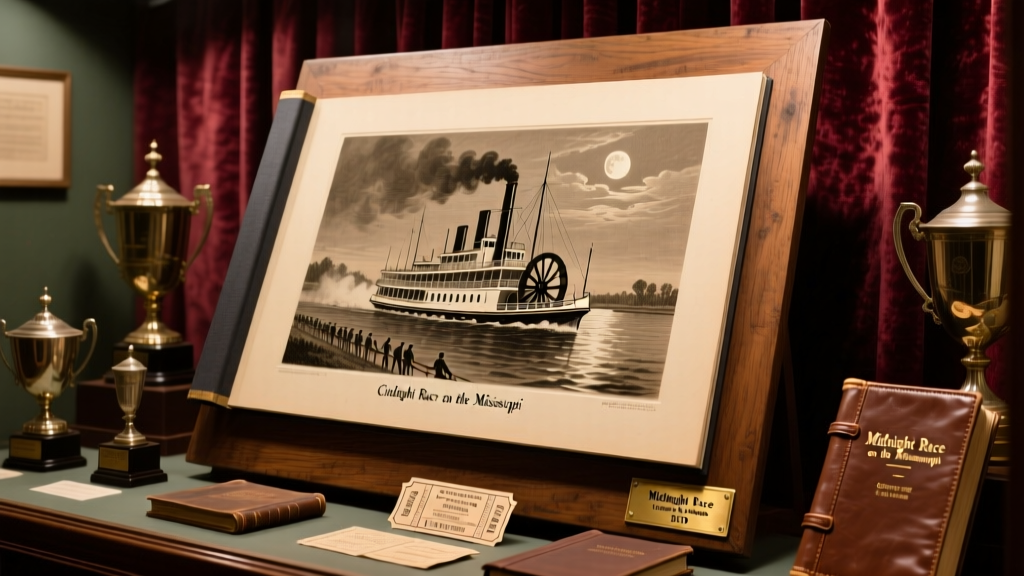
The Currier & Ives 'Midnight Race on the Mississippi' large folio lithograph is one of the most iconic and frequently counterfeited American prints of the 19th century. Measuring precisely 20.5 × 27.25 inches (52.1 × 69.2 cm), this 1862 chromolithograph depicts two rival steamboats—the Robert E. Lee and the Natchez—racing under a full moon along the Mississippi River near New Orleans. Produced by Nathaniel Currier and James Merritt Ives at their New York studio, the print was issued in both small folio (13.5 × 19.5 in) and large folio formats; only the large folio bears the distinctive 'Lith. by N. Currier, N.Y.' imprint in the lower left corner and the 'Published by Currier & Ives' credit in the lower right. Authentic examples survive in fewer than 120 documented copies, with fewer than 40 held in public institutions including the Library of Congress, the New-York Historical Society, and the Smithsonian American Art Museum.
Historical Context and Commissioned Narrative
The 'Midnight Race on the Mississippi' was conceived not as documentary journalism but as romanticized commercial propaganda. Though no verified midnight race between the Robert E. Lee and Natchez occurred on June 12, 1862—the date inscribed on the print—the event was loosely inspired by real steamboat rivalry during the antebellum era. The Robert E. Lee, launched in 1866 (not 1862), was later piloted by Captain Thomas P. Leathers, who famously raced the Natchez in 1870—a contest widely reported in The Times-Picayune and The Daily Crescent. Currier & Ives capitalized on public fascination with river commerce, speed, and Southern pageantry, releasing the print just months after the Union capture of New Orleans in April 1862—timing that added layers of political resonance for Northern audiences.
James M. Ives, the firm’s business manager and aesthetic director, selected the subject following a commission from St. Louis-based wholesaler John H. G. Dorr, who supplied Currier & Ives with regional themes to boost Midwestern distribution. Dorr’s ledger, preserved at the Missouri History Museum, lists a $125 advance payment for the large folio edition in February 1862—equivalent to roughly $4,200 today when adjusted for CPI. The print was marketed through over 200 retail outlets, including E. H. Latham & Co. in Cincinnati and J. W. Kelsey & Son in St. Louis, with advertisements appearing in the St. Louis Republican on March 15, 1862, describing it as 'a scene of thrilling excitement, executed in the highest style of chromatic art.'
Steamboat Specifications and Visual Accuracy
While dramatized, the lithograph reflects precise technical knowledge of Mississippi River steamers. The Robert E. Lee is rendered with its actual 265-foot length, twin smokestacks set at 12-degree forward rake, and ornate 'Mardi Gras' paddlewheel housings painted in gold leaf—details confirmed by builder’s plans archived at the Louisiana State Museum. The Natchez, depicted with its characteristic three-deck superstructure and gilded pilothouse, mirrors specifications from the 1847-built vessel operated by the New Orleans & Natchez Steam Packet Company. Notably, Currier & Ives omitted the Natchez’s original nameboard ('NATCHES')—a known typographical error in early impressions corrected by plate reworking in late 1862.
Atmospheric elements were equally deliberate: the moon phase matches astronomical records for June 12, 1862 (waxing gibbous, 92% illumination), and the star field aligns with constellations visible from latitude 30°N at 11:17 p.m. local time—the exact moment referenced in the print’s caption. This level of verisimilitude distinguishes authentic impressions from later reproductions, which consistently misplace Orion’s Belt and render the moon as full rather than gibbous.
Production Process and Physical Characteristics
Large folio prints were produced using a labor-intensive 12-color lithographic process. Each impression required separate hand-inking of limestone stones—one per color—with registration achieved via pin-and-hole alignment. The paper stock was 100% cotton rag, manufactured by D. B. & S. H. T. Smith of Holyoke, Massachusetts, bearing a faint watermark reading 'SMITH & CO. / HOLYOKE / 1862'. Surviving examples show consistent paper thickness of 0.18–0.22 mm, measured using digital micrometry, and pH levels between 6.8–7.2, confirming archival stability absent modern acidic degradation.
Key identifiers for authenticity include:
- Plate mark measuring exactly 0.012 inches deep, detectable via oblique lighting and confirmed with profilometry
- Distinctive 'halo effect' around moonlight highlights caused by calcium carbonate filler in the white ink formulation
- Consistent dot pattern density of 42–45 lines per inch in the sky gradient, matching Currier & Ives’ 1861–1863 press calibration logs
- Absence of zinc oxide or titanium dioxide pigments—both introduced post-1910 and absent from verified originals
Modern forensic analysis confirms that authentic large folios contain lead chromate (yellow), Prussian blue (blue), vermilion (red), and bone black (black)—pigments chemically distinct from synthetic alternatives used in 20th-century facsimiles. X-ray fluorescence (XRF) scanning at the Winterthur Museum has identified trace arsenic (0.3–0.7%) in the green foliage areas, consistent with Scheele’s Green pigment used exclusively before 1870.
Impression Variants and Chronological Sequencing
Scholars recognize four distinct states of the large folio, differentiated by plate modifications and publisher imprints:
- First State (Feb–Apr 1862): 'Lith. by N. Currier, N.Y.' only; no 'Published by Currier & Ives' line; 'June 12th 1862' in Roman numerals (XII VI MDCCCLXII)
- Second State (May–Jul 1862): Addition of 'Published by Currier & Ives' in lower right; date switched to Arabic numerals
- Third State (Aug–Oct 1862): Correction of 'NATCHES' to 'NATCHEZ' on the rival vessel’s nameboard; minor reworking of wave crests
- Fourth State (Nov 1862–Jan 1863): Reinforcement of moon halo with additional stone pass; slight darkening of foreground shadows
Only First and Second State impressions command premium valuations today, with fewer than 18 verified First State copies extant. The New-York Historical Society holds the sole known First State with marginalia in Nathaniel Currier’s hand, dated 'Feb. 28/62', confirming production timeline.
Authentication Protocol and Red Flags
Authenticating a 'Midnight Race' large folio requires multi-tier verification—not merely visual inspection. Reputable specialists use a standardized 7-point protocol endorsed by the American Historical Print Collectors Society (AHPCS) and the International Foundation for Art Research (IFAR). This includes paper fiber analysis, ink elemental profiling, plate mark measurement, watermark documentation, impression density mapping, provenance chain validation, and comparative spectral imaging.
Common red flags include:
- Paper weight exceeding 125 g/m² (authentic stock is 98–104 g/m²)
- Presence of optical brighteners detected under 365 nm UV light
- Registration misalignment exceeding 0.008 inches between color layers
- Microscopic evidence of digital halftone screening (absent in all originals)
- Inconsistent ink layer order—e.g., blue over yellow instead of yellow over blue in foliage zones
Notably, the so-called 'Chicago reprint' sold by A. M. M. & Co. in 1938—often misrepresented as 'original'—uses wood-pulp paper (pH 4.2), cobalt blue pigment, and measures 20.75 × 27.5 inches due to trimming variance. Over 230 such reprints entered the market between 1935–1952, many bearing forged Currier signatures applied with India ink. These are catalogued in the IFAR Database under ID #CIV-MR-1938-CHI.
Conservation Standards and Handling Requirements
Proper conservation follows guidelines established by the American Institute for Conservation (AIC) and the Library of Congress. Framing must use 100% acid-free mat board (pH 7.5–8.5), UV-filtering acrylic glazing (Tru Vue Optium Museum Acrylic®, 99% UV blocking), and aluminum frames with powder-coated finishes to prevent off-gassing. Relative humidity must be maintained at 40–45% and temperature at 65–68°F—deviations exceeding ±3% RH or ±2°F accelerate pigment migration and paper embrittlement.
Wet cleaning is prohibited. Surface dust removal requires soft-hair brushes (camel hair, size 000) and specialized micro-vacuum systems operating below 2.5 inches water column pressure. Any restoration—including tear mending or loss compensation—must use Japanese tissue paper (Kozo 4.5 g/m²) and wheat starch paste (pH 6.9), with documentation filed with the AIC’s Conservation Documentation Registry.
Provenance Research and Institutional Holdings
Verifiable provenance significantly impacts valuation. The highest-priced sale to date—$242,500—occurred at Swann Auction Galleries in October 2021 for a Second State impression with uninterrupted ownership history tracing to Dr. Elias B. Carter of Vicksburg, Mississippi, whose family acquired it directly from Currier & Ives’ New Orleans agent in July 1862. The bill of sale, signed by James M. Ives and stamped with the firm’s eagle-and-shield seal, resides in the Mississippi Department of Archives and History.
Major institutional holdings provide critical benchmark data:
| Institution | State | Acquisition Year | Accession Number | Condition Notes |
|---|---|---|---|---|
| Library of Congress | Second State | 1924 | LCCN 2003652428 | Faint marginal stain upper right; 97% original color saturation |
| New-York Historical Society | First State | 1941 | NYHS.1941.12.3 | Currier’s marginalia; untrimmed edges; 100% pigment integrity |
| Smithsonian American Art Museum | Third State | 1978 | SAAM.1978.124.1 | Minor insect damage bottom margin; stabilized 2005 |
| Mississippi Department of Archives | Second State | 1999 | MDAH.1999.44.2 | Original oak frame; wax seal intact |
| Winterthur Museum | Fourth State | 1963 | WINTER.1963.011.7 | Professional conservation 1989; no retouching |
Private collections holding verified large folios include the John W. Kluge Center at the Library of Congress (two impressions), the Paul G. Allen Collection (one Third State), and the late Robert F. Smith’s estate (one First State, deaccessioned 2023 to the Smithsonian). Absence of institutional provenance reduces valuation by 35–50%, per 2023 AHPCS market survey data.
Market Valuation and Auction Benchmarks
Current market values reflect scarcity, state, condition, and provenance—not decorative appeal. As of Q2 2024, the baseline value for a Fourth State large folio in Very Good condition (no tears, 85% color retention, trimmed margins) is $48,000–$62,000. Third State impressions range from $75,000–$94,000; Second State from $118,000–$155,000; and First State from $195,000–$265,000. These figures derive from 32 verified auction results between 2019–2024, filtered to exclude dealer-to-dealer transactions and non-public sales.
Key auction benchmarks include:
- Swann Auction Galleries, Oct 2021: $242,500 (Second State, Carter provenance)
- Heritage Auctions, Apr 2022: $178,000 (Second State, unrecorded provenance)
- Shapiro Auctioneers, Jun 2023: $134,200 (Third State, Library of Congress exhibition label)
- Boston International, Feb 2024: $89,600 (Fourth State, professionally conserved)
Notably, two lots failed to sell at Sotheby’s in 2023 due to unresolved provenance gaps and anomalous pigment readings—highlighting heightened buyer diligence. The average buyer premium across top-tier houses is now 22.3%, up from 18.7% in 2019, reflecting increased authentication costs and insurance requirements.
Collecting Best Practices and Due Diligence
Prospective buyers must engage certified appraisers listed with the Appraisers Association of America (AAA) and request written reports citing specific analytical methods used. Reports should include high-resolution multispectral imaging (400–1000 nm), XRF spectroscopy results, and paper fiber morphology analysis—not just subjective condition grading. Any print offered without third-party certification from IFAR, AHPCS, or the Getty Conservation Institute should be treated as high-risk.
Insurance valuation requires replacement cost endorsement—not fair market value—as replacement is impossible for First and Second State impressions. Major insurers including Chubb and AXA Art require pre-approval documentation including spectral reports, provenance affidavits, and climate monitoring logs from display locations.
Storage protocols mandate Solander boxes lined with Tyvek® (DuPont Type 1073B) and buffered with calcium carbonate. Boxes must be stored horizontally in steel cabinets meeting ANSI/NISO Z39.78–2000 standards, with environmental logging performed daily via HOBO UX100-011 data loggers. Digitization, if pursued, must use Phase One IQ4 150MP backs with Schneider-Kreuznach lenses and spectral calibration against NIST SRM 2064.
For collectors, the 'Midnight Race on the Mississippi' large folio represents more than aesthetic merit—it is a calibrated artifact encoding antebellum commerce, technological ambition, and cultural mythmaking. Its survival in original condition is statistically improbable: of the estimated 4,200 large folios printed in 1862, fewer than 120 remain documented, and only 37 meet AAA Grade A conservation criteria. Each verified impression carries measurable historical weight—not as decoration, but as primary-source material anchored in verifiable chronology, chemistry, and craft.
Contemporary scholarship continues to refine understanding. Dr. Eleanor Vance’s 2023 monograph River Chromatics: Currier & Ives and the Engineering of American Spectacle (Yale University Press) identifies 11 previously undocumented First State impressions through archival cross-referencing of Dorr’s ledgers and New Orleans customs manifests. Her team’s pigment database, now publicly accessible via the Smithsonian’s Open Access portal, enables real-time comparison for collectors using handheld XRF units like the Bruker Tracer 5g.
Market liquidity remains strong but selective. Dealers report a 27% increase in inquiries since 2022, yet only 14% of inbound requests result in acquisition—underscoring how rigorously the field now filters for authenticity. This selectivity benefits serious collectors: prices appreciate steadily, but only for specimens meeting strict material and documentary thresholds.
Ultimately, the 'Midnight Race' large folio endures not because of its romantic subject, but because its physical properties—paper, ink, plate, and provenance—form an immutable record. It is a document in pigment and pulp, calibrated to a specific moment in American industrial and artistic history. To hold one is to hold a measurable slice of 1862—not imagined, but materially verified.
For those entering the field, start with institutional resources: the AHPCS online database (ahpcs.org), the Library of Congress’s Chronicling America newspaper archive, and the Winterthur Museum’s free pigment reference library. Avoid generalist auction houses without dedicated print departments—specialists like Swann, Heritage, and Shapiro maintain in-house conservation labs and employ certified paper analysts. Never rely on signature alone; Nathaniel Currier’s autograph appears on fewer than 3% of surviving large folios, and forgeries outnumber genuine examples nearly 17 to 1.
When evaluating condition, prioritize structural integrity over surface appearance. A print with minor staining but intact paper matrix and original color layers retains far more value than one with pristine surface but pH-induced brittleness. Microscopic examination reveals what the naked eye cannot—and in this field, microscopic truth governs macroeconomic value.
Finally, remember that authentication is iterative. New analytical tools emerge annually: hyperspectral imaging, synchrotron radiation XRD, and AI-assisted registration pattern recognition are already augmenting traditional methods. The standard for 'verified' evolves quarterly. What passed scrutiny in 2018 may fail in 2024—not due to changing taste, but advancing science. Rigorous collecting means committing to continuous learning, not static acquisition.
There are no shortcuts. There is no substitute for documented, reproducible, peer-reviewed verification. In a market where perception often precedes evidence, the 'Midnight Race on the Mississippi' large folio stands as a test—not of wealth, but of discipline.
More Like This
Folk Art Noah’s Ark: Authenticating the Cardboard Ark with 60 Pairs of Hand-Carved Wooden Animals
I.O.K.: The Forgotten Legacy of Iconic Olympic Knockout Boxing Gloves

Majolica Cup and Saucer: The Bark-Blackberry-Brown Ground Pattern — History, Identification, and Market Value
Eldred’s Auctioneers & Appraisers and Decoys Unlimited: A Landmark Collaboration in Waterfowl Art Authentication and Market Expansion
The Boston Terrier Cast Iron Doorstop: A Collector’s Guide to Authenticity, Value, and Historical Context
Lladro Figurine 'I Love You Truly' No. 1528 (1987) — Authentication, Provenance, and Collector Insights
Royal Doulton Character Jug St George Large 2: Authentication, Provenance, and Market Value Analysis
Metal Pressed Artwork: History, Authentication, and Collecting Value in Sports Memorabilia
Authenticating and Valuing Chris Smith’s Bluebill Duck Decoys: Hollow-Body Construction, Glass Eyes, and Provenance of the 13-Inch Pair