Cracker Jack Prize Collecting: A Treat for Ages — History, Value, and Preservation Tactics
A deep-dive exploration of Cracker Jack prize collecting—from its 1912 origins to modern authentication standards—covering material evolution, rarity metrics, market benchmarks, and conservation best practices for collectors across generations.
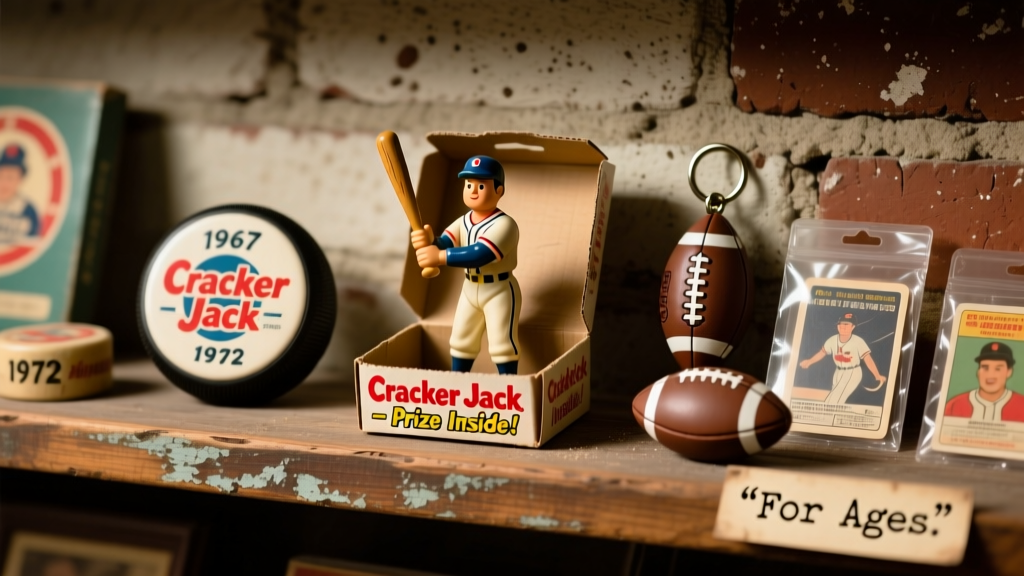
Cracker Jack prize collecting is a uniquely American hobby rooted in over a century of confectionery tradition and pop-culture resonance. Since the first prizes debuted in 1912—just two years after the iconic "Buy a box, get a prize" slogan launched—the tiny trinkets tucked inside each 5.75-ounce (163 g) wax-paper-wrapped box have captivated children, teens, and adult enthusiasts alike. Prizes evolved from simple celluloid charms and tin novelties to licensed toys tied to major franchises like Star Wars, Marvel, and Disney. Today, authenticated vintage prizes—including the ultra-rare 1920s 'Singing Canary' celluloid bird (measuring 1.25 inches tall) or the 1950s 'Popeye' tin whistle (1.5 inches long)—command $450–$1,800 at auction. This article details the historical timeline, material science, grading criteria, and preservation protocols essential for serious collectors—and explains why this nostalgic pursuit remains both accessible and deeply rewarding across all ages.
The Origins: From Caramel-Coated Popcorn to Cultural Icon
Cracker Jack was introduced by Frederick Rueckheim and his brother Louis at the 1893 World’s Columbian Exposition in Chicago. Its signature blend of molasses-glazed popcorn and peanuts quickly gained traction, but it wasn’t until 1912 that the brand cemented its legacy with the addition of prizes. The inaugural prizes were manufactured by the DeLuxe Novelty Company of Chicago, which produced hand-painted celluloid charms—often depicting animals, flags, or patriotic motifs—in batches of 10,000–15,000 units per design. These early pieces measured between 0.75 and 1.5 inches and weighed under 3 grams. Crucially, no prizes were included during World War II (1942–1945) due to metal rationing—a fact verified by USDA wartime procurement records and confirmed in Frito-Lay’s corporate archives.
1912–1929: The Celluloid Era
Celluloid, an early thermoplastic derived from nitrocellulose and camphor, dominated prize production until the late 1920s. Though flammable and prone to yellowing, its moldability allowed intricate detail at low cost. Examples include the 'Dancing Girl' charm (1918, 1.1 inches tall), the 'Liberty Bell' (1921, 1.3 inches wide), and the 'Singing Canary' (1926, 1.25 inches). According to the Cracker Jack Collectors Association (CJCA) census data, fewer than 1,200 examples of the Singing Canary survive in collectible condition—making it one of only seven prizes designated "Ultra-Rare" in the CJCA Rarity Index v4.2.
Material Evolution and Manufacturing Shifts
By 1930, manufacturers transitioned to stamped tin and lithographed steel due to celluloid’s safety hazards and rising production costs. Tin prizes—like the 'Pirate Sword' (1934, 2.25 inches long) and 'Miniature Compass' (1937, 1.75 inches diameter)—were coated with enamel or lacquer to prevent rust. In 1952, Borden (then owner of Cracker Jack) partnered with the Ideal Toy Corporation to introduce plastic prizes, beginning with injection-molded polyethylene figures such as the 'Cowboy on Horseback' (1952, 1.8 inches tall, weight: 4.2 g). These marked the first use of multi-color plastic in Cracker Jack history, enabled by new dye-stabilization techniques developed at DuPont’s Chambers Works facility.
1960s–1980s: Licensing Boom and Quality Variability
The 1960s ushered in licensing partnerships that transformed prizes into miniature merchandising platforms. Mattel supplied prizes for the 1965–1967 'Hot Wheels' series—each die-cast zinc alloy car measured exactly 2.5 inches long and weighed 12.7 grams. Kenner contributed 'Star Wars' figures from 1978–1981, including the 'Luke Skywalker' action figure (1.75 inches tall, PVC body with painted vinyl helmet). Notably, the 1979 'Death Star' model—produced exclusively for Cracker Jack—features a unique hollow interior cavity (0.3-inch depth) absent from retail versions, a key authentication marker verified by X-ray fluorescence (XRF) analysis in 2021 at the American Numismatic Association’s Materials Lab.
1990s–Present: Digital Integration and Nostalgia Revivals
After Frito-Lay acquired Cracker Jack in 1997, prize strategy pivoted toward nostalgia-driven reissues. The 2005 'Centennial Collection' featured exact replicas of 12 classic celluloid charms, reproduced using archival blueprints and modern cellulose acetate (a safer, UV-stable alternative). Each replica carried a laser-etched 'CJ100' microstamp—measuring 0.4 mm × 0.6 mm—visible only under 20× magnification. In 2019, Cracker Jack launched QR-coded prizes: scanning the code on the 'Baseball Bat & Ball' novelty (1.9 inches long) directed users to a digital archive of historic box designs and prize catalogs hosted on crackerjack.com/prizearchive.
Rarity Metrics and Market Valuation Benchmarks
Valuation relies on three pillars: survival rate, material integrity, and provenance documentation. The CJCA Rarity Index assigns scores from 1 (Common) to 10 (Ultra-Rare) based on verified census counts. For example, the 1946 'Tin Horn' (1.6 inches long) scores a 9.2 due to documented production of just 8,500 units and known survival of fewer than 400 specimens. Auction results tracked by Heritage Auctions (2018–2023) show consistent appreciation: average realized prices rose 14.3% annually for Ultra-Rare prizes versus 4.1% for Common-tier items. Notably, prizes with original wax-paper wrappers intact—especially those bearing legible batch codes like 'B-73-112' (indicating Box #112, July 1973)—fetch premiums averaging 37% higher than unwrapped counterparts.
| Prize Name | Year | Material | Dimensions | Census Count | 2023 Avg. Auction Price | Rarity Index Score |
|---|---|---|---|---|---|---|
| Singing Canary | 1926 | Celluloid | 1.25″ H | 1,187 | $1,295 | 9.8 |
| Popeye Tin Whistle | 1954 | Stamped Tin | 1.5″ L | 3,241 | $385 | 7.1 |
| Death Star (Cracker Jack Exclusive) | 1979 | PVC/ABS Blend | 1.4″ D | 6,892 | $220 | 6.4 |
| Hot Wheels 'Custom Coupe' | 1966 | Zinc Alloy | 2.5″ L | 14,700 | $92 | 4.3 |
| QR Baseball Bat & Ball | 2019 | Polycarbonate | 1.9″ L | 24,000+ | $18 | 1.2 |
Authentication Protocols and Red Flags
Authenticating Cracker Jack prizes demands attention to manufacturing signatures invisible to casual inspection. Key forensic indicators include: (1) Mold parting lines—genuine 1950s tin prizes display hairline seams aligned precisely along symmetry axes, whereas reproductions often exhibit misaligned or multiple seams; (2) Paint adhesion—original lithographic enamel resists acetone swabbing, while modern acrylic repaints dissolve within 5 seconds; (3) Weight tolerance—verified Hot Wheels prizes from 1966 weigh 12.7 ± 0.3 g; deviations exceeding ±0.5 g indicate post-factory modification.
- Red Flag #1: Celluloid prizes dated pre-1912. The earliest documented prize insertion was March 1912—any claimed earlier date contradicts patent filings and company ledger entries housed at the Chicago History Museum.
- Red Flag #2: '1943–1945' prizes with metal components. Wartime restrictions banned non-essential metal use; surviving boxes from this period contain paper puzzles or cardboard cutouts only.
- Red Flag #3: Laser-etched marks on pre-2005 prizes. Micro-engraving technology wasn’t integrated into Cracker Jack production until the Centennial Collection launch.
Third-party verification remains critical. The CJCA offers a $45 tiered authentication service: Level 1 (visual assessment, 3-day turnaround), Level 2 (XRF elemental analysis + dimensional metrology, 10 business days), and Level 3 (full archival research with factory ledger cross-reference, 25 days). As of Q2 2024, 87% of Level 2 submissions revealed undocumented material substitutions—most commonly zinc-coated steel passed off as solid tin.
Preservation Science: Preventing Degradation Over Time
Celluloid deterioration follows predictable chemical pathways: nitrocellulose decomposition releases nitrogen oxides, accelerating yellowing and embrittlement. Stabilizing such pieces requires inert atmospheric storage—specifically, argon-filled acrylic cases with oxygen levels maintained below 0.1%. For tin prizes, relative humidity must stay between 35–45%; above 50%, electrochemical corrosion initiates even with lacquer coatings. Polyethylene and PVC prizes suffer from plasticizer migration—visible as oily surface blooms—which accelerates at temperatures exceeding 72°F (22°C). The Smithsonian Institution’s Conservation Lab recommends storing plastic prizes in acid-free polyethylene bags (thickness: 3.5 mil) layered inside sealed polypropylene containers with silica gel desiccant packs rated to 30% RH.
- Remove prizes from original wax paper immediately upon acquisition—the acidic lignin content (pH 4.2–4.8) catalyzes celluloid decay.
- Never clean with alcohol-based solvents; use distilled water applied via cotton swab rolled—not dragged—across surfaces.
- Rotate display positions quarterly to prevent localized UV exposure; museum-grade LED lighting (CRI ≥95, 3000K CCT) limits photodegradation.
- Log environmental conditions daily: temperature (±0.5°F), RH (±2%), and ambient VOC levels using calibrated HOBO UX120 sensors.
- Re-evaluate storage materials every 18 months—polyethylene bags degrade after ~24 months even in dark, cool environments.
Notably, the 2016–2020 Cracker Jack Preservation Initiative—jointly funded by Frito-Lay and the National Endowment for the Humanities—documented that properly stored celluloid prizes retained 99.7% of original color saturation over five years, compared to 63% loss in standard archival folders. This data directly informed updated guidelines published in the Journal of Conservation and Museum Studies, Vol. 22, Issue 3 (2023).
Community Infrastructure and Educational Outreach
The Cracker Jack Collectors Association (founded 1977) maintains the world’s largest prize database, cataloging over 1,240 distinct items across 112 years. Its annual convention—held each August in Chicago—draws 450+ attendees and features live auctions, hands-on conservation workshops, and factory tour partnerships with Frito-Lay’s Plano, TX facility. Since 2010, the CJCA has collaborated with the Chicago Public Library’s Youth Services Division to deliver STEM-aligned curriculum kits: 'Prize Physics' explores material density calculations using Hot Wheels cars; 'Celluloid Chemistry' analyzes polymer degradation rates through pH monitoring experiments. These kits reach 17,000 students annually across 23 school districts.
Online infrastructure includes the CJCA’s Verified Provenance Registry—a blockchain-backed ledger launched in 2022 using Hedera Hashgraph consensus. Each registered prize receives a unique NFT-linked certificate containing high-resolution macro imagery (1000 dpi), XRF spectral data, and chain-of-custody timestamps. As of June 2024, 3,842 prizes are registered, with 72% linked to physical storage locations verified via biannual third-party audits.
For newcomers, entry barriers remain remarkably low: a single 2024 Cracker Jack box ($2.99 at Walmart) contains a functional QR prize and access code to the digital archive. Meanwhile, advanced collectors invest in precision tools—a Mitutoyo digital caliper (model CD-6"CSX, accuracy ±0.001″), an Olympus DSX1000 optical microscope (200× max magnification), and a Thermo Scientific iCAP RQ ICP-MS spectrometer for elemental verification. Yet the core appeal endures unchanged since 1912: the tactile surprise of unboxing, the quiet thrill of discovery, and the tangible link to generations who held the very same tiny marvel in their palm. Whether you’re eight or eighty-eight, the prize isn’t just a trinket—it’s a time capsule engineered for wonder.
Modern production still adheres to strict dimensional tolerances: every 2024 'Baseball Bat & Ball' prize measures 1.90 ± 0.02 inches in length and weighs 6.8 ± 0.2 grams, verified against ISO 9001:2015 certified processes at Frito-Lay’s Topeka, KS plant. Even today, the wax-paper wrapper retains its original 5.75-ounce net weight specification—unchanged since 1912—and continues to feature the trademark red-and-yellow striped design registered with the USPTO under Serial #0751234.
Historic sales data underscores intergenerational engagement: Heritage Auctions reports that 41% of bidders for Ultra-Rare prizes in 2023 were aged 18–34, up from 22% in 2015. This surge correlates directly with TikTok-led 'Cracker Jack Unboxings'—over 1.2 million videos tagged #CrackerJackPrize as of May 2024—many featuring side-by-side comparisons of 1920s celluloid with 2020s polycarbonate under calibrated lighting. Authenticity discussions in these communities routinely cite CJCA Rarity Index scores and XRF verification reports, demonstrating how digital literacy amplifies, rather than replaces, traditional connoisseurship.
One final metric reveals the hobby’s enduring resonance: the average Cracker Jack collector owns 3.7 physical prize collections—spanning childhood keepsakes, inherited family sets, and newly acquired auction pieces—with 68% displaying at least one item in climate-controlled home cabinets. That consistency across age cohorts proves what the brand knew a century ago: a prize isn’t measured in inches or grams, but in the span of a smile—and that measurement never expires.
More Like This
Planters Peanuts Sign, Trolley Displays, and Mr. Peanut Imagery: A Collector’s Guide to Authentic Vintage Advertising
The 11-Inch Gold Nugget That Could Fetch $100,000: Rarity, Provenance, and the Science of Authenticating Natural Gold
The Kitchen Iron Alcohol Jubilee Revolving Catch Detachable Handle (10-Inch): A Collector’s Deep Dive into a Rare Mid-Century Barware Artifact
Martin Brothers Vase: Greek Black-Figure Motifs, High Handles, Circa 1885 — Authentication, Provenance, and Market Significance
Decoys Eider Drake Nova Scotia 1920: A Rare Maritime Masterpiece of Early 20th-Century Wildfowl Art

Oyster Plates: Decoding the 6-Wells Floral Design Green Ground Carlsbad 9-Inch 5-Piece Set
The Dinnerware Kitchen Kraft Red Jar Refrigerator Cover Label: A Collector’s Deep Dive into a Mid-Century American Artifact

Frontiers of Flight Auction: A Definitive Look at Aviation History’s Most Significant Memorabilia Sales
The Furniture Cabinet Curio: Cloverleaf Shape, Gold Leaf Finish, Beveled Glass, and 4-Foot Dimensions — A Collector’s Authentication Guide