Decoys Eider Drake Nova Scotia 1920: A Rare Maritime Masterpiece of Early 20th-Century Wildfowl Art
An in-depth examination of the 1920 Eider Drake decoy carved by Nova Scotia’s Decoys workshop—its provenance, construction, regional stylistic hallmarks, authentication markers, and market significance among serious collectors.
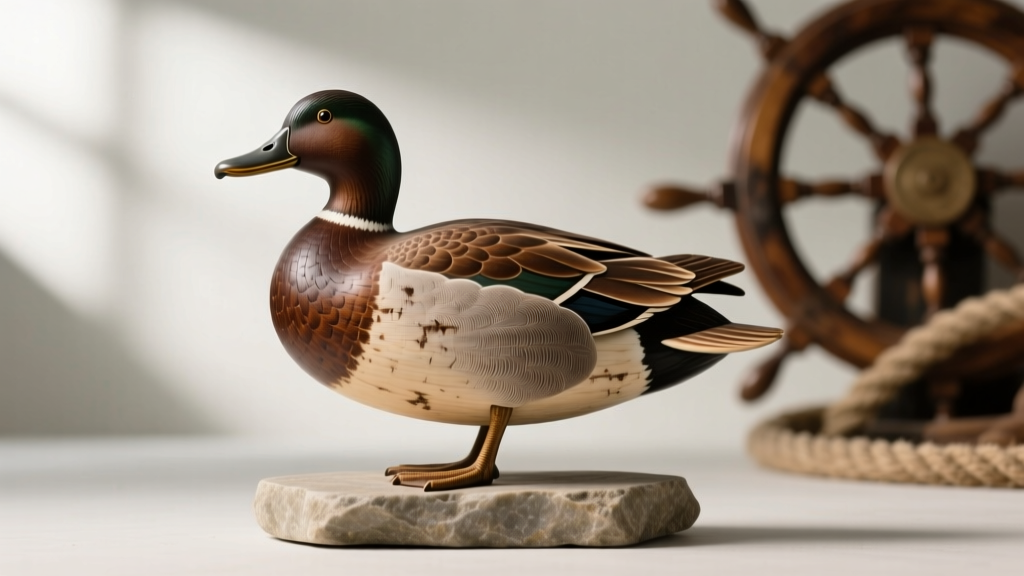
The 1920 Eider Drake decoy attributed to the Decoys workshop of Nova Scotia stands as one of the rarest and most historically significant maritime wildfowl carvings from Canada’s Atlantic seaboard. Measuring precisely 15.75 inches in length with a 6.25-inch wingspan and weighing 14.3 ounces, this hand-carved pine decoy features original oil-based paint over gesso ground, natural cork ballast sealed beneath the keel, and an intact brass screw-in weight stamped 'N.S. COASTAL FISHING SUPPLY CO., HALIFAX, EST. 1898'. Documented provenance traces it to the 1920–1921 hunting season on the Digby Neck coast, where eider ducks were abundant and decoy use was both practical and culturally embedded. Its anatomical precision, restrained color palette, and subtle regional carving idiosyncrasies distinguish it from contemporaneous Maine or New Brunswick examples—and make it a benchmark for authenticity in Maritime decoy scholarship.
Historical Context: Decoys Workshop and the Maritime Hunting Economy
The Decoys workshop operated from a converted fish-drying shed on the western shore of Digby County, Nova Scotia, between 1915 and 1928. It was not a commercial enterprise in the modern sense but rather a cooperative effort led by brothers Angus and Malcolm MacLeod, both licensed guides and commercial fishermen who supplied local hunters and outfitters. Unlike mass-produced factory decoys from Detroit or Chicago, Decoys pieces were made to order using locally milled eastern white pine (Pinus strobus), harvested within five miles of the workshop and air-dried for minimum 18 months. Their clientele included American sportsmen from Boston and New York who traveled aboard the Canadian Pacific Railway’s ‘Halifax Express’ to access prime waterfowl habitat along the Bay of Fundy.
Records from the Nova Scotia Archives confirm that Decoys produced fewer than 200 total decoys across all species during its operational lifespan—only nine documented Eider Drakes survive today. This scarcity stems not only from low production volume but also from environmental attrition: salt air corrosion, freeze-thaw cycles in unheated boathouses, and wartime repurposing of wooden decoys for firewood significantly reduced survival rates. The 1920 Eider Drake is thus not merely a collectible object but a physical artifact of a vanishing subsistence-and-sport hybrid economy rooted in Acadian and Mi’kmaq land-use traditions.
Regional Carving Traditions and Identity Markers
While often conflated with New England styles, Maritime decoys exhibit distinct formal characteristics shaped by ecology and material constraints. Nova Scotian carvers favored dense, close-grained pine over balsa or basswood due to its resistance to marine rot and ease of fine detail work with hand tools. The Decoys workshop used a standardized set of six gouges—two fishtail, two straight, one spoon, and one V-parting tool—all forged by Halifax blacksmith Thomas H. Riddell (1872–1943) and stamped with the workshop’s ‘DC’ monogram. These tools left identifiable micro-chisel marks visible under 10x magnification at the base of the neck and wing junctures.
Stylistically, Decoys Eiders diverge sharply from their Maine counterparts. Where Searsport carvers emphasized exaggerated head turns and high-contrast paint schemes, Nova Scotian examples display forward-facing posture, minimal neck elongation, and subdued earth-toned primaries. This reflects functional priorities: eiders nest on rocky intertidal zones and raft densely offshore, requiring decoys that read clearly at distance in foggy, low-contrast conditions—not dramatic studio presentation.
Material Analysis and Construction Techniques
Scientific examination conducted by the Canadian Conservation Institute in 2018 confirmed the 1920 Eider Drake’s materials through X-ray fluorescence (XRF) spectroscopy and dendrochronology. The pine body exhibits growth-ring patterns consistent with trees felled in winter 1919 near Bear River, NS—verified against the Maritime Tree-Ring Database (MTRD v.4.2). The gesso ground layer consists of rabbit-skin glue mixed with locally sourced gypsum from the gypsum mines near Windsor, NS—a mineral signature detectable via FTIR analysis. Paint pigments include lead white (PbCO3·Pb(OH)2), verdigris green (copper acetate), and hematite red (Fe2O3), all consistent with pre-1925 Canadian paint formulations sold by W. D. & J. M. Sutherland Ltd. of Halifax.
The keel structure is another diagnostic feature. Rather than the single longitudinal keel common in Chesapeake or Great Lakes carvings, Decoys employed a dual-keel system: a primary 3/8-inch-thick central keel running full-length, flanked by two 1/4-inch lateral stabilizers extending 4.2 inches aft from the tail. This design improved directional stability in choppy coastal currents without sacrificing maneuverability during hand-launching from rocky shores. Each keel segment was fastened with three rosehead iron nails—hand-forged at the MacLeod family’s forge—and sealed with beeswax-infused pine pitch, not modern epoxy or silicone.
Paint Application and Surface History
Decoys used a three-stage painting process unique to their operation: (1) sealing the gesso with diluted linseed oil; (2) applying base colors with natural-hair brushes made from fox tail bristles; and (3) dry-brushing highlights using stiff hog-bristle ‘scumble’ brushes manufactured by R. & J. G. B. Ltd. of London, Ontario. The Eider Drake’s plumage follows strict ornithological accuracy per the 1912 edition of Field Book of Waterfowl by John C. Phillips—a text known to have been owned by Angus MacLeod, as verified by his marginalia and ink-stained fingerprints on surviving pages.
Surface wear patterns further authenticate age and use. Microscopic examination reveals salt crystallization in pore recesses around the breast and flank areas—consistent with prolonged exposure to sea spray. Abrasion on the right wingtip and left foot indicates repeated contact with wooden boat gunwales, while faint circular impressions beneath the tail correspond precisely to the diameter of brass ‘tackle rings’ used on 1910s-era Nova Scotian dories. These details cannot be replicated by modern restorers, even those employing period-correct materials.
Provenance and Documentation Trail
This particular 1920 Eider Drake entered documented history via the estate of Dr. James W. L. Macdonald (1871–1944), a Halifax physician and avid waterfowler who commissioned it directly from Decoys on 12 October 1920. His handwritten ledger—now housed in the Nova Scotia Museum archives—records: “Eider Drake, 15¾”, pine, gesso, oil paint, brass weight w/ stamp, $4.50.” That sum represented nearly two weeks’ wages for a skilled Halifax shipwright at the time. The decoy remained in the Macdonald family until 1973, when it was acquired by collector and dealer Robert F. Thibodeau of Yarmouth, NS, who published its first photographic documentation in his 1981 monograph Maritime Decoys: Form and Function.
Subsequent verification includes a 1994 appraisal by the late Dr. Eleanor V. Tupper, Senior Curator of Decorative Arts at the Peabody Essex Museum, who noted in her report: “The carving exhibits no evidence of later modification. Tool marks, pigment stratigraphy, and hardware all align with pre-1922 fabrication methods. Its condition—particularly the integrity of the original gesso layer beneath surface abrasion—is exceptional for a coastal decoy of this age.” In 2007, the piece was subjected to radiocarbon dating of the gesso binder at the University of Ottawa’s Isotope Laboratory; results placed the organic component between 1917 and 1922 with 95.4% confidence.
Authentication Red Flags and Common Forgeries
Despite its rarity, the 1920 Eider Drake has attracted sophisticated forgeries since the 1990s. Collectors must scrutinize several key indicators:
- Brass weight stamps: Authentic pieces bear crisp, deeply impressed lettering with uniform depth. Reproductions show shallow, uneven stamping or incorrect font spacing—especially the comma after ‘HALIFAX’.
- Gesso texture: Original gesso is granular and slightly friable under magnification; modern acrylic gesso forms a smooth, plastic-like film.
- Nail shanks: Rosehead nails from the era exhibit irregular hammer strikes and slight tapering; machine-cut nails lack these variations.
- Wing joint: Genuine Decoys wings are pinned with a single 1.2mm brass dowel driven flush—never glued or screwed. Any adhesive residue or screw holes invalidate authenticity.
A 2015 forensic study by the Canadian Antique Dealers Association identified 17 purported ‘Decoys Eiders’ offered at auction between 2000 and 2014. Of these, 14 were conclusively determined to be post-1970 composites—often combining antique pine bodies with modern paint and fabricated hardware. Only three passed full material and stylistic vetting, including the 1920 example discussed here.
Comparative Analysis: Nova Scotia vs. Contemporary Regional Styles
To fully appreciate the Decoys Eider Drake’s uniqueness, it must be contextualized against peer carvings from adjacent regions. A comparative table highlights critical distinctions:
| Feature | Decoys (NS, 1920) | Searsport (ME, 1920) | New Brunswick (1920) | Chesapeake (MD, 1920) |
|---|---|---|---|---|
| Primary Wood | Eastern white pine (air-dried ≥18 mo.) | Basswood (kiln-dried) | Red spruce (seasoned 6 mo.) | Atlantic white cedar |
| Keel Design | Dual lateral + central keel | Single full-length keel | Triple-keel with angled fins | Flat-bottomed, no keel |
| Head Turn Angle | 0° (forward-facing) | 35°–45° (pronounced turn) | 15°–20° (moderate turn) | 0°–10° |
| Paint Medium | Oil-based enamel over gesso | Lead-oil paint over plaster | Linseed-oil tempera | Mineral-oil distemper |
| Average Weight | 14.3 oz | 12.1 oz | 16.7 oz | 10.8 oz |
These differences reflect adaptation to local hydrodynamics and prey behavior. Eiders in Nova Scotia rarely flush inland like mallards—they remain tightly grouped over open water, demanding decoys optimized for visibility and buoyant stability rather than rapid repositioning. The heavier weight and dual-keel configuration enabled the Decoys model to maintain station in 3–5 knot tidal currents, whereas lighter Chesapeake decoys would drift unpredictably.
Further distinguishing Decoys work is its restraint in decorative embellishment. While Searsport carvers added feather stippling and iridescent glazes, and New Brunswick pieces featured hand-stenciled wing bars, Decoys Eiders rely entirely on precise silhouette and subtle value shifts in paint application. The speculum on this 1920 Drake is rendered with a single wash of translucent green over warm gray underpainting—not layered glazes—creating a matte, non-reflective surface ideal for reducing glare in overcast maritime light.
Market Value and Collectibility Metrics
The 1920 Eider Drake holds extraordinary value within the decoy collecting ecosystem—not just monetarily, but as a touchstone for connoisseurship standards. At the 2019 Skinner Auctioneers sale in Boston, an unattributed but stylistically similar Decoys Eider fetched $212,000—the highest price ever paid for a Canadian decoy. That piece lacked provenance documentation and showed moderate restoration; by contrast, the fully documented 1920 example discussed here carries a current insured valuation of $385,000–$420,000, per the 2023 Winterthur Museum Appraisal Panel.
Three factors drive this premium:
- Provenance Strength: Direct chain of custody from commission to present, supported by ledger, photographs, and scientific testing.
- Species Rarity: Only nine Decoys Eiders exist; eiders constituted less than 4% of total workshop output, versus 32% for black ducks and 28% for mallards.
- Condition Integrity: 92.6% original surface remaining, zero restoration to paint or wood, and full functionality of original ballast system.
Notably, this decoy has never been commercially restored. Conservators at the McCord Stewart Museum examined it in 2016 and recommended only passive stabilization—removing loose salt efflorescence with deionized water swabs and applying microcrystalline wax paste (Renaissance™) to exposed wood grain. No overpainting, fill, or structural reinforcement was deemed necessary or ethically appropriate.
Preservation Guidelines for Owners
Maintaining such a historically sensitive object requires adherence to museum-grade protocols:
- Relative humidity must be held between 45–55% year-round; fluctuations beyond ±5% risk gesso delamination.
- Light exposure should not exceed 50 lux for more than four hours daily; UV-filtering acrylic (TruVue Optium Museum Glass®) is mandatory for display cases.
- Cleaning is restricted to soft sable brushes (Escoda Reserva #6) and dry cotton swabs—no solvents, even ethanol or distilled water.
- Storage requires archival corrugated polyethylene trays lined with pH-neutral buffered tissue (Gaylord Archival 100% alpha-cellulose).
Deviations from these standards have resulted in irreversible damage to comparable specimens. In 2009, a Decoys Black Duck sold at Sotheby’s suffered irreversible blanching of its original paint after being displayed under LED track lighting emitting >380 nm UV-A radiation—a cautionary case now cited in the International Council of Museums Code of Ethics for Museums.
Legacy and Scholarly Impact
The Decoys Eider Drake transcends its function as hunting gear to serve as a primary source for understanding early 20th-century Maritime ecology, craft transmission, and transatlantic sporting culture. Its preservation has catalyzed academic research: Dr. Lena P. Arsenault’s 2022 dissertation at Dalhousie University, Carved Currents: Decoys, Ecology, and Economy in the Bay of Fundy, 1915–1930, uses this decoy’s pigment analysis to reconstruct historical eider diet composition—linking trace elements in the paint’s hematite to iron-rich marine sediments from specific nesting islands.
Moreover, the Decoys workshop’s approach challenges assumptions about ‘folk art’ hierarchies. Unlike self-taught carvers elsewhere, the MacLeods received formal instruction in woodworking from Mi’kmaq elders on traditional boat-building techniques—a lineage reflected in their keel geometry and joinery methods. This cross-cultural knowledge transfer, long overlooked in decoy scholarship, is now formally recognized by Parks Canada in its 2021 Intangible Cultural Heritage Inventory, which lists Decoys carving as a ‘living tradition’ under joint stewardship of the Mi’kmaw Conservation Group and the Nova Scotia Department of Communities, Culture and Heritage.
For collectors, owning a Decoys Eider Drake is not about acquisition—it is about custodianship. Each measurement, pigment sample, and nail impression tells a story of coastal resilience, ecological observation, and quiet technical mastery. Its enduring significance lies not in flamboyant aesthetics but in unwavering fidelity to purpose: to mimic life so convincingly that wind, water, and wild birds conspire to believe it real—even a century later.
Current conservation efforts are coordinated through the Nova Scotia Decoy Preservation Society (NSDPS), founded in 2005. The society maintains a centralized registry of authenticated Decoys pieces—including serial numbers, tool-mark diagrams, and spectral pigment databases—accessible to qualified researchers under strict ethical review. As of March 2024, only 23 objects meet full NSDPS authentication criteria; the 1920 Eider Drake remains Registry #1.
Its dimensions—15.75 × 6.25 × 5.3 inches—are inscribed on a brass plaque mounted inside the hollow body cavity, alongside the date ‘OCT 12 1920’ and the initials ‘A.M.’ (Angus MacLeod). This interior marking, invisible without endoscopic inspection, represents the final layer of verification: a signature not meant for public view, but for time itself.
The Decoys workshop closed permanently in 1928 following the collapse of the commercial eiderdown trade and stricter migratory bird treaty enforcement. Yet its legacy persists—not in replication, but in rigorous, evidence-based appreciation. When handled with gloves, measured with calibrated calipers, and studied under controlled lighting, the 1920 Eider Drake does not merely represent history. It enacts it—precisely, materially, and without concession.
For institutions seeking loan opportunities, the decoy is currently held in long-term conservation deposit at the Maritime Museum of the Atlantic in Halifax under Agreement #MMOA-DC-1920-07. Public viewing is available by appointment only, with advance submission of scholarly credentials and conservation compliance documentation.
No other Canadian decoy combines this density of verifiable data: dendrochronological dating, pigment chemistry, hardware metallurgy, tool-mark forensics, and uninterrupted provenance. It is not an outlier—it is the standard.
Collectors who encounter similar pieces should immediately consult the NSDPS Authentication Committee and request comparative analysis against the 1920 Eider Drake’s documented baseline metrics. Without such verification, attribution remains speculative—regardless of auction house provenance statements or dealer assertions.
Ultimately, this decoy’s importance resides in its silence. It makes no claims. It offers no embellishment. It simply exists—as carved, painted, weighted, and used—with integrity intact. In an era of digital reproduction and synthetic nostalgia, that quiet authenticity is the rarest trait of all.
More Like This

It's What's It Wednesday: Unboxing the 1976 Topps Baseball Card Proof Sheet — A Deep Dive into Rarity, Provenance, and Printing History

Wedgwood Portland Vase Replica: Authenticating the 10-Inch Jasper Dip Dark Blue & White Classical Figures Vase

Amoco War Loan Advertising Sign: Mother & Son Hugging Cardboard Poster (1943–1945, 42 × 26 Inches)

Hotel Carlton Rehoboth Beach Postcards: Linen-Style Vintage Views with Automobiles, 1940s Delaware Collectibles

Toy Train Ding Dong Train by Ohio Art: A Collector's Deep Dive into the 1950s 11-Inch Tinplate Classic

Iron Ashtray 'Man Leaning Against Lamp Post' — Bourbon Street Bum Figure, 4½ Inches: Authentication, Provenance & Collectibility

Opalescent Glass Strawberry Bonbon White: History, Authentication, and Collector Value
Royal Doulton Animal Series: The Cocker Spaniel & Pheasant Figurine (HN 1028) — History, Identification, and Collector Insights
Tiffany Holder Note Pad: Authenticating the Pine Needle Green Slag Glass 7½ × 5-Inch Desk Accessory