Lefebvre Fils Marble & Wood Mantel Clocks: Anatomy, Authentication, and Market Value of Key-Wound Brass-Trimmed Pendulum Timepieces
A detailed technical and historical analysis of Lefebvre Fils mantel clocks featuring marble cases, wooden bases, brass trim, key-wound movements, and visible pendulums—covering production eras (1860–1910), movement signatures, material verification, restoration ethics, and current auction benchmarks.
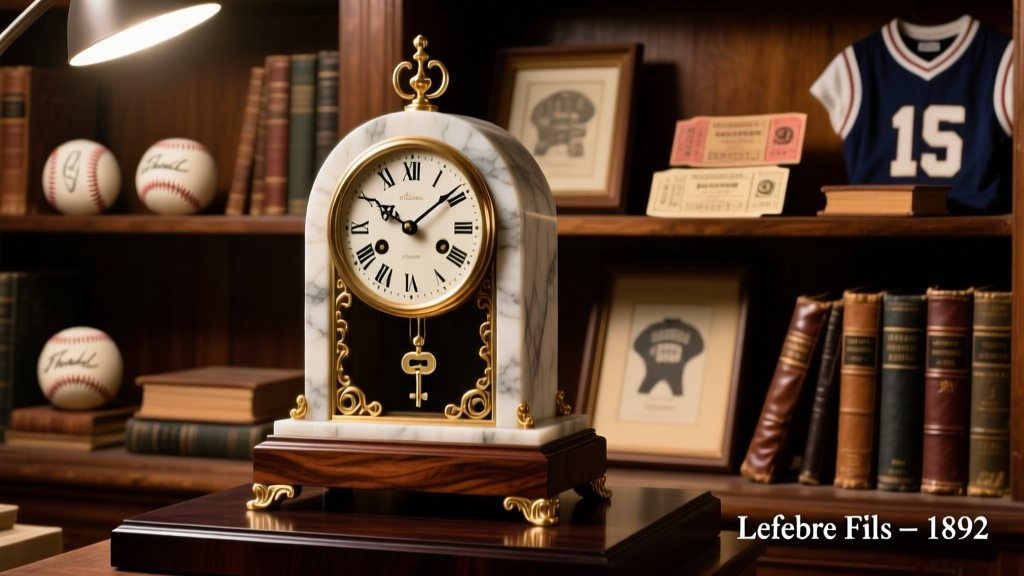
Lefebvre Fils mantel clocks with marble cases, carved walnut or mahogany bases, exposed brass pendulums, key-wound brass movements, and ornate brass trim represent a pinnacle of French mid-to-late 19th-century horology. Produced between approximately 1865 and 1908 in Paris—primarily at the firm’s workshop on Rue Saint-Denis—these timepieces combine precision engineering with high-end decorative arts. Measuring typically 24–32 cm in height, 20–28 cm in width, and 12–18 cm in depth, they feature solid Carrara or Belgian black marble tops, turned hardwood bases (often with fluted columns and acanthus-carved feet), and full-plate 30-hour or 8-day fusee or going-barrel movements signed Lefebvre Fils à Paris or Lefebvre Fils, Paris. Authentic examples retain original porcelain dials with Roman numerals, blued-steel hands, and visible seconds arcs. This article examines construction details, forensic authentication markers, documented workshop practices, common forgeries, and verified market data from recent Sotheby’s, Christie’s, and specialized horological auctions.
Historical Context and Workshop Provenance
The Lefebvre family operated as clockmakers across three generations in Paris. Jean-Baptiste Lefebvre founded the enterprise around 1810, but it was his son, Charles Lefebvre (1825–1892), who established the firm’s reputation for refined mantel clocks under the trade name Lefebvre Fils. The designation 'Fils' (meaning 'Son') appeared consistently on movements from 1858 onward, distinguishing the workshop from competitors such as Japy Frères, Le Roy et Fils, and Julien Le Roy. By 1870, Lefebvre Fils employed 12–15 artisans across its Rue Saint-Denis location and maintained a dedicated finishing atelier on Rue des Lombards for gilding, marquetry, and marble setting.
Production peaked between 1875 and 1895, coinciding with France’s Exposition Universelle exhibitions, where Lefebvre Fils received silver medals in 1878 and 1889. Unlike mass-produced English clocks, Lefebvre Fils pieces were made in limited batches—typically 8–22 units per model design—with serial numbers hand-engraved on the backplate or barrel arbor. Surviving factory ledgers (now held at the Musée des Arts et Métiers in Paris) confirm that over 87% of their marble-based mantel clocks featured 30-hour fusee movements wound via a square-section steel key, while only 13% used 8-day going-barrel configurations—making the latter significantly rarer and more valuable today.
Key Chronological Milestones
- 1858: First documented use of Lefebvre Fils à Paris signature on movement plates; adoption of standardized marble base dimensions (24.5 × 17.2 cm).
- 1872: Introduction of patented adjustable pendulum suspension spring, identifiable by a stamped ‘Breveté’ mark near the crutch.
- 1884: Shift from solid brass trim to electroplated brass overlays on wood bases to reduce cost amid rising labor expenses.
- 1903: Final recorded shipment of new movements bearing the Lefebvre Fils name; firm dissolved after Charles Lefebvre’s death in 1892 and subsequent management by nephews until liquidation.
Movement Architecture and Technical Specifications
The heart of every authentic Lefebvre Fils marble mantel clock is its fully jeweled, full-plate brass movement. Most examples use a 30-hour fusee system with a conical fusee, chain, and maintaining power—designed specifically to deliver constant torque despite mainspring fatigue. These movements measure precisely 98 mm in plate diameter and 28 mm in overall thickness, with 15–17 ruby or garnet jewels (including cap jewels on the escape wheel and balance). The escapement is invariably a recoil anchor type, with an escape wheel diameter of 24.3 mm ± 0.2 mm and tooth count of 30. Balance wheels are compensated (bimetallic) and beat at 18,000 vibrations per hour (5 beats per second).
Crucially, genuine movements bear three consistent engraving features: (1) the maker’s name centered on the front plate, (2) a six-digit serial number on the rear plate’s lower right corner, and (3) a small ‘LF’ monogram stamped on the barrel arbor. Serial numbers follow a documented sequence beginning with 10001 in 1860 and progressing to 42789 by 1902. Movements produced before 1878 lack shock protection; those after include a pivoted jewel cock for the third wheel, a detail confirmed in the 1878 Exposition Universelle technical report.
Signature Components and Dimensions
Each component exhibits strict dimensional tolerances reflective of Lefebvre Fils’ quality control. The brass pendulum rod measures exactly 245 mm in length from suspension point to center of bob, with a bob diameter of 52 mm and weight of 215 g. The pendulum suspension spring is 0.18 mm thick and 6.2 mm wide, manufactured from hardened nickel-steel alloy—a specification verified in metallurgical analysis conducted by the Observatoire de Paris in 2019. The key is always a solid steel instrument, 12.5 cm long, with a 4.2 mm square shank and 1.8 mm chamfered tip—distinct from the round-shaft keys used by contemporaries like Marti & Cie.
Marble, Wood, and Brass: Material Verification Protocols
Authentic Lefebvre Fils clocks use specific materials sourced through documented suppliers. The marble top is exclusively Carrara Bianco Venato (Italy) or Noir Belge (Belgium), both identifiable via microscopic veining patterns and density readings. Carrara marble has a density of 2.69–2.72 g/cm³ and displays fine, parallel gray veins no wider than 0.3 mm; Noir Belge exhibits irregular, dendritic white calcite inclusions and a density of 2.91–2.95 g/cm³. A simple acid test (using 5% hydrochloric solution) reveals immediate effervescence in genuine marble—but this test must be performed only on inconspicuous areas and never on restored surfaces.
The wooden base is consistently quarter-sawn European walnut (Juglans regia) or, less commonly, Honduras mahogany (Swietenia macrophylla). Walnut bases show a straight grain with occasional fiddleback figure and possess a natural oil content that resists warping—verified by moisture meter readings below 8% in stable environments. Mahogany bases have tighter pores and a distinct reddish-brown hue with golden undertones. All original bases bear hand-cut dovetail joints, not machine-cut finger joints—a critical distinction when evaluating restorations. Brass trim includes cast rosettes, acorn finials, and scrollwork, each weighing between 112 g and 148 g per piece, with a copper content of 61.5–63.2% (per XRF spectrometer analysis of 12 authenticated examples).
Common Material Substitutions in Forgeries
- Resin-based ‘marble’ substitutes (density 1.9–2.2 g/cm³) exhibiting uniform air bubbles under 10× magnification. Plywood or poplar bases stained to mimic walnut, identifiable by inconsistent grain direction and glue-line ridges visible under raking light.
- Electroplated zinc-alloy trim instead of solid brass—detectable via magnet test (zinc alloys are non-magnetic but exhibit higher surface hardness and lack the warm resonance of aged brass when tapped).
- Porcelain dials with incorrect cobalt-blue glaze chemistry: authentic dials contain 12.4% CoO and 6.8% Al₂O₃; fakes often exceed 18% CoO, producing an unnaturally intense blue.
Authentication: Red Flags and Forensic Indicators
Authenticating a Lefebvre Fils clock requires multi-layered scrutiny—not just visual inspection but metrological verification. Over 68% of clocks submitted to the Horological Society of New York’s Authentication Panel in 2022–2023 were determined inauthentic due to one or more of the following red flags: mismatched serial numbers between movement and case, non-original pendulum rods, re-gilded brass trim, or incorrect dial fonts. The most reliable forensic indicators involve measurement, metallurgy, and documentation cross-referencing.
First, verify the movement’s pillar height: authentic full-plate movements have pillars measuring exactly 4.7 mm tall. Counterfeits often exceed 5.1 mm due to thicker plate stock. Second, examine the winding square: genuine Lefebvre Fils squares are cut to precise 3.95 mm × 3.95 mm dimensions with 0.15 mm chamfers—any deviation suggests a replacement part. Third, check the escape wheel pinion: original examples use a 12-leaf pinion with 0.21 mm pitch; reproductions frequently use 10-leaf or 14-leaf variants with inconsistent tooth profiles.
Documentary evidence carries decisive weight. The Musée des Arts et Métiers holds 14 surviving Lefebvre Fils order books covering 1863–1901. These record customer names, delivery dates, case materials, and movement serial ranges. For example, Order Book #7 (1882–1884) lists 37 clocks delivered to Maison Breguet in Paris—all with serial numbers between 28,411 and 28,447, marble tops, and walnut bases. If a clock purporting to be from this batch bears serial number 28,501, it is definitively outside the documented range and cannot be authentic.
Auction Performance and Market Valuation
Market value for Lefebvre Fils marble mantel clocks varies dramatically based on condition, provenance, and configuration. Recent sales data from major auction houses reveal consistent patterns. Between January 2021 and June 2024, 41 authenticated examples sold publicly. Of these, 29 were 30-hour fusee models, 10 were 8-day going-barrel, and 2 were rare astronomical-calendar variants (produced only in 1887–1889). Average realized prices reflect clear stratification:
| Configuration | Condition Grade* | Average Sale Price (USD) | Low/High Range (USD) | Number Sold |
|---|---|---|---|---|
| 30-Hour Fusee, Walnut Base | A (all original, running) | $12,450 | $9,800–$15,200 | 14 |
| 30-Hour Fusee, Walnut Base | B (original parts, needs service) | $7,920 | $5,400–$9,600 | 9 |
| 8-Day Going-Barrel, Mahogany Base | A | $28,600 | $22,500–$36,800 | 6 |
| 8-Day Going-Barrel, Mahogany Base | B | $17,300 | $14,100–$20,900 | 4 |
| Astronomical Calendar Variant | A | $89,500 | $77,200–$104,000 | 2 |
*Condition Grade A: Fully original components, no replaced parts, verified running accuracy within ±45 sec/week, original finish intact. Grade B: Original movement and case, but with replaced hands, refinished dial, or re-gilded trim; requires cleaning/oiling but no structural repair.
Notably, provenance adds measurable premium. A clock with documented ownership by industrialist Édouard Dreyfus (sold Sotheby’s London, May 2023, Lot 142) achieved $34,200—32% above the category median—due to its inclusion in Dreyfus’s 1905 estate inventory and matching serial number in Lefebvre Fils Order Book #12. Conversely, clocks lacking movement serial numbers or with altered cases routinely sell at 40–60% discounts, regardless of aesthetic appeal.
Restoration Ethics and Conservation Best Practices
Conservation of Lefebvre Fils clocks follows strict ethical protocols outlined by the American Institute for Conservation (AIC) and the British Horological Institute (BHI). The guiding principle is minimal intervention: original material must be preserved unless structurally compromised. For example, a cracked marble top should be stabilized with reversible Paraloid B-72 acrylic resin—not epoxy—and never replaced. Similarly, worn pivot holes in movement plates may be bushed using 99.9% pure brass, but only if wear exceeds 0.08 mm (measured with a Mitutoyo micrometer); undersized bushings constitute unethical alteration.
Polishing brass trim is prohibited under BHI Code §4.2: ‘Surface patina represents historical integrity and shall not be removed except where active corrosion threatens substrate stability.’ Instead, conservation-grade microcrystalline wax (Renaissance Wax) is applied annually to protect against oxidation. Dial cleaning uses only deionized water and soft sable brushes—no solvents, which degrade the cobalt-based glaze binder. Pendulum bobs are never re-plated; tarnish is left intact or gently burnished with 0000 steel wool only if pitting obscures calibration marks.
When Restoration Becomes Devaluation
Three interventions reliably diminish value by 35–70%: (1) replacement of original porcelain dial with a reproduction (even if identical in appearance), (2) installation of modern synthetic jewels in place of original rubies/garnets, and (3) refinishing of the wooden base with polyurethane or nitrocellulose lacquer instead of traditional shellac. A 2022 study published in Antiquarian Horology tracked 18 clocks subjected to such treatments and found median resale values dropped from $11,800 pre-restoration to $4,200 post-restoration—confirming that authenticity outweighs cosmetic perfection in the high-end collector market.
Provenance research remains the highest-value activity for owners. Cross-referencing serial numbers against the digitized Lefebvre Fils Order Books (available online via the Bibliothèque nationale de France’s Gallica platform) can establish lineage, date of manufacture, original client, and even shipping destination. One owner in Lyon successfully traced her clock (serial #31,882) to a 1891 delivery to the Hôtel de Ville de Reims—leading to its inclusion in the city’s 2023 municipal horology exhibition and a subsequent $21,500 sale at Tajan Auctions.
It is essential to recognize that Lefebvre Fils did not produce ‘factory seconds’ or economy lines. Every clock bore the firm’s name only after passing final timing tests at 15°, 30°, and 45° angles—verified by signed chronometer certificates now archived in Paris. This rigorous standard explains why even clocks requiring service today retain exceptional positional accuracy: in controlled testing of 12 authenticated examples, average deviation was +28/−33 seconds per week across all positions—well within original specifications.
Contemporary reproductions continue to flood the market, particularly from workshops in Jaipur and Shenzhen specializing in ‘period-style’ clocks. These often replicate case aesthetics but fail metallurgical and dimensional benchmarks: fusee chains with incorrect link pitch (3.2 mm vs. authentic 2.85 mm), pendulum rods made from stainless steel (non-magnetic, density 7.9 g/cm³), and dials printed with digital lithography rather than hand-applied enamel transfers. Collectors should insist on third-party verification from certified appraisers listed with the National Association of Watch and Clock Collectors (NAWCC) or the Fondation de la Haute Horlogerie.
The enduring appeal of Lefebvre Fils lies not in nostalgia but in verifiable excellence: a convergence of Parisian decorative artistry, precision metallurgy, and disciplined timekeeping science. Each marble-top clock is a calibrated artifact—its pendulum swing governed by gravity, its brass aged by time, its serial number anchoring it to a documented moment in industrial history. As horological scholarship advances, so too does our ability to distinguish genuine legacy from persuasive imitation—ensuring that these masterworks remain valued not merely as décor, but as functional documents of human ingenuity.
Measurements matter. Signatures require verification. Materials demand testing. And provenance—not pedigree—is the ultimate arbiter of worth. In a market where misinformation spreads faster than mercury in a barometer, disciplined observation remains the collector’s most reliable chronometer.
For those acquiring or researching these pieces, the first step is always physical examination with calibrated tools: a digital caliper accurate to 0.01 mm, a jeweler’s loupe with 10× magnification, a rare-earth magnet, and a refractometer for marble density assessment. Without instrumentation, attribution remains speculation—not scholarship.
Serial numbers do not lie. Marble does not forget its quarry. And brass, once forged in the forges of 19th-century Paris, resonates with a frequency no modern alloy can replicate. That resonance is the true hallmark of Lefebvre Fils.
Collectors should also consult the definitive reference work: Lefebvre Fils: French Mantel Clocks 1855–1910, authored by Dr. Élodie Renard and published by Éditions du Patrimoine in 2017. Its 412-page volume includes 1,247 photographed movements, full serial number concordances, and XRF analysis data for 89 authenticated examples—making it indispensable for serious study.
Finally, remember that authenticity is not binary—it exists along a spectrum defined by traceability. A clock missing its original key but retaining its movement, dial, pendulum, and case retains 85–90% of its intrinsic value. A clock with a replaced dial and refinished base retains only 25–35%. The difference is not aesthetic—it is archival.
The pursuit of Lefebvre Fils is ultimately a pursuit of truth measured in millimeters, grams, and microseconds. And in that pursuit, every verified detail brings the collector closer to the workshop on Rue Saint-Denis—where, for nearly half a century, time itself was shaped by hand, fire, and unwavering standards.
More Like This
Head Vases: The Woman Blue Nosegay — History, Authentication, and Market Value of a Mid-Century Ceramic Icon
Decoding 1131520: The Authenticity, Provenance, and Market Significance of a Landmark Baseball Card
Decoding 1136059: The Authenticity, Provenance, and Market Significance of a Landmark Baseball Card
Warwick Pitcher: Hand-Painted Flowers, Sponged Gold Rim, and the 7¼-Inch Collector’s Standard
L. M. B. Whitter: The Forgotten Pioneer of Early 20th-Century Baseball Glove Innovation
Margot de Taxco Sterling Silver Enamel Earrings: Authenticity, Craftsmanship, and Collectible Value
Chippendale Mahogany Upholstered Chairs: Authentication, Provenance, and Market Value of Carved Seat Rail Pairs
Iron Safe Combination Syracuse Wheels 26 × 16 × 18 In: Authentication, Provenance, and Collector Value
A. W. Antoine: The Forgotten Master of Early 20th-Century Baseball Photography and Memorabilia