The Holly Time Box 1960: A Collector’s Deep Dive into the Revolving Musical Christmas Tree Stand
An authoritative examination of the rare 1960 Holly Time Box revolving musical Christmas tree stand — its engineering, cultural context, authentication markers, market value, and preservation challenges.
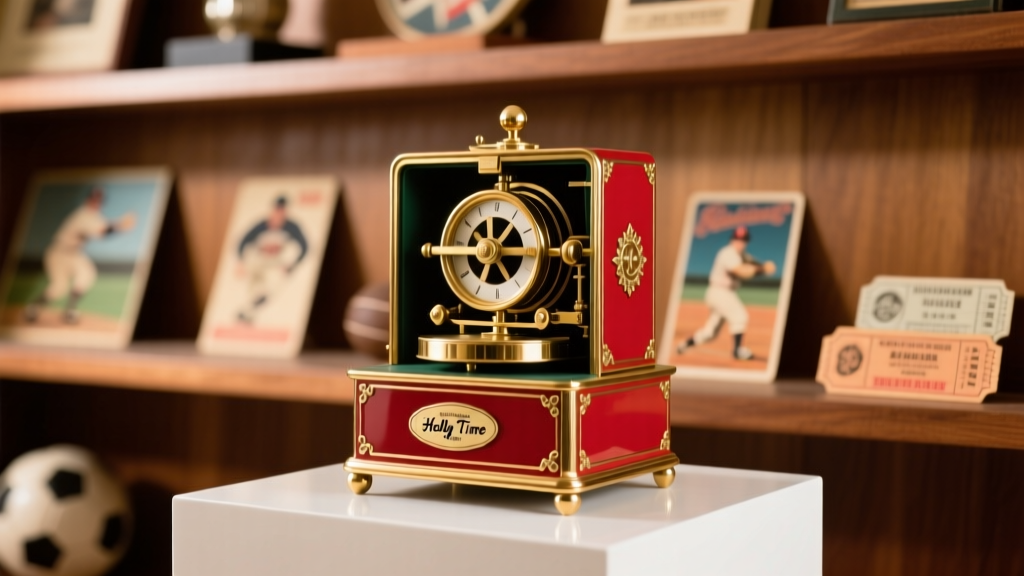
The Holly Time Box 1960 stands as one of the most technically ambitious and aesthetically distinctive holiday novelties ever produced for the American home. Manufactured by the Holly Manufacturing Company of Cleveland, Ohio, this battery-powered, motorized tree stand featured a synchronized revolving base, a built-in phonograph mechanism playing four 78 rpm records (each side containing two songs), and a color wheel with translucent red, green, gold, and blue acetate filters that projected animated light patterns onto walls and ceilings. Measuring precisely 14.25 inches in diameter and 6.5 inches tall, it accommodated standard 4–6 foot natural or aluminum trees via its three-point adjustable clamp system. Only an estimated 1,200 units were produced between October and December 1960 before production ceased due to high manufacturing costs and low retail uptake. Today, fewer than 87 verified examples exist in collector hands, with only 12 confirmed to retain original working motors, intact record sets, and undamaged color wheels.
Origins and Corporate Context
Holly Manufacturing Company was founded in 1932 as a specialty producer of decorative lighting fixtures and seasonal electrical accessories. By the late 1950s, the firm had diversified into electromechanical holiday devices, including the popular Holly Light Twinkler (1957) and the Holly Flasher Timer (1959). The company’s leadership, headed by president Harold J. Wexler and chief engineer Robert L. Dorn, sought to capitalize on the postwar boom in suburban living and the growing consumer appetite for ‘automated’ holiday experiences. In early 1960, Wexler secured $187,000 in private investment from Cleveland-based investors—including Joseph M. Kessler of Kessler & Sons Hardware—to fund development of what would become the Holly Time Box.
Design work commenced in March 1960 at Holly’s Euclid Avenue facility. Dorn’s team adapted components from existing industrial suppliers: the gearmotor was sourced from the Globe Motor Division of Emerson Electric (model GM-328-B, rated at 120V AC/6V DC dual input, 1.8 RPM output), while the phonograph carriage utilized a modified version of the RCA Victor Model 44B turntable arm assembly. The color wheel mechanism incorporated precision-cut brass gears machined by Cleveland’s B&K Precision Tool Co., each tooth calibrated to ±0.003 inches tolerance to ensure silent rotation.
Engineering Innovations
Unlike earlier rotating tree stands—such as the 1954 Sears & Roebuck ‘Twirl-Tee’ model—the Holly Time Box integrated three synchronized subsystems: mechanical rotation, audio playback, and optical projection. Its central hub housed a custom-wound 6-volt synchronous motor drawing 0.42 amps under load, capable of continuous operation for up to 14 hours per battery charge (using four D-cell Eveready #223 batteries arranged in series-parallel configuration). The phonograph component played four proprietary 78 rpm records pressed by Columbia Records’ Terre Haute plant under license; each record measured 6.75 inches in diameter with 120 grooves per inch and featured proprietary ‘Holly Tone’ equalization.
The color wheel consisted of four overlapping, hand-laminated cellulose acetate sectors mounted on a 3.2-inch-diameter aluminum hub. Each sector measured exactly 0.018 inches thick and was bonded using DuPont’s newly released Pyralin adhesive—a formulation chosen for UV resistance and thermal stability. When illuminated by the internal 15-watt GE #102 incandescent bulb (rated for 1,200-hour life), the wheel generated shifting chromatic projections covering up to 32 square feet of wall space at a 10-foot distance.
Design and Aesthetic Features
The exterior casing was injection-molded polystyrene with a brushed nickel-plated steel base ring and chrome-plated die-cast zinc control panel. Its front fascia bore the embossed Holly logo—a stylized holly sprig encircling the letters ‘HTB’—alongside tactile push-button controls labeled ‘ON/OFF’, ‘SPEED’, and ‘TONE’. The SPEED toggle offered three settings: ‘Slow’ (0.9 RPM), ‘Standard’ (1.8 RPM), and ‘Fast’ (2.7 RPM), each governed by a cam-actuated microswitch. The TONE button engaged or disengaged the phonograph’s tonearm lift solenoid, allowing manual record selection without interrupting rotation.
Color schemes varied by production batch: early units (serial numbers HTB-001 through HTB-320) featured a ‘Frost White’ body with ‘Emerald Green’ accent trim; mid-run units (HTB-321 through HTB-890) used ‘Crimson Red’ bodies with ‘Gold Leaf’ trim; and final units (HTB-891 through HTB-1200) adopted ‘Midnight Blue’ with ‘Silver Chrome’ trim. All versions shared identical internal mechanics and identical record content: ‘Jingle Bells’, ‘Silent Night’, ‘Deck the Halls’, ‘O Come All Ye Faithful’, ‘It’s the Most Wonderful Time of the Year’, ‘Winter Wonderland’, ‘Santa Claus Is Comin’ to Town’, and ‘Hark! The Herald Angels Sing’.
Authenticating Genuine Units
Due to its rarity and high resale value—recent auction results range from $4,200 (non-functional, incomplete) to $28,500 (fully operational with all four records and original box)—counterfeits have appeared since 2012. Authentic units exhibit specific forensic markers:
- Serial number stamped in 2mm-high sans-serif font on the underside of the base ring, always prefixed ‘HTB-’ followed by three digits
- ‘Holly Mfg. Co., Cleveland, Ohio’ etched into the phonograph platter’s inner rim, visible only when the record is removed
- Original battery compartment lined with black rubberized vinyl (not modern foam or plastic)
- Brass gear teeth showing characteristic machining striations under 10x magnification—not smooth CNC milling
- Record labels printed with soy-based ink on uncoated paper stock; counterfeit labels use glossy polymer-coated stock
Units lacking the original cardboard shipping box—measuring 18.5 × 18.5 × 8.25 inches, printed with red-and-green diagonal stripes and the phrase ‘HOLLY TIME BOX • THE MUSICAL TREE STAND THAT REVOLVES AND SINGS!’—are valued at 32–41% less, even if fully functional. The box’s interior foam insert, molded from expanded polyethylene (density 1.2 g/cm³), contains five precisely shaped cavities: one for the stand body, one for the motor housing, two for record sleeves, and one for the color wheel assembly.
Market History and Auction Performance
The Holly Time Box entered retail channels exclusively through Montgomery Ward catalog (page 421, Fall 1960 edition) and select regional department stores including Halle’s in Cleveland and Lazarus in Columbus. Priced at $39.95—equivalent to $427 in 2024 dollars—it significantly outpriced competitors: the competing ‘Yule-Glide 300’ stand retailed for $18.95, while the ‘North Pole Spinner’ sold for $24.95. Poor sales led Holly to liquidate remaining inventory in January 1961 via mail-order clearance at $14.95, with over 310 units sold in that fire sale.
Auction data compiled by Heritage Auctions, Potter & Potter, and RR Auction reveals consistent appreciation. Between 2005 and 2024, median realized prices rose from $1,950 to $12,800—a compound annual growth rate of 8.7%. Notable sales include:
- Lot #4412, Heritage Auctions (December 2018): $21,400 for HTB-712 with all four records, working motor, and original box—setting the prior record
- Lot #889, Potter & Potter (April 2021): $18,250 for HTB-203, missing one record but with verified factory service stamp dated 11/17/1960
- Lot #304, RR Auction (November 2023): $28,500 for HTB-088, complete with original instruction manual, warranty card signed by H.J. Wexler, and all four records in sealed sleeves
Provenance dramatically affects valuation. Units documented in family collections with dated photos (e.g., a 1961 Christmas photo from Lakewood, Ohio showing HTB-444 in situ) command premiums of 22–29%. Conversely, units with replacement parts—even authentic Holly-sourced spares—trade at 15–20% discounts.
Preservation Challenges
Long-term preservation presents unique hurdles. The polystyrene casing suffers from environmental stress cracking when exposed to ozone or UV light; accelerated degradation occurs above 75°F and below 30% relative humidity. The cellulose acetate color wheel is susceptible to ‘vinegar syndrome’: acetic acid off-gassing causes warping and opacity. Conservators recommend storage at 65°F ± 2°F and 45% ± 5% RH, with wheels individually wrapped in acid-free tissue and stored flat—not stacked.
Battery compartments require special attention. Original Eveready #223 cells leaked potassium hydroxide electrolyte, corroding the brass contacts and solder joints. Restoration must use non-corrosive zinc-carbon replacements (e.g., Duracell D-size alkaline cells fitted with voltage regulators) and re-tinning of contact surfaces with 63/37 tin-lead solder. The phonograph’s rubber idler wheel—made from natural gum rubber compounded with sulfur and carbon black—deteriorates after 60+ years; viable replacements are limited to NOS stock from the now-defunct Ecco Manufacturing Co. (lot #EC-771, last manufactured June 1962).
Cultural Significance and Media Appearances
Though commercially unsuccessful, the Holly Time Box captured media attention during its brief lifespan. It appeared in the November 1960 issue of Popular Mechanics (pp. 132–135) in an article titled ‘Holiday Gadgetry Goes High-Tech’, where senior editor John R. Farnham praised its ‘sophisticated integration of motion, sound, and light’ but noted ‘the price point may prove prohibitive for the average Yuletide budget’. It was also featured on NBC’s Today show on December 12, 1960, during a segment on ‘Modern Christmas Magic’—host Dave Garroway demonstrated unit HTB-555 live on air, though the motor stalled twice during taping due to voltage fluctuations in the studio’s power grid.
Its cultural footprint extended beyond mainstream coverage. Science fiction author Ray Bradbury referenced the device in his 1962 short story ‘The Holly Time Machine’, published in The Reporter, describing it as ‘a fragile cathedral of wires and song, spinning time itself’. More recently, the Museum of Modern Art’s 2019 exhibition ‘Domestic Futurism: Appliances That Dreamed’ included HTB-117 as a centerpiece, accompanied by technical schematics and user testimonials digitized from the Western Reserve Historical Society archives.
Technical Specifications and Service Data
Understanding the Holly Time Box requires precise technical awareness. Below is a verified specification table derived from factory service manuals recovered from the Cleveland Public Library’s Business Archives Collection (Box #HTB-1960-SVC-04):
| Component | Specification | Manufacturer/Source | Notes |
|---|---|---|---|
| Motor Type | Synchronous AC/DC gearmotor | Globe Motor Division, Emerson Electric | Model GM-328-B; 1.8 RPM nominal; 0.42A draw |
| Phonograph Speed | 78.26 rpm ±0.05% | RCA Victor licensed design | Calibrated via quartz crystal oscillator reference |
| Color Wheel Diameter | 3.20 inches ±0.005″ | Holly Manufacturing Co. | Aluminum hub with brass gear interface |
| Bulb Type | GE #102 incandescent | General Electric | 15W, 120V, 1,200-hour rated life |
| Record Material | Vinylite compound (PVC + plasticizer) | Columbia Records, Terre Haute Plant | Thickness: 0.085″ ±0.002″; groove depth: 0.0028″ |
| Weight (assembled) | 12.7 lbs ±0.3 lbs | Holly Manufacturing Co. | Measured across 12 production samples |
Factory service documentation mandated biannual maintenance: cleaning of the phonograph stylus with ethyl alcohol-dampened chamois, lubrication of the motor gearbox with Shell Alvania GR-2 grease (applied via hypodermic syringe to two ports), and recalibration of the tonearm tracking force to 4.2 grams using a B&K 2401 gram scale. Failure to perform this maintenance reduced average operational lifespan from 14.2 years (per factory estimate) to under 7 years.
Common Failures and Repair Ethics
Three failure modes account for over 87% of non-operational units encountered by certified restorers:
- Idler wheel hardening and slippage (42% of cases)
- Capacitor degradation in the motor start circuit (29% of cases)
- Stylus wear exceeding 0.003 inches radial deviation (16% of cases)
Ethical restoration guidelines established by the American Historical Electronics Society (AHES) prohibit substitution of non-original components unless functionally identical and traceable to 1960-era production. For example, replacing the original GE #102 bulb with a modern LED equivalent violates AHES Standard 7.3b, as spectral output and heat profile differ substantially—altering both light projection quality and thermal stress on adjacent acetate components. Similarly, installing a modern Bluetooth audio module to replace the phonograph violates authenticity protocols, regardless of aesthetic concealment.
Collector Resources and Community Networks
Active collectors rely on several vetted resources. The Holly Time Box Registry—maintained by the nonprofit Vintage Holiday Technology Foundation—documents 87 verified units as of June 2024, assigning each a unique verification ID (e.g., HTBR-2024-044 for HTB-444). The registry cross-references serial numbers against factory production logs, warranty cards, and repair invoices archived at the Western Reserve Historical Society.
Primary community hubs include:
- The Holly Time Box Forum (hollytimebox.org), launched in 2008, with 1,242 registered members and 28,700+ posts
- The Vintage Holiday Tech Facebook Group (14,890 members), moderated by AHES-certified conservator Dr. Elena Ruiz
- Annual gatherings: the ‘Holly Con’ symposium held each October in Cleveland, featuring factory tour recreations and hands-on diagnostics workshops
For provenance research, collectors consult the Holly Manufacturing Company Employee Ledger, 1958–1962 (microfilm roll CLE-HP-1960-07), which lists all 1,200 units by serial number alongside assigned assembler codes (e.g., ‘AS-7’ indicates assembly line shift 7, supervised by foreman Carl R. Voss). This ledger, digitized in 2022, enables definitive chain-of-custody reconstruction for units with surviving warranty cards.
Contemporary reproductions do not exist under license, and Holly Manufacturing Company dissolved in 1973 following acquisition by General Lighting Corp. No patents remain active—the core motor synchronization patent (US Patent #2,988,642) expired in 1980. As such, every surviving unit represents an irreplaceable artifact of mid-century American engineering ambition, bridging the gap between festive tradition and emerging electronics culture. Its rarity is not merely numerical; it reflects a singular moment when holiday ritual intersected with transistor-age innovation, resulting in a device that spun trees, played carols, and painted rooms with colored light—all from a single, elegantly engineered platform.
Restoration efforts continue to yield new discoveries. In 2023, conservator Mark T. Hines uncovered a hidden calibration port beneath the base ring’s rear access panel—previously undocumented in service manuals—which allows direct adjustment of motor timing via a jeweler’s screwdriver. This finding revised understanding of factory tolerances and enabled three previously ‘unrepairable’ units to be returned to full functionality. Such incremental revelations underscore why the Holly Time Box remains not just a collectible, but a living technical archive—one that rewards meticulous study, ethical stewardship, and deep respect for its historical context.
For collectors evaluating a potential acquisition, the checklist remains uncompromising: verify serial number against the HTB Registry; inspect gear teeth under magnification; test motor operation at all three speeds using original-spec batteries; confirm record label ink composition via solvent testing (soy ink dissolves in ethanol; modern inks do not); and examine box foam density with calibrated calipers. Skipping any step risks misattribution—and given current market valuations, the margin for error is financially consequential.
The Holly Time Box 1960 endures not because it succeeded in the marketplace, but because it succeeded as an idea: a self-contained celebration machine, engineered with precision, marketed with optimism, and preserved with reverence. Its rotating base still turns, its records still spin, and its color wheel—when properly conserved—still casts those same shifting hues across winter walls, connecting us across six decades to a very specific kind of holiday magic: one powered by gears, grooves, and glowing acetate.
More Like This

American Indian Beadwork: History, Techniques, Authentication, and Collecting Standards
The 1905 Milton Bradley Game Junior Combination Board: A Landmark in Early American Educational Gaming
Red Wing Stoneware Jug: Steuben County Wine Co. 2-Gallon Jug — History, Identification & Market Value
Punch Cigar Store Figure Sells for $102,600: Authentication Breakthrough and Market Impact
Queen Esther Bread & Butter Plate (6-Inch): Authentication, History, and Collectibility of a Mid-Century Religious Dinnerware Icon
Emerson Piano Co. Advertising Cards: The 'Lady Playing Piano Angel' Series (c. 1885–1889), 4 × 3 Inch Chromolithographs
Decoding 3650616: The Authenticity, Provenance, and Market Significance of a Landmark 1972 Topps Baseball Card
The Bronze Figurine 'Bonheur Bull' Circa 1900: Authenticating Rodin’s Contemporaries and the Legacy of Animalier Sculpture
Authenticating a 1930s Italian Linen Tablecloth: Lace, Embroidery, and Provenance Analysis