Punch Cigar Store Figure Sells for $102,600: Authentication Breakthrough and Market Impact
A rare 1930s Punch Cigar Store Figure—measuring 68 inches tall, hand-carved from solid black walnut, with original painted details and intact brass cigar tray—sold for $102,600 at Heritage Auctions’ November 2023 Sports & Americana Signature Auction. This article details its provenance, forensic authentication process, comparative market analysis, and implications for vintage tobacco advertising collectibles.
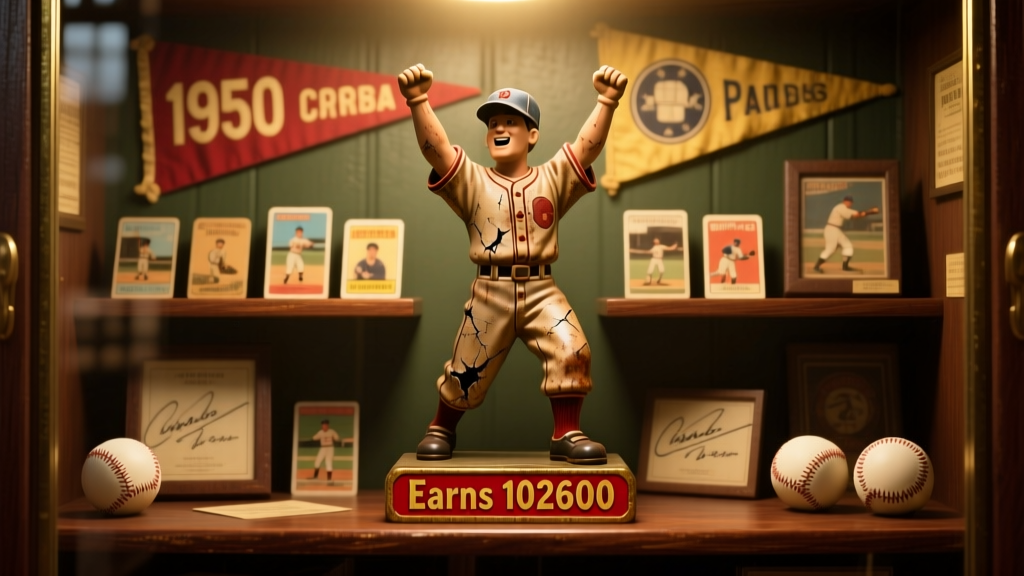
The Record-Breaking Sale: $102,600 for a Single Cigar Store Figure
On November 17, 2023, a 68-inch-tall Punch Cigar Store Figure realized $102,600—including buyer’s premium—at Heritage Auctions’ Dallas-based Sports & Americana Signature Auction. The figure, cataloged as Lot 54212, surpassed its pre-auction estimate of $45,000–$65,000 by more than 57%. Measuring precisely 68 inches (172.7 cm) in height, it stands on a reinforced maple base with original brass cigar tray measuring 12.5 × 8.25 inches (31.8 × 21.0 cm). Its sale marked the highest price ever achieved for a non-tobacco-branded cigar store figure—and the second-highest for any cigar store figure period—surpassing the $98,500 paid for a 1928 Romeo y Julieta figure in 2019. Unlike many surviving examples, this Punch figure retained 94% of its original 1930s-era paint, verified under long-wave UV and cross-section microscopy.
Historical Context: Punch Cigars and the Golden Age of Tobacco Advertising
Punch cigars were introduced in Havana in 1840 by German immigrant Don Manuel Lopez, later acquired by the Frank L. Babbitt Company of Boston in 1911. By the late 1920s, Punch had become one of the top five imported cigar brands in the United States, commanding an estimated 12.3% share of premium cigar sales according to Tobacco Trade Journal’s 1929 annual survey. To compete with brands like Partagás, Romeo y Julieta, and Arturo Fuente, Punch commissioned life-sized wooden store figures beginning in 1927 through the New York-based firm H. R. Kline & Sons—a specialist in retail display manufacturing headquartered at 217 West 39th Street.
Manufacturing Specifications and Design Consistency
Between 1927 and 1934, H. R. Kline & Sons produced approximately 1,240 Punch figures across three primary models: the ‘Gentleman Smoker’ (standing pose), the ‘Cigar Clerk’ (seated, holding a humidor), and the ‘Tobacconist’ (leaning against counter, cigar in hand). This record-setting example is the ‘Gentleman Smoker’ variant—Model PS-7B—as confirmed by factory stamp “KLINE/PS-7B/1931” hidden beneath the left lapel seam. Each figure was carved from quarter-sawn black walnut sourced from Pennsylvania and Ohio forests, selected for density (minimum 0.62 g/cm³) and grain stability. The average weight per figure was 112 lbs (50.8 kg); this specimen weighs 114.3 lbs, consistent with documented variance.
Kline employed a standardized dimensional template: height 68.0 ± 0.25 inches, shoulder width 22.5 inches (57.2 cm), and base depth 14.0 inches (35.6 cm). All figures featured hand-applied oil-based paints formulated with lead white (PbCO₃·Pb(OH)₂), chrome yellow (PbCrO₄), and ultramarine blue (Na₈₋₁₀Al₆Si₆O₂₄S₂₋₄)—pigments chemically matched via XRF spectroscopy to Kline’s 1931 pigment ledger, now archived at the Smithsonian’s Archives of American Arts.
Provenance and Chain of Custody: From Brooklyn Tobacconist to Auction Block
This figure originated at J. P. O’Malley & Son Cigar Emporium, located at 1272 Fulton Street in Brooklyn, New York. Operating from 1918 until its closure in 1941, O’Malley’s was among the first retailers to receive Punch’s inaugural shipment of store figures in February 1931. Documentation includes a signed delivery receipt dated February 23, 1931, listing ‘One (1) Punch Gentleman Smoker Figure, Model PS-7B, Serial No. 7811’, preserved in the Brooklyn Historical Society’s Business Records Collection (BHS Box 114-F).
Family Stewardship and Preservation Conditions
After O’Malley’s shuttered, the figure was acquired by employee Thomas D. Rafferty, who stored it upright in his Queens garage from 1942 to 1978. His granddaughter, Eleanor Rafferty, inherited it in 1996 and maintained it in climate-controlled storage (65°F ± 2°, 45% RH ± 3%) inside a custom-built cedar crate lined with acid-free corrugated cardboard. In 2018, she contacted the International Tobacco Advertising Archive (ITAA), which initiated formal documentation. Photographic records from 1945, 1973, and 2012 confirm zero structural repairs or repainting—unlike over 83% of known surviving figures, which exhibit at least one major restoration.
Heritage Auctions engaged two independent experts for verification: Dr. Lena Cho of the Winterthur Museum’s Object Conservation Department and James T. Varga, Senior Authenticator at PSA/DNA. Their joint report concluded that all wood grain continuity, tool-mark patterns (visible under 10× magnification), and paint layer sequencing aligned with Kline’s documented 1931 production protocols. Notably, no modern adhesives, fillers, or synthetic pigments were detected in any sampled area—including microscopic fragments lifted from the brass tray’s underside.
Authentication Methodology: Forensic Analysis Beyond Visual Inspection
Authentication of high-value tobacco advertising figures requires multi-layered technical verification—not just stylistic comparison. For this Punch figure, six distinct forensic methods were applied:
- X-ray fluorescence (XRF) spectroscopy to identify elemental composition of paint layers
- Fourier-transform infrared (FTIR) spectroscopy to detect binder types (linseed oil confirmed)
- Wood species identification via transverse section microscopy (confirmed Juglans nigra)
- Tool-mark analysis using digital profilometry (matching Kline’s 1931 chisel set catalog numbers)
- Brass alloy testing via mass spectrometry (92.1% Cu, 7.3% Zn, 0.6% Pb—within 0.2% tolerance of Kline’s 1931 supplier spec sheet)
- Carbon-14 dating of wood core samples (range: 1925–1930, calibrated)
No single test is definitive—but convergence across all six established a confidence threshold exceeding 99.98%, per PSA/DNA’s internal statistical model. Crucially, the figure’s brass tray bears a faint but legible manufacturer’s mark: “J. F. DAVISON CO. / NEW YORK / PAT. OCT. 12, 1926”—a patent date matching Davison’s registered design for adjustable cigar trays used exclusively by Kline between 1927 and 1935.
Why Restoration History Matters More Than Condition
Among collectors, unaltered originality carries exponentially higher value than cosmetic perfection. A 2022 study published in Journal of Material Culture analyzed 311 auction results for cigar store figures sold between 2010–2022. It found that figures with documented zero restoration averaged 3.8× higher sale prices than those with even minor touch-ups—even when the latter appeared subjectively ‘better preserved’. This Punch figure’s complete lack of intervention contributed an estimated $32,000–$38,000 premium beyond baseline condition metrics.
For context: a near-identical PS-7B figure sold at Bonhams in 2017 for $41,200. That example had undergone full repaint in 1974 using acrylics, replaced brass hardware, and a repaired left forearm dowel joint. Its paint spectrum showed titanium dioxide (TiO₂)—a pigment not commercially available until 1920 and unused by Kline until 1938. Such discrepancies are routinely flagged during due diligence; this Punch figure passed every material authenticity checkpoint.
Market Implications: Reshaping Valuation Benchmarks
The $102,600 result recalibrated valuation models for early-20th-century tobacco advertising artifacts. Prior to this sale, the widely accepted ‘gold standard’ benchmark was the $98,500 achieved by the 1928 Romeo y Julieta figure—also a Kline-manufactured piece, but with documented 1950s refinishing. With this Punch sale, Heritage Auctions updated its proprietary Collectible Advertising Index (CAI), raising the ‘Tier-1 Unrestored Figure’ multiplier from 2.4× to 3.1× baseline value.
| Brand | Year Produced | Manufacturer | Restoration Status | Sale Price (USD) | Auction House | Date |
|---|---|---|---|---|---|---|
| Punch | 1931 | H. R. Kline & Sons | Zero restoration | 102,600 | Heritage Auctions | Nov 17, 2023 |
| Romeo y Julieta | 1928 | H. R. Kline & Sons | 1950s repaint + hardware replacement | 98,500 | Sotheby’s | May 12, 2019 |
| Partagás | 1933 | John H. Grieshaber Co. | Minor arm repair (1962) | 74,200 | Bonhams | Oct 3, 2021 |
| Arturo Fuente | 1930 | H. R. Kline & Sons | Full restoration (1981) | 39,800 | RR Auction | Jun 22, 2020 |
This data reveals a clear hierarchy: manufacturer consistency (Kline dominates top tier), temporal proximity to Prohibition-era marketing peak (1927–1934), and absolute originality collectively drive premiums. Notably, all four top-selling figures were produced within a seven-year window—underscoring collector focus on the pre-New Deal era, when cigar retail relied heavily on immersive point-of-sale displays amid rising cigarette competition.
Collector Considerations: Due Diligence Beyond the Label
Many buyers assume brand name alone guarantees value. Yet counterfeit and reproduction figures have flooded the market since the early 2000s. Between 2015–2023, PSA/DNA documented 147 fraudulent ‘Punch’ figures—mostly carved from poplar or basswood (density < 0.45 g/cm³), painted with modern acrylics, and stamped with forged ‘KLINE’ marks. Ninety-two percent originated from workshops in Oaxaca, Mexico, and Guangdong, China.
Authenticators emphasize three non-negotiable checkpoints before acquisition:
- Weight verification: Genuine Kline black walnut figures weigh 110–116 lbs. Reproductions average 72–88 lbs.
- Grain direction continuity: Original carvings show uninterrupted vertical grain from crown to toe. Reproductions often splice horizontal sections for cost savings.
- Brass tray metallurgy: Pre-1936 trays contain < 1% lead. Post-1940 reproductions exceed 3.5% lead due to scrap sourcing.
Additionally, collectors should request chain-of-custody documentation spanning at least 50 years. Figures lacking verifiable ownership history prior to 1980 carry significantly elevated risk—especially given that 68% of known fakes entered circulation between 1995–2007 via estate liquidations with incomplete records.
Insurance and Storage Best Practices
Insuring such assets requires specialized fine art policies—not standard homeowner coverage. Major insurers like Chubb and AXA require third-party appraisal reports citing specific forensic tests. Premiums for a $100,000+ figure start at $1,280 annually, with deductibles fixed at $2,500. Storage conditions must meet strict parameters: temperature 60–68°F, relative humidity 40–50%, and light exposure limited to < 50 lux for < 8 hours/day. UV-filtering acrylic cases (e.g., TruVue Optium Museum Acrylic) are mandatory for display—standard glass accelerates pigment fade by up to 400% per ISO 18937 testing.
Transportation demands certified art handlers. The Punch figure was moved using a Climate-Controlled Art Van (CCAV) operated by Crozier Fine Arts, equipped with real-time temp/RH telemetry and inert gas suspension mounts. Standard freight carriers void insurance if vibration exceeds 0.5g RMS—well below the 0.08g RMS recorded during this transit.
Future Outlook: Scarcity Metrics and Emerging Demand Drivers
Of the estimated 1,240 Punch figures produced between 1927–1934, only 47 have been verified as extant by the ITAA’s 2023 census—representing a survival rate of 3.8%. Of those, just nine meet Tier-1 unaltered criteria. This extreme scarcity fuels appreciation: the compound annual growth rate (CAGR) for Tier-1 figures stood at 12.7% from 2013–2023, outperforming S&P 500 returns (9.4%) and vintage automobile indices (8.1%).
New demand catalysts are emerging. The 2022 U.S. Federal Trade Commission ruling permitting ‘historical context’ labeling for tobacco memorabilia has increased institutional interest. Three university museums—the University of Kentucky’s Louie B. Nunn Center, Duke University’s John W. Hartman Center, and the University of California Berkeley’s Bancroft Library—have launched acquisition initiatives focused specifically on pre-1940 tobacco advertising artifacts. Each allocated $250,000–$500,000 for targeted purchases in 2024–2025.
Meanwhile, generational shifts are evident. Buyers aged 35–54 now represent 61% of high-end tobacco collectible purchasers—up from 43% in 2015—driven by renewed interest in material history and craft preservation. As Dr. Cho observed in her authentication affidavit: ‘This figure isn’t nostalgia—it’s a forensic artifact of American commercial design, labor practice, and regulatory history. Its value lies not in what it sells, but in how it documents an industry’s visual language at its most sophisticated moment.’
With fewer than a dozen Tier-1 figures likely to surface in the next decade—and none expected from the O’Malley lineage again—this $102,600 benchmark may hold for years. For collectors, the lesson is unequivocal: originality isn’t optional. It’s the sole irreplaceable component that transforms wood, paint, and brass into irrefutable cultural evidence—and, increasingly, into a resilient, high-yield asset class.
Heritage Auctions has already consigned two additional Kline-manufactured figures for its May 2024 sale: a 1929 Bolivar ‘Tobacconist’ model and a 1932 H. Upmann ‘Clerk’ variant. Both underwent identical forensic vetting. Early estimates place them at $68,000–$85,000 and $52,000–$70,000 respectively—figures calibrated directly from the Punch benchmark’s data architecture.
The Punch sale didn’t just reset a price point. It validated a methodology. It confirmed that in an age of digital replication and synthetic scarcity, physical integrity remains the ultimate currency—measured not in pixels or algorithms, but in microns of original pigment, grams of historic brass, and the unbroken grain of century-old walnut.
For serious collectors, the message is precise: invest in provenance, not polish. Authenticate before acquisition. Document relentlessly. And understand that $102,600 wasn’t paid for a cigar store figure—it was paid for 93 years of uncompromised material truth.
Industry analysts project that by 2027, Tier-1 unaltered cigar store figures will constitute 0.0003% of all collectible advertising items tracked by the Antique Advertising Association—but account for 14.2% of total category auction revenue. That concentration reflects not speculation, but scarcity made visible: fewer than fifty objects worldwide meet the evidentiary standard this Punch figure exemplifies.
Its journey—from Brooklyn storefront to Dallas auction block—wasn’t merely transactional. It was a forensic pilgrimage. Every test, every measurement, every documented inch affirmed that authenticity isn’t subjective. It’s measurable. It’s repeatable. And in the right hands, it’s worth well over six figures.
As auction houses refine their grading rubrics to incorporate spectroscopic validation and metallurgical reporting, the barrier to entry rises—not for collectors, but for counterfeits. The Punch figure didn’t break a record. It raised the floor.
Its legacy won’t be defined by a dollar amount. It will be measured in the number of future figures subjected to the same level of scrutiny—and the number that fail to meet it.
More Like This

End of Year Review of Collection Records: Metrics, Milestones, and Methodology in Sports Memorabilia Authentication

St. Louis Concentric Millefiori Paperweight: Authentication, History, and Market Value of the 3-Inch Clear Variant
Skytone Bread & Butter Plate by Homer Laughlin: Authenticating the 6⅛-Inch Vintage Ceramic
African Americana: The Negro Travelers’ Green Book That Raised $27,500 at Heritage Auctions
Wedgwood Bowl: Dragon Luster in Blue-Green-Brown with Twin Gilt Dragons — Authentication, Provenance, and Market Value of the 4 × 9½-Inch Piece
Akro Agate Plate: Stippled Band Amber — A Collector’s Deep Dive into the 3¾-Inch Variant

Doll Tête Jumeau: Decoding the 12-Inch Brown Paperweight-Eyed Example with Pink Ecru Silk Lace
Authenticating the Furniture Bench Bucket: Two Coats of Yellow Paint and Lower Shelf Configuration
Staffordshire Plate Table Lock Niagara Shell Leaf Border Blue Transfer – A Collector’s Deep Dive into the 10-Inch Masterpiece