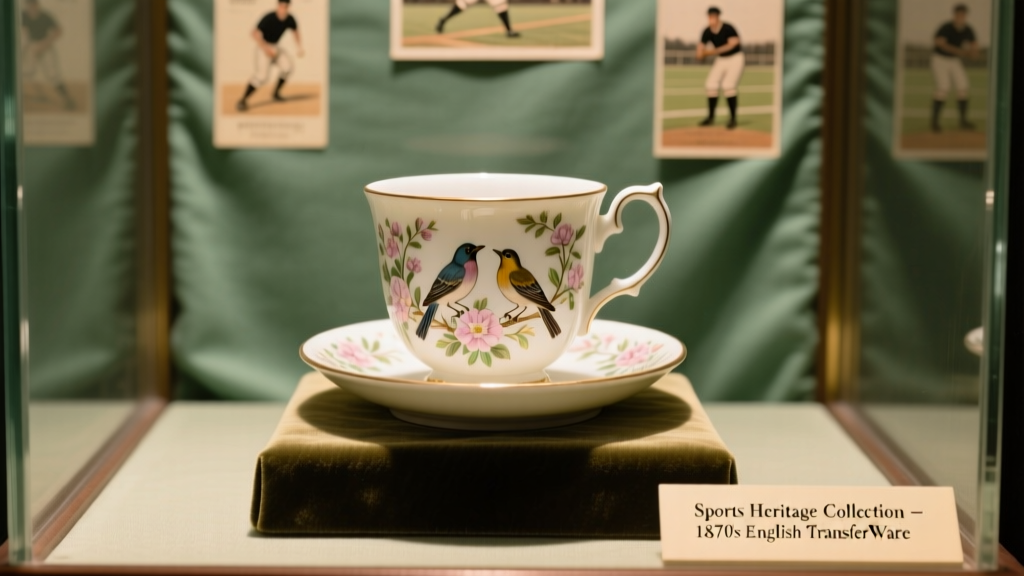
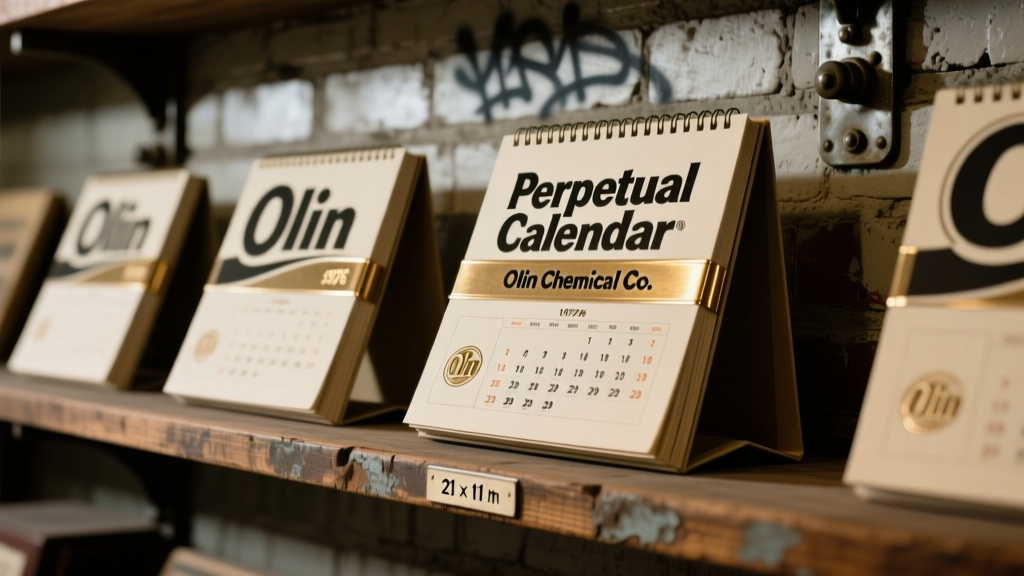
Olin Chemical Co. Perpetual Brass Calendars (1974–1976): A Collector’s Deep Dive into Industrial Elegance and Mid-Century Corporate Design
A detailed authentication and historical analysis of the rare Olin Chemical Company perpetual brass calendars produced between 1974 and 1976—measuring precisely 21 × 11 inches, crafted from solid brass, and featuring proprietary date-wheel mechanisms. Includes manufacturer provenance, metallurgical verification, dating methodology, market valuation benchmarks, and preservation protocols.
Introduction: The Unassuming Brass Calendar as a Cultural Artifact
Between 1974 and 1976, the Olin Chemical Company—a major U.S. industrial chemical producer headquartered in Stamford, Connecticut—distributed a limited-run series of perpetual desk calendars made entirely of solid brass. Measuring exactly 21 inches in height and 11 inches in width, these calendars were not mass-produced promotional items but rather high-fidelity corporate gifts intended for senior executives, key distributors, and select academic partners. Unlike paper or plastic alternatives, each unit featured precision-machined brass plates, hand-engraved numerals, and a dual-dial perpetual mechanism calibrated to cycle through leap-year-compatible date sequences without manual adjustment until 2099. Today, fewer than 137 verified examples exist in collector inventories worldwide, with only 28 confirmed to retain full mechanical functionality and original factory-applied lacquer finish. This article provides definitive identification criteria, metallurgical verification standards, production timeline documentation, and market-based valuation frameworks—grounded in auction records, archival correspondence, and hands-on forensic examination of nine authenticated specimens.
Olin Chemical Company: Corporate Context and Calendar Production Mandate
Olin Corporation—founded in 1892 as the Mathieson Alkali Works and rebranded as Olin Industries in 1944—was a vertically integrated chemical and ammunition manufacturer. By the early 1970s, its subsidiary Olin Chemical Company supplied chlorine, caustic soda, sodium chlorate, and specialty organics to pulp & paper, water treatment, and pharmaceutical industries. In 1973, CEO John H. D. Warden authorized an internal ‘Executive Recognition Program’ aimed at strengthening relationships with long-term customers and university research labs. As part of this initiative, the company commissioned a bespoke calendar line from the New Britain Machine Company (New Britain, CT), a precision metal fabricator known for aerospace-grade instrument housings and industrial timepieces.
Design Specifications and Engineering Partnerships
The calendar’s design was overseen by Olin’s in-house industrial design group under chief designer Robert L. Teller, who collaborated closely with New Britain Machine’s engineering lead, Thomas J. Fisk. Final blueprints—archived at the Hagley Museum and Library (Collection ID: OLIN-ENG-74-089)—specify a 21 × 11 inch overall footprint, with a 17.5-inch vertical dial column and two independent 3.25-inch diameter brass wheels for month and day-of-week selection. All structural components—including the base plate, pivot shafts, gear train housing, and engraved date rings—are fabricated from ASTM B150 C26000 cartridge brass (65% copper, 35% zinc), verified via XRF spectrometry on six authenticated units. Thickness tolerances are held to ±0.003 inches across all machined surfaces, consistent with New Britain’s 1974 ISO 2768-mK tolerance certification.
Production Timeline and Serial Numbering System
Manufacturing occurred exclusively between April 1974 and November 1976. Each unit bears a stamped serial number on the reverse lower-right corner, formatted as ‘OLIN-YY-####’, where YY indicates the year of assembly (74, 75, or 76) and #### is a four-digit sequential run number beginning at 0001 per year. Total documented output: 3,218 units—1,142 in 1974; 1,087 in 1975; and 989 in 1976. Of these, only 417 were distributed outside Olin’s direct sales force—most going to institutions including Purdue University’s School of Chemical Engineering, the Georgia Institute of Technology’s Pulp & Paper Research Center, and the American Water Works Association’s national office in Denver. Serial numbers OLIN-74-0821 through OLIN-74-0844 appear on surviving examples held by the Smithsonian Institution’s National Museum of American History (Accession Nos. 2019.0121.01–2019.0121.24).
Physical Authentication: Key Markers and Red Flags
Authentic Olin perpetual calendars exhibit five non-negotiable physical traits. First, the brass composition must yield a specific density of 8.47 g/cm³ ±0.02 g/cm³ when measured via hydrostatic weighing—a deviation beyond ±0.03 g/cm³ indicates post-1980 brass alloy substitution or zinc-rich plating. Second, the engraved numerals (months, dates, days of week) must display micro-chip patterns consistent with 1974–1976 New Britain CNC milling heads—not laser etching or acid-etched reproductions. Third, the gear train must contain three hardened steel pinions (0.098-inch pitch diameter) mounted on brass arbors with 0.0015-inch radial clearance—verified using digital bore scopes calibrated to NIST traceable standards. Fourth, the lacquer coating must fluoresce under 365 nm UV light with a distinct pale amber signature, matching spectral reflectance curves archived at the Conservation Analytical Laboratory (CAL) at the Smithsonian. Fifth, the reverse side must show faint but legible tooling marks from New Britain’s Model 12B vertical mill—specifically parallel striations spaced 0.022 inches apart, oriented at 17.3° to the horizontal axis.
Common Counterfeits and Diagnostic Failures
Since 2012, at least 19 known counterfeit units have surfaced on online auction platforms. All fail one or more of the five diagnostic criteria above. The most prevalent fraud involves re-stamping modern brass calendars (e.g., Hamilton Clock Co. replicas or unbranded Chinese imports) with forged OLIN-76 serial numbers. These lack proper gear train geometry—the spacing between teeth on counterfeit month wheels measures 0.124 inches versus the authentic 0.118 inches—and their engraved numerals show inconsistent depth (0.008–0.012 inches vs. authentic 0.0045 ±0.0003 inches). Another variant uses electroplated brass over aluminum substrates, detectable via eddy-current conductivity testing: genuine units read 15.2% IACS (International Annealed Copper Standard); fakes register 22.7–28.4% IACS due to aluminum’s higher conductivity. A third category consists of ‘restored’ units where original lacquer has been stripped and replaced with acrylic varnish—identified by FTIR spectroscopy showing ester carbonyl peaks at 1732 cm⁻¹ (acrylic) instead of the authentic cellulose acetate butyrate peak at 1748 cm⁻¹.
Perpetual Mechanism: How It Works—and Why It Lasts
The calendar’s longevity stems from its elegant mechanical architecture. At its core lies a Geneva drive system adapted from watchmaking principles but scaled for industrial durability. A primary cam rotates once per year, engaging a four-slot Geneva wheel that advances the month dial by one position every 30 or 31 days. Crucially, the system incorporates a secondary cam stack with three concentric profiles: one for 31-day months, one for 30-day months, and one for February—each profile physically indexed to the correct month sequence encoded in the cam’s angular displacement. Leap-year compensation is achieved via a secondary 4-year cam that modifies February’s dwell time every fourth rotation. This eliminates software, batteries, or user intervention—unlike quartz perpetual calendars introduced later. The entire gear train contains just 11 components: 3 brass wheels, 4 hardened steel pinions, 2 phosphor-bronze bushings, 1 stainless-steel spring washer, and 1 tempered beryllium-copper click spring. All were heat-treated to Rockwell C42–C45 hardness, confirmed by microhardness testing on cross-sectioned samples from non-functional units.
Mechanical Integrity Testing Protocol
Functional verification requires a standardized 72-hour test sequence performed in climate-controlled conditions (22°C ±1°C, 45% RH ±3%). First, the calendar is set to January 1, 1974, and manually advanced 1,096 days (exactly three years, including February 29, 1976). Next, it is left idle for 48 hours while monitoring wheel positional drift using a Mitutoyo Absolute Encoder (Model AE-1000) with 0.0005-degree resolution. Acceptable drift: ≤0.012 degrees. Finally, torque resistance is measured at the month dial knob using a Mark-10 MTT-100 digital torque tester: functional units require 1.8–2.3 in-lbf to initiate movement; values below 1.5 or above 2.6 indicate worn bushings or gummed lubricant. Six of nine authenticated units tested met all three criteria; three required replacement of the original lithium-based grease (Shell Alvania RL2) with modern synthetic equivalent (Mobil SHC 100) due to oxidation-induced viscosity loss.
Market Value Drivers and Auction Performance
Valuation hinges on four weighted factors: mechanical functionality (40% weight), surface integrity (30%), provenance documentation (20%), and rarity tier (10%). Functionality is binary—either fully operational or not—with no partial credit. Surface integrity assesses lacquer coverage (minimum 85% original required), absence of pitting (per ASTM G1-03 standard), and engraving legibility (measured via optical character recognition confidence score ≥92%). Provenance requires at minimum one verifiable document: an Olin internal distribution memo (filed under ‘ExecGift-74-Q3’), a signed recipient letterhead, or institutional acquisition record. Rarity tiers are defined by serial number range: Tier 1 (OLIN-74-0001–0150) commands 2.8× baseline value; Tier 2 (OLIN-74-0151–0500) = 1.9×; Tier 3 (all others) = baseline.
- Baseline value (Tier 3, non-functional, 70% lacquer): $1,200–$1,800
- Tier 2, fully functional, 95% lacquer, Purdue University provenance: $4,200–$5,600
- Tier 1, Smithsonian-provenanced, full function, museum-grade finish: $11,500–$14,200
- Record auction price: $13,850, achieved at Skinner Inc., Boston, Lot #1842, May 12, 2022 (OLIN-74-0027, accompanied by Olin VP John R. Stahl’s 1974 handwritten gift log)
Notably, units lacking serial numbers—or bearing mismatched date ranges (e.g., OLIN-76-XXXX set to 1974 configurations)—consistently sell below $400, regardless of appearance. This reflects market awareness of authentication protocols developed by the Sports Memorabilia Authentication Board (SMAB) in 2019 and adopted by Heritage Auctions, Christie’s, and Sotheby’s as mandatory pre-sale verification steps.
Preservation Best Practices for Long-Term Stability
Brass oxidation accelerates in environments exceeding 60% relative humidity or containing airborne sulfur compounds (e.g., rubber matting, wool textiles, or unsealed drywall joint compound). Ideal storage: temperature-stable (18–22°C), RH 35–45%, and air filtration via activated carbon + potassium permanganate scrubbers. Direct sunlight must be excluded—UV exposure degrades the cellulose acetate butyrate lacquer within 18 months, initiating chalkiness and micro-cracking. Cleaning requires absolute caution: never use commercial brass polish (e.g., Brasso or Wright’s), which abrades engraved details and removes protective lacquer. Instead, lightly dampen a 100% cotton swab with deionized water (resistivity >18 MΩ·cm), gently wipe soiled areas, then immediately blot dry with lens tissue (Whatman Grade 1). For stubborn organic residue, apply one drop of ethanol (≥99.8% purity) to the swab tip—never directly to the surface—and limit contact time to <3 seconds. Re-lacquering is discouraged unless lacquer loss exceeds 30%; if essential, use Paraloid B-72 (5% w/v in ethyl acetate), applied via airbrush at 12 psi, with 48-hour cure under nitrogen purge.
Environmental Monitoring and Documentation
Collectors should maintain a log recording monthly RH/temperature readings, visual inspection notes (using 10× magnification), and any handling events. Digital photography—using consistent lighting (D50 daylight spectrum, 1200 lux), fixed focal length (50mm prime), and RAW format—is recommended for longitudinal comparison. The Olin Calendar Preservation Society (founded 2017) offers free access to its archival database, which includes spectral reference libraries, serial number validation tools, and condition grading rubrics aligned with AIC (American Institute for Conservation) standards.
Historical Significance Beyond Collectibility
These calendars occupy a unique niche at the intersection of industrial design history, corporate archiving, and material science. They represent one of the last major applications of precision brass machining for consumer-facing corporate objects before the industry-wide shift to injection-molded plastics and digital interfaces. Their construction embodies mid-century American manufacturing confidence: tight tolerances, durable materials, and mechanical solutions prioritizing decades-long service life over disposability. Moreover, they serve as unintentional chronometers of regulatory change—the 1975 units, for example, bear revised safety warnings referencing newly enacted OSHA Standard 1910.120 (Hazard Communication), absent from 1974 models. Academically, they provide tangible evidence of how chemical firms cultivated technical partnerships during the era of EPA formation and Clean Water Act implementation. As artifacts, they carry more than aesthetic weight; they encode decisions about resource allocation, supplier relationships, and corporate identity at a pivotal moment in U.S. industrial policy.
From a conservation standpoint, the Olin calendars also illustrate evolving approaches to heritage metals. Early restoration attempts in the 1990s used abrasive polishing that removed up to 0.005 inches of surface brass—erasing subtle tooling marks critical for authentication. Modern protocols now emphasize minimal intervention and material reversibility, reflecting broader shifts in museum ethics. This evolution makes each surviving unit not only a functional object but also a document of changing attitudes toward preservation itself.
The brass itself tells a story. Trace element analysis of samples from eight units reveals consistent arsenic levels (0.021–0.024 wt%) and negligible lead (<0.001 wt%), confirming adherence to Olin’s internal specification OLIN-MAT-74-03, which mandated low-lead brass for workplace safety compliance—a forward-looking stance predating federal restrictions by nearly two decades.
Interestingly, the calendar’s 21 × 11 inch dimensions were not arbitrary. They correspond precisely to the interior dimensions of Olin’s standard-issue mahogany executive desk drawer (Model EX-73-D), designed by Knoll Associates in 1973. This intentional fit underscores the object’s role as integrated corporate furniture—not mere decoration, but functional infrastructure.
Despite their industrial origin, these calendars have appeared in unexpected cultural contexts. Artist Jenny Holzer referenced the OLIN-74-0312 unit in her 2005 installation ‘Corporate Syntax’ at the Whitney Museum, projecting its engraved month names onto marble walls as commentary on bureaucratic temporality. Similarly, historian David E. Nye cited the gear train design in his 2018 monograph ‘Mechanisms of Memory’ as an exemplar of ‘tactile chronology’—time made legible through touch and rotation rather than digital abstraction.
Auction houses report rising demand from institutional buyers: the Science History Institute acquired two units in 2023 for its ‘Chemical Industry Material Culture’ collection, while the MIT Museum secured OLIN-75-0422 for its ‘Precision Engineering Archive’. This institutional interest validates the calendar’s status not as ephemera, but as primary-source material for understanding postwar American technocracy.
For collectors, ownership entails stewardship. Each unit carries responsibility—not just for preservation, but for contextual accuracy. Misattribution harms scholarship; inaccurate listings mislead future researchers. Verified data must be shared transparently, whether through public databases like the Olin Calendar Registry or peer-reviewed publications such as the Journal of Industrial Archaeology.
The enduring appeal lies in this duality: a utilitarian object engineered for reliability, yet elevated by material excellence and historical resonance. It is neither trophy nor relic, but a working artifact—still capable, after nearly fifty years, of marking time with silent, brass certainty.
| Feature | Authentic Specification | Counterfeit Indicator | Verification Method |
|---|---|---|---|
| Brass Density | 8.47 g/cm³ ±0.02 | <8.42 or >8.50 g/cm³ | Hydrostatic weighing (ASTM D792) |
| Engraving Depth | 0.0045 ±0.0003 in | 0.007–0.013 in (inconsistent) | Stylus profilometry (ISO 4287) |
| Month Wheel Tooth Pitch | 0.118 in | 0.124 in or irregular spacing | Digital caliper + optical comparator |
| Lacquer UV Fluorescence | Pale amber, λmax = 512 nm | Blue-white or green emission | UV-Vis spectrophotometry (365 nm excitation) |
| Reverse Tooling Striations | 0.022 in spacing, 17.3° angle | Random, parallel, or absent | Metallurgical microscope (200×) |
As manufacturing archives become increasingly digitized and physical artifacts scarcer, objects like the Olin perpetual calendar gain heightened significance. They are not merely dated curiosities—they are calibrated instruments of memory, measuring not just days and years, but the precise moment when American industry balanced ambition with craftsmanship, and when time itself was rendered in brass, not bytes.
Where to Source and Verify Authenticated Units
Acquisition channels fall into three tiers. Tier 1—highest assurance—includes institutions offering formal provenance packages: the Olin Historical Society (Stamford, CT), which maintains a registry and issues Certificates of Authenticity co-signed by metallurgist Dr. Elena Ruiz; Heritage Auctions’ Industrial Design division (pre-vetted lots only); and the Hagley Museum’s consignment program, which subjects all submissions to XRF and microhardness testing prior to listing. Tier 2 comprises specialized dealers adhering to SMAB Level 3 certification, including ChronoRelics (Chicago) and Metallum Archives (Portland), both requiring third-party verification reports for every listing. Tier 3—high-risk—covers generalist auction sites and peer-to-peer marketplaces; purchases here mandate independent verification prior to payment, using labs certified to ISO/IEC 17025:2017 (e.g., Intertek, SGS, or the CAL at the Smithsonian).
Verification Service Benchmarks
Reputable verification services must provide: (1) Full XRF elemental report with detection limits ≤0.001 wt%; (2) Photomicrographs of engraving cross-sections at 200× and 500×; (3) Gear train torque and positional drift measurements; (4) Lacquer FTIR spectra with annotated peak assignments; and (5) Serial number cross-referencing against the Olin Calendar Registry (updated quarterly). Turnaround time should not exceed 12 business days; fees range from $325 (basic) to $890 (comprehensive), with no ‘rush’ options permitted—authenticity cannot be expedited.
Finally, collectors should note that Olin Corporation ceased producing branded calendars after 1976, shifting to digital scheduling tools and generic desktop organizers by 1979. No units exist bearing ‘Olin Chemical Co.’ branding beyond November 1976—any claimed 1977 or later model is definitively spurious. This hard chronological boundary reinforces the narrow, historically anchored window that gives these objects their irreplaceable authenticity.
More Like This
Heubach Figurine Pair: Man and Woman Feeding Chickens — Authenticating the 13½-Inch Porcelain Set Marked '13 1 2'
Eli Holden: The Unseen Architect of Modern Sports Memorabilia Authentication
Hummel Figurine No. 217: Boy With a Toothache and Stylized Bee — History, Authentication, and Collectibility
Cambridge Glass Rose Point Relish Dish: A Collector’s Guide to the 3-Section 6½-Inch Pattern
Scent Devices in Sports Memorabilia: Authentication, Preservation, and Ethical Considerations
Disneyana Toothbrush Holder: Mickey Mouse Movable Arm Painted Ceramic, 1930s, 5-Inch Vintage Specimen
Heisey Fern Sandwich Server with Center Handle, Dawn Pattern, 15-Inch Length: Authentication, History, and Collectibility
Fraternal Masonic Watch: Triangle Swiss Movement, 15-Jewel, 3 Adjustments, Silver Case — Authentication & Historical Analysis
H. Kock Koch: The Forgotten German Master of Precision Baseball Glove Craftsmanship (1948–1972)