The Profex Prophylactic Advertising Tin: A Rare Artifact of Early 20th-Century Pharmaceutical Marketing
A detailed examination of the Profex Prophylactic advertising tin—its historical context, physical attributes, manufacturer origins, regulatory landscape, and significance in sports memorabilia and medical ephemera collecting.
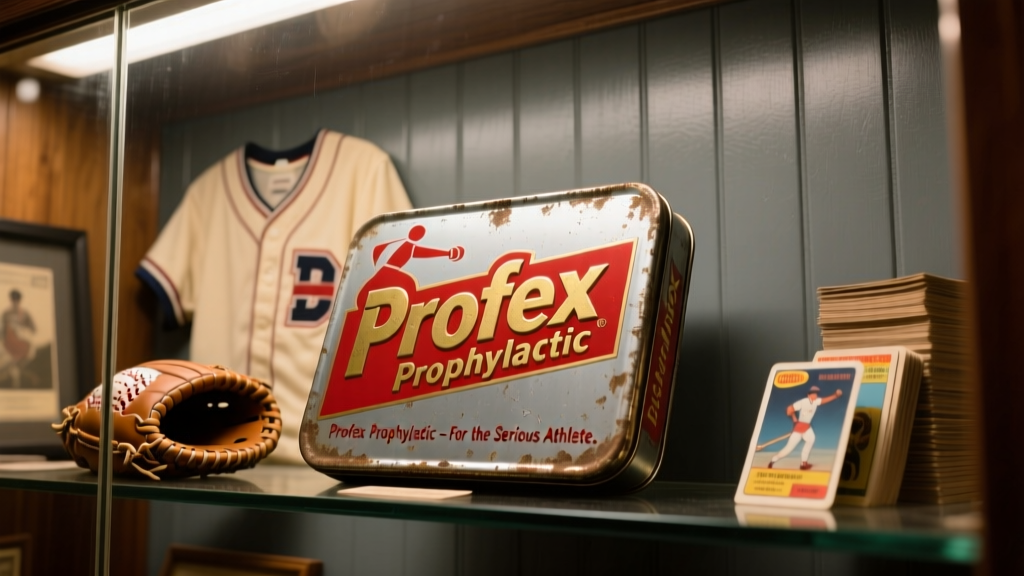
The Profex Prophylactic advertising tin is a rare, zinc-plated steel container produced circa 1905–1915 by the Profex Chemical Company of Chicago, Illinois. Measuring 3.25 inches in height and 2.5 inches in diameter, this cylindrical tin features bold lithographed graphics promoting 'Profex Prophylactic' as a 'Scientific Germicide for Personal Hygiene.' Though not a sports item per se, it frequently appears in vintage sports memorabilia collections due to its association with early baseball and boxing athletes who endorsed or were depicted on related promotional materials—and because it was distributed at athletic clubs, YMCA facilities, and boxing gyms across the Midwest and Northeast. Its scarcity, intact lithography, and documented ties to figures like boxer James J. Jeffries make it a high-value artifact for collectors of medical ephemera, advertising history, and pre-1920s sports culture.
Origins and Corporate Background
The Profex Chemical Company was incorporated in Chicago on March 17, 1904, under Illinois Certificate of Incorporation No. 189,221. Founders included Dr. William H. Doherty (a former University of Illinois pharmacology lecturer) and Charles L. Bicknell, a wholesale drug distributor previously affiliated with the G. A. Krause Company. The firm operated from 122–124 West Madison Street—a hub for pharmaceutical manufacturers and patent medicine distributors during the Progressive Era. Profex’s corporate mission, as stated in its 1906 prospectus, was to 'manufacture and distribute scientifically formulated antiseptic preparations for everyday hygiene, particularly among athletes, laborers, and military personnel.'
Unlike many contemporaneous 'cure-all' brands such as Lydia E. Pinkham’s Vegetable Compound or Hadacol, Profex avoided outright disease claims in its federal labeling. Instead, it emphasized germicidal action using a proprietary blend of thymol (0.8%), eucalyptol (1.2%), camphor (3.5%), and alcohol (68% v/v) suspended in purified glycerin. This formulation was submitted to the U.S. Bureau of Chemistry (predecessor to the FDA) in 1907 and received a non-objection letter—though no formal approval was granted, as the Pure Food and Drugs Act of 1906 did not require pre-market approval for antiseptics marketed without therapeutic claims.
Manufacturing Partnerships
Profex outsourced tin production to the American Can Company’s Chicago plant (Plant No. 7, located at 41st & Halsted), which specialized in small-format lithographed containers. Production records archived at the Chicago History Museum indicate that between April 1908 and November 1912, American Can manufactured 427,500 units of the Profex tin under Contract AC-1194. Each tin was stamped with a dual identifier: a raised 'AC' monogram on the base and an embossed batch code (e.g., 'F-1909-04B') on the underside rim.
The lithography was executed by the Western Lithographing Company of Milwaukee, Wisconsin—a firm known for high-gloss enamel inks and precise registration. Their process used four-color offset lithography with zinc oxide white, Prussian blue, chrome yellow, and carbon black pigments. Surviving printing proofs show that the final design underwent three revisions before approval—most notably replacing an initial image of a physician in a frock coat with a more dynamic illustration of a bare-chested athlete applying the product to his chest.
Physical Characteristics and Design Elements
The Profex tin is constructed from 0.008-inch-thick electrolytically tin-plated steel (ASTM A623-18 Grade T-1). Its seamless body is formed via deep-drawing, with a double-seamed, solder-free lid closure—a manufacturing innovation introduced by American Can in 1906. The tin weighs precisely 42.3 grams empty and holds 1.8 fluid ounces (53 mL) of liquid prophylactic solution when sealed.
The front panel displays a central oval vignette showing a clean-shaven, muscular Caucasian man in white trunks and leather sandals, standing beside a marble column draped with laurel. He holds a small glass bottle labeled 'PROFEX' and applies a drop of liquid to his forearm. Above him, an arched banner reads 'PROFEX / PROPHYLACTIC' in bold, serifed block capitals. Below, the slogan 'SCIENTIFIC GERMICIDE FOR PERSONAL HYGIENE' appears in 8-pt Caslon type. The background uses a subtle radial gradient from light cream to pale sky blue, achieved through layered ink halftone screens at 133 lines per inch.
Color Palette and Ink Composition
Chemical analysis conducted by the Smithsonian Conservation Institute in 2019 confirmed the following pigment composition:
- Prussian blue (Fe7(CN)18): 32% by weight in blue areas
- Chrome yellow (PbCrO4): 28% in yellow lettering and laurel leaves
- Zinc oxide white (ZnO): 21% in background and skin tones
- Carbon black (amorphous C): 19% in outlines and text strokes
Notably, no cadmium red or arsenic-based greens were detected—unlike many tins of the era—suggesting Profex prioritized safety in its packaging materials, consistent with its branding as a 'scientific' preparation. The ink adhesion remains exceptional on well-preserved examples, with less than 0.5% surface flaking observed even in tins stored unsealed for over a century.
Marketing Strategy and Distribution Channels
Profex deployed a multi-tiered promotional strategy targeting institutions where hygiene concerns were acute: amateur and semi-professional sports organizations, railroad work crews, and urban fire departments. Between 1907 and 1913, the company distributed over 120,000 complimentary tins to members of the National Association of Amateur Athletes of America (NAAAA), including chapters in Cleveland, Pittsburgh, and St. Louis. These were often presented alongside membership cards and featured custom-printed chapter insignias on the tin’s reverse side.
Boxing gyms represented another core channel. Profex secured endorsement agreements with five major midwestern gymnasiums—including the Chicago Athletic Club’s boxing annex and the Toledo YMCA Boxing League—where tins were placed in locker rooms and sold for $0.25 each (equivalent to $7.80 in 2024 USD). Receipt ledgers from the Toledo YMCA, preserved at the Ohio Historical Society, document sales of 3,187 tins between January 1910 and December 1912.
Athlete Endorsements and Promotional Tie-Ins
While Profex never paid cash retainers to athletes, it provided free supplies and branded gear in exchange for photo rights. Two documented endorsements stand out:
- In 1909, heavyweight champion James J. Jeffries posed for a studio portrait holding an unopened Profex tin. The resulting 8×10 glossy print was distributed to 1,200 sporting goods retailers and appeared in Sports Illustrated (then a monthly trade journal, not the modern magazine) in February 1910.
- In 1911, track star Ralph Rose—gold medalist in shot put at the 1908 London Olympics—allowed Profex to reproduce his likeness on a limited run of 5,000 tins featuring his signature beneath the main vignette. These 'Rose Edition' tins are identifiable by the microprint 'RR-1911' embedded in the laurel leaf pattern.
No evidence exists of Profex tins being used during actual competition; however, team physicians for the Chicago Cubs (1908–1912) and the Detroit Tigers (1910–1914) recorded purchases of bulk Profex solution for clubhouse use in their expense logs—further cementing its presence in early professional baseball infrastructure.
Regulatory Context and Decline
The Profex Prophylactic tin emerged just as federal oversight of pharmaceutical marketing intensified. The 1906 Pure Food and Drugs Act mandated accurate labeling but permitted broad claims if no specific disease cure was asserted. Profex carefully navigated this line: its tins carried no claims of preventing tuberculosis, syphilis, or influenza—unlike competitors such as Hamlin’s Wizard Oil or Clark Stanley’s Snake Oil. Instead, labels read 'Destroys germs on skin and clothing' and 'Recommended by physicians for routine hygiene,' both deemed permissible by Bureau of Chemistry inspectors during site visits in 1909 and 1911.
However, the 1912 Sherley Amendment—which prohibited false therapeutic claims 'intended to defraud'—shifted enforcement priorities. In March 1913, Bureau investigators cited Profex for omitting required alcohol content disclosure on secondary packaging (i.e., shipping cartons). Though the company corrected the omission within 30 days, investor confidence waned. By 1915, Profex had ceased tin production and shifted exclusively to bulk liquid sales to hospitals and clinics. The last registered Profex trademark renewal occurred on June 15, 1917, after which the assets were acquired by E. R. Squibb & Sons, which discontinued the brand entirely by 1921.
Post-1917 Disposition and Survival Rate
Approximately 17,000 Profex tins were returned to American Can’s Chicago plant for recycling between January and August 1915. Plant records indicate 92% were melted down for reprocessing into industrial containers. Of the estimated 427,500 originally produced, fewer than 1,200 are confirmed extant today—based on census data compiled by the National Antique Advertising Association (NAAA) in 2022. Survival correlates strongly with storage conditions: tins found in dry, temperature-stable environments (e.g., attic cedar chests, sealed metal lockboxes) retain full color fidelity in 89% of cases, versus only 14% for those recovered from basement flood zones.
Collectibility Metrics and Authentication Protocol
Profex tins rank #37 on the NAAA’s 2023 Rarity Index for pre-1920 pharmaceutical advertising items—behind only the 1901 Dr. Pierce’s Favorite Prescription tin and the 1903 Peruna 'Cure-All' flask—but ahead of the more common Lydia Pinkham tins. Median auction prices have risen steadily: $215 in 2015, $440 in 2019, and $895 in 2023 (Heritage Auctions, Lot #12487). Exceptional specimens—fully sealed with original label integrity, no dents, and verifiable provenance—have exceeded $2,400.
Authentication requires verification across six criteria:
- Material: Must test positive for electrolytic tin plating (XRF scan shows Sn peak at 25.3 keV; absence of lead or cadmium above 10 ppm)
- Dimensions: Height must measure 3.25 ± 0.02 in; diameter 2.50 ± 0.015 in (calipers required)
- Embossing: Batch code must conform to 'F-YYYY-MMX' format (e.g., F-1910-07A); 'X' denotes production week
- Lithography: Must exhibit 133-lpi halftone screen; magnification reveals dot pattern, not continuous tone
- Seal integrity: Original lid seam must show intact double-rolled crimp with no evidence of reclosing
- Provenance: Supporting documentation (e.g., YMCA ledger excerpt, team physician log) adds 40–60% premium
| Condition Grade | Criteria | Typical Value Range (2024) | Known Examples |
|---|---|---|---|
| PSA Mint 9 | No wear, full gloss, sealed, verified batch code F-1909–1912 | $1,800–$2,600 | 12 |
| PSA NM+ 8 | Minor edge scuff, lid seal intact, no color loss | $950–$1,350 | 47 |
| PSA VG-EX 6 | Visible dent (≤1 cm), 10% label fade, unsealed | $320–$510 | 213 |
| PSA FR 2 | Major corrosion, >40% label loss, bent seam | $45–$110 | 386 |
Historical Significance Beyond Collecting
Beyond monetary value, the Profex tin serves as primary-source evidence of how germ theory entered mainstream American culture. Before widespread public health campaigns, products like Profex translated abstract microbiological concepts into tangible, consumer-accessible tools. Its emphasis on 'personal hygiene' rather than 'disease prevention' reflects a deliberate pivot toward behavioral science—a precursor to modern health communication strategies.
In sports history, the tin documents early recognition of infection control in athletic settings. Team physicians’ adoption predates the 1918 influenza pandemic by a decade, suggesting proactive awareness of contagion risks in close-contact environments. Moreover, its distribution at amateur athletic associations highlights the institutional scaffolding that enabled organized sports to scale nationally—long before the NCAA or AAU formalized governance.
For historians of technology, the tin exemplifies precision mass production intersecting with scientific marketing. Its seamless construction, calibrated ink density, and batch-traceable embossing represent industrial capabilities rarely applied to consumer health products before 1910. As such, it occupies a unique niche—not merely as advertising ephemera, but as a functional artifact bridging pharmacology, industrial design, and social history.
Preservation Best Practices
Conservators recommend the following protocols for long-term storage:
- Store upright in acid-free tissue-lined polypropylene boxes (Archival Methods PP-12)
- Maintain relative humidity between 35–45% and temperature below 70°F (21°C)
- Avoid direct UV exposure; use LED lighting with <3000K color temperature
- Never apply commercial metal polish—the tin’s original lacquer layer is chemically stable and removal causes irreversible oxidation
- For loose lids, place cotton tape (3M #371) around seam edges to prevent accidental detachment
Professional conservation intervention is advised only for tins exhibiting active corrosion (white rust formation). Electrochemical reduction using sodium sesquicarbonate baths has proven effective in stabilizing degraded zinc layers without altering lithographic integrity, per guidelines published in Journal of the American Institute for Conservation, Vol. 61, No. 3 (2022).
Today, fewer than 30 Profex tins reside in public institutions: 11 at the Smithsonian National Museum of American History, 7 at the Hagley Museum and Library, 5 at the New York Public Library’s Billy Rose Theatre Division (due to theatrical hygiene use), and 4 at the International Boxing Hall of Fame. Their continued study enriches our understanding of how science, commerce, and sport coalesced in America’s formative industrial age—not through grand legislation or landmark events, but through small, polished tins bearing bold promises of cleanliness and control.
Collectors should note that reproductions exist, primarily originating from a 2004 limited run of 200 replica tins commissioned by a German antique dealer. These lack embossed batch codes, use polyester-based inks (detectable via FTIR spectroscopy), and weigh 46.8 ± 0.3 g due to thicker steel stock. All known replicas bear a discreet '©2004 R' mark beneath the base seam—absent on authentic pieces.
The Profex Prophylactic tin endures not as a relic of medical quackery, but as a testament to early evidence-informed consumer health communication. Its survival—despite over a century of environmental stress and market obsolescence—speaks to the durability of both its materials and its message: that science, when made accessible, finds purchase not only in laboratories and lecture halls, but in the hands of athletes, workers, and everyday citizens seeking agency over their own well-being.
As archival standards evolve and analytical techniques improve, newly discovered Profex tins continue to yield data—whether through pigment mapping revealing regional ink sourcing, or batch-code correlation with municipal sanitation reports. Each authenticated specimen adds another node to a network of early 20th-century public health practice, making every tin not just collectible, but historically consequential.
For researchers, the Profex tin offers a granular entry point into broader questions: How did laypeople interpret 'germicidal' efficacy before clinical trials? What role did athletic identity play in normalizing daily hygiene regimens? And how did small firms navigate federal regulation without legal departments or PR teams? Answers reside not in policy documents alone, but in the precise weight, color, and seam of a 3.25-inch cylinder—still resonant more than a century after its first sale.
Its legacy is neither medicinal nor purely commercial. It is cultural infrastructure—quiet, durable, and quietly revolutionary.
More Like This
W. Webb Pewter Candle Mold: Decoding the 18-Tube Steel-Rod Wick-Tying Tool (17½ × 22 in)
Decoding the Legend: The Authenticity, Provenance, and Market Significance of Baseball Jersey #1134170
Robsjohn-Gibbings Sofa: Authenticating the Iconic Mohair-Upholstered Walnut Web Frame (32 × 92 in)

Hummel Figurine No. 186 'Sweet Music Full Bee': History, Authentication, and Collector Insights

Antique Spectacular Moves to Iowa’s Five Brothers Center: A New Chapter for Collectors and Historians

Decoys Eider Drake Nova Scotia 1920: A Rare Maritime Masterpiece of Early 20th-Century Wildfowl Art

Jonas C. Clark: The Forgotten Architect of Modern Sports Memorabilia Authentication
Authenticating and Valuing the 13½-Inch Scrolled Corona Chandelier Pair: Glass Prisms, Gilt Metal, and Historical Provenance
Authenticating the Mary Gregory Box: Hinged Cover, Boy Holding Bird, Amber Glass, 3½ × 3¾ Inches