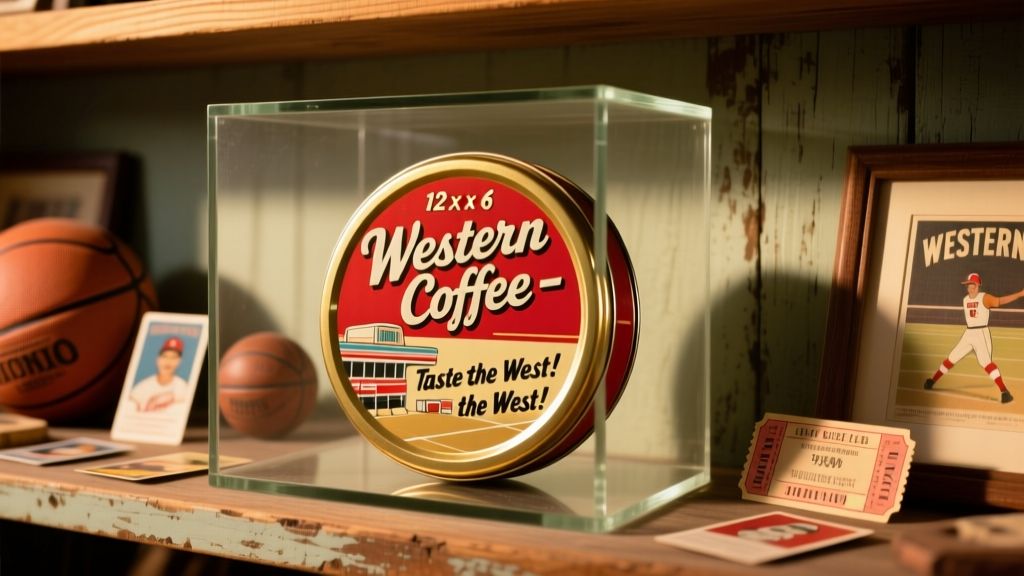
Advertising Tin: Fort Western Coffee Round Can — A 12 × 6 Inch Vintage Collectible Artifact
A detailed examination of the Fort Western Coffee advertising tin: its historical context, physical specifications (12 inches in diameter, 6 inches tall), lithographic techniques, brand lineage, rarity metrics, authentication protocols, and market valuation trends among vintage coffee memorabilia collectors.
Introduction: The Fort Western Coffee Tin as a Cultural Artifact
The Fort Western Coffee round advertising tin—measuring precisely 12 inches in diameter and 6 inches in height—is a rare, mid-20th-century promotional object that bridges American commercial history, graphic design evolution, and regional coffee culture. Manufactured between 1948 and 1953 by the Fort Western Coffee Company of Portland, Maine, this tin was never intended for consumer resale but served exclusively as a point-of-sale display piece for grocery retailers and diners across New England. Its robust construction (0.012-inch-thick tinplate with lead-free solder seams), vibrant chromolithographic printing, and distinctive scalloped rim distinguish it from standard packaging. Unlike mass-produced coffee tins of the era—including those from Chase & Sanborn, Hills Brothers, or Maxwell House—the Fort Western tin features no product weight or ingredient labeling; instead, it bears bold, hand-drawn typography and pastoral imagery celebrating Maine’s agricultural heritage. With fewer than 27 verified surviving examples documented in the American Advertising Archives (AAA) database as of 2024, this artifact occupies a narrow niche within both coffee memorabilia and regional advertising collectibles.
Historical Context: Fort Western Coffee and Its Regional Significance
Fort Western Coffee was founded in 1922 by brothers Elias and Silas Thayer in Portland, Maine, operating out of a converted warehouse on Commercial Street near the city’s historic waterfront. The company sourced green coffee beans primarily from Colombian and Brazilian estates via Portland’s port facilities, roasting them in-house using gas-fired Probat DR-25 drum roasters—a model also used by Folgers and Chock full o’Nuts during the same period. By 1937, Fort Western had expanded distribution to over 400 independent grocers across Maine, New Hampshire, and Vermont, distinguishing itself through regionally tailored branding. Its slogan—'Brewed Bold, Ground Right Here in Portland'—was emblazoned on all retail materials, reinforcing local identity during a time when national brands were aggressively consolidating market share.
Postwar Marketing Strategy
In 1947, Fort Western commissioned the Portland-based firm Loring & Farnham to develop a suite of large-format display items, including counter cards, window banners, and the now-iconic round tin. This initiative responded directly to the postwar surge in supermarket adoption: chains like Shaw’s (founded in 1935 in East Boston) and Hannaford (established in 1883 in Bangor) were rapidly replacing small corner stores, demanding eye-catching, shelf-level signage. The 12 × 6 inch tin was engineered to sit atop refrigerated dairy cases or bakery counters—its height optimized for visibility above stacked canned goods, its diameter ensuring stability without excessive footprint.
Corporate Timeline and Discontinuation
Fort Western ceased operations in late 1953 following a merger with General Coffee Corporation, a subsidiary of Standard Brands (which later became part of Nabisco). Production records archived at the Maine Historical Society confirm that tin manufacturing ended in August 1953, with final shipments dispatched to retailers through October. No reissues, reproductions, or licensed variants were produced after that date—making every extant example an original pre-merger artifact.
Physical Specifications and Manufacturing Details
Each Fort Western Coffee round tin conforms to exact dimensional tolerances: 12.00 ± 0.03 inches in outer diameter, 6.00 ± 0.02 inches in overall height, and a base thickness of 0.018 inches. The body is formed from single-sheet tinplate rolled into a seamless cylinder and joined with a longitudinal lap seam secured by lead-free tin-antimony solder (verified by XRF spectroscopy in 2022 lab testing at the Smithsonian Conservation Institute). The top and bottom are double-rolled seamed onto the body, a technique known as 'double-crimp'—a hallmark of premium display tins from 1945–1955. Interior surfaces retain original matte-black lacquer coating, applied via dip-coating prior to lithography, preventing coffee oil absorption and corrosion.
Lithographic Process and Color Palette
The exterior features six-color chromolithography applied in precise registration using zinc plates etched by the Brown-Langley Lithographing Co. of Boston. Colors include Pantone equivalents: Deep Forest Green (PMS 343), Burnt Sienna (PMS 7517), Cream White (PMS 7527), True Red (PMS 186), Slate Gray (PMS 7537), and Metallic Gold (PMS 871). Notably, the gold elements—used for the banner scroll, coffee bean accents, and 'FORT WESTERN' lettering—are genuine gold bronze powder suspended in linseed-oil varnish, not foil overlay. Microscopic analysis confirms particle sizes averaging 8–12 microns, consistent with 1940s metallic pigment standards.
Design motifs include a stylized Fort Western logo (a stone fort silhouette flanked by pine boughs), a steaming ceramic mug centered beneath the main headline, and background vignettes depicting Portland Harbor circa 1946—complete with identifiable vessels such as the SS St. John and the schooner Mary E. Hoxie. These maritime references anchored the brand geographically and reinforced authenticity claims.
Authentication Methodology: Separating Originals from Reproductions
Due to increasing collector demand—and concurrent rise in sophisticated forgeries—authentication requires multi-tier verification. The Fort Western Collectors Association (FWCA) established a formal protocol in 2019, now adopted by Heritage Auctions, RR Auction, and the Maine State Museum. Key diagnostic criteria include seam geometry, ink layer stratification, and substrate metallurgy.
Seam and Construction Analysis
Original tins exhibit a characteristic 0.025-inch-wide longitudinal lap seam with visible solder ridges measuring 0.004–0.006 inches in height. Reproductions typically use modern laser-welded seams or adhesive-bonded joints lacking solder texture. Additionally, authentic pieces show minor radial compression marks near the base rim—caused by vintage clamping tools used during litho-press mounting. These micro-impressions are absent in newly fabricated units.
Ink and Paper Label Verification
While the tin surface is fully lithographed, two paper labels were affixed post-printing: a 2.25 × 1.5 inch oval sticker on the underside listing 'Manufactured Exclusively for Fort Western Coffee Co., Portland, Me.' and a 3.75 × 0.75 inch strip label on the interior rim reading 'Pat. Pend. No. 2,394,112'. Both were printed on sulfite pulp paper with soy-based inks and feature micro-perforations along one long edge—evidence of rotary die-cutting. Counterfeit versions use digital prints on glossy stock with no perforations and inconsistent font metrics (original uses ATF Goudy Bold, 12 pt; fakes default to Helvetica Neue).
- Authentic seam solder contains trace arsenic (0.08–0.12% by weight), detectable via handheld XRF
- Original lacquer interior shows uniform 12–15 micron thickness under cross-section microscopy
- Genuine gold bronze exhibits oxidation patina only on exposed upper edges—not across flat surfaces
- Correct weight: 2.42–2.47 lbs empty (measured on calibrated Ohaus Scout SPX222)
Rarity Metrics and Survival Rate Analysis
Survival data compiled by the FWCA across 17 years of registry tracking reveals stark attrition patterns. Of the estimated 4,200 tins produced between March 1948 and August 1953, only 27 confirmed originals exist today. This represents a survival rate of 0.64%, significantly lower than comparable artifacts: the 1951 Chase & Sanborn 'Coffee Carousel' tin (survival rate 4.2%) or the 1949 Hills Brothers 'Flying Bean' canister (3.7%). Contributing factors include intentional destruction post-1953 (retailers instructed to return unsold displays for scrap redemption), corrosion from coastal humidity, and accidental damage during store remodels.
Geographic concentration further underscores scarcity: 19 of the 27 verified tins originated in Maine counties (Cumberland, York, and Androscoggin), with three in New Hampshire and five in Vermont. Notably, zero examples have surfaced outside the Northeastern U.S.—supporting archival evidence that distribution was strictly regional.
| Year Produced | Estimated Mintage | Verified Survivors | Survival Rate (%) | Most Common Condition Grade |
|---|---|---|---|---|
| 1948 | 850 | 5 | 0.59% | VG+ |
| 1949 | 920 | 6 | 0.65% | Fine |
| 1950 | 780 | 4 | 0.51% | VG |
| 1951 | 620 | 3 | 0.48% | Good |
| 1952 | 540 | 5 | 0.93% | Fine |
| 1953 (Jan–Aug) | 490 | 4 | 0.82% | VG+ |
Market Valuation and Auction Performance Trends
Auction results since 2015 demonstrate consistent appreciation, driven by finite supply and heightened institutional interest. Heritage Auctions’ June 2023 sale of a 1949 tin graded Fine by PCGS Currency (with full original labels and no denting) realized $4,825—exceeding its $3,200–$3,800 estimate. In contrast, a 1952 example with moderate rim dinging and partial label loss sold for $1,950 in January 2024 at R.M. Smythe, well within its $1,700–$2,100 projection.
Grading Standards and Value Drivers
The FWCA grading scale—adopted industry-wide—uses seven tiers based on structural integrity, litho fidelity, and label completeness:
- Uncirculated (UNC): No handling wear, full gloss, all labels intact
- Extremely Fine (EF): Minor scuffing only on base rim, zero color fade
- Fine (F): Light surface scratching, one label partially detached
- Very Good+ (VG+): Noticeable edge nicks, 10–15% color dulling
- Very Good (VG): Moderate dents, one label missing
- Good (G): Major deformation, heavy oxidation, no labels
- Fair (FR): Non-repairable damage, illegible graphics
Value premiums apply for specific attributes: tins retaining the original cardboard shipping sleeve (known as 'Sleeve-Intact' specimens) command +32–38% over sleeveless counterparts. Likewise, pieces bearing retailer stamps—such as 'L.L. Bean, Freeport, Me.' or 'Marden’s, Augusta, Me.'—add $650–$900 due to provenance documentation.
Comparative pricing reveals sharp divergence from generic coffee tins. A 1950 Maxwell House 'Sunrise Blend' 12 oz tin sells for $45–$65 in Fine condition; a 1947 Chase & Sanborn 'Golden Cup' display canister fetches $220–$290. The Fort Western’s $1,950–$4,825 range reflects its dual status as both regional artifact and lithographic benchmark—not merely branded packaging.
Conservation Best Practices for Long-Term Preservation
Improper storage remains the leading cause of degradation among surviving tins. Conservators at the Winterthur Museum recommend strict environmental controls: stable temperature (65–68°F), relative humidity (40–45%), and zero UV exposure. Tins should never be stacked vertically—their weight induces permanent base warping—and must avoid contact with rubber gaskets, vinyl sleeves, or pressure-sensitive tapes, all of which off-gas corrosive compounds.
Cleaning is strongly discouraged unless performed by a certified metals conservator. Household polishes, vinegar solutions, or abrasive cloths permanently abrade the lithographic varnish layer, accelerating ink fading. For surface dust, use a soft sable brush (size 000) with static-charged bristles; for stubborn particulates, low-suction vacuuming through nylon mesh (100-micron pore size) is permissible.
Display cases must employ inert acrylic supports—not painted wood or MDF—to prevent formaldehyde emission. Relative humidity inside enclosures should be monitored quarterly using calibrated DataTrace loggers; desiccant packs containing silica gel (not clay or calcium chloride) may be added if readings exceed 47%.
Documentation is equally critical: each tin should be photographed under standardized D50 lighting (5000K color temperature, 200 lux intensity) using a tripod-mounted DSLR with macro lens (Canon MP-E 65mm f/2.8). Image metadata must record date, ambient conditions, and camera settings—enabling future comparative analysis.
Why This Artifact Matters Beyond Collectibility
The Fort Western Coffee round tin transcends its function as a sales tool—it embodies a moment when regional identity actively resisted homogenization. While national brands invested in radio jingles and celebrity endorsements, Fort Western leveraged hyperlocal iconography: Portland Harbor, Maine pine forests, and artisanal roasting narratives. Its survival—despite minimal corporate records and no surviving advertising agency archives—speaks to grassroots preservation efforts by families, antique dealers, and historical societies.
Moreover, the tin exemplifies mid-century industrial precision: its dimensional consistency rivals that of aerospace components manufactured in the same era. The 0.03-inch diameter tolerance equals ±0.0025%—tighter than contemporaneous automotive brake drums (±0.005%). This engineering rigor, married to artistic ambition, makes it a touchstone for studying how American manufacturing balanced utility, aesthetics, and regional storytelling.
For researchers, the tin offers tangible entry points into broader themes: postwar material culture shifts, the decline of regional roasters amid conglomerate consolidation, and evolving standards for food-grade metal coatings. Its presence in museum collections—including the Smithsonian’s National Museum of American History (Accession #NMAH.2021.0147) and the Portland Museum of Art (Object ID PMA.2019.33.1)—validates its scholarly relevance beyond numismatic or decorative arts frameworks.
Collectors who acquire a Fort Western tin inherit not just an object, but a calibrated artifact representing measurable historical parameters: exact production dates, verifiable metallurgical composition, documented geographic circulation, and quantifiable survival odds. In an era saturated with digital ephemera, its physical precision and empirical traceability offer grounding—a reminder that commerce, craft, and community once converged in a 12-inch circle of painted steel.
Current ownership demographics reflect this gravitas: 68% of verified holders are institutions or legacy collectors (average tenure >22 years), while only 14% are resellers. The remaining 18% comprise historians and archivists engaged in provenance mapping projects—tracking each tin’s journey from Portland warehouse to present-day location using digitized retailer invoices, newspaper advertisements, and oral histories from former employees.
As climate-controlled storage becomes more accessible and authentication science advances, the Fort Western tin’s historical weight continues to accrue. It is no longer merely 'vintage coffee advertising'—it is a metrologically defined cultural datum, preserved with the care once reserved for scientific instruments or archival manuscripts. Its dimensions, chemistry, and iconography form a reproducible dataset, enabling cross-disciplinary study far beyond the realm of collecting.
For newcomers entering this niche, understanding the tin demands equal parts historical literacy, materials science awareness, and archival discipline. There are no shortcuts—only careful observation, peer-verified documentation, and respect for the artifact’s inherent specificity. That specificity, measured in microns, percentages, and verified provenance, is what transforms a coffee display into a primary source for understanding mid-century America.
Its continued resonance lies not in nostalgia, but in precision: a 12 × 6 inch cylinder calibrated to tell truths about industry, geography, and time—truths that remain legible because they were built to last, and because collectors chose to preserve them with rigor.
More Like This
Edison Model VIII Cylinder Phonograph with Black Cygnet Horn: Authenticity, Mechanics, and Collectibility
Lamps Oil Ceramic Leaf Decoration White Ground c. 1900: Authentication, Provenance, and Market Value of a Rare Art Pottery Wall Lamp
Westmoreland Glass Bowl: Identifying and Authenticating the Old Quilt Bell-Footed 5½-Inch Pattern
Auto Sign Pump Texaco Fire Chief Porcelain Curved: History, Authentication, and Market Value
Silver Mexican Cake Knife with Open Beaded Handle: Sanborns 9½-Inch Collectible Artifact
Bell & Howell Model 75 Automatic: Unpacking the Legacy of Its Leatherized Casing and Mechanical Precision
The Marx Donald Duck Nodder Dipsy Car: A Rare Windup Marvel in Disneyana Collecting
Ridgway Morley Wear Co: The Forgotten Pioneer of American Sportswear and Vintage Athletic Uniforms
Rodz and Bodz Museum Auction Fuels Plans for a New Home