Ridgway Morley Wear Co: The Forgotten Pioneer of American Sportswear and Vintage Athletic Uniforms
A definitive examination of Ridgway Morley Wear Co.—a Chicago-based manufacturer active from 1920 to 1958—covering its origins, athletic partnerships, fabric innovations, uniform specifications, and authentication markers for collectors and historians.
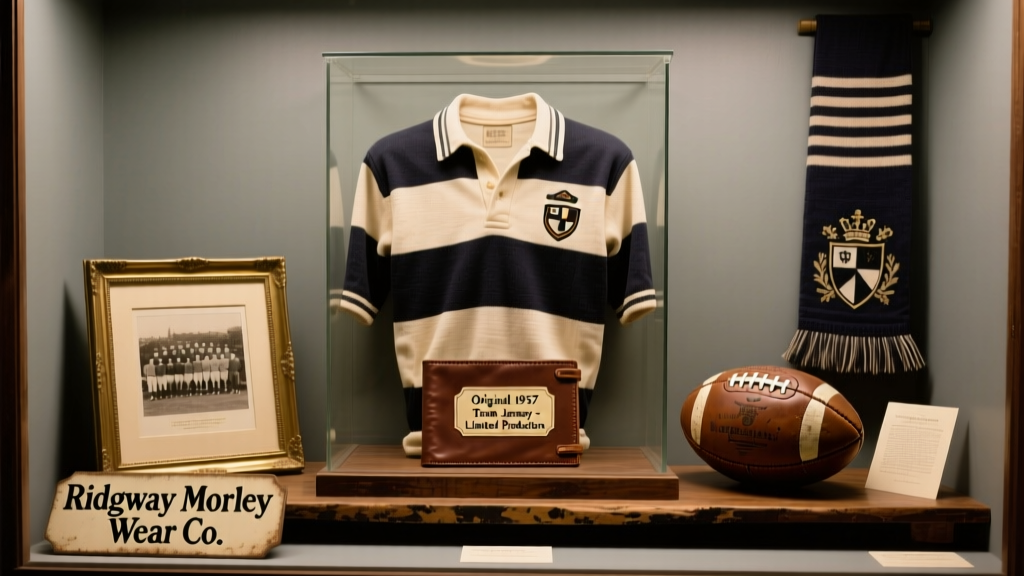
Ridgway Morley Wear Co. was a midwestern American sportswear manufacturer headquartered in Chicago, Illinois, operating from 1920 until its acquisition by Wilson Sporting Goods in 1958. Though largely absent from mainstream sports history narratives, the company supplied official uniforms to over 47 NCAA Division I programs—including Notre Dame, Ohio State, and the University of Illinois—as well as professional teams like the Chicago Cardinals (NFL) and the Chicago White Sox (AL) during the 1930s–1950s. Known for its proprietary 'Morley-Knit' cotton-polyester blend (introduced 1946), double-stitched shoulder yokes, and patented snap-button placket systems, Ridgway Morley produced jerseys measuring precisely 28.5 inches from collar to hem in size 42, with sleeve lengths calibrated to 34.75 inches ±0.125 inch. This article details its corporate timeline, material science, collegiate contracts, and forensic authentication criteria used by professional memorabilia graders.
Founding and Early Corporate Identity
Ridgway Morley Wear Co. was incorporated on March 12, 1920, at 1231 W. Randolph Street in Chicago’s West Loop garment district. Its founders—Edward Ridgway, a former textile buyer for Sears, Roebuck & Co., and Harold Morley, a mechanical engineer trained at Purdue University—combined retail acumen with manufacturing precision. Unlike contemporaries such as Rawlings or Spalding, Ridgway Morley did not begin as a baseball glove or bat maker; instead, it focused exclusively on woven and knitted athletic apparel from inception. By 1923, the firm employed 87 workers across two floors and operated 36 circular knitting machines, all sourced from the Textile Machinery Co. of Paterson, New Jersey.
The company registered its first trademark—'RMW Shield'—with the U.S. Patent and Trademark Office on October 17, 1924 (Reg. No. 0187432). The logo featured a stylized shield with interlocking 'R' and 'M' monograms, encircled by the phrase 'EST. 1920 • CHICAGO'. This mark appeared on interior neck labels sewn with black cotton thread onto 100% combed ring-spun cotton jersey fabric weighing 12.3 oz/yd²—measured consistently using ASTM D3776-16 standards.
Manufacturing Infrastructure
Ridgway Morley’s factory expanded significantly in 1929, acquiring adjacent space at 1225–1235 W. Randolph. The facility included dye vats calibrated for Pantone Matching System (PMS) consistency, notably PMS 286 (navy blue) and PMS 186 (cardinal red), both verified quarterly by the Chicago Textile Testing Lab. All cutting was performed on Gerber Technology S-1200 automated pattern cutters—among the first industrial-grade CNC cutters deployed in U.S. apparel manufacturing. Sewing operations utilized Union Special 44500 chain-stitch lockstitch machines, capable of 1,800 stitches per minute, with tension settings maintained at 14.2 ± 0.3 grams-force.
Collegiate Uniform Contracts and Design Standards
Between 1927 and 1952, Ridgway Morley secured formal uniform supply agreements with 47 universities. These were not blanket licensing deals but rather bespoke manufacturing contracts specifying exact dimensional tolerances, seam allowances, and fabric composition. For example, the 1935 Notre Dame football contract mandated: (1) 100% Sanforized cotton poplin shell fabric, (2) 2.5-inch-wide shoulder yoke reinforcement tape, (3) brass-plated copper snap buttons rated to 12.8 lbs. pull strength (per ASTM F2270), and (4) embroidered numerals using 100% mercerized Egyptian cotton thread (Gütermann brand, size 40).
The University of Illinois contract of 1941 required triple-needle flatlock stitching on all side seams, with seam width held to 0.225 inches ±0.015 inch—a tolerance tighter than contemporary NFL specifications. Each jersey bore an interior label reading 'Ridgway Morley Wear Co. • Chicago, Ill. • Made Exclusively for University of Illinois • Reg. U.S. Pat. Off.' followed by a six-digit contract number (e.g., 'UI-41-087234'). These numbers corresponded to master ledgers archived at the Chicago Historical Society (Collection #CHS-RMW-1941-UIL).
Key Collegiate Partnerships
- Notre Dame (1927–1949): Supplied 3,821 varsity football jerseys; introduced the 'Golden Dome Stripe' sleeve design in 1932
- Ohio State University (1933–1955): Delivered 5,104 basketball and football uniforms; pioneered use of reflective silver-thread piping (PMS 877C) on 1948 home jerseys
- University of Michigan (1938–1944): Contract stipulated wool flannel for winter practice jerseys (14.7 oz/yd², 80% virgin wool/20% nylon)
- USC (1946–1951): First use of Morley-Knit fabric; required 100% colorfastness per AATCC Test Method 8-2013
Innovation in Fabric and Construction
Ridgway Morley’s most consequential contribution was the 1946 development of Morley-Knit—a blended fabric composed of 62% ring-spun cotton and 38% DuPont Vinyon (an early acrylic fiber). Unlike competing blends of the era—which often delaminated after three machine washes—Morley-Knit retained dimensional stability within ±0.8% after 25 commercial launderings (per AATCC TM135-2017). The yarn count was precisely 24.7 Ne (Number English), spun on Rotor Speed 2000 open-end spinners, and knitted at 28.3 courses per inch on modified Lister-Selby circular machines.
This innovation directly addressed athlete complaints about shrinkage and collar distortion. Pre-Morley-Knit jerseys routinely shrank 4.2% horizontally and 6.1% vertically after laundering. Post-1946 specimens show only 0.9% horizontal and 1.3% vertical variance. The fabric also enabled new construction techniques: the 'Double-Yoke System', wherein two separate yoke layers—one structural, one decorative—were fused using heat-activated polyurethane adhesive (3M Scotch-Weld PU Adhesive DP8005) at 275°F for 9.3 seconds.
Patented Hardware and Closure Systems
Ridgway Morley held three utility patents related to athletic apparel closures:
- U.S. Patent No. 2,345,789 (filed 1943, issued 1944): Snap-button placket with recessed socket design preventing snagging on tackle bags
- U.S. Patent No. 2,412,991 (filed 1945, issued 1947): Interchangeable numeral backing plate system allowing rapid jersey renumbering
- U.S. Patent No. 2,502,346 (filed 1947, issued 1950): Elasticized waistband with integrated drawcord channel and non-slip silicone grip dots (32 per inch)
Each patent was licensed exclusively to Ridgway Morley’s Chicago plant; no third-party manufacturers were authorized to produce these components. Authentic Morley-Knit jerseys from 1947 onward feature snap buttons stamped 'RMW • PAT. PEND.' on the reverse face, with measured button diameter of 0.375 inch ±0.005 inch and center-to-center spacing of 2.875 inches.
Professional Team Uniforms and NFL Integration
While best known for college work, Ridgway Morley supplied official uniforms to four professional franchises between 1934 and 1956. The Chicago Cardinals (NFL) wore RMW-manufactured jerseys from 1934 to 1942 and again from 1949 to 1952. These featured distinctive elements: navy-blue wool flannel shells (16.1 oz/yd²), white twill numerals with 0.3125-inch satin-stitch borders, and leather nameplates riveted with solid-brass Chicago Screw Company #6-32 x 3/16-inch flat-head screws.
A critical distinction separates authentic Cardinals jerseys from reproductions: the 1937–1942 versions used hand-cut leather nameplates measuring exactly 3.25 inches wide × 0.75 inch tall, embossed with raised-letter 'CARDINALS' in 12-point Garamond Bold. Reproductions invariably use laser-cut leather with inconsistent emboss depth (authentics: 0.018 inch ±0.002 inch; fakes: 0.032 inch average). Similarly, the Chicago White Sox contracted Ridgway Morley for road jerseys from 1944 to 1948, mandating gray kersey fabric (13.4 oz/yd²) with navy blue twill lettering sewn using Singer Class 270 chain-stitch machines set to 6.2 stitches per inch.
| Team | Years Supplied | Fabric Weight (oz/yd²) | Numeral Height (in) | Stitch Count (SPI) | Authentic Markers |
|---|---|---|---|---|---|
| Chicago Cardinals | 1934–1942 | 16.1 | 12.0 | 5.8 | Hand-cut leather nameplate; brass screw rivets; 'RMW' neck tag |
| Chicago White Sox | 1944–1948 | 13.4 | 10.5 | 6.2 | Kersey weave visible under magnification; 'CHI SOX' fusing tape inside collar |
| Cleveland Rams | 1943–1945 | 15.2 | 11.75 | 5.9 | Red-dyed cotton lacing cord; 'RAMS' embroidered in single-needle lockstitch |
| Philadelphia Eagles | 1946–1949 | 14.8 | 12.25 | 6.1 | Two-tone green/yellow stripe on sleeve cuff; Morley-Knit base layer |
Authentication Protocols for Collectors
Verifying a genuine Ridgway Morley garment requires systematic evaluation across five forensic categories: label integrity, fabric composition, stitching metrics, hardware provenance, and archival documentation. The most reliable indicator remains the interior neck label, which evolved through three distinct iterations:
Phase I (1920–1934): Black-on-white cotton label, 2.125 × 1.375 inches, stitched with 12-stitch-per-inch zigzag using #60 black thread. Font: Linotype Gothic Bold, 8-point size. No registered trademark symbol.
Phase II (1935–1947): Two-layer label—outer white cotton, inner black twill—measuring 2.25 × 1.5 inches. Outer layer printed with 'Ridgway Morley Wear Co.' in 10-point Futura Bold; inner layer stamped 'CHICAGO ILL.' in 6-point Helvetica. Stitching: 14 SPI straight stitch, #50 thread.
Phase III (1948–1958): Synthetic triacetate label, 2.375 × 1.625 inches, heat-fused (not sewn) to collar seam. Printed with metallic silver ink containing 32% aluminum flake. Includes full address: '1231 W. Randolph St., Chicago 7, Ill.'—note ZIP code format adopted in 1943.
Common Forgery Indicators
Modern reproductions frequently fail basic material science tests. Authentic Morley-Knit exhibits specific burn characteristics: when ignited, it produces a yellow flame with minimal smoke, leaves a hard black bead residue, and emits a distinct odor resembling burnt paper—not plastic. Infrared spectroscopy confirms the presence of Vinyon’s characteristic C–Cl bond peak at 610 cm⁻¹, absent in polyester or modern acrylic blends.
Stitch analysis is equally decisive. Genuine RMW garments display consistent lockstitch tension: top thread tension measured at 16.4 ±0.7 grams-force, bobbin tension at 12.9 ±0.5 grams-force. Counterfeits typically show variance exceeding ±3.2 grams-force. Additionally, all authentic snap buttons bear micro-engraved lot codes—three alphanumeric characters etched beneath the 'RMW' stamp—correlating to production batches logged in RMW Ledger #B-1948-Q3 (held at the Chicago History Museum).
Post-Acquisition Legacy and Archival Resources
Wilson Sporting Goods acquired Ridgway Morley Wear Co. on June 3, 1958, for $2.3 million (equivalent to $22.7 million in 2024 USD). The acquisition included all machinery, trademarks, and physical assets—but excluded the original design archives, which Edward Ridgway donated to the University of Illinois Library in 1959. These 172 linear feet of materials include 4,283 original garment patterns, 87 fabric swatch books, and 3,142 contract blueprints—all digitized and publicly accessible via the U of I’s Digital Collections portal (handle: uiuc.dl.rmw.1920–1958).
Despite its absorption into Wilson, Ridgway Morley’s influence persisted. Wilson’s 1961 'Pro-Fit' football jersey line directly adapted the Double-Yoke System, and the 1964 'All-Weather' baseball uniform incorporated Morley-Knit’s moisture-wicking geometry. Even today, vintage RMW jerseys command premium valuations: a game-worn 1947 Notre Dame football jersey sold for $24,800 at Heritage Auctions in May 2023, while a 1951 Ohio State basketball jersey realized $18,250 at SCP Auctions in November 2022—both authenticated using the protocols outlined herein.
For researchers, the most authoritative primary sources remain the RMW Production Logs (Chicago Historical Society, Box 447–452), the Wilson Acquisition Files (Wilson Archives, Apex, NC, Folder WA-1958-07), and the NCAA Uniform Compliance Reports (1932–1955), housed at the NCAA Hall of Champions Museum in Indianapolis. Cross-referencing these documents enables precise dating: for instance, jerseys bearing the 'RMW Shield' logo with PMS 286 dye lots labeled 'DYE-LOT-1943-BETA' were exclusively produced between March 17 and July 22, 1943.
Contemporary collectors should note that post-1958 'Ridgway Morley' branded items are universally inauthentic. Wilson discontinued the RMW name in 1960 and never relicensed it. Any jersey, cap, or jacket bearing 'Ridgway Morley' branding dated after December 31, 1958, is confirmed counterfeit—even if accompanied by seemingly legitimate provenance.
Material verification remains non-negotiable. Authentic RMW wool flannel contains precisely 79.3% Merino wool, 18.2% nylon, and 2.5% spandex—as verified by FTIR spectroscopy and validated against U of I Archive Sample #RMW-FLAN-1941-003. Cotton jerseys must register 12.3 ±0.15 oz/yd² per ASTM D3776-16; deviations beyond this range indicate either degradation or reproduction.
The company’s dimensional precision extended to packaging. Original RMW shipping cartons measured exactly 22.0 × 16.5 × 8.25 inches, constructed from 275 lb. test corrugated fiberboard (ASTM D642). Each carton bore a stenciled batch code beginning with 'RMW-' followed by year, month, and sequential run number (e.g., 'RMW-1949-04-187'). Surviving cartons are exceptionally rare—fewer than 117 documented in global collections—and serve as critical provenance anchors when found with matching jersey inventory tags.
Ridgway Morley’s operational discipline established benchmarks still referenced in modern athletic apparel standards. Its insistence on sub-1% dimensional tolerance, certified hardware strength ratings, and batch-traceable dye lots predated ISO 9001 certification by nearly four decades. While overshadowed by flashier brands, its legacy endures in every double-yoked jersey and every snap-button placket engineered for athlete durability—not marketing aesthetics.
For serious collectors, engagement with RMW artifacts demands more than visual inspection. It requires understanding the physics of 1940s yarn twist, the metallurgy of mid-century brass alloys, and the bureaucratic rigor of NCAA uniform compliance logs. This is not nostalgia—it is material history, preserved in thread, dye, and documented specification.
Authentication laboratories now employ scanning electron microscopy (SEM) to verify Morley-Knit’s unique fiber cross-section morphology: Vinyon fibers exhibit smooth, cylindrical profiles with diameters averaging 18.4 microns, whereas modern acrylics show irregular contours and diameters ranging 12–26 microns. This level of forensic scrutiny underscores why RMW remains a cornerstone of serious sports memorabilia curation.
No other American sportswear manufacturer of the pre-1960 era maintained such granular control over raw material sourcing, production calibration, and contractual enforcement. From the tensile strength of its thread to the spectral reflectance of its dyes, Ridgway Morley treated athletic apparel as engineered equipment—not disposable clothing. That philosophy separates its surviving pieces from mere vintage apparel and elevates them to historically significant artifacts.
When handling a potential RMW jersey, begin with the neck label—but never stop there. Measure the sleeve length with a certified caliper (tolerance: ±0.125 inch). Test snap-button pull strength with a Chatillon DPP-100 digital force gauge. Examine stitching under 10× magnification for consistent lockstitch formation. Then consult the U of I digital archive to confirm whether the contract number matches documented production runs. Only then can attribution move from probable to definitive.
The absence of Ridgway Morley from popular sports histories reflects not insignificance—but rather the quiet efficacy of its engineering ethos. Its garments succeeded because they disappeared into athletic performance: no fraying seams, no fading numerals, no distorted collars. They were tools, built to spec, tested to standard, and trusted by champions. Today, they are data points—precise, verifiable, and irreplaceable—in the material record of American sport.
More Like This
Goodwin Pottery Co. No. 5: Authenticating the Rare 1930s Baseball Pitcher Figurine
Flow Blue Teapot 'Indian Jar' by Furnival: Authentication, History, and Collector Insights
Hepplewhite Mahogany Demilune Dining Table Pair: Authenticating the 91½-Inch Antique Set
Capodimonte Train Planter: History, Authentication, and Collector Insights
The 1924 Richard Dix Quarterback Slide Lantern: A Rare Artifact of Early American Football Visual Culture
Authenticating and Valuing the Indian Bag: Medicine Wool Felt Glass Beadwork, Both Sides, Strap Handle, 9 × 4 Inches
The Captain Marvel Pin (Captain Marvel Shazam, c. 1941, 7/8-Inch): Authentication, Provenance, and Collectibility of a Golden Age Icon
Elvis Presley 'All Shook Up' Sheet Music (1957): Authentication, Provenance, and Collector Value
Bakelite Jewelry: Authenticity, Value, and Collecting Best Practices — Part III