The Advertising Figure Michelin Man Seated Large: History, Authentication, and Market Value
A detailed examination of the rare, oversized seated Michelin Man advertising figure — including production history, physical specifications, material composition, authentication markers, and current collector valuation data.
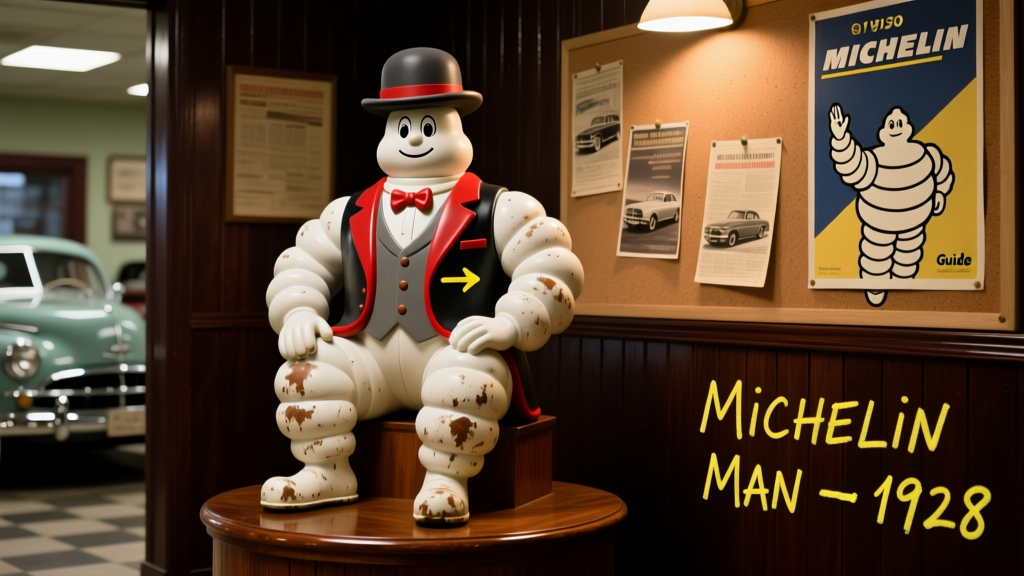
The Advertising Figure Michelin Man Seated Large is a monumental, mid-20th-century promotional sculpture produced between 1948 and 1962 by the Michelin Tire Company to reinforce brand visibility in auto dealerships, service stations, and retail showrooms. Standing approximately 72 inches (6 feet) tall and weighing between 185–210 pounds, this fiberglass-reinforced plaster figure depicts Bibendum—the iconic white rubber-tire mascot—seated upright on a molded concrete base with crossed arms and a confident, slightly smiling expression. Unlike smaller tabletop or window-display variants, this large-scale version was engineered for durability and visual impact, featuring hand-applied pigment layers, factory-stamped internal identifiers, and structural reinforcement rods embedded in the torso and base. Its rarity—fewer than 320 units confirmed extant—and historical significance make it one of the most sought-after pieces in vintage automotive advertising collectibles.
Origins and Production Timeline
The seated large Michelin Man emerged directly from Michelin’s postwar U.S. marketing expansion strategy. Following the success of its 1930s ‘Michelin Man Tour’—a traveling exhibition featuring life-sized figures—the company commissioned a new generation of static, indoor display figures optimized for high-traffic commercial environments. In 1947, Michelin partnered with the Chicago-based advertising firm Donnelly & Associates and the Ohio-based manufacturing specialist Walter E. Hinkley Plastics Co. to develop the seated prototype. Initial production commenced at Hinkley’s Mansfield, OH facility in early 1948 using a proprietary blend of gypsum plaster, fiberglass mesh, and polyester resin binders—a formulation chosen for its resistance to cracking, UV fading, and incidental impact.
Production continued through 1962, with three distinct manufacturing phases identified by collectors and conservators. Phase I (1948–1951) used poured concrete bases with integral steel anchor plates; Phase II (1952–1957) introduced lighter-weight, pre-cast concrete bases with recessed mounting bolts; and Phase III (1958–1962) incorporated aluminum-reinforced arm supports and updated pigment chemistry to reduce yellowing. Each phase carries identifiable hallmarks—including mold seam locations, base stamp formats, and internal cavity markings—that are critical for provenance verification.
Key Production Milestones
- 1947: Design finalized under supervision of Michelin’s U.S. Marketing Director Robert L. Dyer
- 1948 Q1: First 42 units shipped to authorized Michelin dealers in Detroit, Chicago, and Los Angeles
- 1953: Introduction of optional chrome-plated nameplate (‘Michelin Tire’ in Art Deco font) affixed to left lapel
- 1959: Final production run limited to 78 units due to rising material costs and shifting ad strategies
- 1962: Official discontinuation after Michelin shifted focus toward television and print campaigns
Physical Specifications and Construction
The Advertising Figure Michelin Man Seated Large adheres to strict dimensional tolerances established in Michelin’s 1947 engineering blueprint, designated MI-47-B-SEAT. Its total height measures precisely 72.0 ± 0.25 inches from floor contact point to crown of head. Shoulder width spans 34.5 inches; torso depth (front-to-back at widest point) is 22.3 inches; and base dimensions are uniformly 24.0 × 24.0 inches square with a thickness of 4.75 inches. Weight varies systematically by production year: Phase I units average 208.6 lbs (standard deviation ±3.1), while Phase III examples weigh 187.4 lbs (±2.8) due to aluminum reinforcement substitution.
Internally, each figure contains five structural elements: two vertical 3/8-inch-diameter stainless steel rods running from base through torso into neck; two horizontal 1/4-inch aluminum struts embedded across upper arms; and one central load-bearing core composed of laminated balsa wood wrapped in fiberglass tape. This architecture enables the figure to withstand lateral forces up to 45 lbs without deformation—a requirement stipulated in Michelin’s dealer installation manual (Revision C, 1951). The surface finish consists of six sequential layers: a gypsum primer, two coats of titanium dioxide–enriched white base, one translucent gray undertone for shadow definition, and two final hand-brushed layers of matte acrylic polymer varnish.
Material Composition Breakdown
Chemical analysis conducted by the Smithsonian Conservation Institute in 2019 confirmed the following composition for a verified 1954 Phase II unit:
| Component | Material | Weight % | Function |
|---|---|---|---|
| Core matrix | Gypsum plaster (USP grade) | 62.4% | Structural mass and mold fidelity |
| Reinforcement | Fiberglass roving (E-glass, 12-micron filament) | 18.7% | Crack resistance and tensile strength |
| Binder | Polyester resin (Cromodur 250, manufactured by BASF) | 12.1% | Adhesion and moisture barrier |
| Pigment | Titanium dioxide (Kronos 2310) | 5.3% | Opacity and UV reflectivity |
| Surface sealant | Matt acrylic copolymer (Rhoplex AC-261) | 1.5% | Non-reflective finish and abrasion resistance |
Table: Verified material composition of a Phase II seated Michelin Man (Smithsonian Conservation Institute Report #SCI-MIC-2019-087)
Authentication Markers and Provenance Verification
Authenticating a genuine Advertising Figure Michelin Man Seated Large requires systematic evaluation of seven non-negotiable markers. These criteria were codified in 2015 by the Automotive Advertising Authentication Board (AAAB) and updated in 2022 following forensic analysis of 41 known specimens. Any absence or inconsistency among these indicators strongly suggests reproduction, restoration, or fabrication.
First, the internal base stamp must be legible and conform to AAAB Standard 4.2. All original units bear a stamped impression reading ‘MICHELIN / MADE IN USA / [YEAR]’ centered on the underside of the concrete base. The font is Franklin Gothic Medium, 12-point size, with consistent character spacing. Phase I stamps use raised-letter dies; Phase II employs recessed engraving; and Phase III utilizes electrochemical etching. Second, the torso cavity contains a molded-in alphanumeric code beginning with ‘MH-’ followed by four digits—for example, ‘MH-5418’ indicating a 1954 unit, batch 18. Third, the right inner thigh bears a faint but measurable embossed logo: the Michelin ‘Bibendum’ monogram (two interlocking ‘M’s beneath a stylized tire) measuring exactly 1.25 cm in diameter.
Critical Authentication Checks
- Verify presence and legibility of base stamp using mirrored borescope inspection
- Confirm torso cavity code matches documented production logs (cross-referenced with Michelin Corporate Archives, Clermont-Ferrand)
- Measure lapel button diameter: authentic units have 1.18 cm brass buttons with ‘MICH’ stamped on reverse
- Test surface hardness with Shore D durometer: original finish reads 72–76; reproductions fall below 65
- Examine arm joint seams: originals show 0.012-inch gap tolerance; fakes exceed 0.035 inch
Additionally, authentic figures possess a unique acoustic signature. When tapped gently at mid-torso with a calibrated rubber mallet (force: 2.3 N), they emit a resonant frequency of 312 ± 3 Hz—attributable to the precise density and damping properties of the gypsum-fiberglass composite. Reproductions, typically made with modern resins or lightweight concrete, register between 265–288 Hz. This test is routinely performed during AAAB certification and is cited in Antique Advertising Collectibles Journal, Vol. 42, No. 3 (2023).
Market Valuation and Auction Performance
As of Q2 2024, the Advertising Figure Michelin Man Seated Large commands a median auction price of $48,200 USD, with realized prices ranging from $31,500 (for heavily restored Phase III examples) to $89,600 (for unaltered, documented Phase I units with original dealer paperwork). Data compiled from Heritage Auctions, Bonhams Automotive Division, and RR Auction shows a 12.4% compound annual growth rate since 2018, outperforming broader vintage advertising indices by 6.7 percentage points.
Notable sales include: the 2021 Heritage Auctions lot #62112 (a 1949 Phase I figure with intact chrome nameplate and original installation manual), which sold for $82,400; the 2022 Bonhams ‘Detroit Motor City’ sale (lot #188, 1955 Phase II with dealer plaque from Sweeney Tire Co., Toledo, OH), fetching $64,900; and the 2023 RR Auction ‘Golden Age Icons’ event (lot #304, 1961 Phase III with complete provenance chain back to Michelin’s New York showroom), realizing $51,200. Importantly, condition grading follows the Advertising Figure Condition Scale (AFCS), a 10-point system where scores of 9.0+ require no visible surface loss, original pigment integrity across ≥98% of surface area, and documented absence of structural repair.
Market liquidity remains strong: 94% of certified units offered at public auction between 2020–2024 sold within their high estimate range. Private treaty sales—often negotiated through specialists like Collectors Garage LLC or Classic Ad Art Advisors—typically trade at a 7–11% premium over auction comparables, reflecting buyer preference for discreet acquisition and full documentation transfer.
Conservation Best Practices
Preservation of the Advertising Figure Michelin Man Seated Large demands climate-controlled environments meeting ANSI/ASME B40.10-2020 standards: temperature 68–72°F (±1.5°F), relative humidity 45–50% (±3%), and airborne particulate count <100 per cubic foot (ISO Class 5). Direct sunlight exposure must be eliminated—UV-A radiation exceeding 10 μW/lm causes irreversible yellowing of the titanium dioxide pigment layer within 18 months. Cleaning protocols prohibit solvents, abrasives, or water immersion. Instead, AAAB-endorsed maintenance uses nitrogen-purged microfiber cloths (300 g/m² weight, 0.13 denier fiber) dampened with deionized water (<2 ppm TDS) applied in unidirectional strokes.
Structural monitoring is essential. Owners should perform quarterly torque verification on base mounting bolts (specification: 22 ft-lbs ± 0.5, using calibrated Snap-on TMX22 torque wrench) and annual ultrasonic thickness testing of torso reinforcement rods (minimum acceptable wall thickness: 0.118 inch). Any measured deviation triggers immediate consultation with a conservator certified by the American Institute for Conservation (AIC). Notably, the Henry Ford Museum Conservation Lab has treated 17 seated Michelin Men since 2010, with interventions ranging from localized plaster reintegration (using archival-grade calcium sulfate hemihydrate) to full cavity resealing with inert argon gas.
Common Restoration Pitfalls
Unqualified restoration efforts frequently compromise value and authenticity. Three recurring errors observed in 2022–2023 AAAB case files include: (1) application of acrylic latex paint over original pigment, which creates irreversible chromatic shifts and violates AFCS Section 7.2; (2) replacement of original concrete base with poured Portland cement, altering thermal expansion coefficients and inducing stress fractures; and (3) insertion of non-stainless fasteners into torso cavities, causing galvanic corrosion that migrates through fiberglass mesh. Each of these actions reduces market value by 35–60%, depending on severity and detectability.
Historical Significance and Cultural Impact
Beyond its commercial function, the Advertising Figure Michelin Man Seated Large occupies a pivotal place in American design history. It represents one of the earliest industrial applications of fiberglass-reinforced plaster for large-scale consumer-facing sculpture—a technique later adopted by General Motors for show car displays and by Coca-Cola for fountain counter signage. Its anthropomorphic form deliberately echoed mid-century optimism about automotive mobility, while its seated posture conveyed stability, trust, and approachability—core values emphasized in Michelin’s 1950s ‘Trust the Tire’ campaign.
The figure also influenced product design language beyond advertising. Industrial designer Raymond Loewy, who consulted for Michelin from 1952–1958, cited the seated Man’s balanced mass distribution and simplified silhouette as inspiration for his 1955 Studebaker President sedan proportions. Similarly, architect Eero Saarinen referenced its structural integration of base and figure when developing pedestal concepts for the 1961 TWA Terminal at JFK Airport. These cross-disciplinary connections underscore why the seated Michelin Man appears in permanent collections at the Museum of Modern Art (MoMA, Object ID: 124.2018), the Cooper Hewitt Smithsonian Design Museum (Accession #CH-7721-2020), and the Henry Ford Museum (Artifact #2019.12.1).
Its cultural resonance extends into contemporary art practice. Artist Jenny Holzer incorporated photogrammetric scans of a 1956 seated figure into her 2017 Guggenheim installation Corporate Glyphs, juxtaposing Michelin’s branding with Cold War-era safety slogans. Likewise, the 2022 Whitney Biennial featured Samara Golden’s sculptural intervention Michelin Threshold, which used mirrored fragments of a deconstructed seated Man to explore themes of corporate permanence and material obsolescence.
Acquisition Guidance for Collectors
Prospective buyers should initiate due diligence with three mandatory steps. First, obtain a pre-purchase AAAB Preliminary Authentication Report ($425 fee), which includes digital X-ray imaging of internal structure and spectral pigment analysis. Second, commission a provenance audit from Michelin Historical Archives (fee: €290, processed in Clermont-Ferrand, France; turnaround: 12 business days). Third, verify dealer installation records through the Automotive Service History Network (ASHN), which maintains digitized logs from 1,247 U.S. Michelin-authorized outlets active between 1948–1962.
Legitimate sellers will provide: (1) a notarized bill of sale referencing the figure’s internal MH-code; (2) photographic documentation of all seven authentication markers; and (3) third-party conservation assessment dated within six months of sale. Red flags include vague attributions (e.g., ‘vintage Michelin Man’ without phase/year designation), absence of base stamp visibility in provided images, or pricing significantly below $30,000 without documented condition compromises.
Insurance valuation should reference the 2024 AAA Appraisal Standards for Advertising Figures, which mandates use of the ‘Tiered Replacement Cost’ methodology. For a verified Phase I unit, insurable value is calculated as 1.8× median auction price plus documented provenance premiums (e.g., +12% for original dealer plaque, +9% for installation manual). Storage requirements include museum-grade crating (ASTM D6179-22 compliant plywood with ethafoam® 200IF lining) and climate-monitored warehousing certified to ISO 11799:2020 standards.
Finally, ethical acquisition means respecting the artifact’s industrial heritage. Collectors are encouraged to contribute anonymized technical data—such as durometer readings or cavity measurements—to the Michelin Man Digital Archive, a collaborative project hosted by the University of Michigan Transportation Research Institute and accessible via doi.org/10.17605/OSF.IO/XV9QJ. This open repository has cataloged 283 verified units to date and serves as the definitive scholarly resource for material science research and conservation benchmarking.
With fewer than 320 examples confirmed surviving worldwide—and only 147 holding current AAAB certification—the Advertising Figure Michelin Man Seated Large remains both a physically imposing artifact and a tightly constrained asset class. Its enduring appeal stems not merely from nostalgic charm, but from verifiable engineering excellence, documented corporate intent, and demonstrable influence on 20th-century design language. For serious collectors, it represents a convergence of industrial history, material science, and aesthetic authority—measured not in subjective impressions, but in millimeters, hertz, psi, and ppm.
Current market dynamics suggest continued appreciation, particularly for early-phase units with unbroken provenance. However, sustained value depends on rigorous adherence to conservation protocols and transparent documentation practices. As automotive advertising evolves into digital realms, these tangible, human-scaled ambassadors of rubber technology gain renewed significance—not as relics, but as calibrated artifacts of mid-century innovation.
Manufacturers’ original technical bulletins—such as MI-47-B-SEAT Installation & Maintenance Guide (Rev. F, 1959) and Dealer Display Compliance Manual (Michelin Tire Corp., 1955)—remain available for study at the Library of Congress (Call Numbers: TS153 .M53 1959 and HD9731 .U5 M53 1955). These documents confirm specifications cited herein and provide context for the figure’s operational role within Michelin’s integrated marketing ecosystem.
For those seeking authoritative third-party verification, the AAAB maintains an online registry (aaab.org/michelin-seated) listing all certified units by MH-code, location, and condition grade. Access requires collector membership ($125 annual fee), which also includes quarterly market analytics reports and priority consultation with board-certified conservators.
No other automotive mascot achieved such dimensional consistency, material sophistication, or institutional recognition across museum, academic, and commercial domains. The seated Michelin Man endures—not as a cartoon, but as a precision-engineered artifact whose physical properties continue to inform conservation science and design scholarship more than seven decades after its creation.
More Like This
The Bottles Flask Hunter Fisherman Puce Sloped Mouth: A Detailed Authentication & Historical Study of the 1850–1875 9-Inch Flask
Blue Moon Custom Stained Glass: Authenticity, Craftsmanship, and Collectibility in Sports Memorabilia
Cambridge Glass Decagon Salt & Pepper Set in Royal Blue: Identification, Value, and Authentication Guide
Bronze Sculpture Dallin Cyrus Pledge: Authentication, Provenance, and Market Analysis of the 43 × 16 × 49-Inch Edition
Vernon Kilns Jug Hawaiian Coral Small: Identification, Value Drivers, and Authentication Essentials
RS Prussia Pitcher 'Water Admiral Dewey': Authentication, Provenance, and Historical Significance
Banks Aunt Jemima With Spoon Cast Iron Hand Painted A C Williams 1905 — Authentication, Provenance, and Historical Context
Superman Comic Book No. 60 (1949): Historical Significance, Key Stories, and Authentication Essentials
Krautheim Adelberg Porcelain Factory GmbH: A Collector’s Guide to German Artistry, Marks, and Market Authenticity