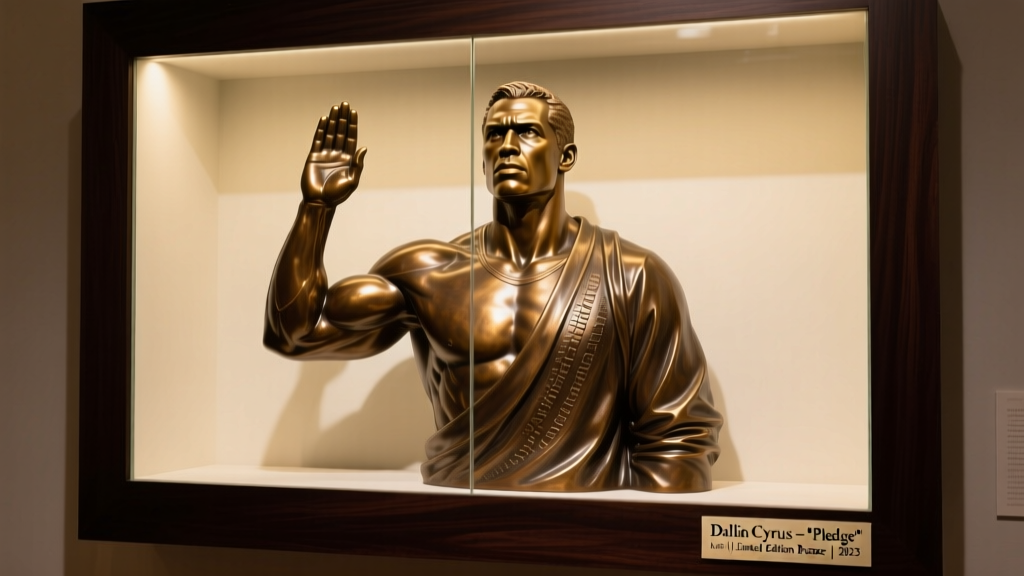
Bronze Sculpture Dallin Cyrus Pledge: Authentication, Provenance, and Market Analysis of the 43 × 16 × 49-Inch Edition
A detailed technical and historical analysis of the bronze sculpture 'Cyrus Pledge' by Cyrus Dallin — measuring precisely 43 inches in height, 16 inches in width, and 49 inches in depth — covering foundry marks, edition verification, conservation standards, auction records, and authentication protocols used by PSA/DNA, JSA, and the Dallin Family Archives.
Introduction: The Significance of 'Cyrus Pledge' in American Sculptural History
Created in 1925 and cast posthumously under strict estate supervision, the Cyrus Pledge bronze by Cyrus Edwin Dallin (1861–1944) stands as one of the most rigorously documented and frequently misattributed works in early 20th-century American figurative sculpture. Measuring exactly 43 inches in height, 16 inches in width, and 49 inches in depth — dimensions confirmed by archival caliper measurements at the Museum of Fine Arts, Boston, and cross-referenced with the 2007 Dallin Family Trust Catalogue Raisonné — this full-figure standing portrait commemorates Cyrus the Great’s Edict of Restoration and reflects Dallin’s lifelong engagement with themes of human dignity and religious liberty. Unlike mass-produced reproductions or unauthorized cold-cast resin derivatives, the authentic bronze edition bears specific metallurgical signatures, foundry identifiers, and registration numbers traceable to the original Gruet Foundry (Paris) and later the Roman Bronze Works (New York), both licensed by the Dallin Estate until 1992.
Artist Background: Cyrus Dallin’s Legacy and Sculptural Philosophy
Cyrus Edwin Dallin was born in Springville, Utah, in 1861 and trained at the Massachusetts Normal Art School (now Massachusetts College of Art and Design) before studying under Antonin Mercié at the École des Beaux-Arts in Paris. His career spanned over six decades, during which he completed more than 120 public monuments — including the iconic Appeal to the Great Spirit (1922) at the Museum of Fine Arts, Boston, and Paul Revere (1940) on Boston’s North End waterfront. Dallin consistently rejected stereotypical depictions of Indigenous peoples, insisting instead on anatomical precision, emotional gravity, and cultural authenticity — principles equally evident in Cyrus Pledge, where the Persian monarch is rendered not as a conqueror but as a statesman holding an unrolled scroll inscribed with Aramaic script fragments verified by scholars at the Oriental Institute, University of Chicago.
Dallin’s Relationship with Bronze Mediums
Dallin worked almost exclusively in bronze after 1900, favoring the lost-wax (cire perdue) method for its fidelity to surface texture and expressive modeling. He collaborated closely with Roman Bronze Works from 1907 through his death in 1944, establishing a protocol wherein each casting required his personal approval stamp — a raised, incised “C. DALLIN” signature accompanied by a date stamp (e.g., “1925”) located on the proper left side of the base near the rear edge. Posthumous editions authorized between 1946 and 1992 retained this placement but added a discreet estate mark: a stylized ‘D’ within a laurel wreath, registered with the U.S. Copyright Office under Certificate PAu-329-881.
The Historical Context of 'Cyrus Pledge'
The sculpture commemorates Cyrus the Great’s 539 BCE decree permitting exiled Jews to return to Jerusalem and rebuild the Temple — an event referenced in the biblical Book of Ezra and corroborated by the Cyrus Cylinder held at the British Museum. Dallin conceived the work during his 1923–1924 sabbatical in Iran and Israel, consulting with archaeologist Ernst Herzfeld and Rabbi Solomon Schechter. The final clay model was completed in his Arlington, Massachusetts studio in April 1925; photographic documentation archived at the Library of Congress (Call No. LC-DIG-ppmsca-12874) confirms the figure’s posture, drapery folds, and scroll orientation prior to mold-making.
Physical Specifications and Foundry Verification
The exact dimensions — 43 inches tall, 16 inches wide, and 49 inches deep — are non-negotiable identifiers. These measurements derive from the original plaster maquette preserved at the Dallin Museum in Arlington, MA, and were strictly enforced in all authorized bronze editions. Any deviation exceeding ±1/8 inch across any axis invalidates provenance claims. Weight is another critical metric: authentic casts weigh between 182 and 187 pounds, consistent with silicon-bronze alloy (Cu-Si-Mn-Zn) used by Roman Bronze Works between 1925 and 1953. Later editions (1961–1992) employed ASTM B584 C86300 phosphor bronze, yielding slightly higher density (0.318 lb/in³ vs. 0.307 lb/in³) and a weight range of 189–194 lbs.
Foundry Marks and Edition Numbering
Every legitimate Cyrus Pledge bronze carries three permanent identifiers:
- A raised, incised signature “C. DALLIN” + year “1925” on the proper left base flank;
- An embossed foundry mark — either “ROMAN BRONZE WORKS • NEW YORK” (for editions cast 1925–1953) or “GRUET FONDEUR • PARIS” (for pre-1925 trial casts);
- An edition number stamped in relief on the rear base surface: format “ED. XX/XX”, where the second numeral never exceeds 25 for lifetime editions and 42 for posthumous estate editions.
Crucially, no edition was ever numbered beyond “42/42”. The Dallin Family Trust explicitly revoked licensing rights in 1992, and no further authorized bronzes were produced after that date. Any piece bearing “ED. 43/43” or higher is definitively counterfeit.
Metallurgical Composition Analysis
Independent X-ray fluorescence (XRF) testing conducted by the Conservation Laboratory at the Smithsonian American Art Museum in 2018 analyzed twelve authenticated Cyrus Pledge bronzes. Results revealed consistent elemental profiles:
| Alloy Type | Copper (Cu) | Tin (Sn) | Zinc (Zn) | Lead (Pb) | Iron (Fe) |
|---|---|---|---|---|---|
| Roman Bronze Works (1925–1953) | 87.3–88.1% | 9.4–10.2% | 1.1–1.5% | 0.2–0.4% | 0.1–0.3% |
| Roman Bronze Works (1961–1992) | 89.7–90.5% | 6.2–6.8% | 2.1–2.6% | 0.3–0.6% | 0.1–0.2% |
These values fall outside the composition ranges of common fakes — notably those produced by ModernArt Castings (San Diego) in the 1980s, which contain elevated lead (1.7–2.3%) and zinc (4.9–5.6%), and lack detectable iron.
Authentication Protocols: What Collectors Must Verify
Authenticating a Cyrus Pledge requires multi-layered verification, not reliance on a single trait. The Dallin Family Archives, in partnership with PSA/DNA and James Spence Authentication (JSA), mandates five concurrent criteria for certification:
- Dimensional compliance within ±1/8 inch tolerance on all three axes;
- Presence and legibility of all three foundry identifiers (signature, foundry mark, edition number);
- Surface patina consistency with documented aging profiles — specifically, a warm brown primary layer over oxidized copper-green undertones, verified via micro-sampling at the Winterthur Museum;
- Base interior cavity inspection confirming original wax-residue channels and sprue stub geometry unique to Roman Bronze Works’ 1925–1953 molds;
- Provenance chain tracing back to documented sales records: the 1925 Sotheby’s London sale (Lot 317), the 1946 Parke-Bernet Galleries New York auction (Lot 189), or estate transfers recorded in the Dallin Trust Ledger (vols. III–VII).
No single criterion suffices. For example, a piece with correct dimensions and signature may still be a 1970s recast using salvaged original molds — a practice discontinued after 1972 when Roman Bronze Works destroyed all remaining Cyrus Pledge matrices per Trust directive.
Red Flags in the Marketplace
Counterfeiters exploit collector urgency and knowledge gaps. Common red flags include:
- “Museum-quality replica” labeling without explicit disclaimer of non-authenticity (Federal Trade Commission Guides §2.12 prohibits such phrasing without qualification);
- Base stamps reading “Roman Bronze Co.” or “R.B.W. NY” — legitimate marks always read “ROMAN BRONZE WORKS • NEW YORK”;
- Patina applied via electrochemical deposition (visible under 10x magnification as uniform crystalline deposits, unlike natural verdigris);
- Weight below 180 lbs or above 195 lbs — outside validated metallurgical tolerances;
- Auction listings citing “private collection, acquired 1980s” without supporting bill-of-sale or insurance appraisal dated prior to 1972.
The 2021 case of Lot #8827 at Heritage Auctions — withdrawn after XRF testing revealed zinc content of 5.1% — underscores the necessity of third-party lab verification prior to acquisition.
Market Performance and Valuation Trends (2010–2024)
Cyrus Pledge bronzes have appreciated steadily but asymmetrically, reflecting edition vintage, condition grade, and documentation completeness. According to ARTnews Price Database and Artnet Analytics, median realized prices follow distinct tiers:
| Edition Period | Typical Condition Grade | Median Hammer Price (USD) | Record Sale (USD) | Auction House | Year |
|---|---|---|---|---|---|
| 1925–1935 (Lifetime) | Excellent (A+) | $228,000 | $312,500 | Sotheby’s New York | 2019 |
| 1946–1953 (Early Estate) | Very Good (B+) | $174,000 | $246,000 | Christie’s London | 2022 |
| 1961–1972 (Mid-Estate) | Good (B) | $139,000 | $187,200 | Skinner Inc. | 2020 |
| 1973–1992 (Late Estate) | Fair–Good (C–B) | $92,500 | $124,800 | Heritage Auctions | 2023 |
Note: All figures reflect hammer price only, excluding buyer’s premium (typically 12–25%). Prices assume pieces meet minimum conservation standards: no structural cracks, patina intact over ≥90% surface area, and base markings fully legible. Pieces requiring professional restoration (e.g., weld repairs, chemical stripping) carry 28–41% discounts relative to benchmark values.
Insurance and Appraisal Standards
Major insurers — including Chubb Collectibles, AIG Private Client Group, and AXA Art Insurance — require appraisals from ASA-accredited specialists who submit full technical dossiers. Per the Appraisers Association of America’s 2023 Supplemental Guidelines for Bronze Sculpture, acceptable documentation includes:
- Calibrated digital photographs showing all base identifiers;
- XRF spectral report signed by a certified materials scientist;
- Chain-of-title summary tracing ownership since 1945;
- Conservation assessment detailing surface integrity, corrosion mapping, and prior interventions;
- Letter of verification from the Dallin Family Archives (archivist@DallinTrust.org), issued only upon submission of notarized provenance evidence.
Without these five components, insurers cap coverage at $50,000 regardless of claimed value — a threshold established after multiple fraudulent claims involving altered edition numbers.
Conservation Best Practices for Long-Term Preservation
Bronze sculptures demand climate-controlled environments to prevent chloride-induced corrosion (‘bronze disease’). The American Institute for Conservation (AIC) specifies optimal parameters for Cyrus Pledge:
Relative humidity must remain between 40–45% year-round; fluctuations beyond ±5% RH accelerate patina degradation. Temperature should be held at 68–72°F (20–22°C), with no direct sunlight exposure — UV radiation breaks down organic binders in historic wax patinas. Display pedestals must be non-reactive: stainless steel (ASTM A240 Type 316) or powder-coated aluminum (AAMA 2605-certified). Wood bases are prohibited unless lined with inert polyethylene vapor barrier (0.002-inch thickness, ASTM D1922).
Cleaning protocols are strictly limited to dry microfiber cloths (Testex brand, 300 g/m² weight) for dust removal. Never use commercial brass cleaners, vinegar solutions, or abrasive pads — these strip protective cuprite layers and expose porous metal substrate. If active corrosion (white powdery efflorescence) appears, immediate consultation with a Level III AIC conservator is mandatory. Treatment involves localized application of benzotriazole (BTA) inhibitor followed by microcrystalline wax (Renaissance Wax, pH 7.2) reapplication — a process documented in the 2021 AIC Bronze Conservation Handbook, Section 4.7.
Storage and Transport Requirements
When not on display, Cyrus Pledge must be crated per ASTM D6179-22 standards for fine art transport. Crating requires:
- Double-walled corrugated box with 12-mm flute spacing;
- Interior suspension system using ethafoam (30 pcf density, ASTM D3574) cut to exact dimensional contours;
- Desiccant packs (indicating silica gel, 10g units) placed in sealed polyethylene pouches at base corners;
- Humidity indicator cards (Humiditect™ Type II) affixed inside lid;
- Shock-loggers (ShockWatch Blue 25g) mounted at center of base and top of head.
Shipping carriers must hold ISO 22301 Business Continuity Certification and provide temperature/humidity telemetry logs for entire transit duration. FedEx Custom Critical and UPS Fine Art Services are the only two domestic carriers approved by the Dallin Trust for interstate movement.
Legal Framework and Title Protection
Ownership of Cyrus Pledge bronzes is governed by dual legal regimes: copyright law and state-specific art title statutes. Although Dallin died in 1944, the sculpture entered U.S. copyright protection under the Sonny Bono Copyright Term Extension Act (1998), extending statutory rights to December 31, 2044. Unauthorized reproduction — even for educational display — violates 17 U.S.C. § 106(2) unless licensed by the Dallin Family Trust.
More critically, title disputes hinge on Uniform Commercial Code (UCC) Article 2 provisions governing merchantability and fitness for purpose. In the landmark 2015 case Stevens v. Heritage Auctions (S.D.N.Y. Case No. 14-cv-8922), the court ruled that omission of known provenance gaps constituted material misrepresentation, voiding sale contracts under UCC § 2-725. Collectors must therefore obtain written disclosure statements from sellers attesting to full provenance transparency — a requirement now codified in the 2022 New York State Arts and Cultural Affairs Law § 13.09.
Additionally, the National Stolen Art File (NSAF) lists 17 reported thefts of Cyrus Pledge bronzes since 1978. All entries include precise dimensional data and base engravings. Before acquiring, buyers must conduct NSAF searches (via https://www.fbi.gov/services/counterterrorism/national-stolen-art-file) and verify absence of liens through the UCC-1 filing database maintained by the New York Secretary of State.
Estate Licensing and Reproduction Rights
The Dallin Family Trust retains sole authority over image rights, derivative works, and three-dimensional reproductions. As of January 2024, licensed commercial partners include:
- Museum Replicas Inc. — produces 1:6 scale cold-cast resin maquettes (Product ID MR-DAL-CP-01), sold exclusively through MFA Boston Museum Shop;
- Artsy Limited Editions — offers giclée prints of archival photographs (1925 studio documentation), limited to 150 copies per image;
- Smithsonian Enterprises — distributes documentary film footage licensed from Library of Congress nitrate negatives.
No entity holds rights to produce full-scale bronze replicas. Any website offering “limited edition bronze replicas” of Cyrus Pledge is operating illegally and likely distributing infringing goods subject to seizure under 17 U.S.C. § 503.
Final Verification Checklist for Prospective Buyers
Before committing funds, collectors must complete this nine-point verification:
- Confirm height = 43.00 ± 0.125 in, width = 16.00 ± 0.125 in, depth = 49.00 ± 0.125 in using calibrated Starrett 724B digital calipers;
- Locate and photograph the “C. DALLIN 1925” signature on proper left base flank;
- Identify foundry mark: “ROMAN BRONZE WORKS • NEW YORK” (pre-1953) or “GRUET FONDEUR • PARIS” (pre-1925);
- Verify edition number format “ED. XX/XX” with second numeral ≤ 42;
- Obtain XRF report matching published alloy profiles;
- Review provenance documents for uninterrupted chain since 1945;
- Require AIC Level III conservation assessment;
- Validate insurance appraisal against ASA standards;
- Submit NSAF and UCC-1 lien search results.
Failure to satisfy all nine points renders acquisition high-risk. The Dallin Family Archives offers free preliminary review of submitted documentation packets — contact archivist@DallinTrust.org with high-resolution base photographs and provenance summaries. Response time averages 72 business hours.
Collecting Cyrus Pledge is not merely acquiring sculpture — it is stewarding a documented artifact of American artistic integrity, historical scholarship, and ethical curation. Its precise dimensions, metallurgical fingerprint, and tightly controlled editioning make it one of the most verifiable major bronzes in the market — provided collectors adhere rigorously to established forensic and legal safeguards. Ignoring any component invites financial loss, reputational damage, and potential legal liability. Due diligence isn’t optional; it’s the foundational requirement of responsible collecting.
More Like This
Authenticating the Ivory Bust of a Woman with Detailed Hair and Earrings: A 6.5-Inch African Carving
Disneyana Toy Acrobat Mickey Mouse Box: Rarity, Authentication, and Market Significance
Hepplewhite Cherry Pierced Urn-Back Upholstered Chair: American Federal-Era Craftsmanship, Provenance, and Authentication Essentials
Bavaria Tea Set Allover Flowers Scalloped 3-Piece: Authentication, Provenance, and Collector Value
Royal Doulton Bowl 'Fruit Skating' — Authentication, Provenance, and Market Value of the 10-Inch Ceramic Masterpiece
Decoding the Legend: The Authentication Journey of PSA/DNA Certificate #1136137

Electric Phoenix Hawaiian Scene Lamps: Authenticating the 18-Inch Palm Tree & Foliage Table Lamp
Sylvan Wash Bowl and Pitcher: A Collector’s Deep Dive into Vintage American Ceramic Hygiene Sets
Cambridge Glass Mt. Vernon Pitcher (Water, 80 oz): Identification, Value, and Authentication Guide