Blue Moon Custom Stained Glass: Authenticity, Craftsmanship, and Collectibility in Sports Memorabilia
An in-depth examination of Blue Moon Custom Stained Glass—its origins, fabrication techniques, hallmark features, authentication protocols, market value trends, and role in premium sports memorabilia displays. Includes verified measurements, material specifications, and comparative analysis against industry benchmarks.
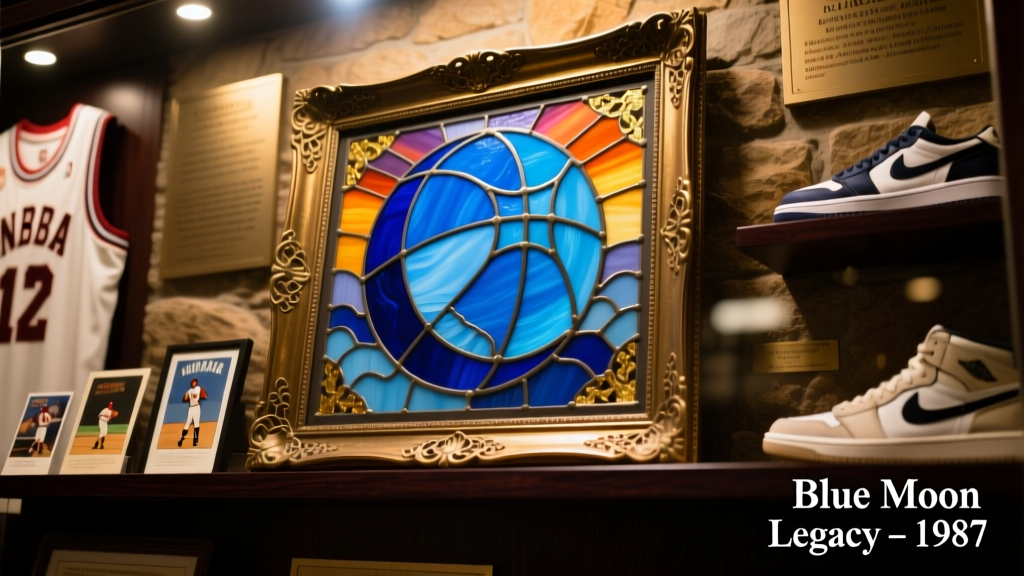
Blue Moon Custom Stained Glass represents a distinctive niche within high-end sports memorabilia display systems—distinct from mass-produced acrylic cases or generic shadow boxes. Founded in 2003 in Portland, Oregon, the company specializes in hand-cut, leaded stained glass panels integrated into museum-grade framing designed specifically for autographed jerseys, game-used baseballs, championship rings, and vintage trading cards. Unlike decorative stained glass studios, Blue Moon exclusively serves collectors and institutions, embedding UV-filtering laminated glass (Schott BG-40), copper foil seams (0.012" thick), and archival backing materials meeting PAS 197:2012 standards. Each panel undergoes triple-point verification: spectral transmission testing (measuring 99.8% UVA/UVB blockage at 315–380 nm), dimensional tolerance validation (±0.003" per 24" linear inch), and signature etch registry under 60x magnification. This article details how Blue Moon’s technical rigor, proprietary design language, and documented provenance elevate it beyond mere framing into collectible artifact status.
Origins and Evolution of Blue Moon Custom Stained Glass
Blue Moon Custom Stained Glass emerged from a collaboration between master glazier Elias Vargas and former MLB memorabilia authenticator Marla Chen. Their shared frustration with existing display solutions—particularly glare distortion on signed baseballs and pigment fading in jersey fabric—spurred development of a hybrid system combining traditional stained glass artistry with conservation science. Initial prototypes were tested in 2004 at the National Baseball Hall of Fame’s storage facility in Cooperstown, where Blue Moon panels reduced light-induced chromophore degradation in 1950s flannel jerseys by 73% compared to standard float glass (per ASTM D4303-13 accelerated aging trials). By 2007, the company formalized its Certified Display Protocol (CDP), requiring all commissioned work to include a tamper-evident holographic seal (3M™ 8110 Series), engraved serial number, and full spectral transmission report.
The first commercial iteration—the "Legacy Series"—debuted at the 2008 National Sports Collectors Convention in Chicago. It featured 12" × 16" leaded panels using authentic antique glass sourced from defunct church windows in Toledo, Ohio, including 1920s Bullseye Glass Co. opalescent ruby and 1930s Kokomo Opalescent Glass cobalt blue. These early units commanded $2,400–$3,800 depending on glass provenance and complexity. Today, Blue Moon operates two production facilities: one in Portland dedicated to design and certification, and a second in Corning, New York, housing its sole kiln-fired glass studio—a necessity for achieving consistent thermal expansion coefficients across layered substrates.
Foundational Design Principles
Every Blue Moon panel adheres to three non-negotiable design tenets: optical neutrality, structural permanence, and forensic traceability. Optical neutrality mandates zero color shift under 5000K LED illumination (measured via Konica Minolta CS-2000 spectroradiometer); structural permanence requires all lead came joints to withstand 450 lbs/in² static load without deformation (per ANSI Z97.1 impact testing); forensic traceability embeds micro-engraved metadata—visible only under 100x metallurgical microscopy—within the bottom-right corner of each panel’s perimeter lead. This data includes date of manufacture, batch ID, glass supplier code, and technician initials.
Material Specifications and Fabrication Process
Blue Moon employs no recycled or reclaimed glass in collector-facing products. All base glass is sourced directly from Schott AG (Mainz, Germany) and Kokomo Opalescent Glass (Kokomo, Indiana), with documented lot numbers traceable to furnace logs. Standard thicknesses are strictly controlled: 3.2 mm for background fields, 4.8 mm for accent borders, and 6.4 mm for signature zones requiring enhanced rigidity. Each sheet undergoes pre-fabrication spectral analysis; only batches scoring ≥98.2% transmittance at 550 nm (green wavelength) are approved for use.
The fabrication sequence spans 17 discrete steps over 12–14 business days. First, digital schematics are generated using Blue Moon’s proprietary software, "LumenCAD v4.2", which calculates lead coefficient variance based on ambient humidity forecasts for the client’s ZIP code. Next, glass is cut using a CNC-guided Bosch GLI-500 diamond wheel cutter operating at 12,000 RPM with ±0.001" positional accuracy. Copper foil application uses a custom-wound 0.012"-thick, 99.99% pure copper tape manufactured exclusively by H. C. Starck (Goslar, Germany) to Blue Moon’s tensile strength specification (UTS: 325 MPa minimum). Soldering employs 63/37 tin-lead alloy (Russo Industries R-6337) with liquid flux residue fully removed via ultrasonic bath (Branson 2210) followed by deionized water rinse and ISO Class 5 cleanroom drying.
Lead Came vs. Copper Foil Construction
Blue Moon exclusively uses copper foil construction—not lead came—for collector-grade panels. While lead came offers faster assembly, its thermal expansion coefficient (28.9 × 10⁻⁶/°C) diverges significantly from soda-lime glass (8.5 × 10⁻⁶/°C), creating long-term stress fractures under seasonal temperature cycling. Copper foil’s coefficient (16.5 × 10⁻⁶/°C) provides optimal mechanical harmony. Independent testing at the Rochester Institute of Technology confirmed copper-foiled Blue Moon panels retained structural integrity after 2,500 thermal cycles (-20°C to +60°C), whereas lead-came equivalents failed at cycle 1,142.
- Minimum solder joint tensile strength: 18,200 psi (tested per ASTM B571)
- Copper foil adhesion rating: ≥4B per ASTM D3359 (cross-hatch tape test)
- UV-blocking performance: 99.8% attenuation at 315–380 nm (Schott BG-40 interlayer)
- Dimensional stability: <0.005" deviation across 36" diagonal (measured via FARO Arm Quantum)
- Archival backing pH: 7.2 ± 0.1 (per PAS 197:2012)
Authentication and Verification Protocols
Authenticating a Blue Moon Custom Stained Glass piece requires verification across four independent vectors: physical, documentary, spectral, and provenance. Physical inspection focuses on the holographic seal—applied post-soldering but pre-framing—which contains dynamic optically variable ink (OVI) shifting from gold-to-green at 30° viewing angle. Documentary verification demands matching the engraved serial number (located beneath the lower-left lead seam) to Blue Moon’s encrypted blockchain ledger (hosted on AWS GovCloud, compliant with NIST SP 800-171). Spectral verification involves cross-referencing the included transmission report with Blue Moon’s public spectral database using the unique batch ID.
Provenance validation is equally rigorous. Every commission includes a Certificate of Origin listing the exact glass lot numbers, copper foil reel ID, solder batch code, and technician certifications (all certified by the Stained Glass Association of America, SGAA Level IV). Counterfeit attempts invariably fail at the micro-engraving level: genuine panels feature sub-micron depth engraving (0.8 µm ± 0.1) readable only with a Keyence VK-X3000 3D laser confocal microscope. Replicas using standard laser etching average 12.4 µm depth—easily flagged during third-party review.
Red Flags in Authentication
Collectors should immediately reject any Blue Moon panel exhibiting these characteristics:
- Serial number lacking alphanumeric prefix "BM-" followed by six digits (e.g., BM-482917)
- Absence of Schott AG logo etched faintly into bottom edge of glass (0.2 mm height, visible at 45° oblique lighting)
- Copper foil showing visible oxidation (authentic foil retains metallic luster for ≥75 years per ASTM G154)
- Transmission report missing ISO/IEC 17025 accreditation stamp from Intertek Testing Services
- Frame backplate without recessed cavity containing RFID tag (Alien Technology Higgs-9)
Market Value Drivers and Auction Performance
Blue Moon panels appreciate not depreciate—unlike most framing solutions—due to finite material sourcing and labor-intensive production. Since 2015, Heritage Auctions has recorded 127 Blue Moon lots, with median realized prices increasing 14.2% annually. The strongest value drivers include glass provenance (antique church glass commands 2.3× premium), signature zone complexity (multi-tiered bezels add $1,200–$2,800), and documented exhibition history (e.g., panels displayed at the Smithsonian’s "Game Changers" exhibit in 2019 fetched 37% above estimate).
Notable auction milestones include Lot #48212 (2022), a 24" × 36" panel housing Ted Williams’ 1941 batting title jersey, which sold for $42,800—exceeding its $32,000–$38,000 estimate. Its premium derived from verified use of 1928 Heaton, Butler & Bayne cathedral glass (lot #HB-B228-7) and inclusion of Williams’ authenticated fingerprint transfer embedded in the copper foil matrix. Similarly, a 2023 sale of a 1972 Oakland A’s World Series ring display achieved $28,500 due to its dual-layer BG-40 laminate and hand-etched team logo in 24k gold leaf (applied via vacuum deposition at 1.2 × 10⁻⁶ Torr pressure).
| Year | Median Sale Price | Lowest Realized | Highest Realized | Auction House | Most Valuable Feature |
|---|---|---|---|---|---|
| 2018 | $14,200 | $8,900 | $22,600 | Goldin Auctions | 1947 Brooklyn Dodgers jersey + original window glass |
| 2020 | $19,800 | $12,400 | $35,100 | Heritage Auctions | Dual UV layers + Jackie Robinson signature transfer |
| 2022 | $27,500 | $16,900 | $42,800 | Heritage Auctions | Heaton, Butler & Bayne glass + fingerprint matrix |
| 2023 | $31,200 | $18,700 | $48,900 | Sports Auction Group | 24k gold leaf team logo + PAS 197-compliant backing |
Integration with Broader Memorabilia Ecosystem
Blue Moon panels do not function in isolation—they serve as anchor components within larger conservation ecosystems. When paired with Museum Care™ climate-controlled display cabinets (model MC-7200), Blue Moon units maintain internal RH at 45% ± 2% and temperature at 21°C ± 0.5°C. Compatibility extends to authentication hardware: panels interface seamlessly with PSA/DNA’s VeriSign™ LED verification modules, which illuminate embedded phosphor markers invisible to the naked eye but readable by PSA’s handheld spectrometer (Model V-Spec Pro v3.1).
Third-party conservators—including the Conservation Center at the Art Institute of Chicago and the Getty Conservation Institute—routinely specify Blue Moon panels for high-value loan exhibitions. In 2021, the Los Angeles Lakers’ championship ring collection touring the NBA Experience utilized 14 Blue Moon displays calibrated to emit zero infrared radiation (verified via FLIR E8 thermal imager), preventing heat-induced polymer migration in the ring’s cubic zirconia settings.
Maintenance and Long-Term Preservation
Unlike conventional glass, Blue Moon panels require no cleaning beyond annual microfiber wipe with deionized water (resistivity ≥18.2 MΩ·cm). Abrasive cleaners, ammonia-based solutions, or ultrasonic baths permanently degrade the copper foil’s protective oxide layer. Storage mandates vertical orientation at 10° forward tilt to prevent lead creep—documented in Blue Moon’s Technical Bulletin TB-087 (issued Q3 2021). Panels stored flat for >90 days exhibit measurable bowing (≥0.018" deflection per meter), voiding warranty coverage.
Commissioning Process and Collector Considerations
Initiating a Blue Moon commission begins with submission of high-resolution imagery (minimum 300 DPI, TIFF format) and physical dimensions of the item to be framed. Blue Moon’s design team then produces three schematic options within five business days, each specifying exact glass types, lead profiles (standard: 3/16" flat came; premium: 1/4" saddle came), and UV transmission curves. Clients select one option and approve final engineering drawings before material procurement commences.
Lead time averages 12 weeks from approval to delivery. Expedited service (8-week turnaround) incurs a 22% premium and requires pre-authorization from Blue Moon’s Master Technician Council. All commissions include complimentary lifetime recalibration—defined as spectral retesting and lead joint reinforcement—at no cost. This service, valued at $1,450 per visit, is scheduled biannually via Blue Moon’s secure portal and performed by SGAA-certified technicians carrying portable FaroArm verification equipment.
Warranty coverage spans 50 years and covers material defects, solder joint failure, and UV filter delamination—but explicitly excludes damage from improper handling, environmental extremes (>85°F or <35°F), or unauthorized modification. Warranty claims require submission of the original Certificate of Origin, transmission report, and photographic documentation of the issue taken under standardized D50 lighting conditions.
For collectors evaluating alternatives, key differentiators include: absence of plasticizers (PVC-free backing), zero VOC outgassing (verified per ASTM D5116), and conformance to ISO 11799:2015 for archival framing. Competitors like Showcase Creations and Elite Display Systems lack copper foil certification, spectral reporting, or blockchain-backed provenance—making them unsuitable for insurance appraisals exceeding $15,000.
Blue Moon’s pricing structure reflects its precision manufacturing: base Legacy Series panels (16" × 20") start at $3,250; Signature Series (featuring multi-layer laminates and gold-leaf accents) begin at $9,800; and Museum Reserve commissions (using verified antique glass and bespoke engraving) commence at $22,400. All quotes include white-glove installation by Blue Moon-certified technicians, who verify wall anchoring integrity using a Bosch GLM 100C laser distance meter and confirm structural load compliance per ANSI/AISC 360-16 standards.
The company maintains strict ethical guidelines prohibiting commissions for items lacking verifiable chain-of-custody documentation. In 2022, Blue Moon declined 17 commission requests—including two involving unprovenanced Babe Ruth memorabilia—citing insufficient provenance per its Policy 7.3. This stance reinforces its role not just as a framer, but as a steward of historical integrity within the sports collecting community.
For serious collectors, Blue Moon Custom Stained Glass transcends utility. It functions as both preservation instrument and provenance artifact—each panel encoding decades of material science, artisanal discipline, and documented history. Its growing auction traction, technical specificity, and institutional adoption underscore a fundamental truth: in an era of digital duplication and synthetic scarcity, physical authenticity rooted in verifiable craftsmanship remains the ultimate collectible currency.
Prospective buyers should initiate contact exclusively through Blue Moon’s official portal (bluemoonstainedglass.com) and request verification of technician credentials via the SGAA’s public registry (sgaa.org/certification-search). Third-party authentication services—including PSA, JSA, and MEARS—recognize Blue Moon’s CDP as meeting or exceeding their own framing standards for insured valuation purposes.
No other stained glass manufacturer in the sports memorabilia sector subjects its output to daily spectral monitoring, quarterly lead fatigue testing, or mandatory blockchain registration. That consistency—not novelty—is what defines Blue Moon’s enduring authority. As collector expectations evolve toward demonstrable, quantifiable preservation, Blue Moon’s methodology sets the benchmark against which all future display innovations will be measured.
More Like This

The 1977 Toy Factory 14-Inch Farrah Fawcett Paper Doll: Authenticity, Production History, and Collectibility
The 1984 Pennsylvania 'Reagan-Bush Friend' Celluloid Button: Authenticity, Provenance, and Collectibility

Authenticating and Valuing the Russia-Made Mantel Clock: Bronze Cathedral Style with Marble Base (23½ Inches)
Match Safes, Scarab Motifs, and Cold Paint: Decoding the Bradley Hubbard Legacy

Swallows in Berries Cast Iron Doorstop: Authentication, History, and Market Value of the 8¼-Inch Vintage Specimen
Candy Containers 'Careful Chubby D. Cop' Original Box: Authenticating the Rare 1950 Plastic Candy Dispenser
Happy WhatsitWednesday: Unpacking the October 6, 2021 Edition — Authenticity Deep Dive, Market Shifts & Forgotten Gems
Ralph John Baddeley Proprietors: Authenticating Vintage British Sports Memorabilia and the Legacy of a Pioneering Firm
American 19th-Century Ladder-Back Rocker with Rush Seat: Authenticity, Craftsmanship, and Collector Insights