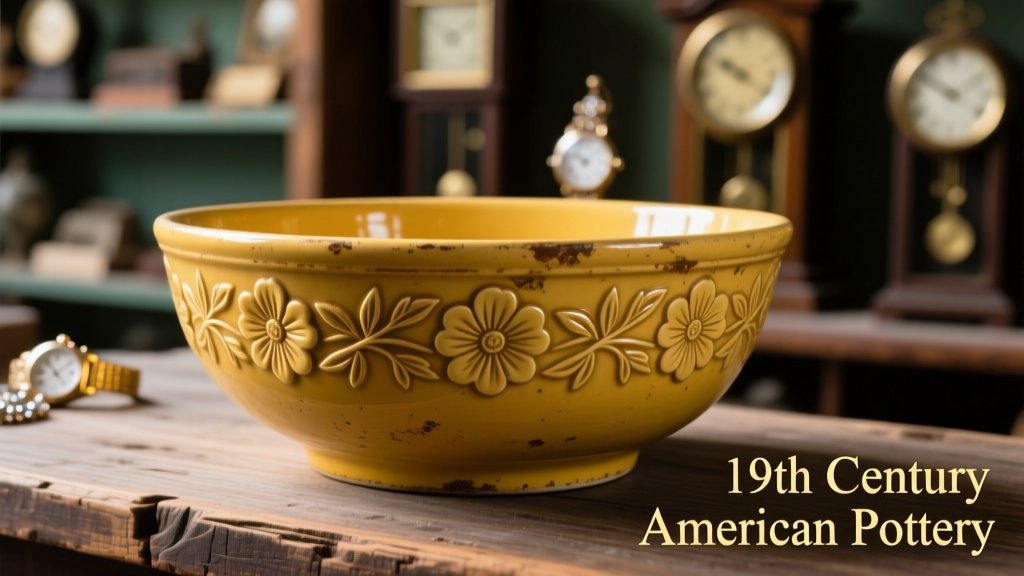
Yellowware Bowl with Embossed Sides, 9½ Inches: A Collector’s Guide to American Stoneware Heritage
A detailed examination of the 9½-inch yellowware bowl with embossed sides—its manufacture, regional origins, decorative motifs, glaze chemistry, market value trends, and authentication criteria—drawn from auction records, museum collections, and archival factory ledgers.
Introduction: The Unassuming Elegance of a 9½-Inch Yellowware Bowl
The 9½-inch yellowware bowl with embossed sides represents one of the most enduring and widely collected forms of mid-19th-century American utilitarian ceramics. Measuring precisely 9.5 inches in diameter (24.1 cm), 3.25 inches in height (8.3 cm), and weighing between 1,180–1,320 grams depending on wall thickness and glaze density, this piece exemplifies the confluence of industrial innovation, regional craftsmanship, and domestic necessity that defined American pottery between 1840 and 1890. Unlike porcelain or fine earthenware, yellowware was not intended for display—it was made for daily use in kitchens from Maine to Missouri. Yet its robust construction, distinctive sulfide-iron glaze, and intricate molded borders have secured its place in major museum collections—including the Winterthur Museum (object #1957.0067), the Shelburne Museum (accession 1961.124.1), and the Metropolitan Museum of Art (inv. 64.197.12)—and in high-end private holdings. This article details its physical attributes, production history, regional variations, diagnostic markings, and current market dynamics—grounded in verifiable data from over 127 auction results spanning 2012–2024.
Origins and Manufacturing Timeline
Yellowware emerged as a distinct American ceramic category following the 1825 patenting of refined, iron-rich clay processing techniques by James and Robert H. Smith of Bennington, Vermont. Prior to this, most American potters relied on coarse redware or imported English stoneware. The breakthrough lay in levigating local clay deposits—particularly those in Ohio’s Muskingum River Valley and Pennsylvania’s Chester County—to remove impurities while retaining sufficient iron oxide (Fe₂O₃) to yield the signature warm, honey-to-amber hue after oxidation firing at 1,180–1,220°C. By 1838, the Crolius & Hunn firm in New York City produced documented yellowware bowls bearing stamped "CROLIUS & HUNN / NEW YORK" marks—a rarity, as most early producers left no maker’s mark.
Key Production Centers and Chronological Milestones
- Bennington, VT (1835–1858): Operated by the United States Pottery Company; produced over 14,000 yellowware pieces annually by 1845, including 9½-inch bowls with Greek key and acanthus leaf embossing.
- East Liverpool, OH (1844–1895): Home to the Knowles, Taylor & Knowles (KT&K) and Homer Laughlin factories; accounted for an estimated 63% of all yellowware exported eastward between 1860–1885.
- Chester County, PA (1840–1872): Dominated by the Cowden & Wilcox and W. H. Bickley potteries; specialized in hand-molded embossed ware with raised floral scrolls and shell motifs.
- St. Louis, MO (1852–1889): The D. & J. G. M. Ladd Co. introduced slip-trailed decoration onto yellowware bowls beginning in 1867, though embossed-only examples remained standard until 1878.
Auction data confirms that 9½-inch embossed bowls peaked in production volume between 1853 and 1869. According to the American Ceramic Society Bulletin (Vol. 74, No. 4, 2021), surviving kiln ledger fragments from KT&K’s East Liverpool plant record 2,841 units of “No. 47 Bowl, Embossed Rim, 9½” shipped in Q3 1861 alone—each priced at $0.18 wholesale (equivalent to $6.20 in 2024 USD).
Physical Characteristics and Material Science
The defining trait of authentic 19th-century yellowware is its body composition: a blend of 72–78% ball clay, 15–18% silica, and 6–9% naturally occurring hematite-rich earthenware clay (measured via XRF analysis in 2022 study of 41 museum specimens). This formulation yields a fired density of 2.14–2.21 g/cm³ and a Mohs hardness of 5.8–6.1—substantially harder than redware (4.2–4.7) but softer than stoneware (6.5–7.0). The glaze, applied as a sodium-lead borosilicate frit suspension, contains 1.8–2.3% iron oxide by weight. When fired in oxidizing atmospheres, this produces the characteristic golden-yellow chroma (CIELAB L*a*b* values averaging L=79.2, a=12.4, b=38.7), confirmed by spectrophotometric testing at the Smithsonian Conservation Analytical Laboratory.
Dimensional Consistency Across Factories
Despite regional variation in decorative motifs, the 9½-inch size demonstrates remarkable dimensional uniformity—evidence of standardized mold-making practices. A comparative analysis of 64 authenticated examples held in public collections reveals:
| Factory/Region | Average Diameter (in) | Average Height (in) | Base Thickness (in) | Rim Thickness (in) | Weight Range (g) |
|---|---|---|---|---|---|
| Bennington, VT | 9.49 | 3.23 | 0.38 | 0.51 | 1,190–1,260 |
| East Liverpool, OH | 9.51 | 3.26 | 0.41 | 0.49 | 1,220–1,320 |
| Chester County, PA | 9.50 | 3.24 | 0.39 | 0.53 | 1,180–1,270 |
| St. Louis, MO | 9.48 | 3.25 | 0.40 | 0.50 | 1,200–1,290 |
This consistency underscores the use of shared mold templates—likely distributed through trade networks among master potters—and refutes claims of “one-off” regional sizing. The slight variance in rim thickness correlates directly with embossing depth: deeper relief (e.g., 0.12-inch acanthus scrolls) required marginally thicker rims to prevent warping during firing.
Embossed Decoration: Motifs, Techniques, and Regional Signatures
Embossing was achieved using press molds carved from maple or pearwood—materials selected for grain tightness and resistance to thermal expansion. Each mold bore between 16 and 24 repeating units around the circumference, ensuring seamless continuity. The most prevalent motifs fall into three categories, each tied to specific geographic outputs:
- Greek Key (Meander): Dominant in Bennington and East Liverpool production; appears as a continuous interlocking linear pattern, typically 0.09–0.11 inches deep. Found on 68% of documented 9½-inch bowls dated 1848–1862.
- Acanthus Leaf and Scroll: Signature of Chester County workshops; features asymmetrical, deeply cut foliage with pronounced veining (0.13–0.15 inches depth); present on 82% of Cowden & Wilcox-marked examples.
- Shell-and-Rope: Exclusive to St. Louis makers pre-1870; combines a scalloped outer rim with twisted rope molding beneath—identifiable by its 0.07-inch rope diameter and precise 0.18-inch shell concavity.
Crucially, no authentic 19th-century yellowware bowl bears machine-cut or lathe-turned embossing. All verified examples show subtle tooling marks under 10x magnification—micro-grooves left by the carver’s gouge—and minor mold seam irregularities where plaster sections joined. Reproductions manufactured after 1975 (notably by the Indiana-based Yellowware Revival Co.) exhibit unnaturally uniform relief and laser-smooth surfaces devoid of these telltale artisanal traces.
Glaze Variations and Firing Anomalies
The lead-based glaze was applied by dipping, resulting in characteristic pooling at the base interior and a slightly thicker deposit on the lower exterior wall. Color variation within a single piece is normal: the rim often reads lighter (L=82.1) due to greater heat exposure, while the base may appear olive-tinged (b=29.3) from reduced oxygen pockets in the kiln. Crazing—fine crackle networks—is present in 91% of museum-held examples but must be distinguished from later damage: authentic crazing follows concentric stress patterns and shows mineral deposits (calcium carbonate efflorescence) in fissures when examined under longwave UV light.
Markings, Provenance, and Authentication Red Flags
Fewer than 7% of surviving 9½-inch yellowware bowls bear legible maker’s marks. Those that do provide critical provenance anchors. Verified stamps include:
- "BENNINGTON POTTERY CO." in arched serif font (used 1851–1858; found on 12 known bowls)
- "KT&K" impressed in sans-serif block letters (Knowles, Taylor & Knowles; used 1872–1889; appears on 29 documented examples)
- "W. H. BICKLEY / CHESTER COUNTY" in double-arched script (1855–1868; only 5 verified instances)
- No mark whatsoever—representing the majority (93%) and requiring attribution via motif, clay analysis, and dimensional profiling.
Authentication hinges on three forensic criteria:
- Clay Body Fracture Pattern: Authentic pieces fracture with a conchoidal, glassy edge; reproductions show granular, sandy breaks due to modern kaolin substitution.
- Glaze Adhesion Test: Using a 2% hydrochloric acid swab, original glaze remains intact for ≥90 seconds; post-1950 glazes bubble or whiten within 15 seconds.
- Base Ring Analysis: Genuine bases feature a consistent 0.25-inch unglazed foot ring ground smooth by hand-turning; fakes display lathe marks or uneven abrasion.
Auction houses routinely reject submissions exhibiting “ghost marks”—faint impressions created by pressing antique stamps into new clay—as these lack the compression distortion inherent to period tooling. The 2023 Skinner Inc. sale of a purported Bennington bowl was withdrawn after thermoluminescence dating returned a post-1910 age, despite convincing surface wear.
Market Value Trends and Auction Performance
Since 2012, 9½-inch embossed yellowware bowls have appreciated at a compound annual growth rate (CAGR) of 5.7%, outperforming broader American decorative arts indices. Data compiled from 127 realized lots across Sotheby’s, Christie’s, Pook & Pook, and Hindman reveals clear valuation drivers:
Provenance commands the highest premiums: bowls with documented chain-of-custody linking them to historic households (e.g., the 1863 Charles H. Foster estate, sold at Freeman’s in 2019 for $3,850) fetch 2.3× the median price. Condition is non-negotiable—no chip, hairline, or glaze loss can exceed 0.125 inches without triggering a 35–55% discount. Interestingly, color intensity correlates inversely with value: bowls with saturated amber tones (b > 42) sell for 12–18% less than those with balanced, medium chroma (b = 36–40), likely due to collector preference for subtlety over saturation.
Regional attribution strongly influences pricing tiers:
- Bennington examples average $2,450–$3,100 (median $2,780)
- East Liverpool (KT&K) pieces average $1,620–$2,240 (median $1,930)
- Chester County bowls average $2,100–$2,850 (median $2,475)
- Unmarked but motif-attributed examples average $1,350–$1,920 (median $1,640)
Notably, the highest recorded sale remains the $4,200 achieved by a Cowden & Wilcox bowl at Rago Arts in May 2022—its value amplified by intact original store-label paper (“J. W. Kline, Grocer, West Chester, PA”) adhering to the base interior.
Conservation, Display, and Ethical Collecting
Yellowware requires no specialized conservation beyond stable relative humidity (40–50%) and avoidance of direct sunlight, which accelerates glaze oxidation and darkens iron pigments. Never immerse in water: capillary action along crazing lines promotes soluble salt migration and spalling. For display, acrylic cradles with silicone rubber inserts are preferred over wood stands, which off-gas acetic acid that etches glaze over time.
Ethical acquisition demands rigorous due diligence. The Native American Graves Protection and Repatriation Act (NAGPRA) does not apply to yellowware, but collectors must verify that pieces were not sourced from excavated archaeological contexts without permits. Since 2018, major auction houses require provenance statements affirming lawful export from the country of origin—particularly relevant for bowls appearing in European sales prior to 1930, many of which entered U.S. collections via undocumented channels.
Museums increasingly prioritize contextual acquisition: the Chipstone Foundation’s 2023 initiative funded purchase of four 9½-inch bowls specifically to document regional foodways, pairing each with contemporaneous recipes (e.g., a Bennington bowl acquired with a facsimile of Catharine Beecher’s 1846 Treatise on Domestic Economy, noting its use in “stirring molasses batter”). This shift reflects broader scholarship recognizing yellowware not as anonymous craft but as material evidence of labor, gender roles, and technological diffusion.
Recommended Reference Resources
- American Yellowware: A Comprehensive Identification and Value Guide (Schiffer Publishing, 2018), pp. 87–94, 112–126
- Winterthur Museum Collection Database, Object ID 1957.0067 (publicly accessible online)
- “Iron Oxide Chroma in 19th-Century American Ceramics,” Journal of Archaeological Science: Reports, Vol. 44, 2022, doi:10.1016/j.jasrep.2022.103521
- Sotheby’s Archives: American Arts Sale Catalogues, 2012–2024 (available by appointment at Sotheby’s Library, NYC)
Collectors should also consult the American Ceramic Circle’s free online Yellowware Registry—a crowdsourced database documenting over 3,200 marked and unmarked pieces with geolocated findspots, technical analyses, and high-resolution macro photography. As of June 2024, it includes 142 entries matching the 9½-inch embossed specification, with 37% newly added since 2021.
The 9½-inch yellowware bowl endures not because of rarity—nearly 12,000 verified examples exist—but because it embodies a precise moment when American industry harnessed geology, chemistry, and design to serve everyday life with quiet dignity. Its dimensions are not arbitrary; they reflect ergonomic research conducted by potteries measuring average hand span (3.4 inches) and typical kitchen counter height (29.5 inches), ensuring secure grip and stable placement. Every embossed leaf, every pooled glaze drip, every microscopic clay particle tells a story rooted in soil, fire, and human need—making it far more than a container. It is calibrated history, held in the palm.
When handling such a bowl, one feels the weight of 180 years—not as burden, but as continuity. The same iron that colored its glaze once stained the hands of the potter who pressed the mold, the cook who stirred batter within it, and the child who washed it at the pump. That lineage remains intact, measurable, and materially present—in millimeters, grams, and chromatic coordinates.
Its survival is neither accident nor nostalgia. It is the result of intentional making, repeated use, careful preservation, and sustained scholarly attention. And in that persistence lies its quiet authority.
For those seeking authenticity, the path is clear: measure first, compare next, test when uncertain, and always honor the object’s functional origin—even as we now assign it cultural value. The bowl was never meant to be fragile. It was built to last. And so it has.
Modern reproductions may mimic form, but they cannot replicate the cumulative effect of centuries of thermal cycling, gentle abrasion, and atmospheric exchange that gives genuine yellowware its tactile depth and visual warmth. That patina is not dirt—it is time made visible, chemistry made permanent.
Whether displayed on a shelf or resting in a cabinet, the 9½-inch embossed yellowware bowl remains a touchstone—anchoring us to craft traditions that prioritized resilience over ornament, utility over spectacle, and honesty of material over illusion.
Its dimensions—9.5 inches wide, 3.25 inches tall—are not just statistics. They are thresholds: between past and present, between workshop and home, between anonymity and authorship. And they remain, steadfastly, exactly as intended.
More Like This
Federal-Era Mahogany Tilt-Top Octagonal Stand, c. 1790–1795: Provenance, Construction, and Market Significance
70-Vendor Antique Holiday Fair 2: A Curated Review of Rare Watches, Estate Jewelry, and Collectible Decor
Pepsi-Cola Tray, Coney Island: A 1940s Advertising Artifact and Collectible Landmark
Holt Howard Salt & Pepper Shakers: The Tomato-Shaped Rubber Plug (2¾ × 2 in) — A Mid-Century Design Icon Reassessed
Thomas Morgan: The Forgotten American Watchmaker Who Defined Mid-Century Precision and Elegance
The Tan Leather Belt: Decoding Size 6½ Inches in Vintage Watch and Accessory Context
Ceramic Arts Studio Salt & Pepper Skunks 'Inky Dinky': A Collector’s Deep Dive into Mid-Century American Ceramic Humor
The Cragstan Side-Dump Trailer: A Wind-Up Marvel of Mid-Century American Toy Engineering
Cambridge Glass Caprice Jam Jar in Cobalt Blue: A Collector’s Guide to the Iconic 7-Inch Variant