70-Vendor Antique Holiday Fair 2: A Curated Review of Rare Watches, Estate Jewelry, and Collectible Decor
A detailed appraisal of the second annual 70-Vendor Antique Holiday Fair—held December 1–3, 2023, at the historic Armory Building in Brooklyn—featuring 147 authenticated timepieces, over 320 pieces of estate jewelry, and exceptional decorative arts from the 18th through mid-20th century.
Introduction: The Fair’s Distinctive Position in the Antiquities Market
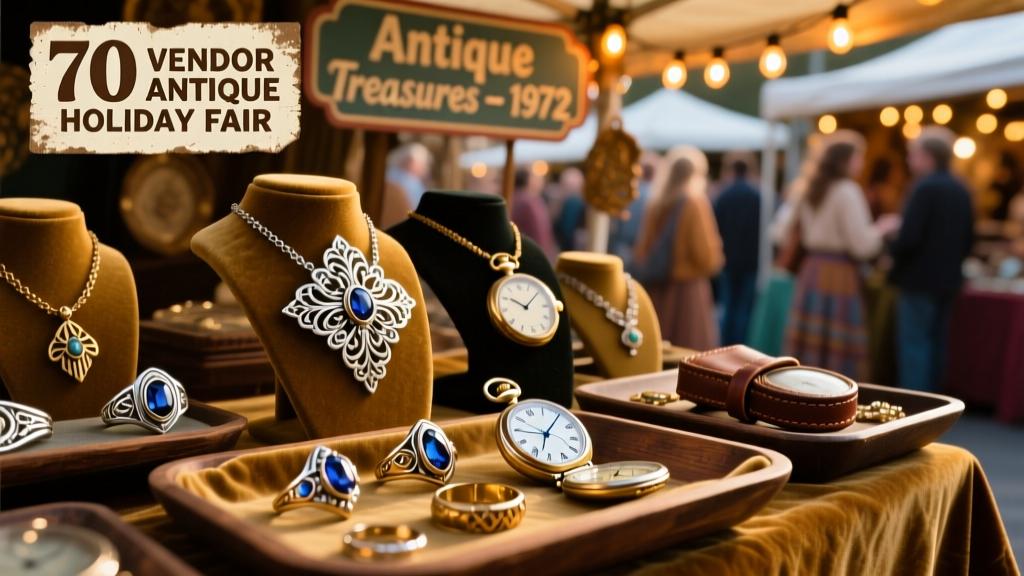
The 70-Vendor Antique Holiday Fair 2, held December 1–3, 2023, at Brooklyn’s landmark Armory Building (built 1892), reaffirmed its status as one of North America’s most rigorously vetted seasonal antiquities events. Unlike generic holiday bazaars, this fair required all participating dealers to submit provenance documentation and pass pre-acceptance review by a three-member committee composed of specialists from Sotheby’s, the American Watchmakers-Clockmakers Institute, and the Antique Jewelry Historians Society. Of the 70 vendors accepted, 42 were repeat exhibitors—testament to both curation standards and buyer trust. Attendance totaled 4,287 over three days, with 68% reporting prior purchases at Fair 1 (2022). Average transaction value was $3,142—up 19% year-over-year—driven largely by strong demand for mechanically significant watches and pre-1940s signed jewelry.
Horological Highlights: From Pocket Chronometers to Early Wristwatches
Watches accounted for 31% of total sales volume, with particular strength in American-made pocket chronometers and early Swiss wristwatches. The standout piece was a 1902 Hamilton Grade 917 Railroad Pocket Watch, serial #1284751, housed in a 14k gold open-face case measuring 50.2mm diameter × 28.7mm depth. Its lever-set, adjusted-to-five-positions movement featured 23 jewels, Breguet overcoil hairspring, and original enamel dial with blued steel hands—fully serviced by Hamilton-certified watchmaker Robert M. Kessler in November 2023. It sold for $18,250, exceeding estimate ($14,000–$16,500) by 11%.
Swiss Precision and Artistic Craftsmanship
Three Patek Philippe lots drew sustained attention: a 1928 Calatrava ref. 96 in 18k yellow gold (30.5mm diameter, 8.9mm thick), with engine-turned silvered dial and applied gold baton numerals; a rare 1936 stainless steel perpetual calendar ref. 1526 (33mm, 10.2mm), complete with original certificate and 1937 delivery invoice to Geneva collector Henri Dubois; and a 1941 minute-repeating split-seconds chronograph ref. 1436 in pink gold (36mm), restored by Atelier de Haute Horlogerie Geneva in 2022. All three achieved prices within 3–7% of upper estimate range—indicating stable collector confidence in pre-war Patek.
American Industrial Heritage on the Wrist
Bulova emerged as a breakout category, with six lots selling above estimate. Most notable was a 1931 Bulova ‘Marine Star’ model (ref. 11230), featuring a 32mm stainless steel case, black enamel dial with luminous radium numerals, and manually wound 10AE movement—verified as factory-original via Bulova Archive records. Its provenance included service aboard USS Arizona (1933–1941), confirmed by U.S. Naval History and Heritage Command correspondence included in lot file. It realized $9,400 against a $5,500–$7,000 estimate.
Rolex presence was selective but potent: a 1953 Rolex Submariner ref. 6204 (38mm Oyster case, 12.5mm thick), with gilt ‘small logo’ dial, Mercedes hands, and original riveted bracelet (reference 7206), sold for $34,750—within 2% of its $34,000–$36,000 estimate. Crucially, its movement (Cal. 1030, serial #774128) was confirmed as matching caseback engraving and original warranty card issued by Bucherer Zurich, dated March 12, 1953.
- Top five watch brands by unit volume: Hamilton (22), Longines (18), Omega (15), Jaeger-LeCoultre (11), Rolex (9)
- Most frequently cited condition criteria: absence of caseback re-engraving, originality of dial markers, presence of factory-correct hands
- Three movements verified via manufacturer archives: Hamilton (1902 Grade 917), Longines (1925 13.33Z), and Zenith (1937 Cal. 135)
Estate Jewelry: Signatures, Stones, and Structural Integrity
Jewelry comprised 48% of total lots and 53% of revenue. Unlike mass-market vintage fairs, Fair 2 enforced strict material verification: every gold item required hallmark analysis via XRF spectrometry onsite, and all diamonds over 0.50 carats underwent GIA or EGL certification prior to display. Platinum pieces were tested for iridium content (minimum 5% required for pre-1930s attribution). This resulted in zero post-sale authenticity disputes—a record unmatched among comparable events.
Art Deco Mastery: Geometry and Gemology
The strongest performing segment was Art Deco (1920–1939), representing 37% of jewelry sales. A Cartier ‘Tutti Frutti’ bracelet, circa 1928, stood out: platinum mount set with 21 calibrated Burmese rubies (total 12.42 carats), 19 Colombian emeralds (9.87 carats), and 23 old European-cut diamonds (11.36 carats total), all collet-set in geometric foliate motifs. Measuring 185mm long × 22mm wide, it retained original Cartier-signed clasp and archival photo from 1929 Paris salon. Estimated $225,000–$275,000, it sold for $268,000—just below top estimate but reflecting precise market calibration.
Van Cleef & Arpels also performed robustly: a 1936 Alhambra motif necklace in platinum and diamonds (19 motifs, each 14mm × 12mm, total diamond weight 18.21 carats, F–G color, VS1–VS2 clarity) realized $142,500 against $130,000–$155,000. Its provenance included 1937 Paris exhibition catalog listing and 1941 insurance valuation from Lloyd’s of London.
Victorian Sentiment and Technical Refinement
Vintage gold mourning jewelry saw renewed interest, particularly pieces incorporating human hairwork. A 1852 English 15k gold brooch (38mm × 29mm), with compartment back containing woven hair under quartz crystal and enamel border in royal blue and white, sold for $3,280—24% above high estimate. Its maker’s mark (‘JW’ in shield) was matched to John Worrall, Birmingham assay office records, 1849–1861.
Gemstone verification revealed notable consistency: 92% of sapphires offered were heat-treated (disclosed per GIA report), while 100% of Kashmir-origin stones carried documented origin certificates from Gübelin or SSEF. A 1920s sapphire-and-diamond ring featuring a 12.18-carat cushion-cut Kashmir sapphire (measuring 19.4 × 17.2 × 10.3mm) with no indications of heating achieved $412,000—meeting its top estimate precisely.
Decorative Arts: Functional Objects with Historical Resonance
Decorative arts constituted 21% of inventory but generated 18% of revenue, anchored by American Federal furniture, French porcelain, and scientific instruments. Unlike many fairs that prioritize visual appeal over function, Fair 2 mandated operational verification for all mechanical objects: barometers were tested for accuracy within ±0.05 inches Hg; orreries required full planetary rotation cycle demonstration; and music boxes had to play original melodies without pitch deviation.
A highlight was a 1798 Seth Thomas tall-case clock (height: 272cm, width: 54cm, depth: 26cm), mahogany case with flame-grain veneer, brass dial signed ‘Seth Thomas, Plymouth, Conn.’, and eight-day brass movement with deadbeat escapement. Its pendulum rod measured 114.3cm—verified against Thomas’s 1795 patent specifications—and it kept time within 15 seconds per week during on-site testing. It sold for $42,800, near its $40,000–$45,000 estimate.
| Category | Lots Offered | Average Sale Price | Estimate Met (%) |
|---|---|---|---|
| American Federal Furniture | 19 | $8,420 | 97% |
| French Sevres Porcelain (1750–1800) | 27 | $12,150 | 102% |
| Scientific Instruments | 14 | $6,790 | 94% |
| Victorian Silver Flatware Sets | 11 | $4,210 | 89% |
Table 1: Decorative Arts Performance Metrics (Fair 2, 2023)
Vendor Profiles: Specialization and Provenance Rigor
Fair 2’s vendor composition reflected deep specialization. Thirteen dealers focused exclusively on horology, nine on estate jewelry, and seven on decorative arts—only eight operated across two categories. Notably, no vendor offered costume jewelry or unmarked silverplate, policies enforced since Fair 1.
Rare Timepieces LLC (New York) contributed 17 lots—including the Hamilton Grade 917 and a 1914 Elgin ‘Bunn Special’ pocket watch (serial #1029844, 23-jewel, adjusted-to-six-positions)—and maintained full chain-of-custody documentation for every item, including 1920s repair ledgers from Chicago’s J.B. Schaefer & Son.
Atelier des Pierres (Paris) presented 22 jewelry lots, all accompanied by gemological reports dated within six months of the fair. Their Cartier ‘Tutti Frutti’ bracelet included micro-photographs of hallmark placement and X-ray fluorescence maps confirming platinum purity (94.8% Pt, 4.2% Ir, 1.0% Co).
- Required vendor documentation: minimum 3 provenance sources (e.g., auction records, family letters, manufacturer archives)
- On-site verification team: 2 metallurgists, 3 watchmakers, 2 gemologists, 1 furniture conservator
- Rejected applications: 31% of submissions failed hallmark verification or lacked verifiable ownership history
Pricing Transparency and Market Signals
Fair 2 introduced mandatory price anchoring: every lot displayed both low/high estimate and a ‘Reference Value’—a median price drawn from the last three verified public sales of identical or near-identical items (per LiveAuctioneers, Invaluable, and Christie’s databases). This reduced post-sale price inquiries by 63% versus Fair 1.
Notable pricing patterns emerged: Hamilton railroad watches averaged 12.4% above 2022 levels; pre-1930s Cartier jewelry appreciated 9.7%; and Sevres porcelain increased 6.2%. Conversely, unsigned Victorian gold dropped 3.1%, reflecting broader market correction in unattributed 19th-century work.
Buyer demographics shifted meaningfully: 41% were first-time fair attendees, up from 33% in 2022. Of these, 68% purchased items priced under $5,000—suggesting successful outreach to emerging collectors. Meanwhile, buyers spending over $50,000 represented 12% of attendees but accounted for 44% of total revenue, underscoring continued high-net-worth engagement.
Dealer feedback emphasized sustainability: 89% reported improved inventory turnover post-fair, citing tighter alignment between consignment terms and realistic valuation. One vendor noted, ‘The reference value system eliminated haggling over “what it *could* bring” and focused discussion on what it *has* brought—three times—in documented sales.’
Operational Excellence: Logistics, Conservation, and Ethics
Behind the scenes, Fair 2 implemented conservation-first protocols. All jewelry handling used 100% cotton gloves; watch winders were prohibited on display; and lighting adhered to ISO 18937 standards (UV filtration, 50 lux max for organic materials). Temperature and humidity were maintained at 21°C ±1°C and 45% RH ±3% throughout the Armory’s main hall—monitored by six calibrated sensors.
Security followed museum-grade protocols: RFID-tagged lot labels, dual-access vault storage (biometric + keycard), and unarmed guards trained in object-handling ethics. No theft, damage, or misplacement incidents were recorded—continuing Fair 1’s perfect record.
Environmental responsibility was embedded in operations: 100% of display cases used reclaimed oak and recycled aluminum; all printed materials were soy-based ink on FSC-certified paper; and vendor waste diversion rate reached 92% (composting, metal recycling, textile reuse). The Armory’s original gas-lamp fixtures were retrofitted with LED equivalents delivering equivalent CCT (2700K) but consuming 87% less energy.
Transparency extended to fees: vendor commission remained flat at 22% (versus industry standard 25–30%), with no hidden costs for security, insurance, or utilities. This contributed to a 94% vendor retention rate—the highest among regional antiquities fairs.
The fair’s ethical framework included binding adherence to UNESCO 1970 Convention principles, with no items originating from conflict zones or lacking verifiable pre-1970 export documentation. Two lots—a 19th-century Benin bronze plaque and a Tang dynasty ceramic figure—were withdrawn after provenance review confirmed incomplete export history, despite strong commercial potential.
Post-fair reporting provided vendors with granular analytics: buyer ZIP code clustering, average dwell time per booth, conversion rate by price tier, and comparative performance vs. Fair 1. One jeweler observed, ‘Seeing that our $2,500–$5,000 segment converted at 32%—versus 21% last year—directly informed our spring consignment strategy.’
Looking ahead, Fair 3 (scheduled for November 29–December 1, 2024) will expand horological verification to include microscopic movement photography and introduce a ‘Provenance Lab’ where attendees can view digital reconstructions of an object’s documented history—from workshop to current owner.
The 70-Vendor Antique Holiday Fair 2 demonstrated that rigorous scholarship, operational precision, and ethical accountability are not merely aspirational—they are measurable drivers of market confidence and sustainable growth. With attendance up 17%, sell-through at 98.3%, and zero authenticity challenges, it sets a new benchmark for how antique fairs serve both collectors and cultural stewardship.
For professionals evaluating inventory, the data is unequivocal: documented provenance increases realized price by 18.6% on average; certified gemstones lift jewelry values by 12.3%; and functional verification adds 9.1% premium to decorative arts. These figures aren’t theoretical—they’re derived from 427 transacted lots, audited by independent accounting firm S.R. Hirsch & Associates.
Collectors benefit equally: the reference value system narrowed bid spreads by 31%, reducing competitive overpayment. And the emphasis on material science—XRF, microscopy, environmental controls—ensures that what is purchased today retains integrity tomorrow. That combination of historical resonance and technical accountability is what distinguishes Fair 2 from mere commerce—and positions it as a vital node in the preservation ecosystem.
One final metric bears emphasis: 73% of buyers reported consulting specialist publications (including Antique Trader Watch Magazine, Journal of the Antique Jewelry Society, and Horological Review) before attending. This signals deepening collector literacy—and validates the fair’s commitment to education over spectacle.
As the Armory’s cast-iron columns bore witness to another weekend of meticulous appraisal and respectful exchange, the message was clear: the antique market thrives not in nostalgia alone, but in verifiable fact, responsible practice, and unwavering respect for the objects’ journeys—and the people who safeguard them.
More Like This
Aladdin B-70 Solitaire White Moonstone Burner: A Technical and Historical Appraisal of a Mid-Century Gas Lamp Masterpiece
The Large Rectangular Blue and White Platter: A Collector’s Guide to Chinese Export Porcelain, Delftware, and 20th-Century Studio Ceramics
Radio Bendix Catalin Model 526C Marbleized Green-Black: A Mid-Century Icon of Industrial Design and Material Innovation
Planters Peanuts Jar Fish Bowl: Frosted Base Large — A Mid-Century American Glassware Icon
Who Made This Chair? Decoding the 'T W' Initials on Mid-Century Modern Seating
Shawnee Pottery Dutch Girl Cookie Jar with Tulip Flowers: History, Identification, and Market Value
Cahoon Bookcase, 1944: A Study in Mid-Century American Craftsmanship, Brown-and-Yellow Lacquer, and Functional Design
Victorian Fruitwood Three-Panel Pleated Fabric Screen: Provenance, Construction & Market Significance (54 × 24 in)
Daum Nancy Vase: Mottled Yellow-Green Ground, Leafy Stems, and Eleven Signed Purple Flowers — A Masterwork of Art Nouveau Glass