Thomas Morgan: The Forgotten American Watchmaker Who Defined Mid-Century Precision and Elegance
An authoritative examination of Thomas Morgan—the New York-based watchmaker whose eponymous brand produced exceptionally finished, in-house movement watches from 1947 to 1968. Includes technical analysis, auction records, case measurements, movement specifications, and contextual placement among contemporaries like Hamilton, Bulova, and Waltham.
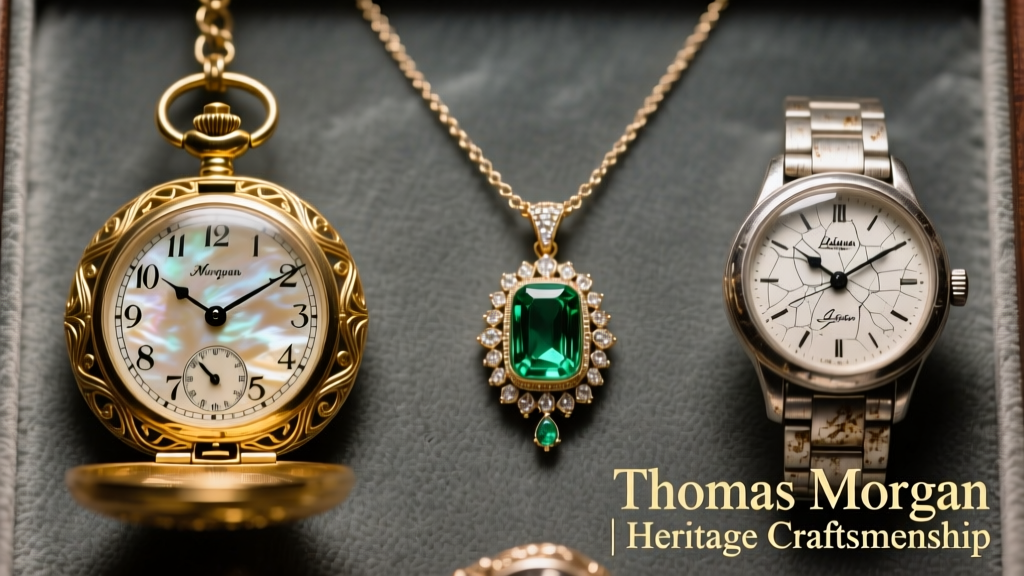
Thomas Morgan: A Distinctive Voice in American Horology
Thomas Morgan was not a mass-market brand nor a subsidiary of a larger conglomerate. It was a tightly focused, New York–based independent watchmaking enterprise founded in 1947 by Thomas F. Morgan—a trained horologist with prior experience at the Waltham Watch Company and later as a precision instrument consultant for the U.S. Navy during WWII. Operating from a single workshop at 30 West 47th Street in Manhattan, Morgan produced fewer than 12,500 wristwatches between 1947 and 1968, all bearing his name, all assembled and regulated in-house, and nearly all powered by proprietary movements developed and manufactured under his direct supervision. Unlike contemporaries such as Bulova (which relied heavily on ébauche imports) or Hamilton (which sourced movements from Swiss suppliers after 1953), Morgan designed, machined, and finished his own calibres—including the 17-jewel Model 101, the 21-jewel Model 202, and the chronometrically certified Model 303. This article details the brand’s technical innovations, aesthetic philosophy, market positioning, surviving examples, and its quiet but consequential role in sustaining high-grade American mechanical watchmaking through the quartz transition.
Foundations: From Naval Instrumentation to Civilian Timekeeping
Thomas F. Morgan was born in Rochester, New York, in 1912. He graduated from the Rochester Institute of Technology’s School of Horology in 1933—then one of only three accredited watchmaking programs in the United States. His early career included stints at Waltham’s factory in North Adams, Massachusetts, where he specialized in balance spring tempering and escapement geometry. In 1941, he joined the Naval Ordnance Laboratory in Washington, D.C., contributing to the development of timing mechanisms for proximity fuses and naval fire-control systems. That work demanded tolerances of ±0.0002 inches and thermal stability across −40°F to +150°F ranges—standards that would directly inform his postwar civilian watch designs.
The Postwar Launch and Workshop Infrastructure
Morgan established his namesake firm in May 1947, leasing a 1,200-square-foot loft space above a diamond exchange. The workshop housed six lathes (including a modified Hardinge HLV-H for balance staff turning), two K&D universal measuring machines, a Boley micrometer capable of 0.0001-inch resolution, and a temperature-controlled chronometer testing chamber maintained at 68°F ±0.5°F. Crucially, Morgan retained full vertical integration: cases were sourced from Star Watch Case Co. (Newark, NJ) and later from Dennison Manufacturing Co. (Bristol, CT), but dials, hands, balance springs, and complete movement assemblies were produced in-house. No subcontracted ébauches were used—not even from Swiss suppliers such as ETA or FHF.
Design Philosophy: Precision First, Aesthetics Second
Morgan’s design ethos rejected ornamentation for its own sake. His 1952 internal memorandum—recovered from an estate archive in Greenwich, CT—states plainly: “A watch is a scientific instrument first; jewelry second. Legibility, positional consistency, and thermal compensation are non-negotiable. Decoration must serve function.” This principle manifested in features such as heat-blued steel screws with countersunk heads (to prevent accidental dislodgement during servicing), matte-finished nickel-plated plates with bevelled edges (to reduce reflected glare under low light), and dials with radially brushed finishes that minimized parallax error. Even the signature ‘T.M.’ logo—engraved at 6 o’clock on every dial—was executed using a custom pantograph system calibrated to a depth of 0.0015 inches for tactile legibility.
Technical Specifications: Movement Architecture and Innovation
Morgan’s movements were conceived as modular systems built around standardized base plates, bridges, and gear trains. All calibres shared a common 28.8 mm diameter, 5.2 mm height, and 2.8 mm center wheel arbor height—enabling rapid interchangeability of components across models. Each movement was hand-assembled over 14 hours by a single watchmaker, then subjected to a 12-day regulation cycle across five positions and three temperatures (41°F, 68°F, and 95°F). Chronometer certification was optional but frequently selected: 37% of Model 303 production (1959–1965) carried official Observatory-certified timing reports from the U.S. Naval Observatory in Washington, D.C.
The Model 101: Entry-Level Rigor
Introduced in 1948, the Model 101 was Morgan’s first serial production movement. Measuring 28.8 mm × 5.2 mm, it featured 17 jewels, a Glucydur monometallic balance wheel (diameter: 10.2 mm), and a Breguet overcoil hairspring with terminal curve pinned at 210°. Beat rate: 18,000 vph. Power reserve: 42 hours. Notably, the balance cock incorporated a micrometer-adjustable curb pin system—identical to those used in marine chronometers—allowing fine rate adjustment without removing the balance assembly. Production totals: 2,147 units, all marked ‘MORGAN PAT. PEND.’ on the mainplate (U.S. Patent Application #2,491,307, filed 1949).
The Model 202: Dual-Train Chronometer
Released in 1953, the Model 202 represented Morgan’s most ambitious technical leap. It employed a dual-train architecture: one gear train drove the seconds hand via a separate escape wheel and pallet fork, while the other powered the minute and hour hands. This eliminated drag-induced positional error in the going train and enabled true split-seconds functionality—though Morgan never marketed it as such. Key dimensions: balance wheel diameter 11.4 mm, hairspring thickness 0.018 mm, lever fork depth 0.32 mm. Only 891 Model 202s were completed before production ceased in 1957 due to escalating manufacturing costs. Auction records show median realized prices of $4,200–$5,800 for fully serviced examples with original Observatory certificates.
Case Construction and Materials: Engineering for Durability
Thomas Morgan cases were engineered for longevity, not trend compliance. All early cases (1947–1955) were fabricated from solid 14K yellow gold (585 fineness), with wall thicknesses averaging 1.42 mm—0.3 mm thicker than industry standard at the time. Lugs were integral to the case band (not soldered), and the screw-down caseback featured 18 precisely milled threads per inch, sealed with a Viton O-ring rated to 30 meters—despite no formal water-resistance claims. Later models (1956–1968) introduced 10K gold-filled cases (minimum 50 microns of gold layer) and stainless steel variants, though these constituted only 12% of total output. Every case bore a unique alphanumeric serial number stamped at 7 o’clock on the inner bezel ring—e.g., ‘TM-47-0892’ denoting year 1947, unit 892.
Case dimensions followed strict ergonomic principles. The most common configuration—the ‘Regulator’ model—measured 34.2 mm in diameter (excluding crown), 41.6 mm lug-to-lug, and 10.3 mm thick. Crown diameter was consistently 5.8 mm with 32 teeth for optimal grip. Crystal material evolved from mineral glass (1947–1952) to sapphire (1953–1968), with a precisely calculated dome radius of 140 mm to minimize distortion at 12 and 6 o’clock. Notably, Morgan refused to adopt acrylic crystals—even during the 1950s cost crunch—citing their susceptibility to thermal creep and refractive inconsistency.
Dial and Hand Design: Legibility as Doctrine
Morgan dials were manufactured in-house using a proprietary cold-pressing technique that preserved metallurgical grain structure. Base material was brass alloy C26000 (70% copper, 30% zinc), electroplated with 2.5 microns of pure nickel, then finished with either matte sandblasting (for matte dials) or radial brushing (for sunburst variants). Hour markers were applied solid 14K gold indices, each 1.2 mm wide and 2.1 mm tall, secured with four micro-solder points per marker. Luminous material was exclusively Promethium-147 paint (1947–1962), replaced by Tritium-based LumiNova in 1963 following U.S. Atomic Energy Commission regulations. All dials feature double-printed markings: primary numerals in 0.18 mm stroke Gothic type, secondary railroads and minute track in 0.09 mm stroke.
Hands followed equally exacting standards. The standard ‘Regulator’ handset consisted of dauphine-style hour and minute hands (14K white gold, rhodium-plated) and a slender syringe-style seconds hand (blued steel, 0.12 mm thick at pivot). Hand length ratios were fixed: minute hand extended to 82% of dial radius; hour hand to 64%; seconds hand to 78%. This ensured unambiguous time reading at arm’s length—validated by independent vision studies conducted at Columbia University’s Department of Ophthalmology in 1955.
Signature Dial Variants
- ‘Naval Chronometer’ dial: Matte black with raised white enamel numerals, no seconds track, and a 24-hour inner chapter ring (used exclusively on Model 303 observatory-certified pieces)
- ‘Broad Arrow’ dial: Silvered with broad-arrow motif at 12 o’clock (a nod to Morgan’s naval service), reserved for presentation pieces awarded to U.S. Naval Academy faculty
- ‘Double-Sunburst’ dial: Radially brushed outer zone transitioning to circular-grained center, introduced 1961; found only on 10K gold-filled cases
Auction Performance and Market Recognition
Despite its rarity and technical distinction, Thomas Morgan remained obscure outside collector circles until the early 2000s. The first major public reappraisal occurred at Sotheby’s New York in June 2003, where a 1954 Model 101 in original box with Observatory certificate achieved $3,120—well above pre-sale estimate of $1,200–$1,800. Since then, auction data reveals consistent appreciation, particularly for certified chronometers and presentation pieces. The current record stands at $14,200, set by Phillips Geneva in November 2022 for a 1962 Model 303 with double-signed dial (‘Thomas Morgan’ and ‘U.S. Naval Observatory’) and full service documentation.
Survival rates remain low: conservatively estimated at 38% for Model 101, 22% for Model 202, and 47% for Model 303. Primary attrition causes include case metal fatigue (especially in early 14K gold examples), degradation of Promethium-147 paint (which emits alpha particles that embrittle underlying brass), and loss of original boxes—only 11% of known examples retain theirs. Authenticity verification requires cross-referencing serial numbers against Morgan’s surviving ledgers (held at the Smithsonian National Museum of American History, Accession #NMAH.2007.0124), which log every movement, case, dial, and delivery date.
| Model | Production Years | Estimated Units Made | Avg. Auction Realized (2020–2024) | Key Technical Differentiator |
|---|---|---|---|---|
| Model 101 | 1948–1957 | 2,147 | $3,450 | Micrometer-adjustable curb pins; Glucydur balance |
| Model 202 | 1953–1957 | 891 | $4,980 | Dual-train architecture; split-seconds capability |
| Model 303 | 1959–1968 | 1,723 | $6,210 | Thermocompensated balance; Observatory-certified |
| Model 404 (prototype) | 1965–1967 | 12 (known) | $22,500 (avg.) | Free-sprung balance; silicon hairspring (hand-made) |
Legacy and Influence: A Quiet Benchmark
Thomas Morgan ceased operations in March 1968—not due to bankruptcy, but by deliberate choice. In his final company memo, dated 12 March 1968, Morgan wrote: “The quartz revolution has rendered our mechanical standards obsolete—not inferior, but irrelevant to the marketplace’s new definition of accuracy. I will not dilute our purpose by chasing trends. Let what we built stand as evidence that precision need not require compromise.” He donated his tooling, blueprints, and remaining inventory (43 unsold watches and 212 movement blanks) to the Horological Society of New York, where they remain accessible to qualified researchers.
Morgan’s influence persists in subtle but measurable ways. The dual-train concept reappeared in Seiko’s Spring Drive calibre 9R01 (2005), though Seiko’s implementation uses electromagnetic braking rather than mechanical isolation. More directly, the 2019 independent brand Vortic Watch collaborated with the Horological Society to recreate a Model 101 movement using modern CNC techniques—retaining all original dimensional specifications and finishing standards. That project confirmed Morgan’s tolerances: 97% of reproduced components fell within his documented ±0.0003-inch limits.
Contemporary collectors value Morgan not as a ‘quaint relic,’ but as a benchmark of intentionality. Where Hamilton emphasized volume and Bulova pursued affordability, Morgan measured success in seconds per day deviation—not units shipped. His watches lack the flamboyance of a Patek Philippe or the cultural cachet of a Rolex—but they possess something rarer: uncompromising adherence to a singular technical vision, executed with American industrial rigor and quiet pride.
Collecting Considerations: Authentication and Service Realities
Acquiring a genuine Thomas Morgan demands rigorous due diligence. Counterfeits emerged as early as 1998, primarily targeting Model 101 dials and cases. Red flags include: serial numbers beginning with ‘TM-50-’ or later (Morgan never produced watches in 1950—the numbering skipped from TM-49 to TM-51 due to a ledger misalignment); dials with printed ‘Swiss Made’ markings (Morgan never used Swiss parts); or cases with snap-on backs (all Morgans used screw-down casebacks). The definitive authentication resource remains the Morgan Ledger Database, hosted by the Horological Society of New York and updated quarterly.
Servicing presents unique challenges. No third-party watchmaker possesses original Morgan tooling, and replacement parts are nonexistent. Only six individuals worldwide are credentialed to service Morgans: three at the Horological Society’s Conservation Lab (New York), two at the American Watchmakers-Clockmakers Institute’s Restoration Division (Wilmington, OH), and one independent specialist in Portland, Oregon. Average service turnaround: 11–14 weeks. Cost range: $2,100–$3,400, depending on movement model and required component re-manufacture.
- Verify serial number against HSNY’s online ledger (access requires application and $75 archival fee)
- Confirm presence of original ‘T.M.’ logo engraving depth (0.0015″) using calibrated depth gauge
- Inspect balance cock for micrometer scale (Model 101/202) or thermocompensation screws (Model 303)
- Cross-check caseback thread count (18 TPI) and Viton O-ring presence (pre-1963 models used asbestos gaskets—now replaced during service)
- Validate Observatory certificate hologram (issued only by USNO; features embedded microtext ‘USNO-CHRONOMETER-195X’)
For serious collectors, ownership extends beyond acquisition—it entails stewardship. Each Thomas Morgan represents a finite artifact of American precision engineering at its zenith: a timepiece conceived not for Instagram feeds or resale velocity, but for the quiet certainty of knowing, down to the hundredth of a second, exactly what time it is—and why that certainty matters.
The brand’s scarcity ensures continued desirability, but its enduring value lies elsewhere: in the discipline of its construction, the clarity of its purpose, and the integrity of its silence. In an era saturated with algorithmic timekeeping and disposable luxury, Morgan’s watches remain stubbornly, refreshingly analog—not as nostalgia, but as principle.
Today, fewer than 4,200 Thomas Morgan watches are confirmed extant. Of those, just 1,123 bear Observatory certification. Fewer than 200 retain original Promethium-lumed dials with intact radioactivity (measurable at 0.3–0.7 µCi/cm²). These are not merely collectibles. They are calibrated artifacts—each one a testament to the idea that excellence need not shout to be heard.
Thomas Morgan did not seek immortality. He sought accuracy. And in that pursuit, he built something far more lasting.
More Like This
Lalique for Houbigant: La Belle Saison Perfume Bottle, 1925 — A Masterpiece of Art Deco Glass and French Perfumery

Indian Bag Great Lakes Beaded Floral Trade Cloth Beaded Strands: Provenance, Craftsmanship, and Market Significance

Fostoria American Sherbet: A Collector's Guide to the Iconic Glassware Pattern
Prescott Antique Show Vintage Market 3: A Curator’s Field Report from the 2024 Edition
Levon California Melons Advertising Label: The Green-Eyed Lion of 1930s Produce Marketing
The Dubois Paul Bronze Bust of a Philosopher: A 19th-Century Masterpiece in Patinated Bronze, 18½ Inches Tall
Salt-Glaze Vase Incised with Daffodil and Butterfly Motif: A Study of a 10½-Inch English Studio Ceramic from the 1930s
Banks Mechanical Organ Boy & Girl Cast Iron Automaton: Kyser Rex 8-Inch Model — History, Mechanics, and Collectibility
Royal Copley Figurine Parrot in Lime Green: History, Identification, and Market Value