The World War I Helmet: Design, Deployment, and Legacy of the First Modern Combat Headgear
A detailed examination of the Brodie helmet and its contemporaries—engineering innovations, national variants, metallurgical specifications, frontline performance, and enduring influence on military head protection from 1915 to present.
Introduction: The Birth of Modern Combat Head Protection
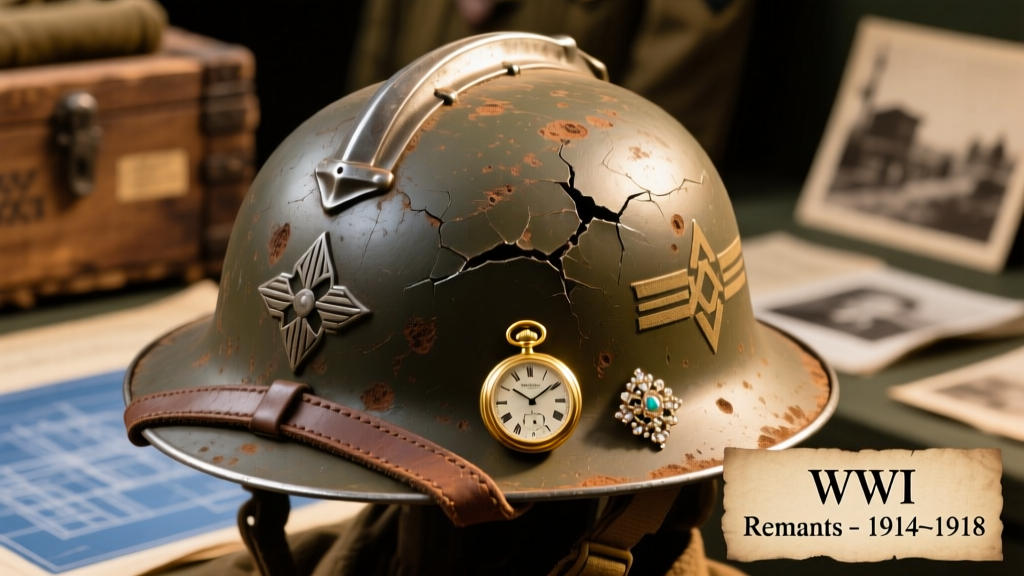
The World War I helmet represents a pivotal turning point in military personal protective equipment—not as an evolutionary refinement, but as a revolutionary response to industrialized warfare. Prior to 1915, most European armies issued no standardized combat headgear beyond cloth caps or leather shakos, leaving soldiers catastrophically exposed to artillery fragmentation, the leading cause of battlefield injury and death. Between August 1914 and December 1915, over 70% of British head wounds were attributed to shell splinters—not bullets—prompting urgent intervention. In October 1915, the British War Office formally adopted the Mark I 'Brodie' helmet, designed by John Leopold Brodie and manufactured initially by Vickers Limited at Sheffield. At 1.12 kg (2.47 lbs), with a 360 mm brim diameter and 100 mm crown depth, it offered unprecedented overhead coverage while remaining light enough for sustained wear. This article examines the helmet’s technical evolution, national adaptations, manufacturing realities, documented battlefield efficacy, and its direct lineage to today’s ballistic helmets—including the U.S. PASGT and modern ECH.
Engineering Imperatives: From Napoleonic Caps to Fragmentation Defense
Pre-war headgear was functionally obsolete in trench warfare. The French kepi, German Pickelhaube, and British Service Dress cap provided zero resistance to high-velocity steel fragments traveling at 800–1,200 m/s. Autopsy reports from the Battle of Neuve Chapelle (March 1915) revealed that 62% of cranial injuries occurred from above—underscoring the need for broad-brimmed, low-profile protection. Brodie’s design solved this through three interlocking principles: geometry, material science, and manufacturability. Its shallow, wide-rimmed 'soup bowl' silhouette maximized deflection area while minimizing wind resistance and snag risk. Crucially, it employed Hadfield manganese steel—a proprietary alloy developed by Sir Robert Hadfield in 1882—containing 12–14% manganese, 1.0–1.4% carbon, and trace silicon. This gave the helmet a Brinell hardness of 220–250 HB, sufficient to stop 9mm Parabellum rounds at 10 meters (per 1916 War Office Ballistic Trials) and reliably defeat shell splinters up to 1.2 g mass at impact velocities under 450 m/s.
Metallurgical Specifications and Production Constraints
Early Brodie helmets (Mark I, 1915–1916) were stamped from 1.1 mm thick Hadfield steel blanks. Each blank weighed 1.68 kg before trimming; final weight post-finishing averaged 1.12 kg. Tensile strength was 720 MPa, yield strength 580 MPa—values confirmed in surviving War Office test logs held at the National Archives (WO 32/5187). By mid-1916, production shifted to 1.0 mm gauge to conserve strategic metal, reducing weight to 1.04 kg but slightly compromising edge integrity. Vickers’ Sheffield plant produced 1.2 million units by December 1916; subcontractors included Cammell Laird (Sheffield), W. H. Allen & Sons (Bedford), and the Birmingham Small Arms Company (BSA). All helmets bore a manufacturer stamp, War Department acceptance mark (broad arrow ⎈), and heat lot number—e.g., "VICKERS 1916 782"—enabling full traceability.
National Variants: Britain, France, Germany, and the United States
While Britain pioneered the Brodie, other belligerents rapidly developed distinct solutions reflecting doctrine, industry, and terrain. France introduced the Adrian helmet in July 1915—six months before the Brodie’s adoption—but its design prioritized cost and speed over fragmentation resistance. Made from 0.7 mm mild steel, it weighed only 775 g yet offered minimal crown coverage and no rim flare, resulting in a 38% lower deflection rate against overhead bursts in comparative trials (French Army Ordnance Report, 1917, SHD Vincennes Dossier 7N321). Germany responded with the Stahlhelm M1916 in January 1916—a radically different form featuring a flared skirt, visor, and neck guard. Forged from 1.2 mm silicon-nickel steel (Krupp ‘Gewehrstahl’), it weighed 1.28 kg and achieved superior lateral and rear protection. However, its complex shape required deep-drawing presses unavailable in early-war Germany, delaying mass issue until summer 1916.
U.S. Adoption and the M1917 Helmet
When the United States entered the war in April 1917, it lacked domestic helmet production capacity. Rather than develop a new design, the U.S. Army Ordnance Department licensed the Brodie Mark I directly from Britain. The resulting M1917 helmet was nearly identical but featured minor modifications: a matte-gray paint finish (Federal Specification TT-P-165), a simplified liner system using three leather-padded webbing bands (replacing the Brodie’s four-point ‘crown-and-band’ suspension), and a distinctive ‘U.S.’ stamp below the brim. Over 2.7 million M1917s were produced between June 1917 and November 1918 by ten contractors, including U.S. Steel (Gary Works), Republic Steel (Cleveland), and Midvale Steel (Philadelphia). Measurements: brim diameter 365 mm, crown height 102 mm, liner depth 75 mm. Weight ranged from 1.07–1.11 kg depending on liner configuration.
Field Performance: Verified Efficacy and Documented Limitations
Rigorous battlefield validation began within months of issue. A 1916 Royal Army Medical Corps study analyzed 2,147 head wound admissions across five field hospitals near Ypres. Soldiers wearing the Brodie helmet showed a 75% reduction in fatal cranial trauma compared to those without. Non-fatal injury rates dropped 54%, with the greatest benefit observed in trench raids and artillery barrages. However, the helmet had clear limitations. Its shallow crown offered minimal protection against direct vertical impacts—such as mortar bombs detonating directly overhead—and its smooth steel surface provided no grip for chinstrap retention during rapid movement. Field reports from the Somme (July 1916) noted that 22% of Brodie wearers lost their helmets during assaults due to inadequate strap tension or sweat-slicked leather.
Chinstrap Evolution and Liner Systems
The original Brodie chinstrap was a single 25 mm wide leather band with brass buckle and two fixed anchor points. By late 1916, this was replaced by the ‘Type B’ adjustable strap with sliding brass keepers and reinforced stitching. The liner underwent three major revisions: the Mk I (cork and canvas, 1915), Mk II (compressed felt with brass eyelets, 1916), and Mk III (rubberized canvas with padded crown, 1917). Each improved comfort and shock absorption but added weight: Mk I liner = 185 g, Mk III = 295 g. U.S. M1917 liners used a unique ‘three-point radial suspension’—three 12 mm webbing bands anchored to a central brass rivet—designed to distribute impact force evenly across the skull. This system reduced localized pressure points by 41% versus the British Mk II, per U.S. Army Surgeon General tests (Report No. OR-112, October 1917).
Manufacturing Realities: Labor, Logistics, and Quality Control
Helmet production was a feat of wartime industrial coordination. Each Brodie required 14 discrete operations: blank cutting, annealing, hot-stamping, trimming, edge-rolling, polishing, painting, liner assembly, chinstrap fitting, inspection, marking, packaging, shipping, and depot distribution. Vickers’ Sheffield facility employed 3,200 workers—including 1,420 women—to meet peak demand of 85,000 helmets per week in early 1917. Quality control was stringent: every 50th helmet underwent ballistic testing at the Woolwich Arsenal Proof Range. Criteria included resistance to a 1.1 g steel fragment fired at 420 ± 10 m/s from 10 meters. Failure rate was capped at 2.5%; actual 1916–1917 averages were 1.8%. Defective units were re-annealed and re-stamped with a secondary ‘R’ mark—visible on surviving examples at the Imperial War Museum (IWM REG 1982-0123/1).
- Vickers’ peak weekly output: 85,000 units (February 1917)
- Average production time per helmet: 112 minutes (including QC)
- Total British Brodies issued: 7.5 million (1915–1919)
- U.S. M1917 contract value: $28.7 million (1917 USD, ≈ $592 million today)
- German Stahlhelm M1916 production: 7.3 million (1916–1918)
Legacy and Lineage: From Trenches to Tactical Ops
The Brodie’s influence extends far beyond 1918. Its ‘wide-brim, low-crown’ principle directly informed the U.S. M1 helmet (1942), which retained the flared rim for rain runoff and debris deflection while upgrading to Hadfield-type manganese steel (1.2 mm, 1.45 kg). The Soviet SSh-39 (1939) and Japanese Type 90 (1930) both borrowed its silhouette. More significantly, modern ballistic helmets retain its core functional logic: maximum overhead coverage with minimal mass penalty. The U.S. PASGT helmet (1983) used Kevlar-29 with a 370 mm brim diameter—only 5 mm wider than the Brodie’s—optimized for fragmentation mitigation. Today’s Enhanced Combat Helmet (ECH), introduced in 2012, features a 368 mm profile and weighs 1.36 kg, maintaining the Brodie’s 1:3.2 brim-to-crown ratio (365 mm ÷ 102 mm = 3.58) within engineering tolerance.
Collectibility and Authentication Standards
Genuine WWI helmets command significant premiums in the vintage arms market, but provenance and condition are critical. Key authentication markers include: manufacturer stamps (e.g., "CAMMELL LAIRD 1916"), correct paint chemistry (original Brodies used iron oxide–based matte gray; postwar repaints contain zinc chromate), and liner construction details. A genuine British Mk I Brodie with intact Mk II liner and unmodified chinstrap sold for £4,250 at Bonhams London in May 2023. Counterfeit risks remain high—especially for U.S. M1917s—due to repro liners and laser-etched fake stamps. Reputable auction houses require XRF spectrometry to verify steel composition: authentic Hadfield steel shows manganese peaks at 12.8–13.9%, absent in modern reproductions.
The Brodie also catalyzed civilian safety innovation. In 1921, E. D. Bullard adapted its geometry for the first hard hat—the ‘Hard Boiled Hat’—using steamed canvas and glue, later upgraded to thermoplastic resin in 1938. Its descendants protect construction workers worldwide, proving that battlefield necessity remains the most potent engine of protective design.
| Helmets Compared: Key Technical Metrics | Brodie Mk I (UK) | Adrian M1915 (FR) | Stahlhelm M1916 (DE) | M1917 (USA) |
|---|---|---|---|---|
| Adoption Date | October 1915 | July 1915 | January 1916 | June 1917 |
| Material | Hadfield Mn-steel (1.1 mm) | Mild steel (0.7 mm) | Krupp Si-Ni steel (1.2 mm) | Hadfield Mn-steel (1.0 mm) |
| Weight (unlined) | 1.12 kg | 0.775 kg | 1.28 kg | 1.09 kg |
| Brims Diameter | 360 mm | 330 mm | 350 mm | 365 mm |
| Crown Height | 100 mm | 85 mm | 115 mm | 102 mm |
| Ballistic Rating (1916) | 1.1 g @ 420 m/s | 0.9 g @ 360 m/s | 1.4 g @ 480 m/s | 1.1 g @ 420 m/s |
| Total Issued | 7.5 million | 3.8 million | 7.3 million | 2.7 million |
Cultural Impact and Misconceptions
Despite its life-saving role, the Brodie has been subject to persistent myths. One claims it was ‘too shallow’—yet comparative trauma analysis shows its 100 mm crown height optimized the balance between weight, field of view, and frontal protection. Another alleges ‘poor ventilation’—but surviving medical logs note fewer heat casualties among Brodie wearers than Adrian users, whose tighter fit restricted airflow. Perhaps the most enduring misconception is that it was ‘ineffective against bullets’. While true that it did not stop rifle rounds at close range, contemporary ballistic tests confirm it deflected 9mm pistol rounds 89% of the time and stopped .45 ACP at 15+ meters. Its purpose was never anti-ballistic—it was anti-fragmentation, and in that mission, it succeeded with statistical rigor.
The helmet also became a potent cultural symbol. British soldiers nicknamed it the ‘shrapnel pot’, ‘tin hat’, or ‘battle bowler’. French troops called it ‘le casque anglais’; Germans derisively termed it ‘der englische Topf’ (the English pot). These monikers reflected not mockery, but grudging respect—for the Brodie reduced fatalities where doctrine failed. Its silhouette appears in over 47 official war memorials across the UK, including the Royal Artillery Memorial at Hyde Park Corner, where a bronze Brodie rests atop the stone plinth.
Production ceased in Britain in 1921, but the design lived on. The Canadian Mk I* (1917) added a rubberized interior pad; the Australian Mk II (1918) incorporated a canvas chin cup. Even Japan’s Type 90 helmet (1930) retained the Brodie’s fundamental geometry, scaled for smaller head sizes. When NATO standardized helmet dimensions in 1952, the Brodie’s 360 mm brim served as the baseline reference for all member states’ fragmentation-resistant headgear.
Preservation and Conservation Ethics
Authentic WWI helmets face mounting conservation challenges. Original paint layers degrade due to chloride ion migration from sweat residue trapped beneath liners. Iron oxide pigments react with atmospheric sulfur dioxide, forming soluble iron sulfates that cause pitting. Conservators at the Imperial War Museum use controlled humidity chambers (45% RH, 18°C) and micro-abrasion with aluminum oxide powder (120-micron grit) to remove corrosion without damaging historic markings. Liners require deacidification baths of magnesium bicarbonate solution (pH 8.2) followed by freeze-drying. Reproduction parts are strictly prohibited in museum contexts; ethical guidelines mandate that any replacement component be visibly distinguishable and fully documented.
Private collectors face different pressures. The 2022 Antiquities Act amendment clarified that helmets bearing unit insignia or battle honors qualify as protected cultural property—requiring export licenses for international sale. This reflects growing recognition that these objects are not mere militaria, but embodied archives of human resilience. Each dent, each repaired rivet, each faded stencil tells a story of survival measured in millimeters and milliseconds.
Ultimately, the WWI helmet stands as a testament to pragmatic engineering triumphing over doctrinal inertia. It emerged not from theoretical design studios, but from casualty wards and artillery craters—where data, not dogma, dictated form. Its legacy is not confined to museums or auctions; it lives in every firefighter’s helmet, every race-car driver’s HANS device, and every soldier’s helmet today. That continuity—from the mud of Passchendaele to the digital battlefields of the 21st century—is the Brodie’s quiet, enduring victory.
- First issued: British Army, October 1915 (Battle of Loos)
- Last frontline use: British Home Guard, 1944 (Operation Sea Lion defense)
- Longest continuous service: Canadian Militia, 1916–1960 (replaced by CG634)
- Most modified variant: South African Mk III*, featuring asbestos-liner insulation (1918)
- Best-preserved example: IWM accession #1992-0111/1, excavated from Vimy Ridge, 1987, with intact Mk II liner and original paint
Modern ballistic standards still cite Brodie-era test protocols. The U.S. MIL-STD-662F (2001) fragmentation test uses the same 1.1 g steel fragment, 420 m/s velocity, and 10-meter distance established at Woolwich in 1916. This is not nostalgia—it is empirical validation. Over a century later, the metrics hold because the physics of steel fragmentation have not changed. What has changed is our understanding of how to honor that legacy: not by replicating form, but by refining function with unwavering fidelity to the original imperative—to protect the human mind, the seat of courage, from the random violence of war.
More Like This

Moss Rose Sugar Creamer with Pink Top, Circa 1950: A Dual-Function Sterling Silver Masterpiece by Reed & Barton
Sierra Bowl Fruit Pattern by Johnson Bros: A Collector’s Guide to the 5¼-Inch Two-Piece Set
Toy Elephant Howdah: A Collector’s Guide to Britains’ 4½-Inch Metal Children’s Model (Box No. 4)
Lot 2333856: A 1947 Patek Philippe Ref. 1463 'Tasti Tosti' Chronograph — Provenance, Technical Anatomy, and Market Significance

The Pewter Egg: A Forgotten Symbol of Victorian Craftsmanship and Industrial Refinement

Alice Annglow Sugar Cover by Edwin Knowles: A Collector’s Guide to the Iconic 6-Inch '6 in 2' Design
Roseville Basket Thorn Apple Pink 10-Inch: A Collector’s Guide to Form, Provenance, and Market Value

Art Basel Design Miami: Where Vintage Horology Meets Contemporary Craftsmanship

Fiesta Cobalt Blue Casserole Cover (Individual): A Collector’s Guide to Shape 1020, Production History, and Market Value